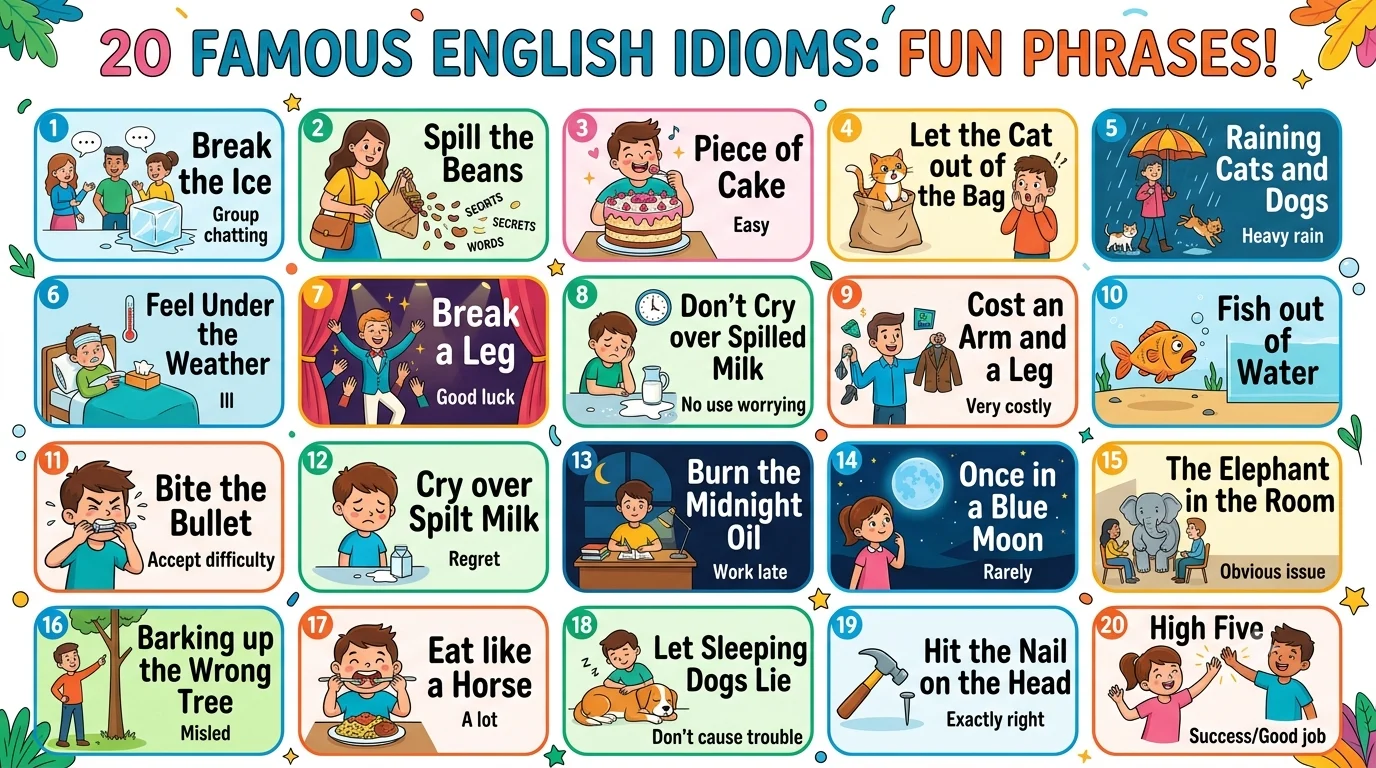
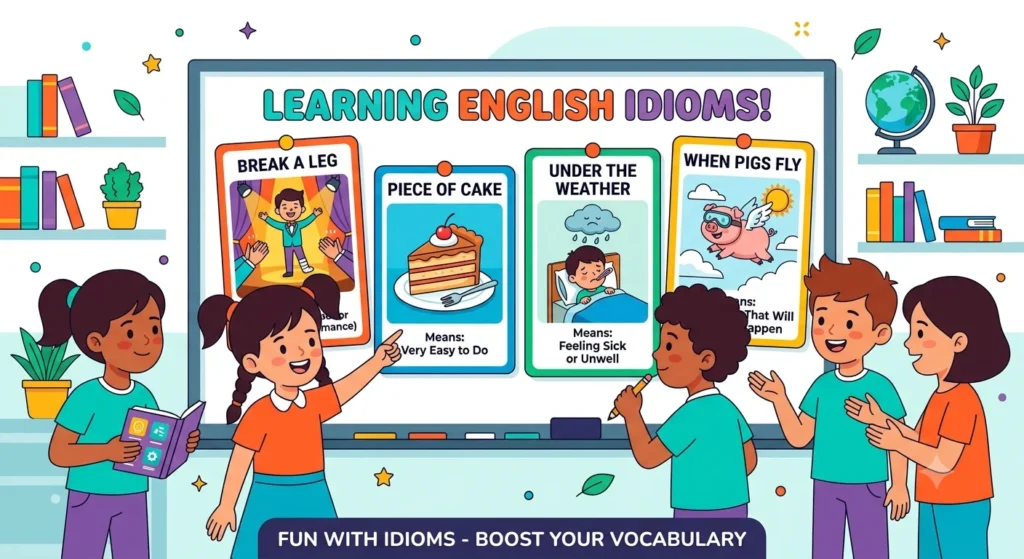
Have you ever looked at a funny picture and instantly understood an English idiom? That’s exactly why pictures for idioms with meaning are one of the easiest and most enjoyable ways to improve your English vocabulary.
Whether you’re a student, teacher, parent, or English learner, this guide will help you master 20 idioms with pictures and sentences using simple explanations, real-life examples, and easy-to-remember meanings.
Why Learning Through Pictures for Idioms Works
Learning idioms through images helps your brain connect words with situations, making them easier to remember.
Benefits of Using Pictures for Idioms
- Improves memory retention
- Makes difficult idioms easy to understand
- Helps children and beginners learn faster
- Great for classroom activities
- Perfect for competitive exams
- Makes English speaking more natural
Many teachers also use pictures for idioms with answers in quizzes, worksheets, and classroom games because visual learning increases understanding.
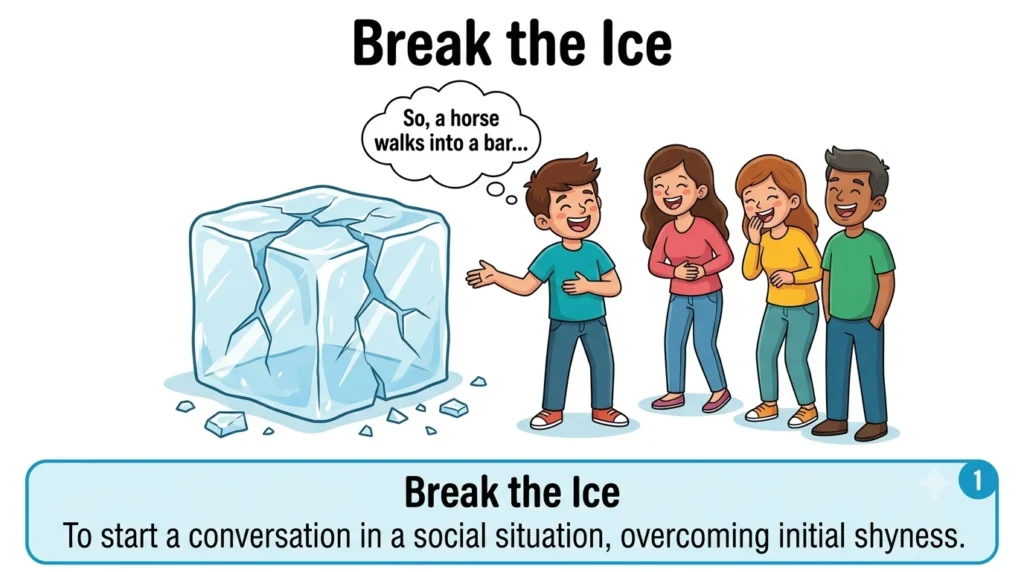
Break the Ice
Word-by-Word Meaning
- Break = smash
- Ice = frozen water
Idiomatic Meaning
To start a conversation and make people feel comfortable.
Example Sentences
- I told a joke to break the ice at the meeting.
- Games help students break the ice on the first day.
Common Error
❌ Breaking the ice means breaking frozen water.
✅ It means starting friendly communication.
Usage Note
Perfect for meetings, interviews, and first conversations.
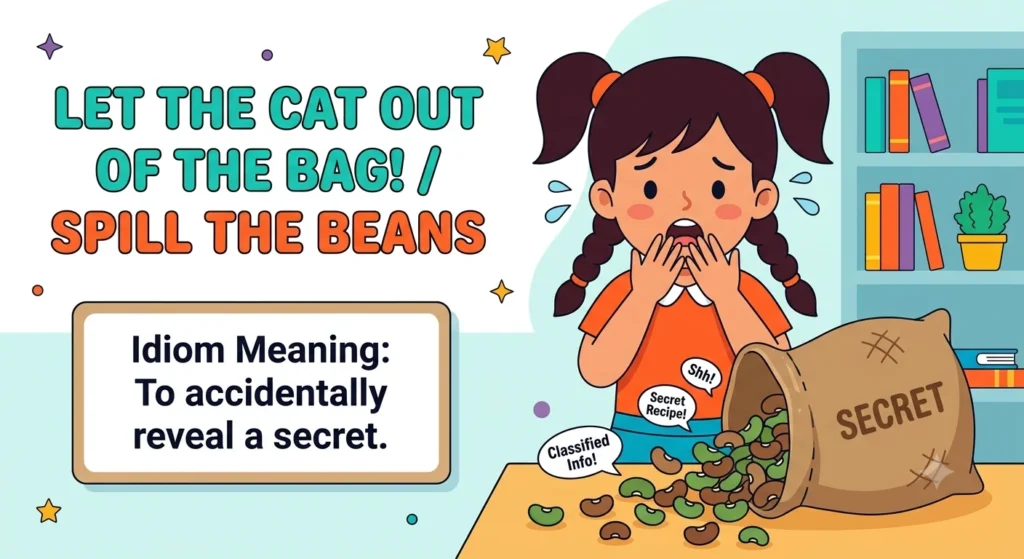
Spill the Beans
Word-by-Word Meaning
- Spill = drop
- Beans = seeds
Idiomatic Meaning
To reveal a secret accidentally or intentionally.
Example Sentences
- Sarah spilled the beans about the surprise party.
- Don’t spill the beans before tomorrow.
Common Error
It has nothing to do with cooking.
Usage Note
Use when someone reveals confidential information.
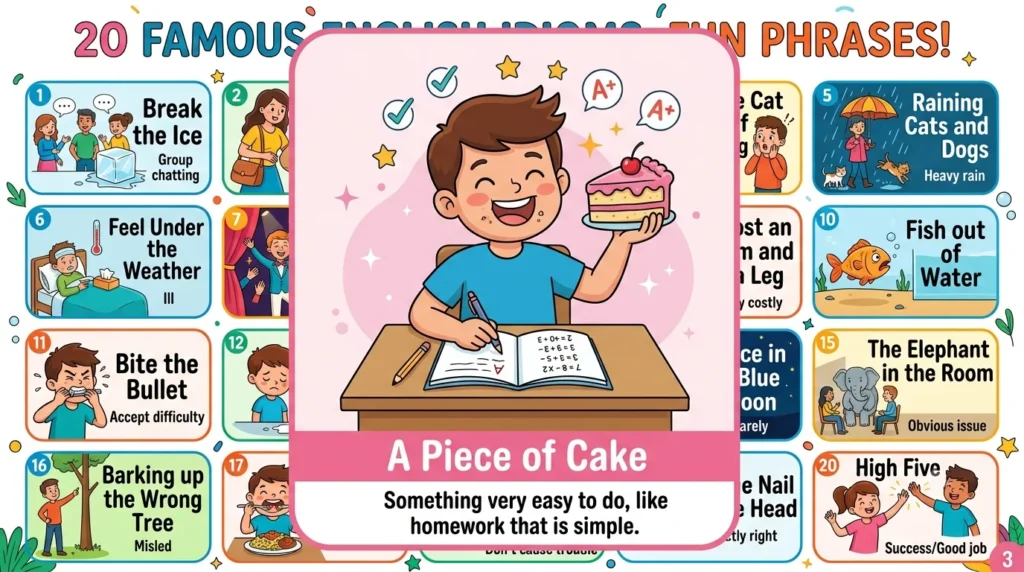
Piece of Cake
Word-by-Word Meaning
- Piece = part
- Cake = dessert
Idiomatic Meaning
Something very easy.
Example Sentences
- The exam was a piece of cake.
- Driving became a piece of cake after practice.
Common Error
It doesn’t describe food.
Usage Note
Common in everyday conversations.
Hit the Sack
Word-by-Word Meaning
- Hit = strike
- Sack = bag
Idiomatic Meaning
Go to sleep.
Example Sentences
- I’m tired. I’ll hit the sack.
- He hit the sack early.
Common Error
It doesn’t mean hitting a bag.
Usage Note
Informal expression.
Under the Weather
Word-by-Word Meaning
- Under
- Weather
Idiomatic Meaning
Feeling sick.
Example Sentences

- I’m under the weather today.
- She stayed home because she felt under the weather.
Common Error
Not about rain or sunshine.
Usage Note
Used when someone feels slightly ill.
Once in a Blue Moon
Word-by-Word Meaning
A blue moon is rare.
Idiomatic Meaning
Something that happens very rarely.
Example Sentences
- We eat out once in a blue moon.
- He visits us once in a blue moon.
Common Error
Not related to the moon’s color.
Usage Note
Describes rare events.
Let the Cat Out of the Bag
Word-by-Word Meaning
Cat coming out of a bag.
Idiomatic Meaning
Reveal a secret.
Example Sentences
- Jake let the cat out of the bag.
- Don’t let the cat out of the bag.
Common Error
Not about pets.
Usage Note
Very common in spoken English.
Cost an Arm and a Leg
Word-by-Word Meaning
Body parts.
Idiomatic Meaning
Very expensive.
Example Sentences
- That phone cost an arm and a leg.
- The vacation cost an arm and a leg.
Common Error
Not about body parts.
Usage Note
Used for expensive products.
Hold Your Horses
Word-by-Word Meaning
Control horses.
Idiomatic Meaning
Wait or be patient.
Example Sentences
- Hold your horses!
- Hold your horses before making a decision.
Common Error
No actual horses involved.
Usage Note
Friendly advice.
Bite the Bullet
Word-by-Word Meaning
Bite a bullet.
Idiomatic Meaning
Face a difficult situation bravely.
Example Sentences
- I bit the bullet and apologized.
- She bit the bullet before surgery.
Common Error
Not literal.
Usage Note
Used during difficult decisions.
40+ Gardening Idioms 🌱 Meaning & Examples
Burn the Midnight Oil
Word-by-Word Meaning
Burning oil at night.
Idiomatic Meaning
Study or work late into the night.
Example Sentences
- Students burned the midnight oil before exams.
- He burned the midnight oil to finish the project.
Common Error
Not about lamps.
Usage Note
Common in education.
A Blessing in Disguise
Word-by-Word Meaning
A hidden blessing.
Idiomatic Meaning
Something bad that later turns out good.
Example Sentences
- Losing that job was a blessing in disguise.
- Missing the bus became a blessing in disguise.
Usage Note
Used after positive outcomes.
Kill Two Birds with One Stone
Word-by-Word Meaning
One stone, two birds.
Idiomatic Meaning
Complete two tasks at once.
Example Sentences
- Walking to work kills two birds with one stone.
- Studying while traveling kills two birds with one stone.
Common Error
Not about birds.
The Ball Is in Your Court
Word-by-Word Meaning
Ball in your court.
Idiomatic Meaning
Now it’s your turn to decide.
Example Sentences
- I’ve explained everything. The ball is in your court.
- The ball is in your court now.
Pull Someone’s Leg
Word-by-Word Meaning
Pull a leg.
Idiomatic Meaning
Joke with someone.
Example Sentences
- I’m just pulling your leg.
- Don’t worry, he’s pulling your leg.
Cry Over Spilled Milk
Word-by-Word Meaning
Milk has spilled.
Idiomatic Meaning
Don’t worry about mistakes that can’t be changed.
Example Sentences
- Don’t cry over spilled milk.
- We can’t change the past.
Add Fuel to the Fire
Word-by-Word Meaning
Adding fuel to flames.
Idiomatic Meaning
Make a bad situation worse.
Example Sentences
- His comments added fuel to the fire.
- Don’t add fuel to the fire.
Hit the Nail on the Head
Word-by-Word Meaning
Hit a nail perfectly.
Idiomatic Meaning
Say exactly the right thing.
Example Sentences
- You hit the nail on the head.
- Her answer hit the nail on the head.
A Fish Out of Water
Word-by-Word Meaning
Fish outside water.
Idiomatic Meaning
Feeling uncomfortable in a new situation.
Example Sentences
- I felt like a fish out of water.
- New employees often feel like a fish out of water.
Rain Cats and Dogs
Word-by-Word Meaning
Cats and dogs falling.
Idiomatic Meaning
Raining very heavily.
Example Sentences
- It’s raining cats and dogs.
- Yesterday it rained cats and dogs.
Common Error
Animals are not actually falling.
Usage Note
A classic English weather idiom.
Reference Table of Idioms
| Idiom | Meaning |
|---|---|
| Break the Ice | Start a conversation |
| Spill the Beans | Reveal a secret |
| Piece of Cake | Very easy |
| Hit the Sack | Go to sleep |
| Under the Weather | Feel sick |
| Once in a Blue Moon | Very rarely |
| Let the Cat Out of the Bag | Reveal a secret |
| Cost an Arm and a Leg | Very expensive |
| Hold Your Horses | Wait patiently |
| Bite the Bullet | Face difficulty bravely |
| Burn the Midnight Oil | Work or study late |
| Blessing in Disguise | Hidden advantage |
| Kill Two Birds with One Stone | Achieve two goals together |
| Ball Is in Your Court | Your turn to decide |
| Pull Someone’s Leg | Joke with someone |
| Cry Over Spilled Milk | Regret the past |
| Add Fuel to the Fire | Make things worse |
| Hit the Nail on the Head | Be exactly right |
| Fish Out of Water | Feel uncomfortable |
| Rain Cats and Dogs | Rain heavily |
How to Practice Idioms Using Pictures
The best way to master idioms is by combining visuals with daily practice.
Try these activities:
- Draw your own idiom pictures.
- Guess idioms from classroom images.
- Match pictures with meanings.
- Create flashcards.
- Practice speaking with friends.
- Use pictures for idioms and phrases during revision.
Many learners also search for a pictures for idioms PDF because printable worksheets make revision easier at home or in school.
Frequently Asked Questions (FAQs)
What are pictures for idioms?
Pictures for idioms are illustrations that visually represent English idioms, making their figurative meanings easier to understand and remember.
Why are pictures helpful for learning idioms?
Images improve memory, increase engagement, and help learners quickly connect literal and figurative meanings.
Where can teachers use pictures for idioms with answers?
Teachers commonly use them in classrooms, worksheets, quizzes, presentations, homework, and speaking activities.
Can beginners learn English idioms using pictures?
Yes. Visual learning is one of the easiest methods for beginners, children, and ESL students.
Are dioms with pictures and sentences enough for beginners?
Absolutely. Learning these twenty common idioms provides a strong foundation for understanding everyday English conversations.
Conclusion
Learning pictures for idioms with meaning transforms difficult English expressions into memorable, enjoyable lessons. By studying these 20 idioms with pictures, understanding their meanings, and practicing them in daily conversations, you’ll sound more natural and confident in English.
Keep revising, create your own visual flashcards, and challenge yourself to use one new idiom every day. With regular practice, these expressions will become a natural part of your vocabulary.

“Rose Macaulay shares the charm of idioms on LearnIdom.com, making language learning delightful, insightful, and full of wit for every reader.”