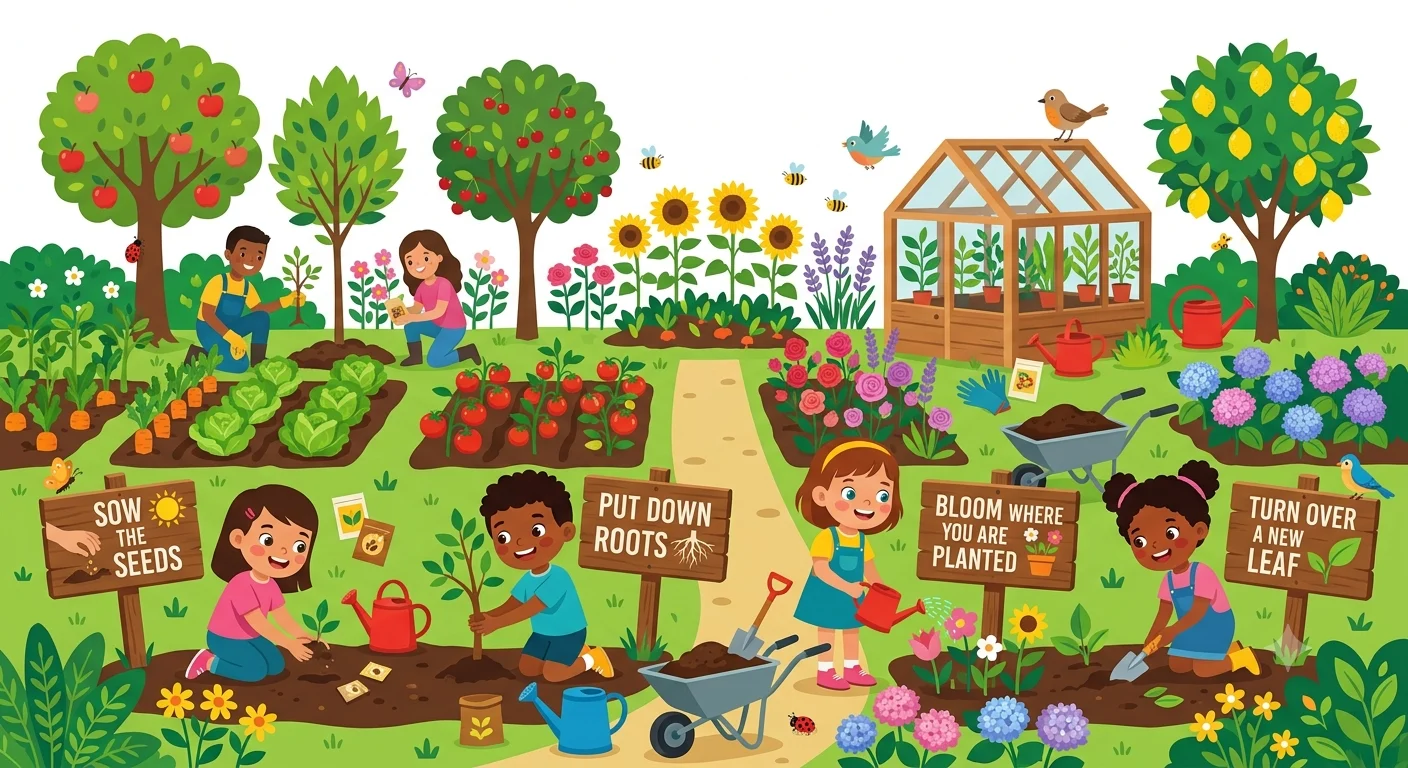
Have you ever heard someone say, “The grass is always greener on the other side” or “Put down roots”? These gardening idioms make everyday English more colorful and expressive. Whether you’re an English learner, student, or language enthusiast, this guide will help you understand and confidently use the most popular gardening-related expressions.
Gardening has inspired English speakers for centuries, which is why gardening idioms and phrases remain common in daily conversations, books, movies, and workplaces. Let’s explore the most useful ones.
What Are Gardening Idioms?
Gardening idioms are expressions that use gardening, flowers, plants, trees, seeds, or nature to express ideas beyond their literal meanings.
For example:
- Literal: She planted a tree in her backyard.
- Idiomatic: He planted the idea in my mind.
These expressions make English more natural and engaging.
Why Learn Gardening Idioms?
- Improve spoken English naturally.
- Understand native speakers better.
- Write more expressive essays and emails.
- Perform better in English exams and interviews.
- Build a richer vocabulary.
Sow the Seeds
Word-by-Word Meaning
Sow = Plant seeds
Seeds = Small parts that grow into plants
Idiomatic Meaning
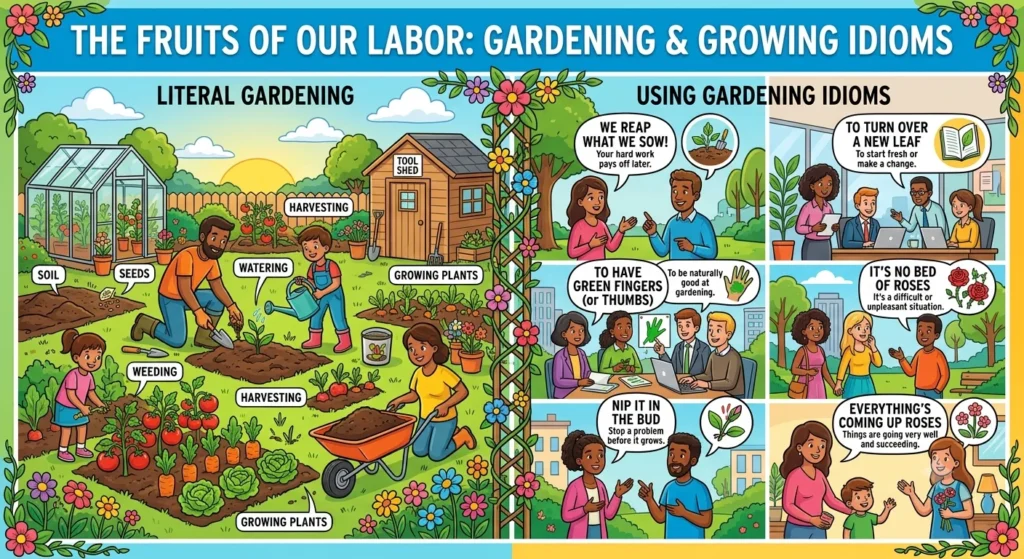
To start something that may develop in the future.
Example Sentences
- The teacher sowed the seeds of curiosity.
- Her speech sowed the seeds of change.
Common Error
❌ Sow the flowers
✅ Sow the seeds
Usage Note
Usually used when discussing future success, problems, or ideas.
Reap What You Sow
Word-by-Word Meaning
Reap = Harvest
Sow = Plant
Idiomatic Meaning
Your actions determine your future results.
Example Sentences
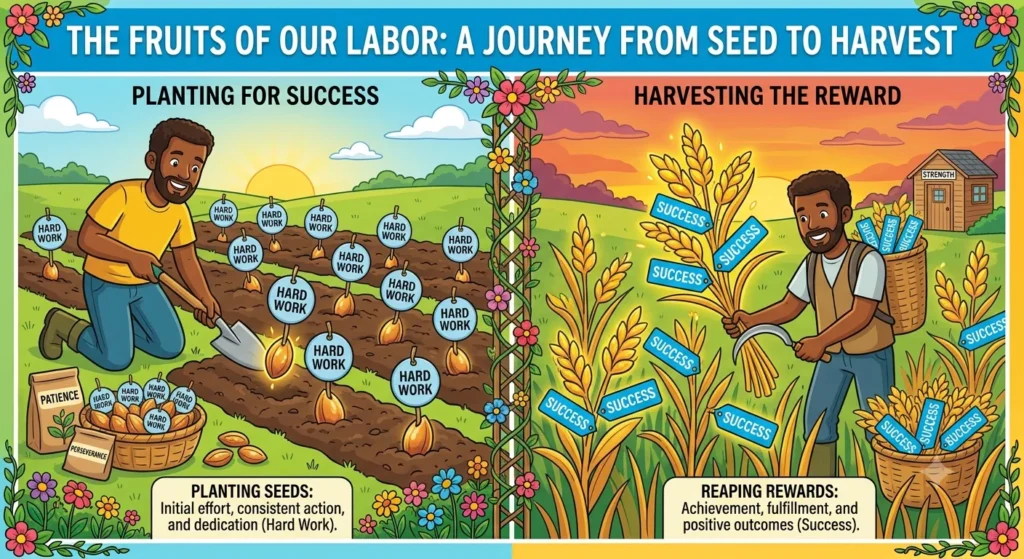
- If you work hard, you’ll reap what you sow.
- He cheated and eventually reaped what he sowed.
Common Error
Don’t confuse it with luck.
Usage Note
Often used to teach responsibility.
Put Down Roots
Word-by-Word Meaning
Roots = Underground part of a plant
Idiomatic Meaning
To settle permanently somewhere.
Example Sentences
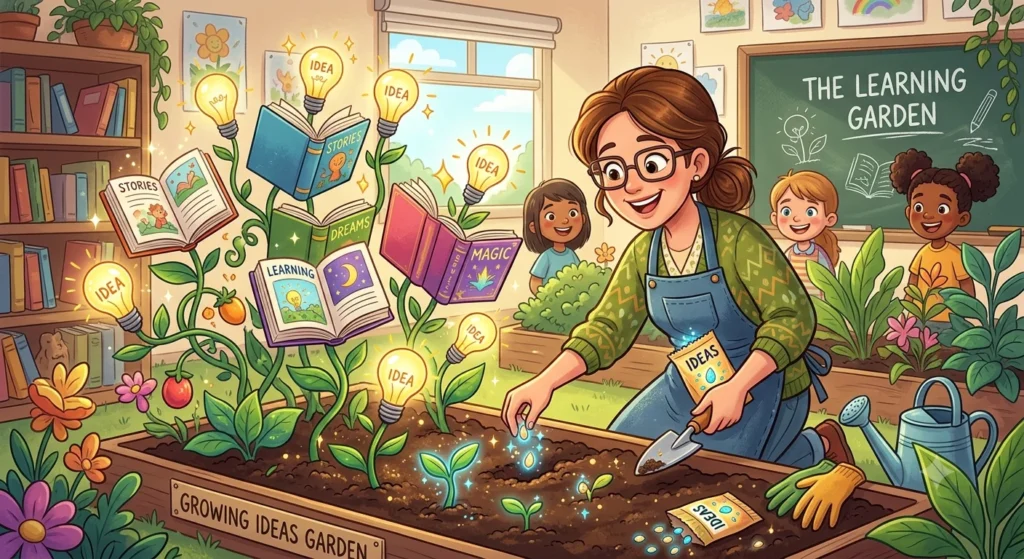
- They finally put down roots in Canada.
- After years of traveling, she wanted to put down roots.
Common Error
Not about actual tree roots.
Usage Note
Common in conversations about family and careers.
Nip It in the Bud
Word-by-Word Meaning
Bud = Young flower
Idiomatic Meaning
Stop a problem before it grows.
Example Sentences
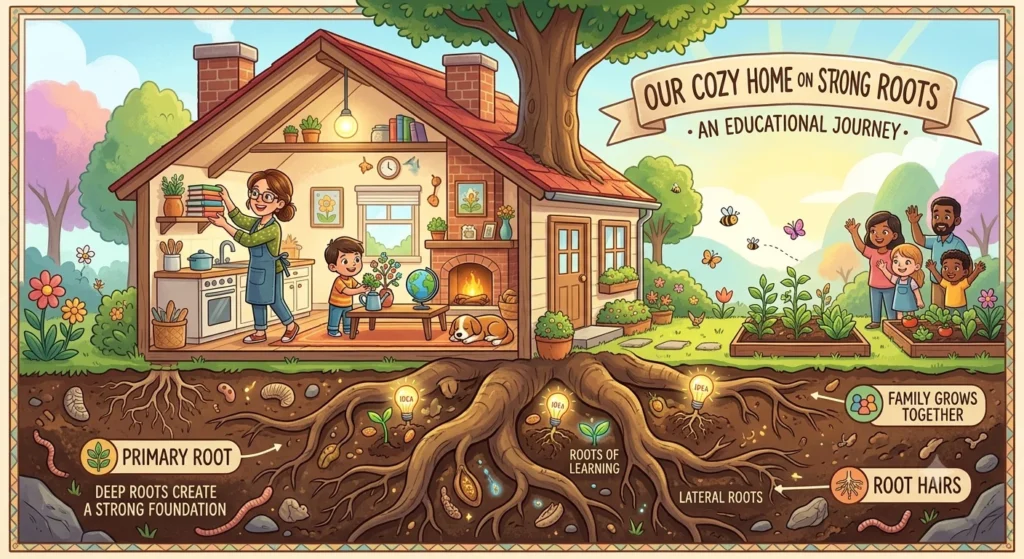
- We should nip the issue in the bud.
- Parents should nip bad habits in the bud.
Common Error
❌ Nip it in the butt
✅ Nip it in the bud
Usage Note
Very common in business and parenting.
Turn Over a New Leaf
Word-by-Word Meaning
Leaf = Plant leaf
Idiomatic Meaning
Start behaving in a better way.
Example Sentences
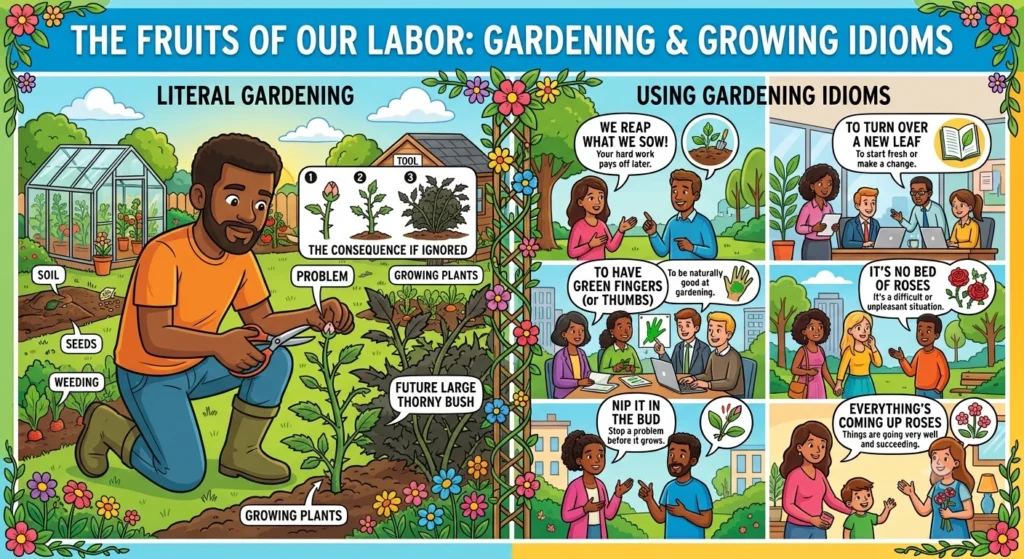
- He’s turned over a new leaf.
- She decided to exercise every day and turn over a new leaf.
Common Error
Don’t interpret it literally.
Usage Note
Often used after someone changes bad habits.
The Grass Is Always Greener on the Other Side
Word-by-Word Meaning
Another garden looks greener.
Idiomatic Meaning
Other people’s lives often seem better than our own.
Example Sentences
- Don’t quit your job just because the grass is always greener on the other side.
- Social media often makes us think the grass is greener elsewhere.
Common Error
Not about actual grass.
Usage Note
Very popular in daily English.
Bloom Where You Are Planted
Word-by-Word Meaning
Bloom = Grow flowers
Idiomatic Meaning
Make the best of your current situation.
Example Sentences
- Even in a difficult city, she bloomed where she was planted.
- Students should bloom where they’re planted.
Usage Note
Excellent motivational expression.
Come Up Roses
Word-by-Word Meaning
Roses grow beautifully.
Idiomatic Meaning
Everything turns out successfully.
Example Sentences
- The project came up roses.
- His interview came up roses.
Usage Note
Usually describes successful outcomes.
Plant the Seed
Word-by-Word Meaning
Place a seed in the soil.
Idiomatic Meaning
Introduce an idea.
Example Sentences
- She planted the seed for a new business.
- The movie planted the seed of adventure.
Usage Note
Common in business, teaching, and parenting.
Weed Out
Word-by-Word Meaning
Remove unwanted plants.
Idiomatic Meaning
Remove unwanted people or things.
Example Sentences
- We need to weed out fake information.
- The company weeded out weak applicants.
Usage Note
Popular in workplaces.
Bear Fruit
Word-by-Word Meaning
A tree produces fruit.
Idiomatic Meaning
Produce successful results.
Example Sentences
- Years of practice bore fruit.
- Her efforts finally bear fruit.
Fresh as a Daisy
Word-by-Word Meaning
A healthy flower.
Idiomatic Meaning
Energetic and refreshed.
Example Sentences
- She woke up fresh as a daisy.
- After vacation, everyone looked fresh as a daisy.
Push Up Daisies
Word-by-Word Meaning
Flowers growing above someone.
Idiomatic Meaning
A humorous expression meaning someone has died.
Example Sentences
- In old stories, villains end up pushing up daisies.
- The phrase is humorous, not formal.
Usage Note
Avoid in serious conversations.
Branch Out
Word-by-Word Meaning
Tree branches spread.
Idiomatic Meaning
Try something new or expand.
Example Sentences
- The company branched out into online business.
- She wants to branch out into photography.
Barking Up the Wrong Tree
Word-by-Word Meaning
A dog barking at the wrong tree.
Idiomatic Meaning
Blaming or pursuing the wrong person or idea.
Example Sentences
- You’re barking up the wrong tree.
- The police first barked up the wrong tree.
Money Doesn’t Grow on Trees
Word-by-Word Meaning
Money isn’t produced by trees.
Idiomatic Meaning
Money must be earned.
Example Sentences
- Dad reminded us money doesn’t grow on trees.
- Spend wisely because money doesn’t grow on trees.
Like a Weed
Word-by-Word Meaning
Weeds grow quickly.
Idiomatic Meaning
Growing very fast.
Example Sentences
- The child is growing like a weed.
- The business expanded like a weed.
Stop and Smell the Roses
Word-by-Word Meaning
Pause to enjoy flowers.
Idiomatic Meaning
Slow down and enjoy life.
Example Sentences
- Remember to stop and smell the roses.
- Life is busy, but don’t forget to stop and smell the roses.
In Full Bloom
Word-by-Word Meaning
Flowers fully open.
Idiomatic Meaning
At the highest level of beauty or success.
Example Sentences
- The garden is in full bloom.
- Her career is in full bloom.
Thorn in Someone’s Side
Word-by-Word Meaning
A thorn causes pain.
Idiomatic Meaning
A constant annoyance.
Example Sentences
- The noisy neighbor is a thorn in my side.
- Delays became a thorn in the company’s side.
Gardening Idioms and Phrases at a Glance
| Idiom | Meaning |
|---|---|
| Sow the Seeds | Start something |
| Reap What You Sow | Face consequences |
| Put Down Roots | Settle permanently |
| Nip It in the Bud | Stop early |
| Turn Over a New Leaf | Improve yourself |
| Grass Is Always Greener | Others seem better |
| Bloom Where You Are Planted | Make the best of life |
| Plant the Seed | Introduce an idea |
| Weed Out | Remove unwanted things |
| Bear Fruit | Produce success |
Gardening Idioms with Meaning: How to Remember Them Easily
The easiest way to remember gardening idioms with meaning is to connect each expression with a real gardening activity. Imagine planting seeds, watering flowers, pulling weeds, or watching a tree grow. These mental images make the figurative meanings much easier to remember.
Practice by writing one sentence each day using a different idiom. Within a few weeks, these expressions will feel natural in both speaking and writing.
Plant Idioms You Should Know
Many learners search for plant idioms because plants symbolize growth, patience, and change. Expressions like Plant the Seed, Put Down Roots, Turn Over a New Leaf, and Bear Fruit are among the most useful plant-related idioms used in English conversations.
Idioms About Planting Trees
There are several idioms about planting trees that symbolize hope, planning, and long-term success. While “plant a tree” is often used literally, English also uses tree-related expressions such as Put Down Roots, Branch Out, and Money Doesn’t Grow on Trees to express broader life lessons.
If you’re specifically looking for idioms about planting trees with the word speak, there is no standard English idiom that combines tree planting and the word speak. However, you can naturally use both in a sentence, such as:
“His speech planted the seed of environmental awareness.”
This combines the idea of speaking with the idiomatic expression plant the seed.
Plant a Tree Idiom Explained
Many people search for a plant a tree idiom, but “plant a tree” itself is generally a literal phrase rather than a traditional English idiom. However, it is widely used symbolically to represent investing in the future, leaving a legacy, or creating hope for future generations.
If you’re searching for a Plant a Tree Idiom 5 Words, a simple five-word inspirational phrase is:
- Plant trees, grow hope every day.
This is a motivational phrase rather than a traditional idiom.
Similarly, the phrase Plant a Tree Idiom Cryptogram usually refers to a classroom puzzle or educational word game based on tree-related expressions, not an official English idiom.
Short Garden Phrases
If you enjoy inspirational language, here are some short garden phrases:
- Bloom where you’re planted.
- Every seed tells a story.
- Grow with patience.
- Let kindness blossom.
- Plant hope every day.
- Nature teaches resilience.
- Small seeds create forests.
- Every flower has its season.
Idioms About Planting Trees and Music
There are no widely recognized English idioms about planting trees and music together. However, writers often combine these themes creatively:
- Music plants seeds of joy.
- Every melody helps dreams bloom.
- Let your song take root.
- Harmony grows like a healthy tree.
These are poetic expressions rather than established idioms.
Frequently Asked Questions
What are gardening idioms?
Gardening idioms are expressions based on plants, flowers, seeds, gardens, or trees that have figurative meanings rather than literal ones.
Why are gardening idioms popular?
They make communication more vivid, memorable, and emotionally engaging because they use familiar images from nature.
Are gardening idioms used in everyday English?
Yes. Native speakers regularly use gardening idioms in conversations, business meetings, books, movies, and social media.
What is the easiest gardening idiom to learn?
“Plant the Seed” is one of the easiest because it clearly represents introducing an idea that may grow over time.
Is “Plant a Tree” an English idiom?
Not traditionally. It is usually a literal phrase, although it is often used symbolically to represent hope, legacy, and investing in the future.
Conclusion
Learning gardening idioms is a simple yet powerful way to make your English sound more natural and expressive. From sowing the seeds of success to bearing fruit after hard work, these timeless expressions appear in everyday conversations, literature, education, and business communication.
Start by practicing one idiom each day, use it in your own sentences, and try to recognize it in books, movies, or conversations. Over time, these colorful expressions will become a natural part of your vocabulary and help you communicate with greater confidence.

“Rose Macaulay shares the charm of idioms on LearnIdom.com, making language learning delightful, insightful, and full of wit for every reader.”