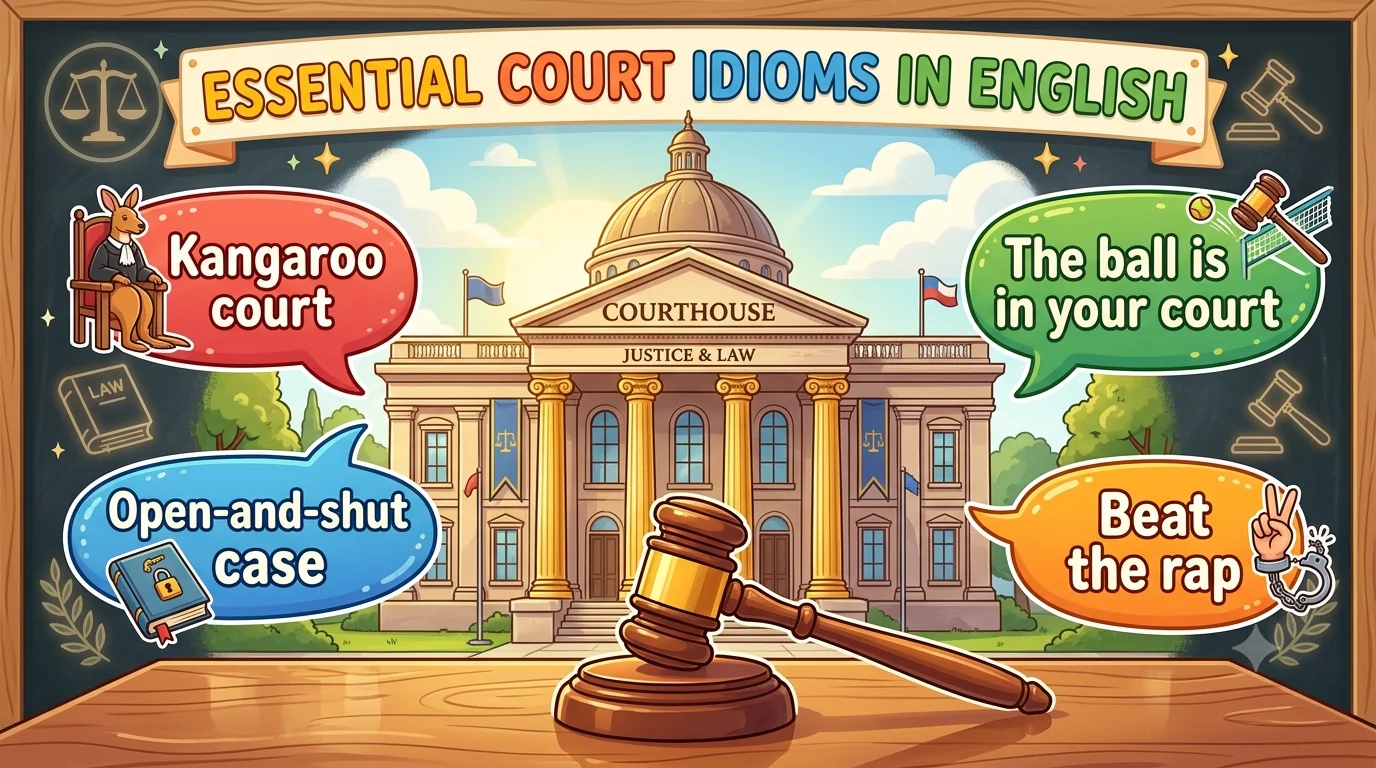
Have you ever watched a gripping legal drama and felt completely lost when characters tossed around phrases like “beating the rap” or “kangaroo court”? You’re not alone. Court idioms in English often confuse even advanced learners because they carry meanings far beyond their literal words.
Here’s the exciting truth: mastering these court idioms and phrases will not only help you understand movies and TV shows better—they’ll make your everyday conversations more vibrant, precise, and natural. Imagine telling a friend waiting for a job offer, “The ball is in their court now.” Or describing someone who avoided consequences by saying, “They really beat the rap there!”
These expressions appear everywhere—in business meetings, political debates, news headlines, and casual chats. Whether you’re preparing for an English exam, working in law, watching courtroom dramas, or simply love language, this comprehensive guide will transform your understanding.
In this article, you’ll discover powerful judge idioms and courtroom expressions, complete with clear meanings, real-life examples, common errors to avoid, and practical usage tips. We’ll also explore the fascinating idiom to play examples that will make your speech more colorful and authentic.
Ready to become fluent in legal English? Let’s dive into the fascinating world of court idioms in English!
What Are Court Idioms and Why Learn Them?
Word-by-Word Meaning
“Court” refers to the place where legal cases are heard, while “idioms” are phrases whose meanings can’t be understood from the individual words alone. Together, court idioms are expressions borrowed from the legal world that people use in everyday situations.
Figurative Meaning
These idioms describe situations involving justice, fairness, responsibility, decision-making, and consequences—but they apply far beyond actual courtrooms. You’ll hear them in offices, homes, and social settings.
Why They Matter
- Sound more natural: Native speakers use these constantly
- Understand media: Movies, news, and TV shows are full of them
- Improve business communication: Many relate to negotiation and responsibility
- Boost exam scores: IELTS, TOEFL, and Cambridge exams love idioms
Example in Context
“When my boss said the promotion decision was pending, I knew the ball was in my court to prove myself.”
Common Error
❌ Avoiding idioms because they seem too informal
✅ Using them appropriately in both formal and casual settings
Usage Note
Court idioms are versatile. Use them in emails, presentations, meetings, and social conversations—they show language sophistication.
The Ball Is in Your Court
Word-by-Word Meaning
This phrase comes from tennis, where the ball lands on one player’s side, making it their responsibility to return it. The “court” refers to the playing area, not a legal courtroom.
Figurative Meaning
You use this court idiom to tell someone that it’s now their responsibility to take action or make a decision. The initiative has completely passed to them.
Example Sentences

- “I’ve sent the proposal and followed up three times. Now the ball is in their court.”
- “You’ve heard both sides of the argument—the ball is in your court to decide.”
- “After negotiating for weeks, the company made its final offer. The ball is now in the union’s court.”
Common Error
❌ “The ball is at your court”
✅ “The ball is in your court”
Usage Note
This is among the most common court idioms in English. It’s widely acceptable in professional settings and perfect for emails, meetings, and everyday conversations.
Kangaroo Court
Word-by-Word Meaning
“Kangaroo” refers to the Australian animal. This term likely originated in 19th-century America, possibly referring to judges who “hopped” from town to town.
Figurative Meaning
A kangaroo court is an unfair, biased legal proceeding that violates basic justice. It often involves a predetermined outcome, lack of due process, or a biased judge.
Example Sentences
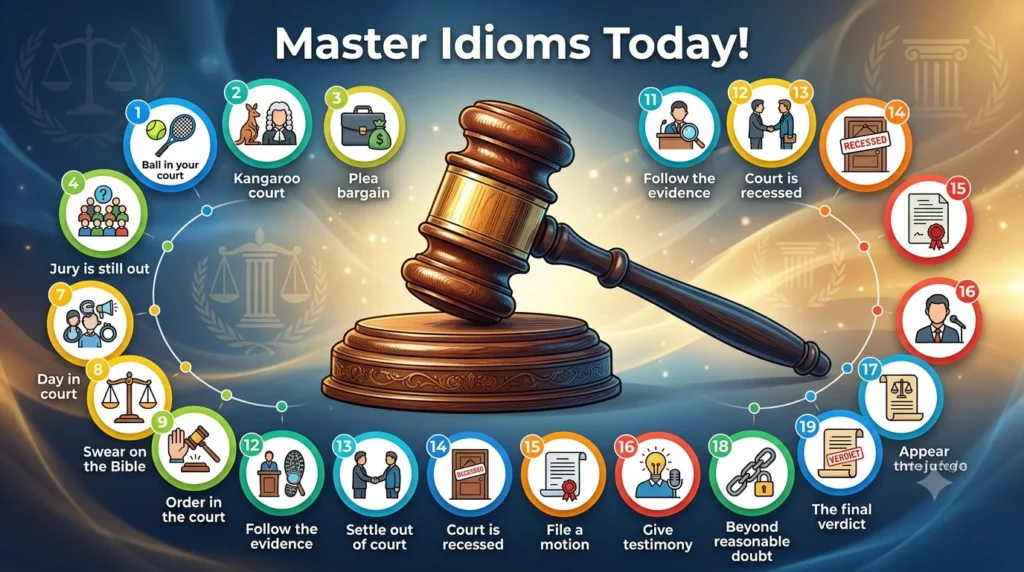
- “The media trial turned into a kangaroo court before the actual evidence was presented.”
- “He refused to attend what he called a kangaroo court with no impartial jury.”
- “Many accused the tribunal of being a kangaroo court designed to silence dissent.”
Common Error
❌ Thinking it refers to Australian courts
✅ It describes any unfair, biased proceeding
Usage Note
This is a strong criticism. Use it carefully as it implies severe injustice. You’ll often hear it in political contexts.
Beat the Rap
Word-by-Word Meaning
“Rap” in legal slang means a criminal charge or conviction. To “beat” it means to overcome or escape it successfully.
Figurative Meaning
To beat the rap means to avoid conviction or punishment for a crime, often through skilled legal defense or technicalities.
Example Sentences
- “Despite strong evidence, the celebrity beat the rap thanks to his expensive legal team.”
- “She was accused of fraud but beat the rap on a technicality.”
- “Many believe wealthy people can always beat the rap while others can’t.”
Common Error
❌ “Beat the wrap”
✅ “Beat the rap” (it comes from legal slang)
Usage Note
This court idiom often carries a slightly cynical tone—it suggests the person may have gotten away with something.
Friend at Court
Word-by-Word Meaning
Having a “friend” at “court” means having an ally in a powerful place where decisions are made.
Figurative Meaning
A friend at court is someone influential who can help you achieve something or protect you from trouble.
Example Sentences
- “Having a friend at court helped him get the contract despite stiff competition.”
- “She thought she’d get special treatment because she had a friend at court, but she was wrong.”
- “It’s always wise to have a friend at court when navigating corporate politics.”
Common Error
❌ Using it only literally for actual courts
✅ It applies broadly to any situation where influence matters
Usage Note
This phrase dates back to royal courts in the 1400s and has evolved to mean any helpful, influential connection.
In Contempt of Court
Word-by-Word Meaning
“Contempt” means disrespect or disregard. “Of court” means toward the court or judge.
Figurative Meaning
Being in contempt of court means showing disrespect or disobedience to a judge or court procedures.
Example Sentences
- “The lawyer was held in contempt of court for repeatedly ignoring the judge’s orders.”
- “If you refuse to answer the question, you could be found in contempt of court.”
- “The witness was threatened with contempt of court for laughing during proceedings.”
Common Error
❌ “Contempt of the court”
✅ “Contempt of court” (no “the” needed)
Usage Note
This is a serious charge that can lead to fines or even jail time. You’ll hear it in actual courtrooms and TV dramas.
As Sober as a Judge
Word-by-Word Meaning
“Judge” refers to the legal official known for seriousness and authority. “Sober” means not intoxicated.
Figurative Meaning
This means completely sober, clear-headed, or very serious—emphasizing the dignity associated with judges.
Example Sentences
- “He arrived at the party as sober as a judge because he was the designated driver.”
- “She was as sober as a judge when explaining the serious consequences.”
- “The CEO was as sober as a judge during the crisis management meeting.”
Common Error
❌ Thinking it always refers to alcohol
✅ It also describes a serious, somber demeanor
Usage Note
This judge idiom is somewhat old-fashioned but useful for emphasizing someone’s seriousness.
An Open-and-Shut Case
Word-by-Word Meaning
“Open” suggests the case is transparent and simple. “Shut” implies it’s resolved without complication.
Figurative Meaning
An open-and-shut case is a simple, straightforward legal matter with an obvious outcome.
Example Sentences
- “With all that evidence, the lawyer thought it was an open-and-shut case.”
- “The judge declared it an open-and-shut case and gave a quick verdict.”
- “Many thought the lawsuit was an open-and-shut case, but it dragged on for years.”
Common Error
❌ Using it for physical objects
✅ It’s about situations with obvious outcomes
Usage Note
You’ll often hear this in legal dramas when a prosecutor feels the outcome is obvious.
Plea Bargain
Word-by-Word Meaning
“Plea” is the defendant’s formal answer to criminal charges. “Bargain” means negotiation.
Figurative Meaning
A plea bargain is an agreement where the defendant pleads guilty to a lesser charge in exchange for a lighter sentence.
Example Sentences
- “The prosecutor offered a plea bargain: plead guilty to a misdemeanor and avoid jail time.”
- “He accepted the plea bargain to avoid the risks of a trial.”
- “Many cases end with a plea bargain rather than a full trial.”
Common Error
❌ “Plea deal” (though commonly used in casual speech)
✅ “Plea bargain” is the more formal, traditional term
Usage Note
This can be used as a noun (“He took a plea bargain”) or verb (“He plea bargained”).
Cop a Plea
Word-by-Word Meaning
“Cop” here is slang for taking or accepting. “Plea” is the legal response to charges.
Figurative Meaning
To cop a plea means to plead guilty to a crime in the hope of getting a lighter punishment.
Example Sentences
- “The defendant copped a plea to avoid a long trial.”
- “She decided to cop a plea rather than risk a jury finding her guilty.”
- “Many criminals cop a plea because it’s faster and cheaper than fighting the case.”
Common Error
❌ “Cop the plea”
✅ “Cop a plea” is the standard expression
Usage Note
This is informal and often used in newspaper crime reports.
Abide by a Decision
Word-by-Word Meaning
“Abide” means to accept or follow. “Decision” refers to the court’s ruling.
Figurative Meaning
To abide by a decision means to accept and follow the orders a court or judge has given.
Example Sentences
- “The company was forced to abide by the court’s decision.”
- “We must abide by the decision, even if we disagree with it.”
- “He promised to abide by the judge’s ruling.”
Common Error
❌ “Abide to a decision”
✅ “Abide by a decision”
Usage Note
This is a formal phrase often used in legal documents and business contexts.
Get Off Easy / Lightly
Word-by-Word Meaning
“Get off” means to escape or be released. “Easy/lightly” means with little difficulty.
Figurative Meaning
To get off easy means to receive a very light punishment or avoid consequences.
Example Sentences
- “Considering the crime, he got off very easy with just community service.”
- “She got off lightly because it was her first offense.”
- “In my opinion, he got off easy after causing so much damage.”
Common Error
❌ Using it for easy physical tasks
✅ It’s specifically about punishment or consequences
Usage Note
This often implies the punishment was less than the speaker thinks is fair.
The Jury Is Still Out
Word-by-Word Meaning
In a courtroom, the jury leaves to deliberate. This means they haven’t returned with a verdict yet.
Figurative Meaning
“The jury is still out” means a final decision hasn’t been reached.
Example Sentences
- “The jury is still out on whether the new policy will be effective.”
- “I asked if they’d hire me, but the jury is still out.”
- “The jury is still out on that issue—experts disagree.”
Common Error
❌ Using it when someone is literally a jury member
✅ It means people are undecided
Usage Note
This has become a very common everyday expression. Use it in business meetings, personal discussions, and even social media posts.
A Miscarriage of Justice
Word-by-Word Meaning
“Miscarriage” here means a failure or breakdown. “Justice” refers to fairness.
Figurative Meaning
A miscarriage of justice is a very wrong or unfair legal decision that suggests the legal system failed.
Example Sentences
- “Many believe the conviction was a miscarriage of justice.”
- “The appeals court overturned the verdict, calling it a miscarriage of justice.”
- “He spent years in prison because of a miscarriage of justice.”
Common Error
❌ Using it for minor unfairness in daily life
✅ It’s for serious legal injustice
Usage Note
This is a powerful phrase. Use it carefully—it implies the system failed severely.
Word-by-Word Meaning
Out of Court
Figurative Meaning
Literally means outside the courtroom.
This phrase means settling a dispute without going to trial.
Example Sentences
- “The two companies settled the dispute out of court.”
- “We’d prefer to resolve this out of court to save time and money.”
- “The celebrity agreed to pay a settlement out of court.”
Common Error
❌ “Out of courts”
✅ “Out of court”
Usage Note
You’ll hear this in legal news constantly. It’s a common alternative to expensive and public trials.
Cast Doubt On
Word-by-Word Meaning
“Cast” means to throw or direct. “Doubt” means uncertainty.
Figurative Meaning
To cast doubt on someone or something means to make people question its truth or reliability.
Example Sentences
- “The new evidence cast doubt on the witness’s credibility.”
- “His testimony cast doubt on the entire prosecution case.”
- “The scandal cast doubt on the company’s integrity.”
Common Error
❌ “Cast doubt over”
✅ “Cast doubt on”
Usage Note
This is useful in arguments, debates, and discussions where you’re challenging someone’s reliability.
Clear Someone’s Name
Word-by-Word Meaning
“Clear” means to prove innocence. “Name” represents one’s reputation.
Figurative Meaning
To clear someone’s name means to prove they are not guilty of a crime or wrongdoing.
Example Sentences
- “After years of fighting, he finally cleared his name.”
- “The evidence was enough to clear her name in the media.”
- “She went to court specifically to clear her name.”
Common Error
❌ “Clear someone’s reputation” (though similar, this is the correct idiom)
✅ “Clear someone’s name”
Usage Note
This is often about public reputation—sometimes even more important than legal innocence.
A Hung Jury
Word-by-Word Meaning
“Hung” in this context means unable to reach a decision. “Jury” is the panel of citizens deciding the case.
Figurative Meaning
A hung jury is a jury that cannot agree on a verdict, resulting in a mistrial.
Example Sentences
- “The trial ended in a hung jury after two weeks of deliberation.”
- “The judge declared a mistrial due to a hung jury.”
- “It was a complicated case, so a hung jury wasn’t surprising.”
Common Error
❌ Thinking it’s about being “hung over”
✅ It’s about a jury that can’t reach a verdict
Usage Note
A hung jury case usually requires a new trial. This can cause frustration for everyone involved.
The Moment of Truth
Word-by-Word Meaning
“The moment” is the exact time. “Truth” refers to the reality or outcome.
Figurative Meaning
The moment of truth is the point when someone must face the reality of a situation.
Example Sentences
- “The moment of truth came when the jury returned.”
- “Waiting for the exam results was the moment of truth.”
- “For the defendant, the trial’s verdict was the moment of truth.”
Common Error
❌ Using it only for literal truth or facts
✅ It means the deciding moment
Usage Note
You can use this in many daily situations. It’s an emotional and dramatic phrase.
Take the Fifth
Word-by-Word Meaning
“The Fifth” refers to the Fifth Amendment in the U.S. Constitution, which protects against self-incrimination.
Figurative Meaning
To take the Fifth means to refuse to answer a question because the answer might incriminate you.
Example Sentences
- “The politician took the Fifth rather than answer the questions.”
- “She decided to take the Fifth during the investigation.”
- “He refused to testify and took the Fifth on every question.”
Common Error
❌ Using it outside the U.S. without explanation
✅ It’s an American phrase
Usage Note
Outside legal situations, people use it playfully to avoid answering awkward questions.
Poetic Justice
Word-by-Word Meaning
“Poetic” suggests something beautifully fitting. “Justice” means fairness.
Figurative Meaning
Poetic justice is when someone gets exactly the punishment or reward they deserve in a way that feels satisfyingly appropriate.
Example Sentences
- “When the corrupt manager was fired, it felt like poetic justice.”
- “It was poetic justice that he got caught doing exactly what he’d accused others of.”
- “The ending of the movie was pure poetic justice.”
Common Error
❌ Confusing it with legal justice
✅ It’s about the universe providing karma
Usage Note
This is popular in stories, movies, and everyday conversations when someone gets what they deserve.
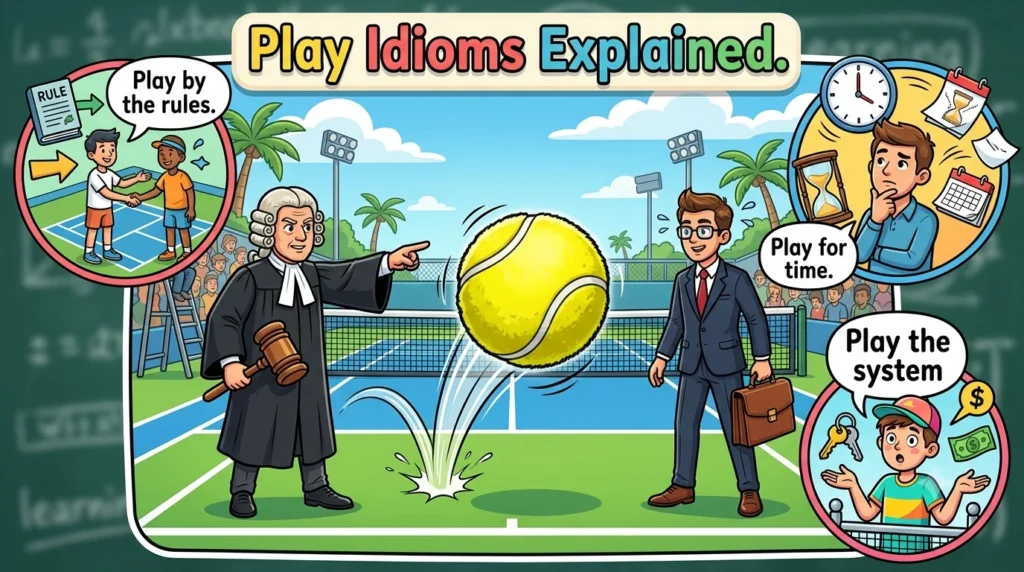
Play Idiom Examples: Understanding “Court Idiom to Play”
What Does “Court Idiom to Play” Mean?
When we talk about “court idiom to play,” we’re referring to expressions where the word “play” appears in a legal or courtroom context. Here are the most important ones:
1. Play by the Rules
- Meaning: Follow the established rules or laws
- Example: “A good lawyer always plays by the rules of the court.”
2. Play the System
- Meaning: Take advantage of legal loopholes
- Example: “He tried to play the system, but the judge saw through it.”
3. Play the Defendant Role
- Meaning: Act as if you’re a defendant in a situation
- Example: “Stop playing the defendant and take responsibility for your actions.”
4. Play Fair
- Meaning: Act honestly and justly
- Example: “The prosecutor promised to play fair during the trial.”
5. Play for Time
- Meaning: Delay making a decision
- Example: “The defense lawyer was playing for time while gathering more evidence.”
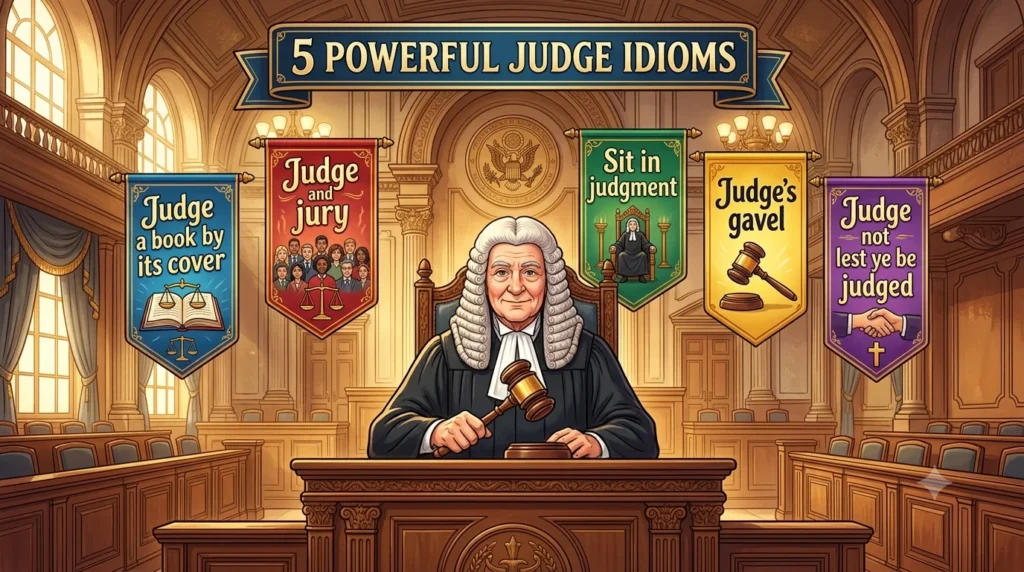
Top Judge Idioms You Must Know
Since you asked about judge idioms, here are five more expressions specifically about judges:
1. Judge a Book by Its Cover
- Meaning: Make judgments based on appearances
- Example: “Don’t judge a book by its cover—the shy lawyer was brilliant in court.”
2. Judge and Jury
- Meaning: Someone who makes decisions alone
- Example: “My boss acts like the judge and jury in every meeting.”
3. Sit in Judgment
- Meaning: To evaluate or criticize someone
- Example: “Who are you to sit in judgment of my career choices?”
4. Judge’s Gavel
- Meaning: Symbol of authority in court
- Example: “The judge’s gavel came down, and the courtroom fell silent.”
5. Judge Not Lest Ye Be Judged
- Meaning: Don’t criticize others if you’re not perfect
- Example: “Remember, judge not lest ye be judged—everyone makes mistakes.”
FAQ
1. What are the 10 most common idioms in English?
While “most common” depends on context, court idioms are frequently used. The top 10 include: “the ball is in your court,” “beat the rap,” “kangaroo court,” “open-and-shut case,” “plea bargain,” “cop a plea,” “hung jury,” “moment of truth,” “get off easy,” and “take the Fifth.”
2. What does the idiom “a friend at court” mean?
It means having an influential person who can help you, especially in high places. This phrase dates back to medieval royal courts and is now used in business and politics.
3. What phrases are used in court?
Common court phrases include “order in the court,” “all rise,” “objection,” “overruled,” “sustained,” “contempt of court,” “do you swear to tell the truth,” “your honor,” and “counselor.”
4. What are the 20 idioms listed in this article?
We’ve covered 20 essential court idioms in English: the ball is in your court, kangaroo court, beat the rap, friend at court, in contempt of court, as sober as a judge, open-and-shut case, plea bargain, cop a plea, abide by a decision, get off easy, the jury is still out, miscarriage of justice, out of court, cast doubt on, clear someone’s name, hung jury, moment of truth, take the Fifth, and poetic justice.
5. What is the difference between “cop a plea” and “plea bargain”?
They’re essentially the same thing. “Plea bargain” is the more formal term, while “cop a plea” is the informal, slang version. Both mean agreeing to plead guilty to a lesser charge in exchange for a lighter sentence.
6. What is a “kangaroo court” and where did it come from?
A kangaroo court is an unfair, biased legal proceeding. The term likely originated in 19th-century America, possibly from judges who “hopped” from town to town or from “claim jumpers” dealing with unfair courts in the Gold Rush era.
7. How can I use court idioms in everyday conversation?
Use “the ball is in your court” for responsibility, “the jury is still out” for undecided situations, “beat the rap” for escaping consequences, and “moment of truth” for important decisions. These work in business, social, and casual settings.
8. Are these idioms used only in American English?
While some, like “take the Fifth,” are specifically American, most court idioms are used globally in English-speaking countries. “Kangaroo court,” “open-and-shut case,” and “the ball is in your court” are recognized worldwide.
Conclusion
Mastering these court idioms in English will transform your language skills dramatically. You’ll understand legal dramas better, impress your colleagues with colorful expressions, and communicate with greater precision and flair.
The secret to becoming fluent in idioms? Practice regularly. Start with just two or three expressions this week. Use them in conversations, emails, or even social media posts. Over time, they’ll become second nature.
Remember, language learning is a journey—not a destination. Every new idiom you learn adds color and depth to your communication. Don’t worry about making mistakes; native speakers make them too!
Here’s your action plan for the next 7 days:
- Day 1-2: Learn 3 idioms from this list
- Day 3-4: Write example sentences with each
- Day 5-6: Use them in conversations or messages
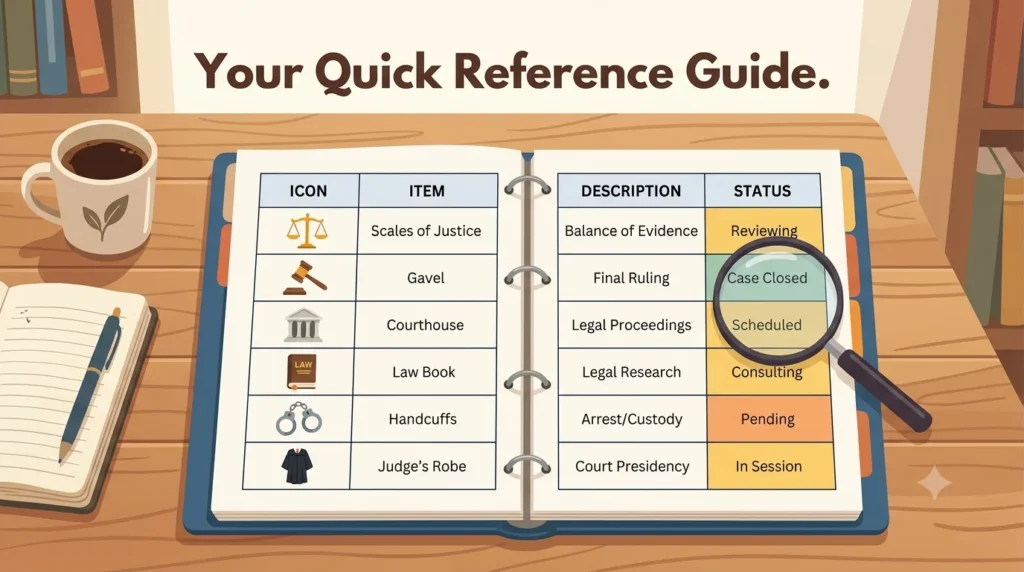
- Day 7: Review all idioms using our quick reference table
If you found this guide helpful, share it with fellow English learners. Leave a comment below telling us which court idiom is your favorite and why. Subscribe to our blog for more language tips and start your journey to English fluency today—because when it comes to mastering idioms, the ball is definitely in your court!
Happy learning, and may your language skills always find poetic justice! 🎓⚖️

“Iris Murdoch explores the beauty of language and idioms on LearnIdom.com, making learning phrases engaging, memorable, and fun for everyone.”