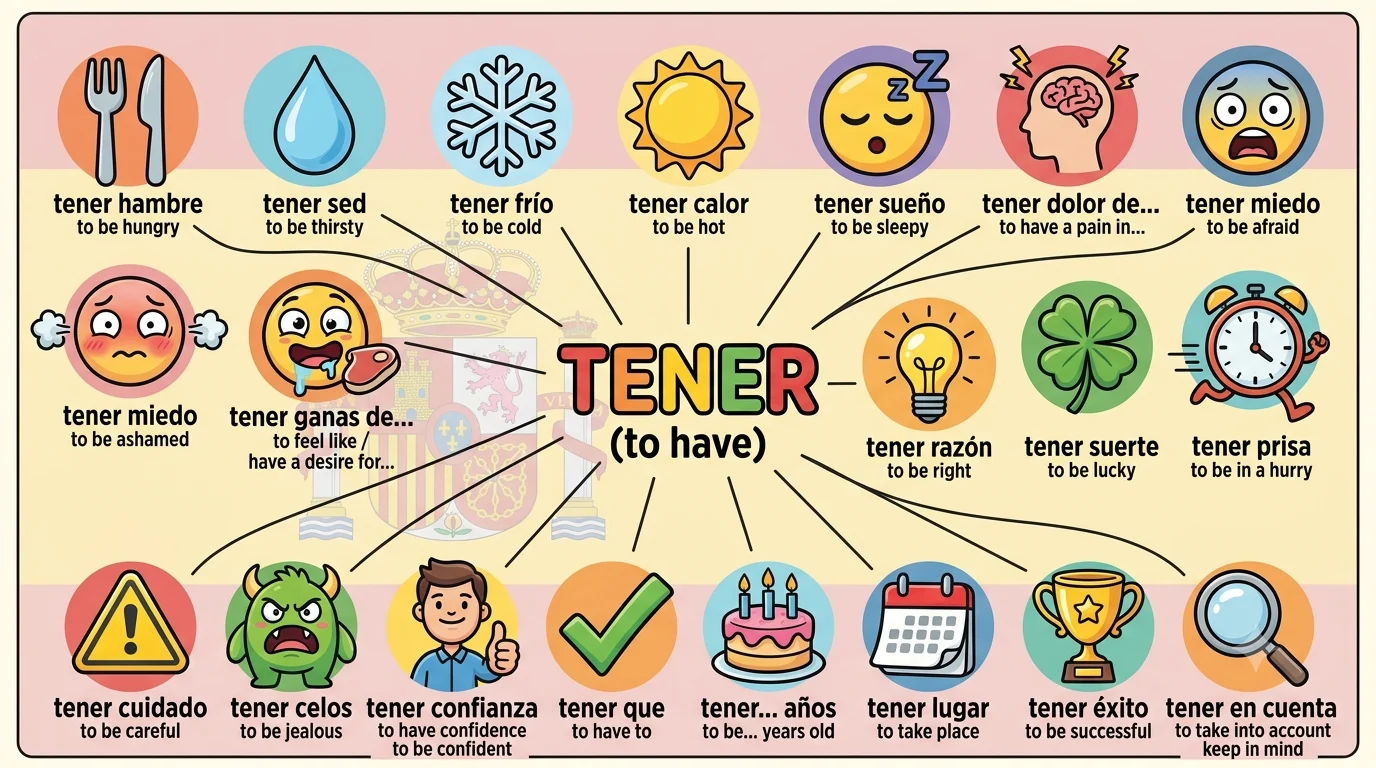
Are you tired of literally translating “I am hungry” into Spanish only to get puzzled looks? The secret lies in mastering Spanish tener idioms, which flip the script by using the verb “tener” (to have) instead of “ser” or “estar” (to be) for everything from age to emotions.
This comprehensive guide breaks down the 20 most essential Spanish tener expressions, giving you the tools to speak naturally and confidently like a native speaker.
What Are Spanish Tener Idioms?
In English, we say “I am hungry” or “I am 20 years old.” In Spanish, however, you don’t are—you have. This is the core of tener expressions. The verb “tener” means “to have,” but in these idioms, it takes on meanings that translate to “to be” in English.
Think of it this way: instead of describing your state of being, you’re describing what you possess. You possess hunger, you possess thirst, you possess years of age. This concept takes practice to internalize, but once you do, you’ll unlock a whole new level of natural Spanish conversation. Native speakers use these phrases countless times every single day.
Understanding the Grammar Rule
When using these expressions, remember that the words following “tener” (like hambre, sed, frío) are nouns, not adjectives. This is a crucial distinction that affects how you modify them.
Key Rule:
- Use mucho/mucha to intensify (because you’re modifying a noun), not muy.
- ✅ Tengo mucha hambre. (I am very hungry.)
- ❌ Tengo muy hambre. (Incorrect)
Tener in Spanish Conjugation: The Reference
Before diving into the idioms, let’s review the present tense conjugation of this essential irregular verb. Mastering tener in Spanish conjugation is the foundation for all these expressions.
| Pronoun | Conjugation | English |
|---|---|---|
| Yo | tengo | I have |
| Tú | tienes | You have (informal) |
| Él/Ella/Usted | tiene | He/She has, You have (formal) |
| Nosotros | tenemos | We have |
| Vosotros | tenéis | You all have (Spain) |
| Ellos/Ellas/Ustedes | tienen | They have, You all have |
Essential Tener Expressions for Physical Sensations
This is where most learners start their journey with Spanish tener idioms. These expressions describe how your body feels. If you want to use tener expressions sentences to talk about your physical state, these are your go-to phrases.
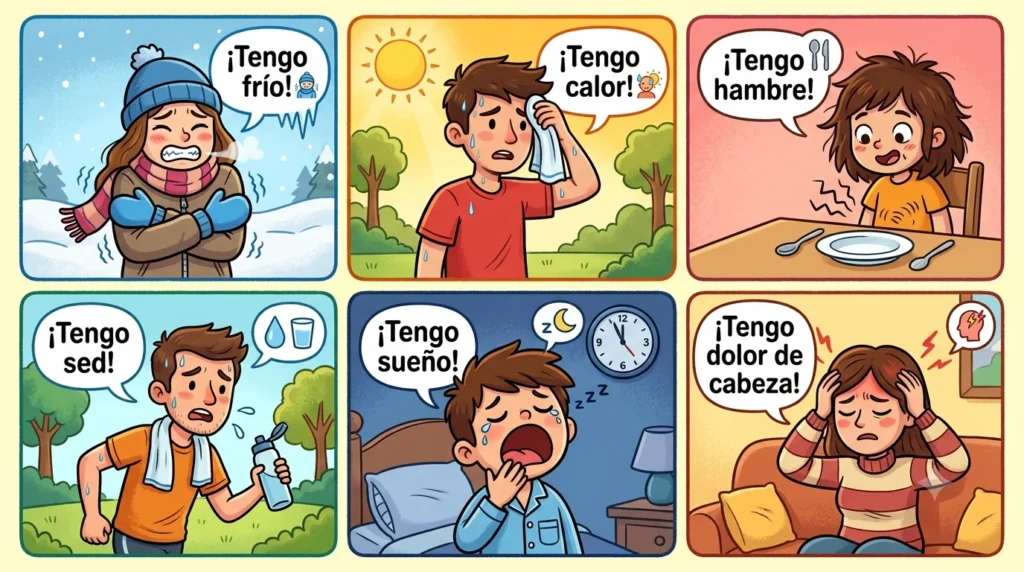
Tener Hambre (To be hungry)
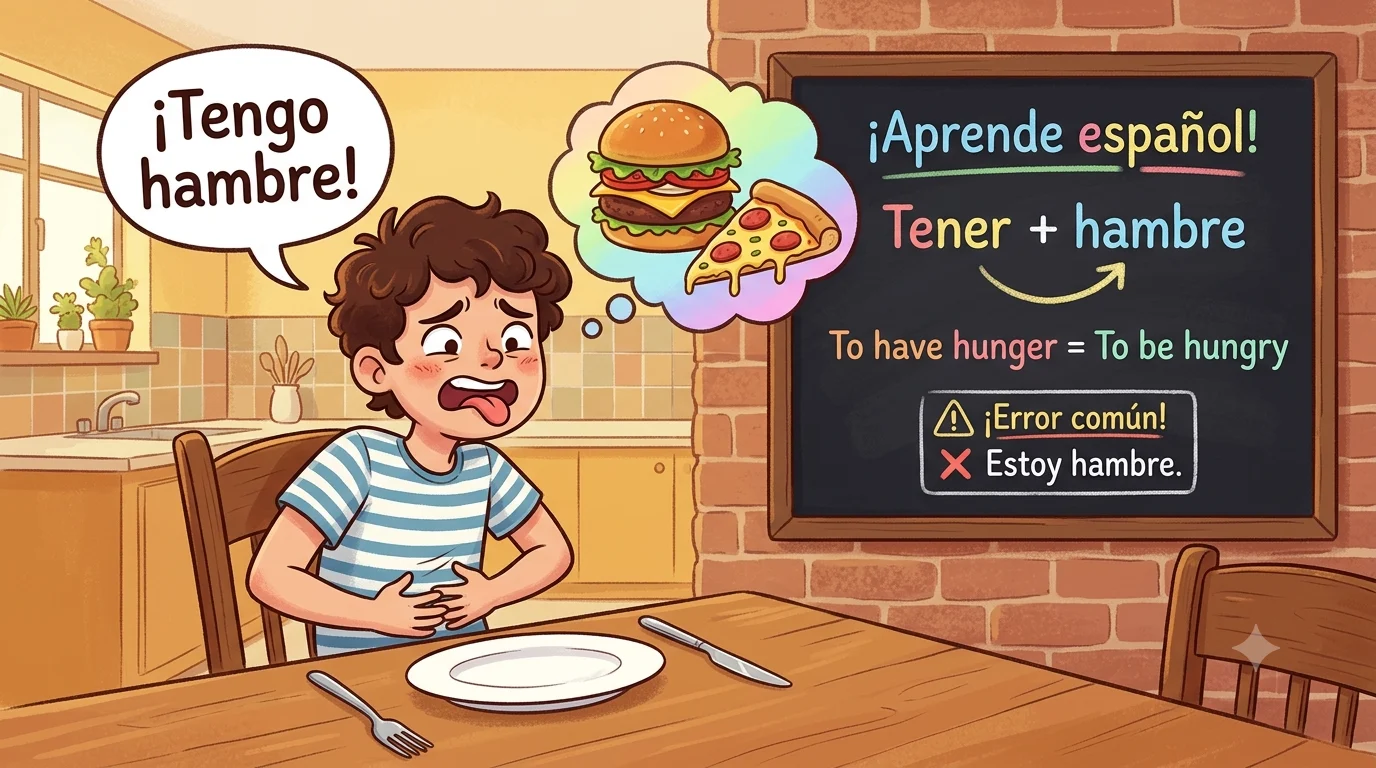
Word-by-word meaning: To have hunger
Idiomatic meaning: To be hungry
Example sentence: Tengo hambre, ¿qué vamos a comer? (I’m hungry, what are we going to eat?)
Common error: Don’t say Estoy hambre. Use tener.
Usage note: Hambre is a feminine noun despite starting with a stressed ‘a’. Use mucha hambre, not mucho hambre.
Tener Sed (To be thirsty)
Word-by-word meaning: To have thirst
Idiomatic meaning: To be thirsty
Example sentence: ¡Tengo mucha sed! Necesito agua. (I’m very thirsty! I need water.)
Common error: Using ser or estar instead of tener.
Usage note: Like hambre, sed is feminine—use mucha sed.
Tener Frío (To be cold)
Word-by-word meaning: To have cold
Idiomatic meaning: To be cold (referring to a person or animal)
Example sentence: ¿Tienes frío? Cierra la ventana. (Are you cold? Close the window.)
Common error: These expressions only apply to living beings feeling temperature, not objects. For objects, use hace frío (it’s cold outside).
Usage note: Use mucho frío as frío is masculine.
Tener Calor (To be hot)
Word-by-word meaning: To have heat
Idiomatic meaning: To be hot (referring to a person or animal)
Example sentence: Los niños tienen calor, vamos a la piscina. (The children are hot, let’s go to the pool.)
Common error: Confusing this with hace calor (the weather is hot).
Usage note: Use mucho calor as calor is masculine.
Tener Sueño (To be sleepy)
Word-by-word meaning: To have sleep/dream
Idiomatic meaning: To be sleepy
Example sentence: Los niños tienen sueño, es hora de dormir. (The children are sleepy, it’s time to sleep.)
Common error: Confusing sueño as the noun “dream” versus this expression meaning “sleepiness.”
Usage note: Tener sueño refers to the feeling of needing sleep.
Tener Dolor de (To have a…ache)
Word-by-word meaning: To have pain of
Idiomatic meaning: To have a (body part) ache
Example sentence: Tengo dolor de cabeza. (I have a headache.)
Common error: Forgetting de after dolor.
Usage note: Follow with body parts like cabeza (head), estómago (stomach), or garganta (throat).
Tener Idioms for Emotions and Mental States
Beyond physical sensations, Spanish tener idioms are the key to expressing feelings and attitudes naturally. These tener expressions in spanish worksheet favorites are essential for everyday conversation.
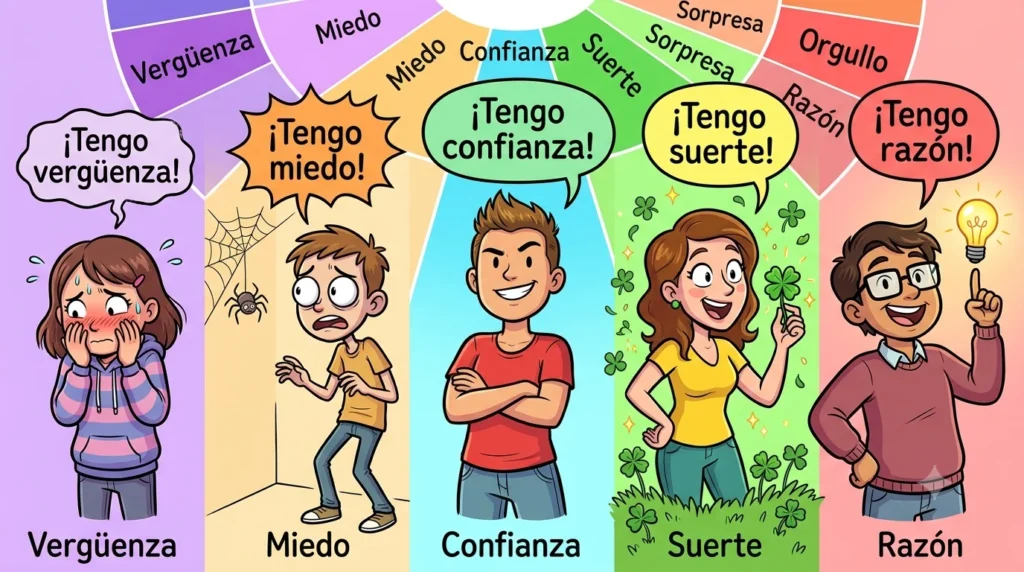
Tener Miedo (To be afraid)
Word-by-word meaning: To have fear
Idiomatic meaning: To be afraid
Example sentence: Tengo miedo de las arañas. (I am afraid of spiders.)
Common error: Using the wrong preposition after miedo.
Usage note: Use miedo de + noun/infinitive, or miedo a + noun/infinitive.
Tener Vergüenza (To be ashamed/embarrassed)
Word-by-word meaning: To have shame
Idiomatic meaning: To be embarrassed or ashamed
Example sentence: Tengo vergüenza de hablar en público. (I’m embarrassed to speak in public.)
Common error: This is a stronger word than you might expect. Don’t use it casually.
Usage note: Often followed by de + infinitive or noun to specify what the shame is about.
Tener Ganas de (To feel like)
Word-by-word meaning: To have desires of
Idiomatic meaning: To feel like (doing something)
Example sentence: Tengo ganas de comer pizza. (I feel like eating pizza.)
Common error: Forgetting the de after ganas.
Usage note: You can also use it with nouns: Tengo ganas de pizza (I’m craving pizza).
Tener Razón (To be right)
Word-by-word meaning: To have reason
Idiomatic meaning: To be right or correct
Example sentence: Mi profesor siempre tiene razón. (My teacher is always right.)
Common error: Using the wrong gender with adjectives.
Usage note: The opposite is no tener razón (to be wrong).
11. Tener Suerte (To be lucky)
Word-by-word meaning: To have luck
Idiomatic meaning: To be lucky
Example sentence: ¡Qué suerte tienes! (You’re so lucky!)
Common error: Using the adjective suerte as if it were an adjective.
Usage note: You can also say tener mala suerte (to be unlucky).
Tener Expressions for Actions and Situations
These tener idioms describe how you approach actions—whether you’re in a hurry, being careful, or something else entirely.
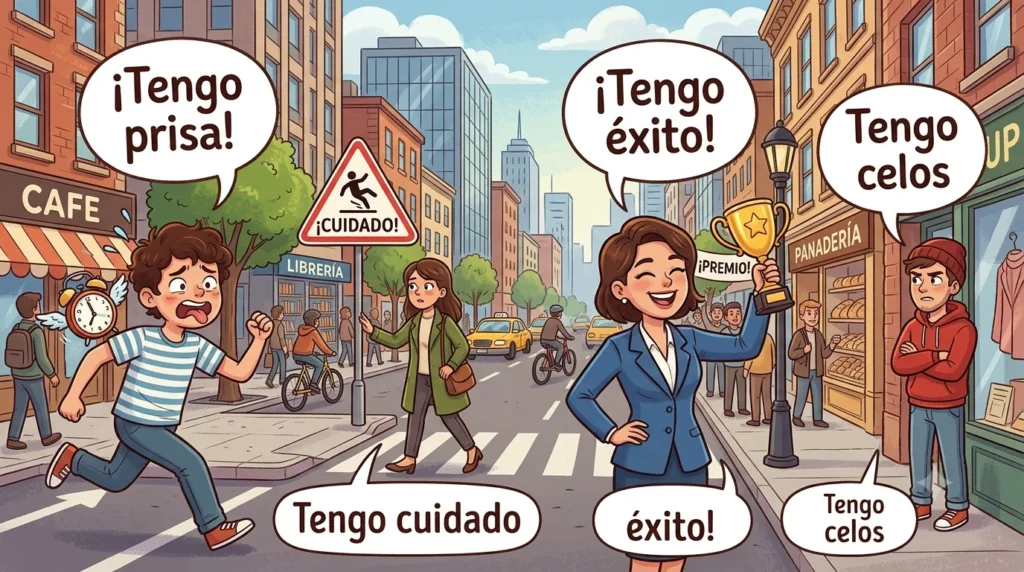
Tener Prisa (To be in a hurry)
Word-by-word meaning: To have hurry
Idiomatic meaning: To be in a hurry
Example sentence: Lo siento, tengo prisa, hablamos después. (Sorry, I’m in a hurry, let’s talk later.)
Common error: Forgetting that prisa is a noun requiring mucho.
Usage note: Very common in daily life—you’ll hear and use this often.
Tener Cuidado (To be careful)
Word-by-word meaning: To have care
Idiomatic meaning: To be careful
Example sentence: Ten cuidado con el perro. (Be careful with the dog.)
Common error: Using the verb form of cuidar instead of this idiom.
Usage note: This can also be used as a command: ¡Ten cuidado! (Be careful!)
Tener Celos (To be jealous)
Word-by-word meaning: To have jealousies
Idiomatic meaning: To be jealous
Example sentence: Mi hermana tiene celos de mi novia. (My sister is jealous of my girlfriend.)
Common error: Using celoso as an adjective instead of this noun construction.
Usage note: Follow with de to specify who or what you’re jealous of.
Tener Confianza (To be confident/trusting)
Word-by-word meaning: To have confidence
Idiomatic meaning: To be confident or to trust
Example sentence: Tengo confianza en mis habilidades. (I have confidence in my abilities.)
Common error: Confusing this with confiar (to trust).
Usage note: Often used in a trust context—tener confianza en alguien means to trust someone.
Advanced Tener Phrases and Constructions
These are the tener expressions that will move you from intermediate to advanced level. They’re essential for creating natural tener expressions sentences and understanding how Spanish works in context.
Tener Que + Infinitive (To have to)
Word-by-word meaning: To have that [do something]
Idiomatic meaning: To have to do something
Example sentence: Tenemos que estudiar para el examen. (We have to study for the exam.)
Common error: Forgetting the “que” or adding it incorrectly.
Usage note: This expresses obligation. It’s the equivalent of “have to” in English.
Tener ___ Años (To be ___ years old)
Word-by-word meaning: To have ___ years
Idiomatic meaning: To be ___ years old
Example sentence: ¿Cuántos años tienes? Tengo veinticinco años. (How old are you? I’m 25 years old.)
Common error: Never use ser or estar to express age. It’s always tener.
Usage note: This is the ONLY way to say age in Spanish. No exceptions.
Tener Lugar (To take place)
Word-by-word meaning: To have place
Idiomatic meaning: To take place or occur
Example sentence: La fiesta tiene lugar en el centro comunitario. (The party takes place at the community center.)
Common error: Using tener as if it meant possession in this context.
Usage note: This is a formal expression used in announcements or descriptions.
Tener Éxito (To be successful)
Word-by-word meaning: To have success
Idiomatic meaning: To be successful
Example sentence: Mi tío tuvo mucho éxito en los negocios. (My uncle was very successful in business.)
Common error: Don’t treat éxito as a false cognate. It doesn’t mean “exit.”
Usage note: Éxito is a false friend. This is always about success, never about exiting.
Tener En Cuenta (To take into account)
Word-by-word meaning: To have in account
Idiomatic meaning: To take into account
Example sentence: Ten en cuenta que no hablo español muy bien. (Take into account that I don’t speak Spanish very well.)
Common error: Not using en cuenta correctly.
Usage note: This is a fixed phrase—always use it as a unit.
Tener Expressions Chart: Reference
Here’s your complete tener expressions chart for quick reference:
| Spanish Expression | Literal Meaning | Actual Meaning |
|---|---|---|
| tener hambre | to have hunger | to be hungry |
| tener sed | to have thirst | to be thirsty |
| tener frío | to have cold | to be cold |
| tener calor | to have heat | to be hot |
| tener sueño | to have sleep | to be sleepy |
| tener miedo | to have fear | to be afraid |
| tener vergüenza | to have shame | to be embarrassed |
| tener ganas de | to have desires of | to feel like |
| tener razón | to have reason | to be right |
| tener suerte | to have luck | to be lucky |
| tener prisa | to have hurry | to be in a hurry |
| tener cuidado | to have care | to be careful |
| tener celos | to have jealousies | to be jealous |
| tener confianza | to have confidence | to be confident |
| tener que | to have that | to have to |
| tener años | to have years | to be years old |
| tener lugar | to have place | to take place |
| tener éxito | to have success | to be successful |
| tener en cuenta | to have in account | to take into account |
| tener dolor de | to have pain of | to have a…ache |
Tener Expressions Sentences: Real-World Examples
Let’s put these tener expressions sentences into everyday contexts. Here are 10 sentences using tener in Spanish that you can start using immediately:
1. Tengo hambre, vamos a cenar. (I’m hungry, let’s have dinner.)
2. Mi hermana tiene sed después del ejercicio. (My sister is thirsty after exercise.)
3. Los estudiantes tienen sueño en clase. (The students are sleepy in class.)
4. ¿Tienes miedo de volar? (Are you afraid of flying?)
5. Tengo ganas de viajar a México. (I feel like traveling to Mexico.)
6. Ellos tienen razón sobre el proyecto. (They are right about the project.)
7. Tenemos prisa, el tren sale en cinco minutos. (We’re in a hurry, the train leaves in five minutes.)
8. Ten cuidado con la comida caliente. (Be careful with the hot food.)
9. ¿Cuántos años tiene tu abuela? (How old is your grandmother?)
10. Ten en cuenta que el examen es difícil. (Take into account that the exam is difficult.)
Tener Expressions Practice: Conversation Dialogues
Practice these tener expressions practice dialogues with a partner:
Dialogue 1: At a Restaurant
Person A: ¿Tienes hambre? (Are you hungry?)
Person B: Sí, tengo mucha hambre. Y tú, ¿tienes sed? (Yes, I’m very hungry. And you, are you thirsty?)
Person A: No, no tengo sed, pero tengo ganas de comer pizza. (No, I’m not thirsty, but I feel like eating pizza.)
Person B: ¡Qué buena idea! (What a good idea!)
Dialogue 2: Getting Ready
Person A: ¡Date prisa! Tenemos prisa. (Hurry up! We’re in a hurry.)
Person B: Lo siento, tengo sueño hoy. (Sorry, I’m sleepy today.)
Person A: Ten cuidado, no olvides tu chaqueta. (Be careful, don’t forget your jacket.)
Person B: Tienes razón, hace frío afuera. (You’re right, it’s cold outside.)
Tener Expressions in Spanish Worksheet: Self-Assessment Quiz
Test your knowledge with this tener expressions in spanish worksheet style quiz. Fill in the blanks with the correct form of tener and the appropriate noun.
1. Mi hermano ________ (tener) mucha ________ (hunger) después del fútbol.
2. ¿________ (tener) tú ________ (thirst) en este calor?
3. Ella ________ (tener) 30 ________ (years).
4. Nosotros ________ (tener) que estudiar para el examen.
5. Yo ________ (tener) miedo de los perros grandes.
6. ¿________ (tener) vosotros ________ (sleep) ahora?
7. Ellos ________ (tener) razón sobre la película.
8. Tú ________ (tener) suerte de tener un buen trabajo.
9. Mi madre ________ (tener) celos de mi hermana.
10. Yo ________ (tener) ganas de comer chocolate.
Answer Key:
- tiene, hambre 2. Tienes, sed 3. tiene, años 4. tenemos 5. tengo 6. Tenéis, sueño 7. tienen 8. tienes 9. tiene 10. tengo
Regional Variations of Tener Idioms
Spanish tener idioms can vary across different Spanish-speaking countries. Here are some interesting regional variations:
Spain
- Tener mono = to miss someone/something (literally “to have monkey”)
- Example: Tengo mono de mi familia (I miss my family)
Mexico
- Tener chispa = to be witty or clever (literally “to have spark”)
- Tener colmillo = to be street-smart (literally “to have fang”)
Argentina
- Tener pinta = to look like or seem like (literally “to have paint”)
- Example: Tiene pinta de ser español (He looks like he’s Spanish)
Colombia
- Tener berraquera = to be brave or determined
- Tener mala leche = to be in a bad mood (literally “to have bad milk”)
Common Mistakes to Avoid with Spanish Tener Idioms
Here are the most frequent errors learners make and how to avoid them:
| Incorrect | Correct | Why |
|---|---|---|
| Estoy hambre | Tengo hambre | Use tener, not estar or ser |
| Tengo muy hambre | Tengo mucha hambre | Hambre is a noun, use mucha |
| Tengo 20 años viejo | Tengo 20 años | Don’t add “old” |
| Tengo que de estudiar | Tengo que estudiar | No “de” after que in this context |
| Tengo ganas estudiar | Tengo ganas de estudiar | Always use de after ganas |
| Tengo la razón | Tengo razón | No article needed for general statements |
| Tengo miedo de volar | Tengo miedo a volar | Both are acceptable but use de for specific things |
Frequently Asked Questions
What are the 20 most common Spanish tener idioms?
The 20 most common Spanish tener idioms are: hambre, sed, frío, calor, sueño, dolor de, miedo, vergüenza, ganas de, razón, suerte, prisa, cuidado, celos, confianza, que + infinitive, años, lugar, éxito, and en cuenta. These cover physical sensations, emotions, actions, obligations, and advanced expressions.
Why does Spanish use “tener” for age instead of “ser” or “estar”?
Spanish speakers express age as something you possess—you “have years” rather than “are years old.” This is a fundamental difference in how the two languages conceptualize age. You’ll never say soy 20 años—it’s always tengo 20 años.
What’s the difference between “mucho” and “muy” with tener expressions?
Because tener expressions are followed by nouns (like hambre, sed, frío), you use mucho/mucha to intensify. You cannot use muy, which modifies adjectives. So: tengo mucha hambre (not tengo muy hambre).
Can I use these tener expressions with all tenses and conjugations?
Yes! Once you know the expression (e.g., tener hambre), you can conjugate tener in any tense: tuve hambre (I was hungry), tendré hambre (I will be hungry), tenía hambre (I used to be hungry). The tener in Spanish conjugation changes, but the idiom stays the same.
What’s the difference between “tener que” and “tener ganas de”?
Tener que expresses obligation or necessity (“to have to” do something), while tener ganas de expresses desire or wish (“to feel like” doing something). Example: Tengo que estudiar (I have to study) vs. Tengo ganas de estudiar (I feel like studying).
Your Journey to Fluency Starts Now
Mastering Spanish tener idioms transforms your Spanish from a literal translation of English to something that sounds natural, authentic, and confident. These aren’t just grammar rules—they’re the building blocks of everyday conversation that you’ll use whenever you express hunger, cold, age, emotions, or obligations.
Start small. Pick five tener expressions to focus on this week. Use them in conversation, practice them with a partner, or work through the tener expressions in spanish worksheet quiz we provided above. Notice how often native speakers use these expressions in movies, songs, and podcasts.
The secret to sounding like a native isn’t just knowing the words—it’s using them in context. So next time you’re hungry, don’t say “I am hungry.” Say tengo hambre. When you’re in a hurry, say tengo prisa. And when someone asks your age, proudly say tengo ___ años. That’s how you truly speak Spanish.
Ready to practice? Use these tener expressions sentences in your next Spanish conversation. Remember: Tienes razón—it’s time to start using these idioms today. With regular practice using the tener expressions practice exercises above, you’ll be speaking like a native before you know it.

“Iris Murdoch explores the beauty of language and idioms on LearnIdom.com, making learning phrases engaging, memorable, and fun for everyone.”