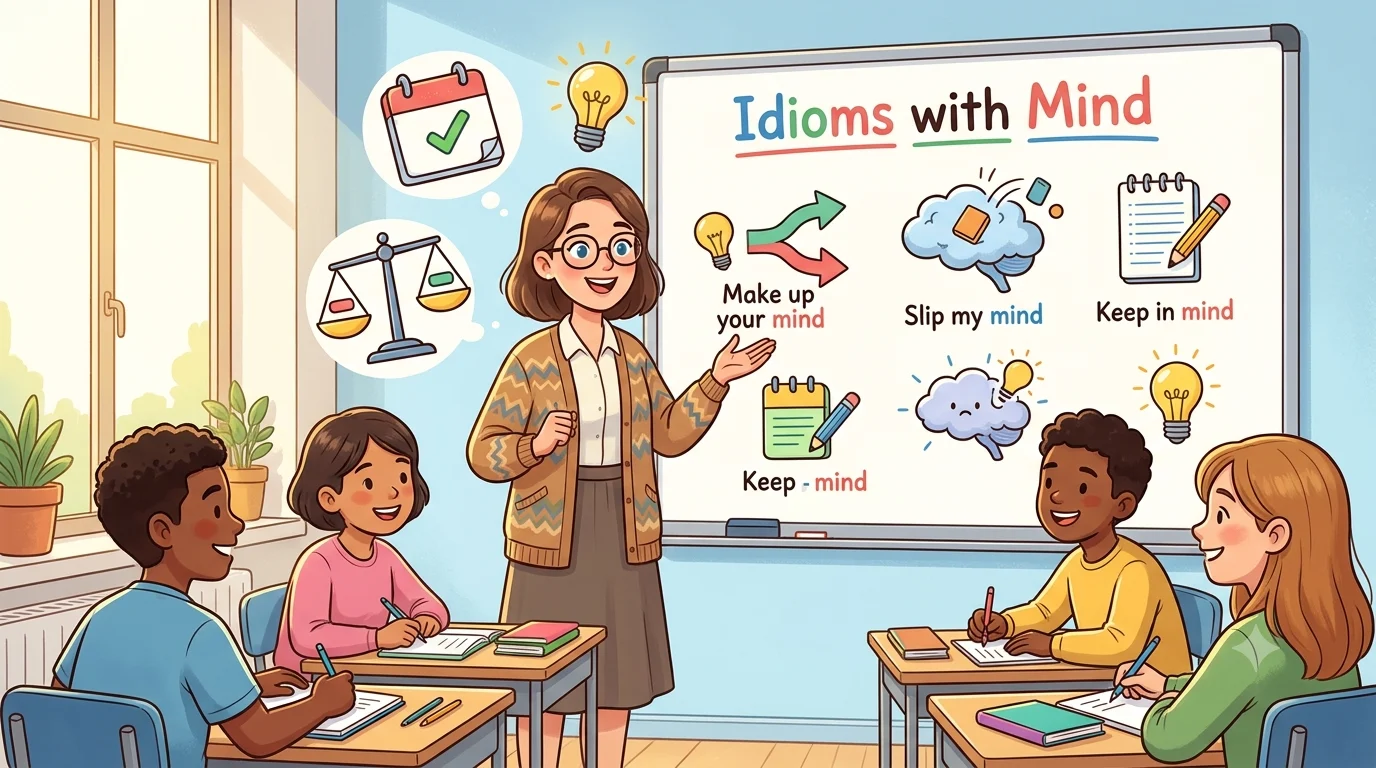
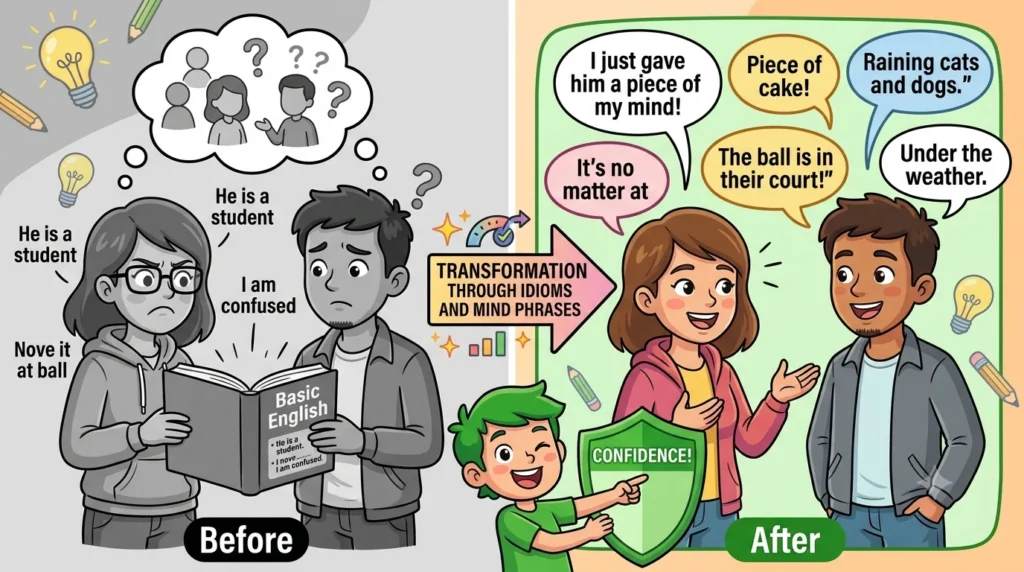
Do you ever feel like your English sounds a bit too textbook? One of the fastest ways to sound like a native speaker is by mastering idioms mind expressions. These colorful phrases pop up constantly in everyday conversations, movies, and business meetings, and using them correctly can transform your fluency from basic to brilliant.
Let’s dive into the world of mind idioms—those fascinating expressions that use the word “mind” to talk about thinking, remembering, deciding, and everything in between. By the end of this guide, you’ll have a toolkit of 20 essential idioms that will make your English sound more natural and engaging. Whether you’re looking for idioms mind meaning explanations or need idioms mind examples to practice, this comprehensive guide covers everything you need to know.
Understanding Idioms Mind Meaning and Their Daily Use
The word “mind” appears in countless English idioms because it represents everything about how we think, feel, and process the world around us. When you learn idioms mind expressions, you’re not just memorizing phrases—you’re unlocking a more natural way to express yourself.
These idioms mind in English are particularly valuable because they help you:
- Sound more fluent and native-like
- Express complex thoughts with simple phrases
- Understand movies, TV shows, and native speakers better
- Build confidence in professional and social settings
The beauty of these idioms mind meaning patterns is that they reveal how English speakers conceptualize decisions, memories, and mental states. By learning them, you’re understanding English culture itself.
Make Up Your Mind
Word-by-word meaning: To create or form your decision.
Idiomatic meaning: To make a decision after thinking about something carefully.
Example sentences:
- “I can’t decide which dress to wear—I need to make up my mind soon!”
- “After months of deliberation, she finally made up her mind to study abroad.”
- “Stop wasting time and make up your mind about which car to buy.”
Common error: Don’t confuse this with “change your mind.” Making up your mind is about reaching a decision, while changing it is about reversing one.
Usage note: Very common in everyday conversation, especially when someone is being indecisive. You might hear native speakers say, “Oh, just make up your mind already!” when someone is taking too long to choose.
Change Your Mind
Word-by-word meaning: To alter your previous thought or opinion.
Idiomatic meaning: To change a decision or opinion that you previously had.
Example sentences:
- “I was going to order pizza, but I changed my mind and got sushi instead.”
- “He said he’d join us, but he changed his mind at the last minute.”
- “After seeing the reviews, I changed my mind about watching that movie.”
Common error: Using this for simple preference changes rather than actual decisions. “I changed my mind” should be used when you’ve reconsidered something important.
Usage note: Often used with the preposition “about”—”I’ve changed my mind about moving to London.”
Slip Your Mind
Word-by-word meaning: To slide away from your memory.
Idiomatic meaning: To forget something completely.
Example sentences:
- “I meant to call you back, but it completely slipped my mind.”
- “Don’t rely on me to remember—these things tend to slip my mind.”
- “Her birthday slipped my mind last week, and I felt terrible.”
Common error: Using it for intentional forgetting. “Slip your mind” is always unintentional and accidental.
Usage note: Often used with “completely” for emphasis. “Your birthday completely slipped my mind!”
Cross Your Mind
Word-by-word meaning: To pass through your thoughts briefly.
Idiomatic meaning: To think of something briefly or have an idea occur to you suddenly.
Example sentences:
- “The thought of quitting my job crossed my mind, but I decided against it.”
- “It never crossed my mind that she might be lying.”
- “A wild idea crossed my mind, but I dismissed it immediately.”
Common error: Using it for long, deliberate thoughts rather than brief moments of consideration.
Usage note: Very common in negative constructions: “It never crossed my mind” means “I never thought of that.”
Bear in Mind / Keep in Mind
Word-by-word meaning: To carry or hold something in your thoughts.
Idiomatic meaning: To remember or consider something when making a decision.
Example sentences:
- “Bear in mind that the store closes at 6 PM.”
- “When you’re writing your essay, keep in mind that the deadline is strict.”
- “Always bear in mind the safety rules when using equipment.”
Common error: Forgetting to specify what exactly to remember. Always include the information: “Bear in mind that…”
Usage note: These are interchangeable and among the most common idioms mind expressions used in professional and academic contexts. They’re particularly useful in business emails and meetings.
Speak Your Mind
Word-by-word meaning: To verbalize what’s in your thoughts.
Idiomatic meaning: To say exactly what you think, even if it might be unpopular.
Example sentences:
- “She’s not afraid to speak her mind, even when it causes arguments.”
- “Feel free to speak your mind—this is a safe space for honest opinions.”
- “I appreciate employees who speak their mind during meetings.”
Common error: Confusing with “mind your language.” One is about honesty, the other about politeness.
Usage note: Can be positive or negative depending on context. Sometimes it’s praised as honesty, other times it’s criticized as being too blunt. In professional settings, it’s generally valued when done respectfully.
Out of Your Mind
Word-by-word meaning: Outside of rational thinking.
Idiomatic meaning: To be crazy, insane, or not thinking clearly.
Example sentences:
- “Are you out of your mind? You can’t wear shorts in this freezing weather!”
- “I must have been out of my mind to agree to this challenge.”
- “She was out of her mind with worry when her son didn’t come home.”
Common error: Using it too literally. This is an exaggeration, not a medical diagnosis.
Usage note: Can also be used to express being very upset or worried: “I’m out of my mind with worry.” The “with + emotion” construction is very common.
Put Your Mind to Something
Word-by-word meaning: To place your mental focus on a task.
Idiomatic meaning: To focus your effort and energy on achieving something.
Example sentences:
- “You can achieve anything if you put your mind to it.”
- “She put her mind to learning Spanish and became fluent in six months.”
- “If you put your mind to it, you’ll pass that exam easily.”
Common error: Forgetting the “to” at the end. It’s “put your mind to something,” not “put your mind in something.”
Usage note: Highly motivational and often used to encourage others. Parents frequently say this to children! It’s one of the most inspirational idioms mind expressions.
Have Something in Mind
Word-by-word meaning: To have a thought in your mental awareness.
Idiomatic meaning: To have a plan, suggestion, or idea.
Example sentences:
- “What kind of restaurant do you have in mind for dinner?”
- “I have a few candidates in mind for the position.”
- “Do you have anything specific in mind for the project?”
Common error: Using for physical objects. This is only for ideas and plans.
Usage note: Very useful in planning conversations. When someone asks “What do you have in mind?” they’re asking for your suggestion.
Be in Two Minds
Word-by-word meaning: To exist with two separate thoughts.
Idiomatic meaning: To be unable to decide between two options.
Example sentences:
- “I’m in two minds about accepting the job offer—it pays well but the hours are terrible.”
- “She was in two minds about moving to New York.”
- “He’s in two minds about whether to study medicine or law.”
Common error: Using for simple preferences rather than major decisions.
Usage note: British English uses “in two minds”; American English sometimes uses “of two minds.” This is one of the more formal idioms mind expressions.
Peace of Mind
Word-by-word meaning: Tranquility of mental state.
Idiomatic meaning: A feeling of being free from worry and anxiety.
Example sentences:
- “Having health insurance gives me peace of mind.”
- “I need some peace of mind after this stressful week.”
- “Knowing you’re safe gives me great peace of mind.”
Common error: Don’t confuse with “a piece of mind” (which means giving someone a scolding).
Usage note: Extremely common in both British and American English. Insurance companies love using this phrase in their advertising!
Give Someone a Piece of Your Mind
Word-by-word meaning: To offer a portion of your thoughts.
Idiomatic meaning: To tell someone what you really think, usually in anger.
Example sentences:
- “If he’s late again, I’m going to give him a piece of my mind.”
- “She gave her roommate a piece of her mind about the noise.”
- “The customer gave the manager a piece of his mind about the poor service.”
Common error: Confusing with “piece of mind.” “Peace of mind” is calm; “a piece of your mind” is criticism.
Usage note: Always uses the phrase “give someone” and implies confrontation. Use carefully—this expression is quite strong!
Mind over Matter
Word-by-word meaning: Mental power over physical obstacles.
Idiomatic meaning: The idea that mental strength can overcome physical challenges or circumstances.
Example sentences:
- “She finished the marathon despite being exhausted—it was pure mind over matter.”
- “Pain is just a sensation; use mind over matter to push through.”
- “He proved that mind over matter works by completing the obstacle course.”
Common error: Taking too literally. It’s about mental discipline, not magic.
Usage note: Often used in sports, fitness, and motivational contexts. This is one of the most powerful idioms mind meaning phrases for self-improvement.
Have an Open Mind
Word-by-word meaning: To possess an unclosed mental state.
Idiomatic meaning: To be willing to consider new ideas and other people’s opinions.
Example sentences:
- “Keep an open mind about the new project; it’s different but might work.”
- “She’s very open-minded and loves learning about other cultures.”
- “Try to have an open mind when meeting people from different backgrounds.”
Common error: Using without the article “an.” It’s “have an open mind” or “be open-minded.”
Usage note: The related adjective “open-minded” is more common in everyday speech than the full idiom.
Great Minds Think Alike
Word-by-word meaning: Exceptional intellects share similar thoughts.
Idiomatic meaning: Smart people often have the same ideas or make similar decisions.
Example sentences:
- “You bought the same present? Great minds think alike!”
- “We both suggested the same solution—great minds think alike.”
- “Great minds think alike, they say, and we both arrived at the same conclusion.”
Common error: Using it seriously. This is usually said humorously or playfully.
Usage note: Often a light-hearted way to acknowledge when two people share the same thought. The complete proverb is “Great minds think alike, but fools seldom differ.”
Have a Mind of Its Own
Word-by-word meaning: To possess its own consciousness.
Idiomatic meaning: When an object behaves unpredictably or makes its own decisions.
Example sentences:
- “This old computer seems to have a mind of its own.”
- “My printer has a mind of its own; sometimes it prints, sometimes it doesn’t.”
- “The remote control appears to have a mind of its own today.”
Common error: Using for people. This is for objects that don’t behave as expected.
Usage note: Very common when talking about technology that doesn’t cooperate. You’ll hear this a lot about smartphones, printers, and cars!
Mind Your Own Business
Word-by-word meaning: To focus on your own affairs.
Idiomatic meaning: To not interfere in other people’s lives or concerns.
Example sentences:
- “I wish my neighbors would mind their own business instead of gossiping.”
- “I told him to mind his own business when he started asking about my salary.”
- “Why don’t you just mind your own business and leave me alone?”
Common error: Using too rudely. This can be quite direct and confrontational.
Usage note: Can be rude depending on tone. A softer version is “I’d rather not discuss that.” This is one of the most direct idioms mind expressions.
Never Mind
Word-by-word meaning: To never think about it.
Idiomatic meaning: It doesn’t matter; forget it; don’t worry about it.
Example sentences:
- “What were you saying? —Never mind, it wasn’t important.”
- “Never mind about the mistake—everyone makes errors sometimes.”
- “I can’t find the document. Never mind, I’ll look for it later.”
Common error: Using in formal writing. This is best for conversation.
Usage note: Often shortened to “NVM” or “nvm” in text messages. Very casual and friendly.
Come to Mind
Word-by-word meaning: To arrive in your thoughts.
Idiomatic meaning: To be remembered or thought of.
Example sentences:
- “Nothing immediately comes to mind when I think about my favorite movie.”
- “Several solutions come to mind for this problem.”
- “A perfect example comes to mind right now.”
Common error: Confusing with “bring to mind” (which means to remind someone of something).
Usage note: Very common in meetings and brainstorming sessions. A useful phrase for professional contexts.
My Mind Went Blank
Word-by-word meaning: My thoughts became empty.
Idiomatic meaning: To suddenly be unable to think of anything.
Example sentences:
- “The teacher asked me a question, and my mind went blank.”
- “When I reached the podium, my mind went completely blank.”
- “I was about to say something important, but my mind went blank.”
Common error: Using for forgetting one specific thing rather than a complete mental block.
Usage note: Often happens in stressful situations like exams or presentations. Very relatable for students and professionals!
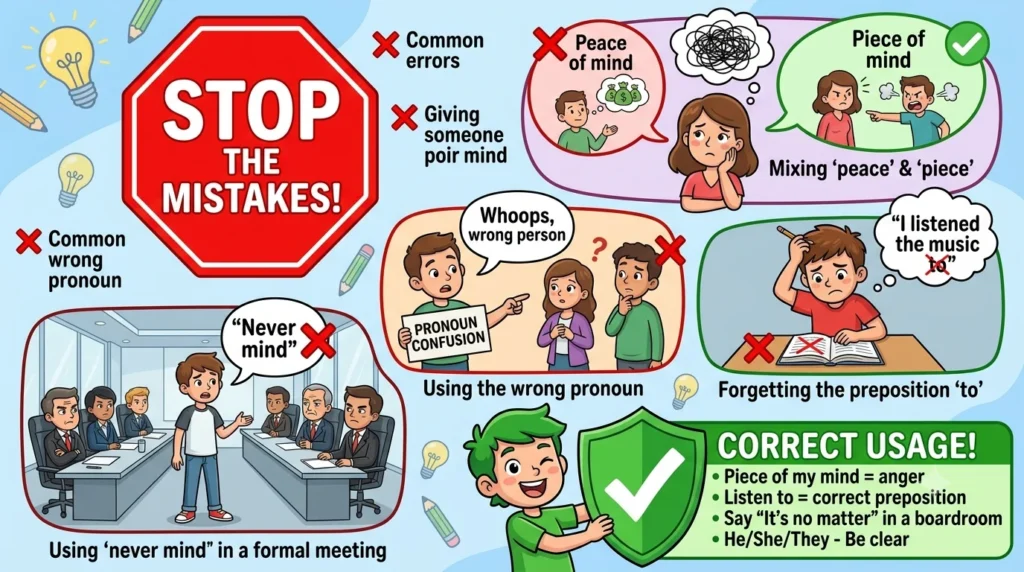
Common Mistakes to Avoid with Idioms Mind
Learning idioms mind expressions is exciting, but learners often make these common mistakes:
Mistake 1: Mixing up similar idioms
- “Peace of mind” (calmness) vs. “Piece of your mind” (criticism)
- “Make up your mind” (decide) vs. “Change your mind” (reverse decision)
Mistake 2: Forgetting required prepositions
- “Bear in mind that…” (not “bear in mind for”)
- “Put your mind to it” (not “put your mind in it”)
Mistake 3: Using idioms in formal situations
- “Never mind” is casual; use “Don’t worry about it” in formal contexts
- “Mind your own business” can be rude; use “I’d rather not say” politely
Mistake 4: Getting the pronoun wrong
- Always use the correct possessive: “my mind,” “your mind,” “her mind,” etc.
Practical Exercises to Master Mind Idioms
Exercise 1: Sentence Completion
Complete these sentences with the correct idioms mind expression:
- I can’t decide which phone to buy—I need to ______________.
- The thought of moving abroad ______________ but I’m still considering it.
- Please ______________ that the meeting starts at 10 AM sharp.
- If you ______________, you can achieve anything.
- What kind of vacation do you ______________?
Answer Key:
- make up my mind
- crossed my mind
- bear in mind
- put your mind to it
- have in mind
Exercise 2: Context Matching
Match the situation with the correct idioms mind expression:
| Situation | Idiom |
|---|---|
| You’re nervous about a presentation and forget your points | My mind went blank |
| Someone asks for your honest opinion | Speak your mind |
| You can’t decide between two options | In two minds |
| You feel calm and stress-free | Peace of mind |
Exercise 3: Create Your Own Sentences
Write your own sentences using these idioms mind expressions:
- Out of your mind: ________________________________
- Never mind: ________________________________
- Come to mind: ________________________________
- Open mind: ________________________________
Exercise 4: Real-Life Application
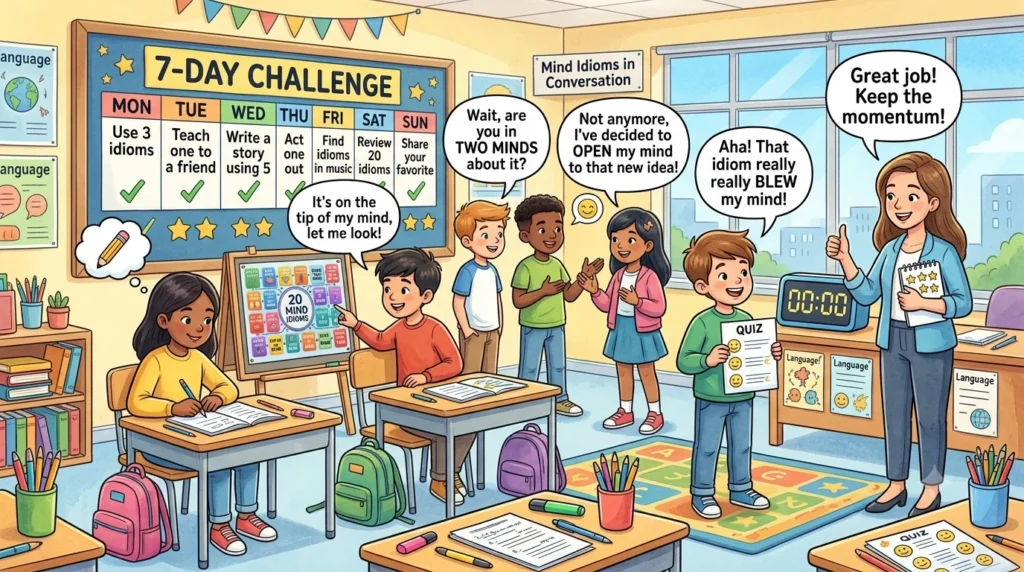
Idioms mind exercises for daily practice:
- Monday: Use “make up your mind” when making a decision
- Tuesday: Practice “bear in mind” when making plans
- Wednesday: Try “speak your mind” in a discussion
- Thursday: Use “peace of mind” when talking about relaxation
- Friday: Practice “change your mind” about weekend plans
- Saturday: Use “slip your mind” when you forget something
- Sunday: Review all 20 idioms mind expressions!
Exercise 5: Idioms Quiz
Test yourself—can you complete these idioms mind in English?
- “I’m in two _____ about accepting the job.” (Answer: minds)
- “What do you have in _____ for dinner?” (Answer: mind)
- “She’s not afraid to _____ her mind.” (Answer: speak)
- “You can do it if you _____ your mind to it.” (Answer: put)
- “It completely _____ my mind to call you back.” (Answer: slipped)
Real-Life Stories: How Mind Idioms Transform Communication
Sarah’s Story: Sarah had studied English for years but always sounded like a textbook. When she started using idioms mind expressions, her colleagues suddenly took her more seriously. “When I said ‘bear in mind’ during a meeting, my boss nodded approvingly,” she recalls. “It made me sound professional and confident.”
Carlos’s Story: “I used to forget important tasks all the time,” Carlos shares. “But when a friend told me, ‘Just put your mind to using reminders,’ everything changed. I started using ‘never mind’ casually and ‘peace of mind’ to describe how I felt—my English became much more natural!”
These stories show that idioms mind meaning goes beyond vocabulary—it’s about connecting with people on a deeper level.
Frequently Asked Questions
What does “mind” mean in idioms?
In idioms, “mind” refers to thoughts, feelings, memory, and mental processes. It represents everything about how we think and make decisions. The word appears in dozens of idioms mind expressions because thinking is such a universal human experience. When you understand idioms mind meaning, you unlock a deeper understanding of English thought patterns.
What are the most common idioms with mind?
The most common idioms mind expressions include “make up your mind,” “change your mind,” “bear in mind,” “speak your mind,” and “never mind.” These appear most frequently in everyday English conversations, movies, and business settings. If you learn these five first, you’ll understand about 70% of idioms mind in English used daily.
How can I practice expressions with mind?
You can practice idioms mind exercises like sentence completion, role-playing conversations, journaling using new idioms daily, or watching movies and noting how native speakers use them naturally. The best approach is to pick 3-4 idioms mind expressions per week and use them in real conversations.
What’s the difference between “peace of mind” and “a piece of your mind”?
“Peace of mind” means feeling calm and free from worry—it’s a positive state. “A piece of your mind” means giving someone an angry criticism or telling them what you really think—it’s confrontational. Remember: peace = calm, piece = criticism. This is one of the most confusing idioms mind pairs for learners!
Are there idioms about mind in other languages?
Yes! Many languages have equivalents for idioms mind expressions, though they may use different metaphors. For example, French uses “se faire une raison” (to resign oneself) where English might use “put your mind to something.” German uses “sich etwas durch den Kopf gehen lassen” (to let something go through your head) similar to “cross your mind.” Learning these connections can make memorization easier!
How many idioms with mind should I learn first?
Focus on 5-6 idioms mind expressions first—the most common ones. Master these before adding more. Quality over quantity! Once you’re comfortable with “make up your mind,” “change your mind,” “bear in mind,” “speak your mind,” “never mind,” and “peace of mind,” you’ll have a strong foundation in idioms mind in English.
How can I remember all these idioms?
Use these memory techniques for idioms mind expressions:
- Visual association: Picture the idiom literally (e.g., “slip your mind” = thoughts slipping away)
- Create stories: Weave new idioms into a short story
- Use spaced repetition: Review idioms at increasing intervals
- Practice with friends: Challenge each other to use idioms mind in conversations
- Keep a journal: Write daily entries using new idioms mind expressions
Can I use idioms with mind in professional settings?
Yes, but choose carefully! “Bear in mind” and “keep in mind” are excellent for professional settings. “Speak your mind” can be appropriate in meetings when encouraging honest feedback. However, avoid “out of your mind” and “mind your own business” in formal contexts. Understanding idioms mind meaning helps you gauge appropriate usage.
Conclusion
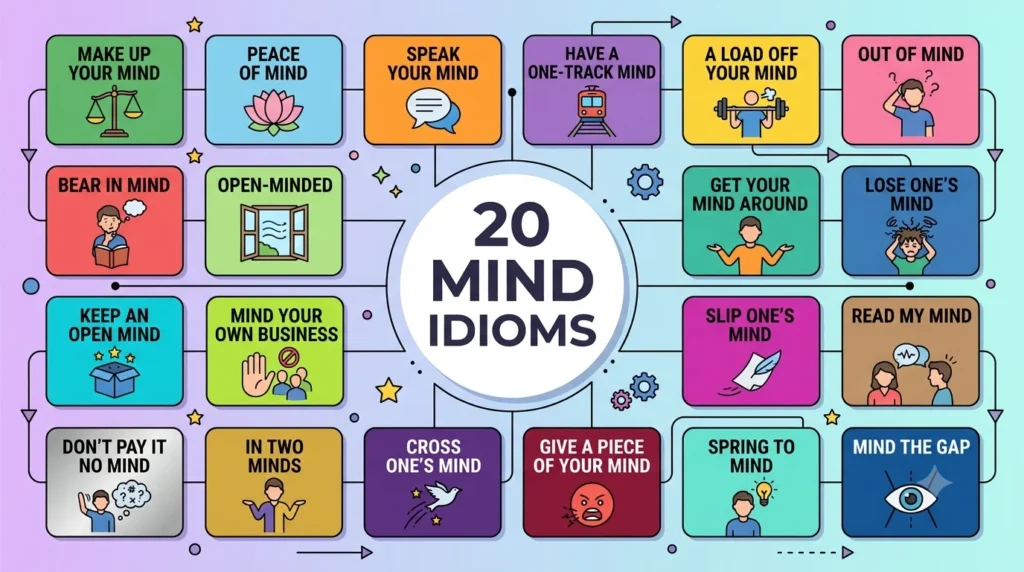
Learning idioms mind expressions is a game-changer for your English fluency. These 20 essential phrases will help you sound more natural, express yourself more precisely, and understand native speakers better in both personal and professional contexts.
Your 7-Day Challenge:
- Day 1-2: Master “make up your mind,” “change your mind,” and “bear in mind”
- Day 3-4: Add “speak your mind” and “never mind” to your vocabulary
- Day 5-6: Practice “peace of mind” and “put your mind to it”
- Day 7: Review all 20 idioms mind expressions and try to use 5 in one conversation
Remember, learning idioms mind in English is a journey—not a race. Start by mastering 3-5 of these phrases this week and use them daily. Listen for them in movies, podcasts, and conversations. Complete the idioms mind exercises provided above, and soon these expressions will come naturally to you.
The beauty of these idioms mind meaning and usage patterns is that they reveal how English speakers think about thinking itself. By learning them, you’re not just memorizing phrases—you’re understanding how native speakers conceptualize decisions, memories, and mental states. Every time you use “bear in mind” in a meeting or “make up your mind” with friends, you’re one step closer to true English fluency.
Ready to practice? Write down six idioms with mind that you want to master this week. Try using them in conversations, journal entries, or even social media posts. The more you use them, the more natural they’ll become!

“L.P. Hartley brings classic idioms to life on LearnIdom.com, helping readers explore language with wit, clarity, and timeless insight.”