Reading is more than turning pages—it opens minds, builds confidence, and improves communication. Learning idioms for reading makes your English sound more fluent and natural while helping you understand books, conversations, and everyday expressions more easily.
Whether you’re a student, teacher, book lover, or English learner, this guide covers the most popular reading and book idioms with simple explanations, practical examples, and easy-to-understand usage tips.
Why Learn Idioms for Reading?
Learning idioms for reading in English helps you understand novels, newspapers, conversations, movies, and academic materials more naturally.
Benefits include:
- Improve spoken English
- Understand native speakers better
- Build stronger vocabulary
- Read books with greater confidence
- Write more naturally
- Prepare for IELTS, TOEFL, and competitive exams
If you regularly enjoy reading, these expressions are also perfect idioms for book lovers because they frequently appear in literature and daily conversations.
Read Between the Lines
Word-by-word Meaning
Read the hidden words between written lines.
Idiomatic Meaning
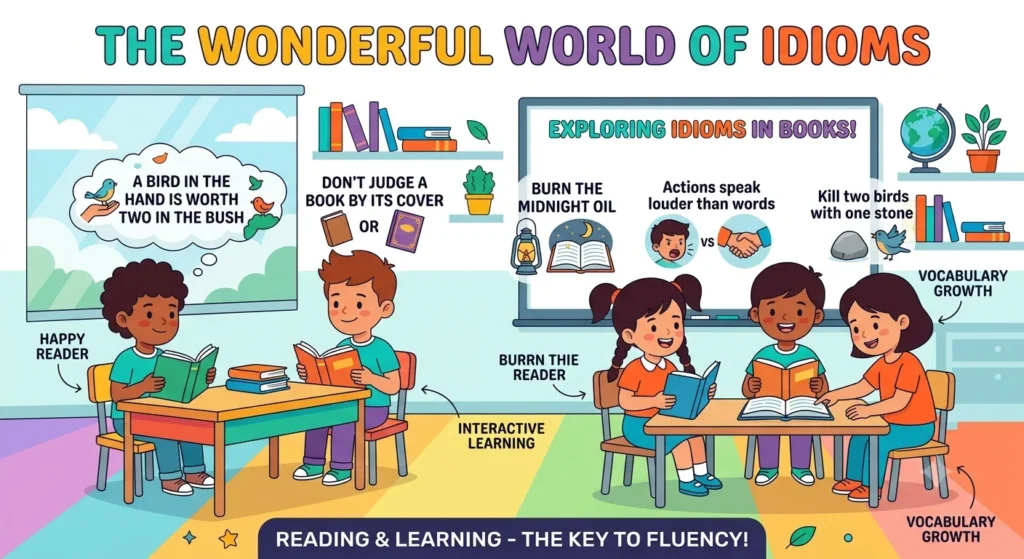
Understand the hidden or implied meaning.
Example Sentences
- I could read between the lines and knew she was upset.
- Good readers always read between the lines.
Common Error
❌ Read inside the lines.
Usage Note
One of the most common idioms for reading books and conversations.
An Open Book
Word-by-word Meaning
A book that anyone can open.
Idiomatic Meaning
Someone whose thoughts and feelings are easy to understand.
Example Sentences
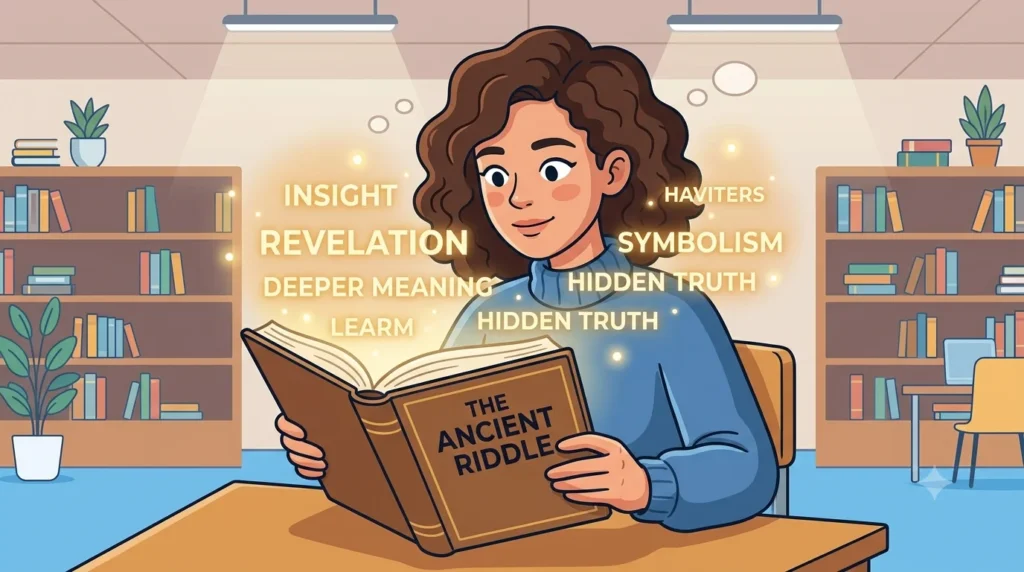
- Sarah is an open book.
- His face is like an open book.
Common Error
Don’t confuse it with an actual open book.
Usage Note
Often describes honest personalities.
By the Book
Word-by-word Meaning
Following the book exactly.
Idiomatic Meaning
Following rules carefully.
Example Sentences
- The teacher does everything by the book.
- Police handled the case by the book.
Common Error
Not related to reading books.
Usage Note
Common in workplaces.
Bookworm
Word-by-word Meaning
A worm living in books.
Idiomatic Meaning
Someone who loves reading.
Example Sentences
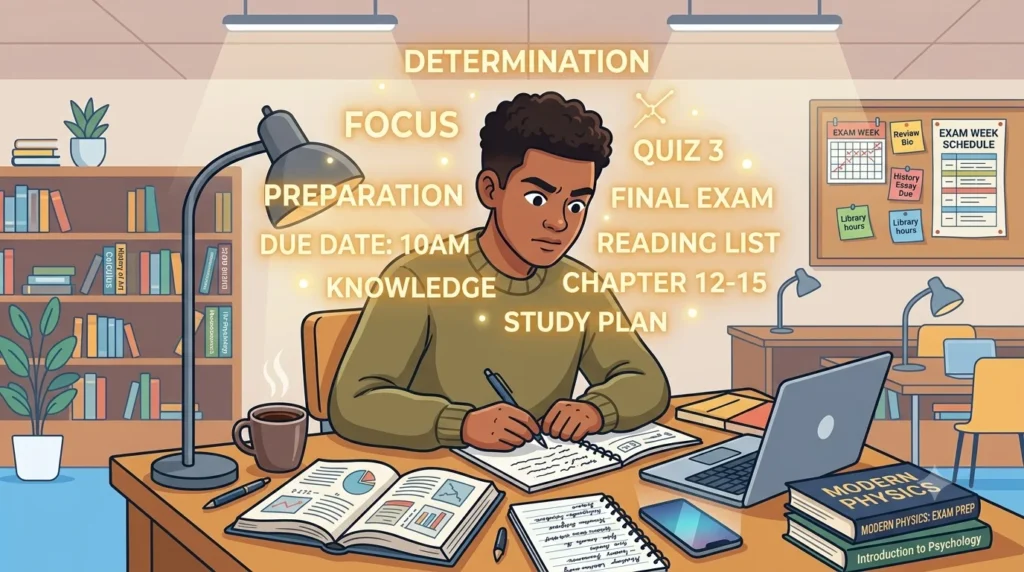
- My sister is a real bookworm.
- Every library has many bookworms.
Common Error
Not an actual insect.
Usage Note
One of the favorite book idioms.
Hit the Books
Word-by-word Meaning
Hit books physically.
Idiomatic Meaning
Study seriously.
Example Sentences

- I need to hit the books tonight.
- Students hit the books before exams.
Common Error
Never means physically hitting books.
Usage Note
Popular among students.
Judge a Book by Its Cover
Word-by-word Meaning
Judge only by the cover.
Idiomatic Meaning
Don’t judge by appearance.
Example Sentences
- Never judge a book by its cover.
- People often make this mistake.
Common Error
Using it only for books.
Usage Note
Applies to people and situations.
On the Same Page
Word-by-word Meaning
Reading the same page.
Idiomatic Meaning
Agreeing or understanding together.
Example Sentences
- We’re finally on the same page.
- Let’s get on the same page.
Common Error
Not about reading together.
Usage Note
Common in meetings.
Turn Over a New Leaf
Word-by-word Meaning
Turn a new page.
Idiomatic Meaning
Start behaving better.
Example Sentences
- He turned over a new leaf.
- She decided to improve herself.
Common Error
Leaf means page here.
Usage Note
Very common motivational idiom.
Take a Leaf Out of Someone’s Book
Word-by-word Meaning
Take one page from another’s book.
Idiomatic Meaning
Copy someone’s good habit.
Example Sentences
- Take a leaf out of her book.
- We should learn from successful people.
Common Error
Not stealing ideas.
Usage Note
Positive expression.
Crack Open a Book
Word-by-word Meaning
Open a book.
Idiomatic Meaning
Begin reading or studying.
Example Sentences
- He never cracks open a book.
- Time to crack open your textbooks.
Common Error
Not literally breaking books.
Every Trick in the Book
Word-by-word Meaning
All tricks written in a book.
Idiomatic Meaning
Every possible method.
Example Sentences
- We tried every trick in the book.
- She knows every trick in the book.
Common Error
Not about one specific book.
Throw the Book at Someone
Word-by-word Meaning
Throw a book.
Idiomatic Meaning
Punish someone severely.
Example Sentences
- The judge threw the book at him.
- They wanted maximum punishment.
Common Error
Not literal.
Book Smart
Word-by-word Meaning
Smart because of books.
Idiomatic Meaning
Academically intelligent.
Example Sentences
- She’s book smart.
- He’s book smart but lacks experience.
Common Error
Don’t confuse with street smart.
In Someone’s Good Books
Word-by-word Meaning
Inside someone’s good book.
Idiomatic Meaning
In someone’s favor.
Example Sentences
- I’m in my boss’s good books.
- She’s in her teacher’s good books.
Common Error
Books should remain plural.
In Someone’s Bad Books
Word-by-word Meaning
Inside bad books.
Idiomatic Meaning
Not favored by someone.
Example Sentences
- He’s in his father’s bad books.
- Don’t get into the teacher’s bad books.
Common Error
Often confused with “bad mood.”
Cook the Books
Word-by-word Meaning
Cook books.
Idiomatic Meaning
Falsify financial records.
Example Sentences
- The company cooked the books.
- Police investigated the fraud.
Common Error
Not about cooking recipe books.
A Closed Book
Word-by-word Meaning
A shut book.
Idiomatic Meaning
Something difficult to understand.
Example Sentences
- Physics is a closed book to me.
- History used to be a closed book.
Common Error
Opposite of “an open book.”
Read Someone Like a Book
Word-by-word Meaning
Read a person like reading a book.
Idiomatic Meaning
Understand someone completely.
Example Sentences
- Mom can read me like a book.
- Good detectives read people like books.
Common Error
Not literal reading.
Cover to Cover
Word-by-word Meaning
From first cover to last.
Idiomatic Meaning
Read the entire book.
Example Sentences
- I read the novel cover to cover.
- She finished it in one day.
Common Error
Not used for partial reading.
Lose Yourself in a Book
Word-by-word Meaning
Forget yourself while reading.
Idiomatic Meaning
Become completely absorbed in reading.
Example Sentences
- I lost myself in a mystery novel.
- Book lovers enjoy losing themselves in books.
Common Error
Doesn’t mean getting physically lost.
Usage Note
A favorite expression among passionate readers.
Summary Table
| Idiom | Meaning |
|---|---|
| Read Between the Lines | Understand hidden meaning |
| Bookworm | Loves reading |
| Hit the Books | Study hard |
| On the Same Page | Agree |
| Judge a Book by Its Cover | Don’t judge appearances |
| Cover to Cover | Read completely |
| Book Smart | Academically intelligent |
| An Open Book | Easy to understand |
| Crack Open a Book | Start reading |
| Lose Yourself in a Book | Become deeply absorbed |
Common Tips for Learning Reading Idioms
- Read English books daily.
- Watch English movies with subtitles.
- Practice using one idiom every day.
- Keep a vocabulary notebook.
- Use idioms in conversations.
- Write short stories using new expressions.
These methods make learning idioms for reading in English much easier and more enjoyable.
Why Reading Idioms Improve English
Understanding idioms on importance of reading helps learners communicate like native speakers. Reading regularly introduces natural expressions that grammar books often miss.
If you’re building vocabulary, these expressions are useful whether you’re searching for 100 idioms for reading, 100 idioms and their meanings, or simply exploring popular book idioms. Mastering them will improve reading comprehension, writing, speaking, and listening skills.
Frequently Asked Questions
1. What are idioms for reading?
Idioms for reading are expressions related to books, studying, learning, and understanding hidden meanings. They often have figurative meanings rather than literal ones.
2. Which is the most common reading idiom?
“Read between the lines” is one of the most widely used idioms because it teaches people to understand implied meanings.
3. What are good idioms for book lovers?
Popular idioms for book lovers include:
- Bookworm
- Cover to Cover
- Lose Yourself in a Book
- Crack Open a Book
- Read Between the Lines
4. How can I remember English idioms easily?
Practice one idiom daily, read English books, use flashcards, write example sentences, and include idioms in everyday conversations.
5. Are these idioms useful for IELTS and spoken English?
Yes. These idioms frequently appear in spoken English, writing tasks, interviews, classrooms, and English proficiency exams.
Conclusion
Learning these idioms for reading is one of the easiest ways to make your English sound more natural and confident. Instead of memorizing long vocabulary lists, focus on using one or two idioms each day in conversations, writing, or while reading your favorite books.
Whether you’re searching for idioms for reading books, improving your English skills, exploring book idioms, or looking for idioms and their meanings, these expressions provide a strong foundation for fluent communication. Keep reading, keep practicing, and soon these idioms will become a natural part of your everyday English.

“L.P. Hartley brings classic idioms to life on LearnIdom.com, helping readers explore language with wit, clarity, and timeless insight.”