Railroad idioms turn trains, tracks, and journeys into colorful expressions about everyday life. If a project is on the right track, a plan goes off the rails, or you get sidetracked, you are using train language in a figurative way.
These expressions are useful when talking about work, school, goals, conversations, opportunities, and even the end of something. Let’s explore the most useful railroad idioms in English and learn how to use them naturally.
What Are Railroad Idioms?
Railroad idioms are expressions connected with trains, railway tracks, stations, and journeys that have a figurative meaning.
For example, on the right track does not usually mean that someone is physically standing on railway tracks. It means they are doing something correctly or moving toward the desired result.
Some train expressions are established idioms, while others are common metaphors. Knowing the difference helps you use them naturally rather than treating every train-related phrase as a fixed idiom.
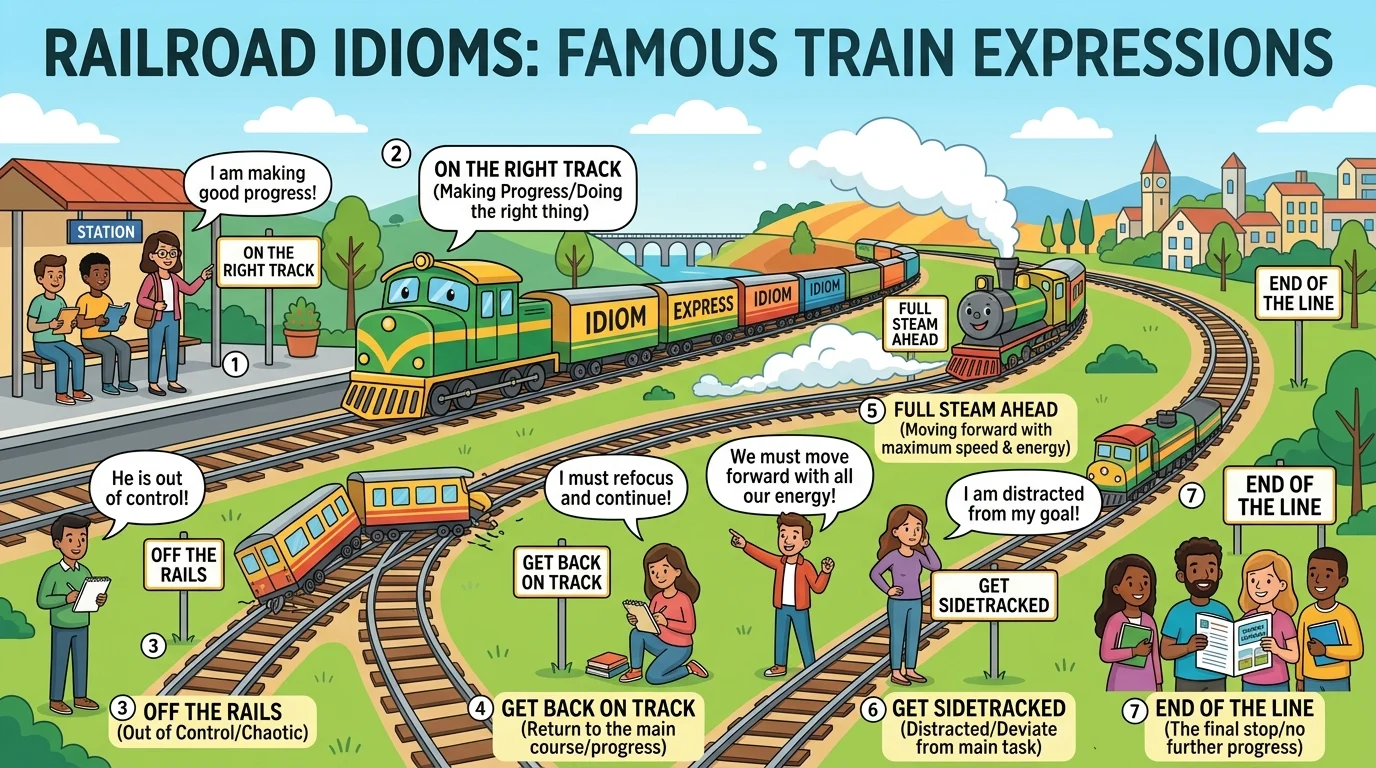
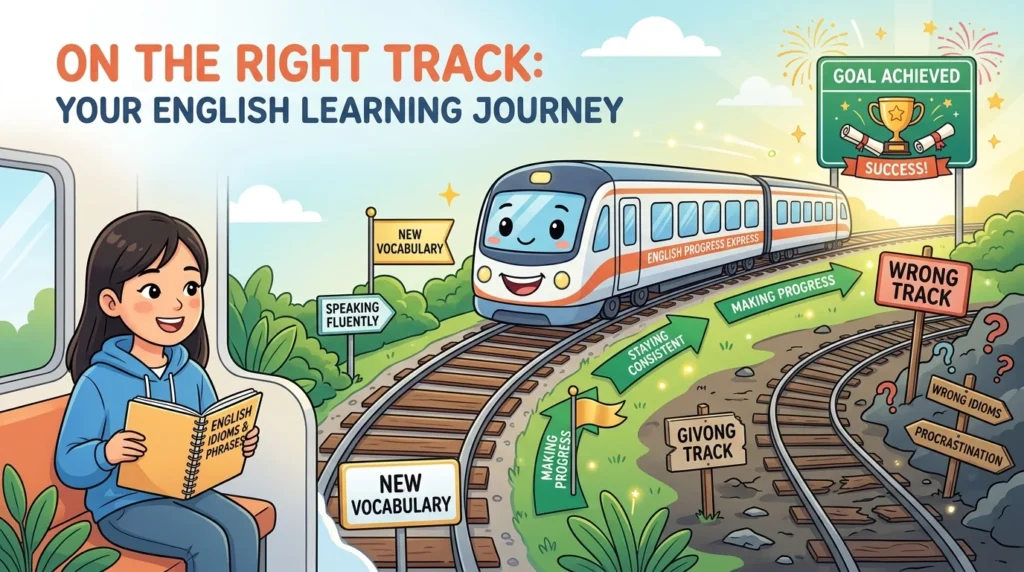
On the Right Track
Word-by-word meaning: Traveling on the correct railway track.
Idiomatic meaning: Doing something correctly or making suitable progress.
Examples:
- Your research is on the right track.
- We are on the right track to finish the project.
Common error: Say on the right track, not “in the right track.”
Usage note: This is one of the most common train-related expressions in English.
Off the Rails
Word-by-word meaning: A train has left its tracks.
Idiomatic meaning: A situation has become uncontrolled, confused, or unsuccessful.
Examples:
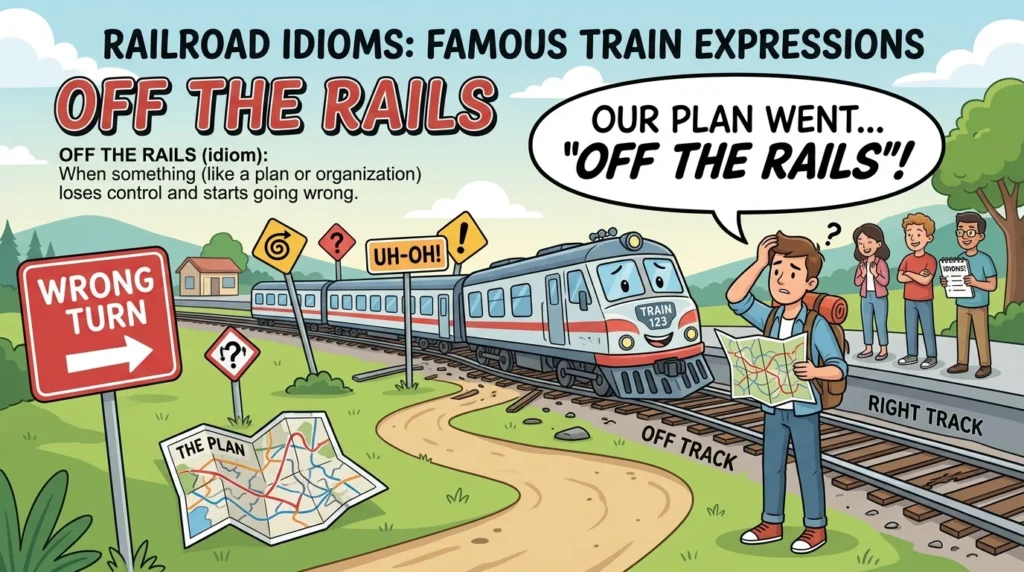
- The meeting went off the rails after the argument.
- Our original plan went off the rails.
Common error: Do not use it simply to mean “finished.”
Usage note: It is often used for plans, discussions, organizations, or situations.
Get Back on Track
Word-by-word meaning: Return to the railway track.
Idiomatic meaning: Return to the correct direction after a problem or delay.
Examples:
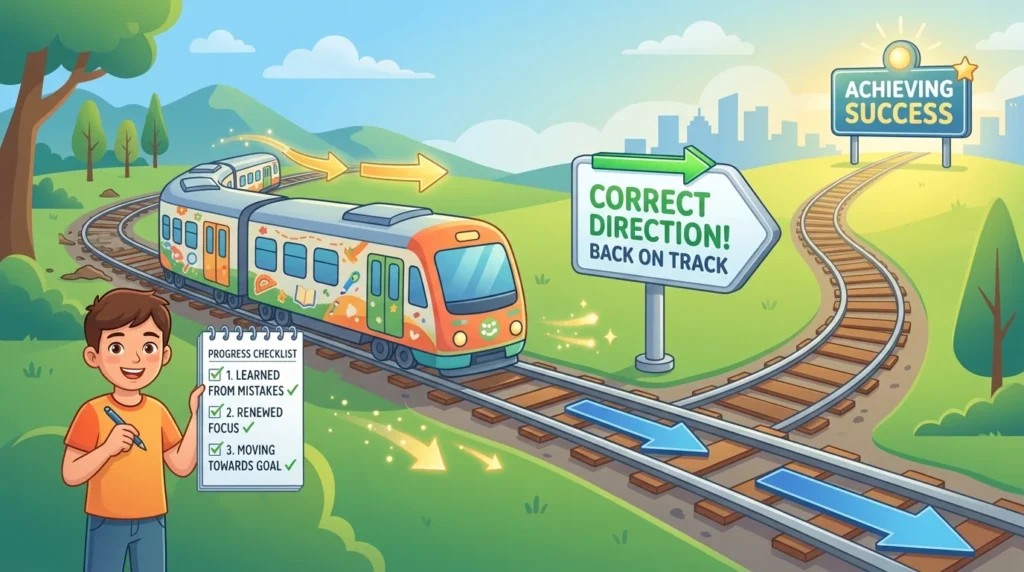
- I missed a few classes, but I am back on track now.
- We need a new plan to get the project back on track.
Common error: “Get back in track” is incorrect.
Usage note: This expression is particularly useful for recovery and progress.
Get Sidetracked
Word-by-word meaning: Move onto a side railway track.
Idiomatic meaning: Become distracted from the main task, subject, or goal.
Examples:
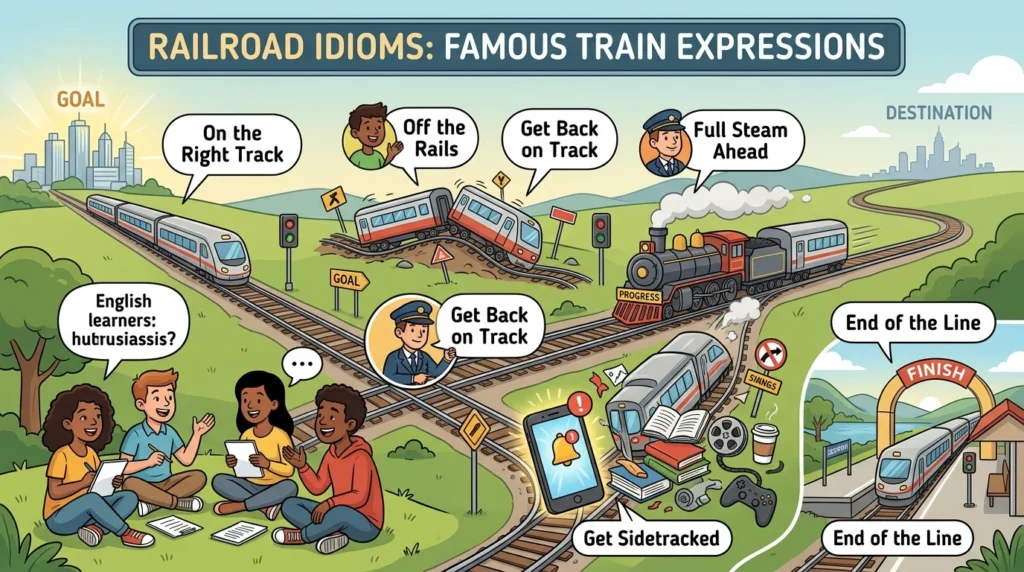
- I got sidetracked while writing my article.
- We got sidetracked and forgot the main question.
Common error: Do not confuse sidetracked with off the rails. Being sidetracked usually means becoming distracted.
Usage note: It is common in conversations about work and studying.
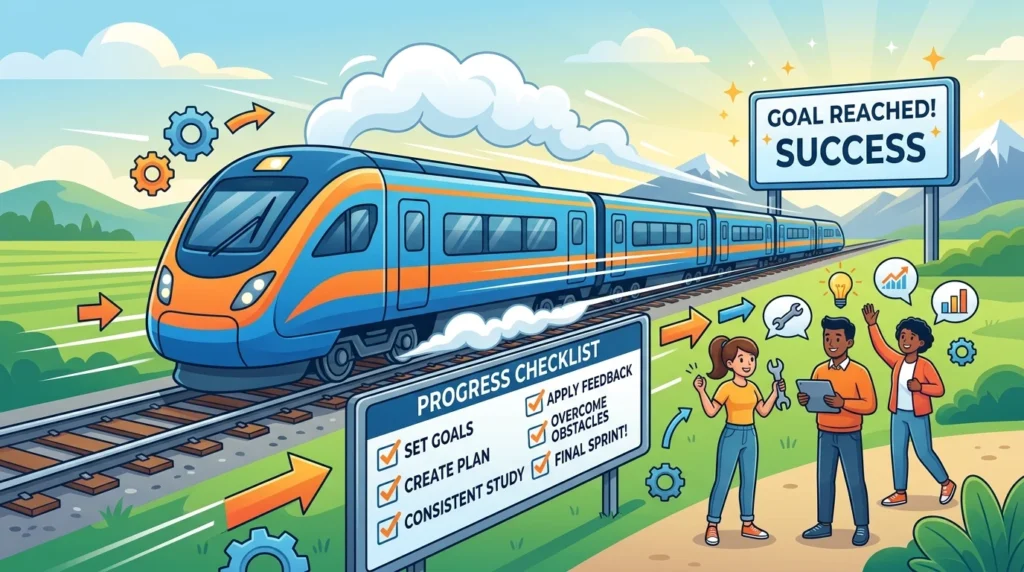
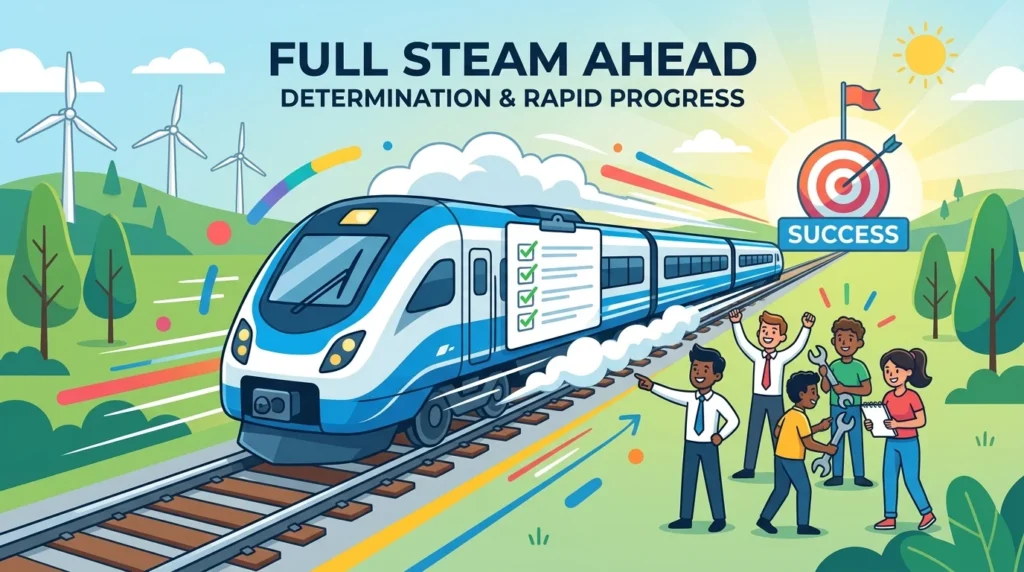
Full Steam Ahead
Word-by-word meaning: Moving forward with maximum steam power.
Idiomatic meaning: Proceed with energy, speed, and determination.
Examples:
- After approval, the team went full steam ahead.
- We are moving full steam ahead with the new project.
Common error: “Full steam forward” is not the usual expression.
Usage note: It has a positive, energetic tone.
Train of Thought
Word-by-word meaning: A sequence of thoughts compared with a train journey.
Idiomatic meaning: The connected flow of someone’s ideas.
Examples:
- I lost my train of thought during the presentation.
- That question interrupted my train of thought.
Common error: The standard phrase is train of thought, not “thought train.”
Usage note: This is a very common expression in everyday English.
Lose Your Train of Thought
Word-by-word meaning: Lose the sequence carrying your thoughts.
Idiomatic meaning: Forget what you were saying or thinking.
Examples:
- Sorry, I lost my train of thought.
- The interruption made me lose my train of thought.
Common error: It normally refers to a temporary interruption in your thinking.
Usage note: It is natural in conversations, meetings, and presentations.
On the Wrong Track
Word-by-word meaning: Traveling along an incorrect railway track.
Idiomatic meaning: Following an incorrect idea, approach, or line of reasoning.
Examples:
- If you think the problem is money, you may be on the wrong track.
- We were on the wrong track, so we changed our approach.
Common error: Do not use off the rails when you simply mean that an idea is incorrect.
Usage note: This phrase is useful for politely discussing mistakes.
Hit the Buffers
Word-by-word meaning: A train reaches the buffers at the end of a track.
Idiomatic meaning: Come to a stop, especially because of an obstacle.
Examples:
- The project hit the buffers because funding was delayed.
- Negotiations hit the buffers after the disagreement.
Common error: It does not necessarily mean something has been successfully completed.
Usage note: This expression is particularly associated with British English.
Jump the Tracks
Word-by-word meaning: A train leaves its railway tracks.
Idiomatic meaning: A situation or discussion suddenly moves away from its original direction.
Examples:
- The conversation jumped the tracks.
- The story seemed to jump the tracks halfway through.
Common error: Do not use this phrase when you simply mean “finish.”
Usage note: It can be used literally or figuratively.
Miss the Boat
Although boat is not railroad vocabulary, this expression is often grouped with transportation-based idioms because it has a similar idea of missing an opportunity.
Word-by-word meaning: Fail to catch a boat.
Idiomatic meaning: Miss an opportunity.
Examples:
- Apply now so you do not miss the boat.
- We waited too long and missed the boat.
Usage note: If you want a strictly railroad expression, miss the train can be used literally, while “miss the boat” is the established opportunity idiom.
Miss the Train
Word-by-word meaning: Fail to board a train before it leaves.
Idiomatic meaning: Depending on context, it can suggest missing an opportunity or being too late.
Examples:
- I missed the train because I arrived late.
- We cannot wait forever or we may miss the train.
Common error: Its figurative meaning is less fixed than miss the boat.
Usage note: Context makes the intended meaning clear.
All Aboard
Word-by-word meaning: Everyone should get onto the train.
Idiomatic meaning: An enthusiastic invitation to join an activity or plan.
Examples:
- We are starting a new project— all aboard!
- All aboard for our next adventure!
Common error: It is informal and playful, so avoid it in highly formal writing.
Usage note: It works especially well in humorous or friendly contexts.
End of the Line
Word-by-word meaning: The final point of a railway line.
Idiomatic meaning: The point where something ends or cannot continue.
Examples:
- Without more funding, this could be the end of the line.
- After years of disagreement, they decided it was the end of the line.
Common error: It can sound quite final, so use it carefully.
Usage note: This is particularly useful when discussing the ending of a process or situation.
Last Stop
Word-by-word meaning: The final station on a train route.
Idiomatic meaning: The final stage or destination of something.
Examples:
- This is our last stop before the final decision.
- Retirement marked the last stop of his professional journey.
Common error: Last stop is more metaphorical than some established idioms on this list.
Usage note: It is effective in descriptive and creative writing.
Pull Into the Station
Word-by-word meaning: A train arrives at a station.
Idiomatic meaning: Used metaphorically to describe something approaching its final stage.
Examples:
- After months of work, the project is pulling into the station.
- Our discussion is finally pulling into the station.
Common error: This is a metaphorical expression rather than a fixed idiom in every context.
Usage note: Use it when you want a clear train-related image for approaching completion.
Runaway Train
Word-by-word meaning: A train moving without proper control.
Idiomatic meaning: A person, event, or situation that seems to be developing too quickly to control.
Examples:
- The rumor became a runaway train on social media.
- Once the problems started, they felt like a runaway train.
Common error: Do not use it for every fast-moving situation; the idea of losing control is important.
Usage note: It can describe situations that gather momentum rapidly.
Couple of Stops Away
Word-by-word meaning: A destination is only a few train stops away.
Idiomatic meaning: Something is relatively close to being achieved or reached.
Examples:
- We are only a couple of stops away from finishing the project.
- The team is a couple of stops away from its final goal.
Common error: This is a conversational metaphor, not a traditional fixed idiom.
Usage note: It works best in informal or creative contexts.
Lay the Tracks
Word-by-word meaning: Build railway tracks.
Idiomatic meaning: Establish the foundation needed for future progress.
Examples:
- Good planning lays the tracks for future success.
- The new policy laid the tracks for further development.
Common error: It is a metaphor, so context should make the comparison clear.
Usage note: This expression works well in professional and motivational writing.
Stay on Track
Word-by-word meaning: Remain on a railway track.
Idiomatic meaning: Continue following the correct plan or direction.
Examples:
- A daily schedule helps me stay on track.
- We need to stay on track if we want to meet the deadline.
Common error: Do not confuse it with get back on track. The first means continuing correctly; the second means recovering after a setback.
Usage note: This is a useful everyday expression for goals and tasks.
Railroad Idioms for Finishing Something
If you are searching for idioms for finishing something in English, train imagery gives you several useful choices.
End of the line emphasizes a final point, while pull into the station can creatively describe a project approaching completion. Hit the buffers suggests that progress has stopped, but it does not necessarily mean the work was completed successfully.
For ordinary situations, expressions such as wrap things up, get the job done, bring something to a close, and see something through are more natural.
For example:
We are on the right track, and we should be able to wrap things up tomorrow.
Phrases for Finishing Something
There is no single phrase that fits every type of ending. Here are useful alternatives:
| Phrase | Meaning |
|---|---|
| Wrap things up | Finish remaining work |
| Get the job done | Complete a task |
| Bring it to a close | Finish something formally |
| See it through | Continue until completion |
| Call it a day | Stop working for now |
| End of the line | Reach a final point |
| That’s a wrap | Informally say something is finished |
These phrases are useful when looking for a phrase for finishing something without repeating the word “finish.”
Idioms for Finishing Something Funny
For a funny or casual tone, expressions such as That’s a wrap, job done, or a playful train metaphor like We have reached the last stop! can make the ending more interesting.
For example:
The report is finally finished. All aboard the completed-project train!
The last example is creative rather than a traditional idiom, so it is best used in casual writing.
Idioms for Ending a Relationship
Not every railroad expression is suitable for relationships, but end of the line can sometimes describe a relationship that has reached its final point.
Example:
After years of trying to solve the same problems, they felt it was the end of the line.
Other common English expressions include go separate ways and call it quits. These are more directly connected with relationships than most railroad idioms.
To Complete Something: Synonyms and Useful Expressions
If you are looking for a to complete something synonym, these choices can help:
- Finish
- Complete
- Accomplish
- Finalize
- Conclude
- Fulfill
- Wrap up
- Carry out
- See through
The best word depends on context. For example, you can complete a task, finalize a document, accomplish a goal, or wrap up a meeting.
What Is the Idiom for Completing a Task?
For everyday English, get the job done is a natural expression for completing a task. See it through emphasizes continuing until something is completed, while wrap things up often refers to finishing the remaining details.
A railroad-related alternative is end of the line, but it emphasizes reaching a final point rather than simply completing a task.
What Are Common Phrases Using “Finish”?
Common phrases include:
- Finish the job
- Finish up
- Finish off
- Finish on time
- Finish strong
- Finish the task
For more idiomatic English, you can say wrap things up, get the job done, or see it through.
How Do You Say “Done” in a Cool Way?
In casual English, you can say:
- That’s a wrap!
- Job done!
- All wrapped up!
- Mission accomplished!
- We’re all set!
For a playful railroad theme, We’ve reached the last stop! gives the sentence a train-inspired twist.
FAQs About Railroad Idioms
What are the most common railroad idioms?
Some of the best-known train-related expressions include on the right track, off the rails, get back on track, get sidetracked, full steam ahead, train of thought, lose your train of thought, on the wrong track, and end of the line.
What is an idiom for complete?
Depending on the context, wrap up, see through, get the job done, bring to a close, and finish off can express the idea of completing something.
What is a railroad idiom for progress?
On the right track, stay on track, get back on track, and full steam ahead are useful expressions for discussing progress.
What does “off the rails” mean?
Off the rails means that a situation, plan, discussion, or activity has gone out of control or away from its intended direction.
What does “end of the line” mean?
End of the line means reaching the final point of something or a situation where continuation is no longer possible.
Conclusion
Railroad idioms make everyday English more vivid by turning trains and railway journeys into memorable ideas about progress, mistakes, distractions, opportunities, and endings. Expressions such as on the right track, get back on track, off the rails, full steam ahead, and end of the line can make your English sound more natural and expressive.
If you are learning these expressions, start with five common ones and create your own sentences. Try describing a successful plan as on the right track, a distraction as getting sidetracked, and strong progress as full steam ahead.
Once these expressions become familiar, you will start noticing train-related idioms in conversations, books, articles, and everyday English. Keep practicing, and soon your English will be full steam ahead!

“Wilkie Collins brings classic idioms to life on LearnIdom.com, making language learning engaging, memorable, and full of literary charm.”