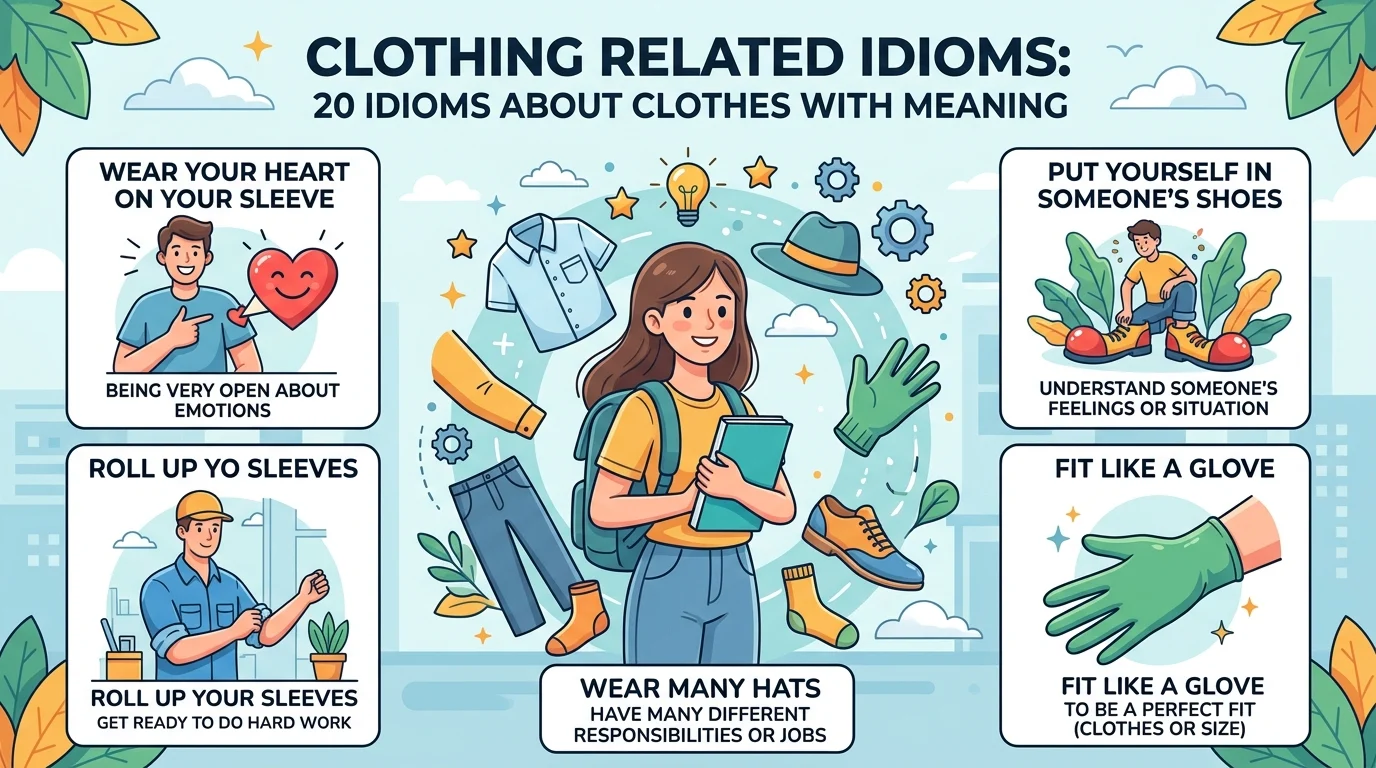
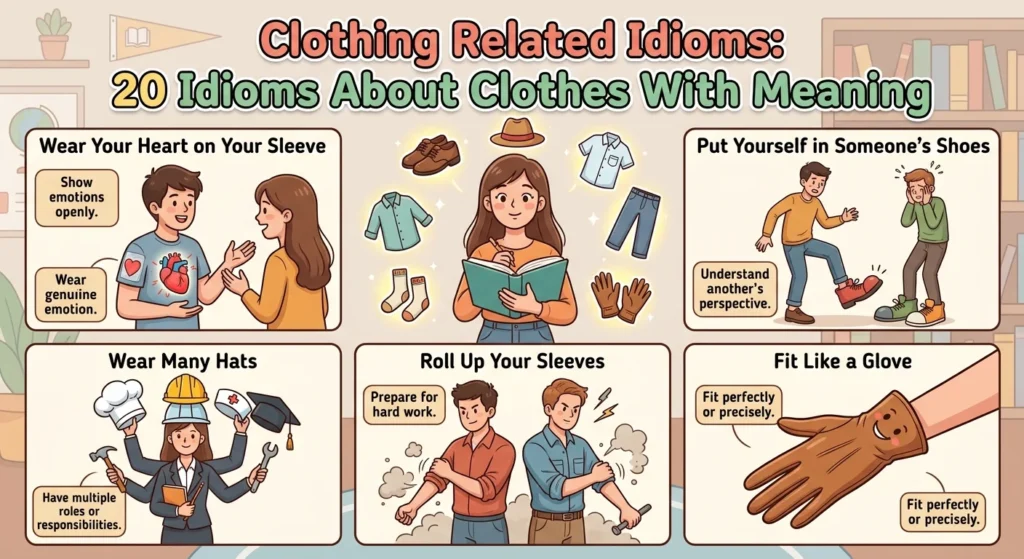
Clothing related idioms turn ordinary words about shirts, shoes, hats, and sleeves into memorable expressions. If you are searching for clothing idioms with meaning, this guide explains common expressions in simple English.
Imagine someone saying, “Put yourself in my shoes.” They are not asking you to borrow their footwear. They are asking you to imagine their situation. That is what makes clothing idioms so interesting: the literal words are about clothes, while the real meaning is often about emotions, work, money, relationships, or behavior.
What Are Clothing Related Idioms?
Clothing related idioms are fixed English expressions that contain words associated with clothing or accessories. Their figurative meaning is usually different from the literal meaning.
For example, wear your heart on your sleeve does not mean putting a physical heart on your clothing. It means showing your feelings openly.
These expressions are useful because they make English sound more natural and expressive. You may encounter them in conversations, novels, news writing, films, classroom exercises, and word puzzles.
If you are exploring clothing related idioms NYT searches, it is also important to distinguish between a general idiom guide and a specific crossword or puzzle clue. A newspaper puzzle may use an unusual clue for a familiar expression, while an idiom article explains the expression itself.
Wear Your Heart on Your Sleeve
Word-by-word meaning: Wear your heart where it can be seen on your sleeve.
Idiomatic meaning: To show your emotions openly.
Example:
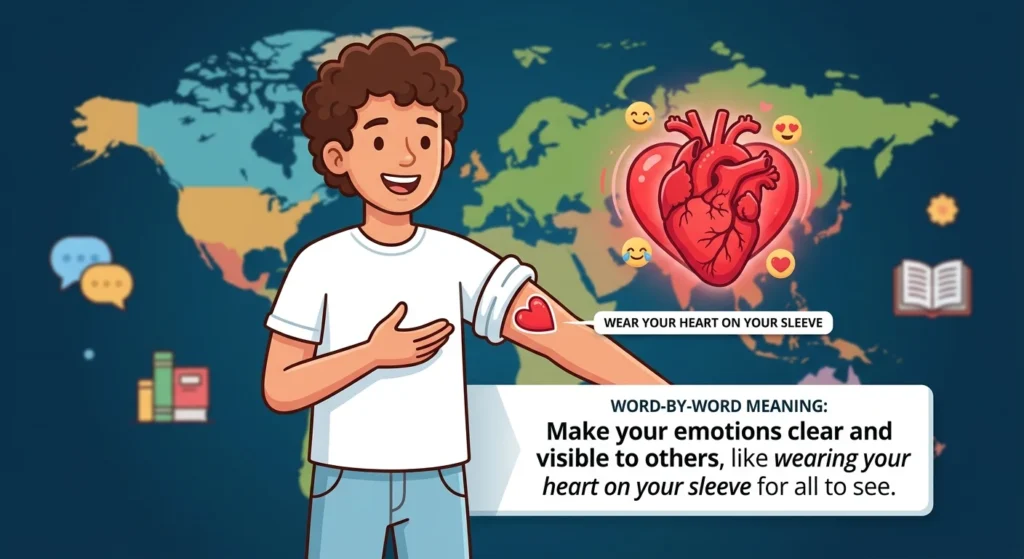
Maria wears her heart on her sleeve, so everyone knows when she is excited or worried.
Common error: Do not interpret this expression literally.
Usage note: It usually describes someone who is emotionally open and honest.
Put Yourself in Someone’s Shoes
Word-by-word meaning: Imagine wearing another person’s shoes.
Idiomatic meaning: Imagine being in another person’s situation.

Example:
Before criticizing him, put yourself in his shoes.
Common error: Do not use it simply to talk about someone’s footwear.
Usage note: This is especially useful when talking about empathy and understanding.
Fit Like a Glove
Word-by-word meaning: Fit perfectly like a glove fits a hand.
Idiomatic meaning: To suit someone or something perfectly.
Example:
The new position fits her like a glove.
Common error: It is not limited to physical clothing.
Usage note: It can describe a job, role, personality, plan, or situation.
Roll Up Your Sleeves
Word-by-word meaning: Move your sleeves upward.
Idiomatic meaning: Prepare to work hard.
Example:
We have a difficult project, so let’s roll up our sleeves.
Common error: It does not always mean literally adjusting your clothes.
Usage note: It is common in both professional and casual English.
Wear Many Hats
Word-by-word meaning: Wear several hats.
Idiomatic meaning: Have several responsibilities or roles.
Example:
As a small-business owner, she wears many hats.
Common error: Do not assume the expression refers to a person’s fashion choices.
Usage note: It is useful for describing people who perform different jobs or duties.
Have an Ace Up Your Sleeve
Word-by-word meaning: Have an ace hidden in your sleeve.
Idiomatic meaning: Have a secret advantage, plan, or solution.
Example:
The team looked worried, but the coach had an ace up his sleeve.
Common error: The standard expression is up your sleeve, not “in your sleeve.”
Usage note: It often suggests an unexpected advantage.
Keep Something Under Your Hat
Word-by-word meaning: Keep something hidden under your hat.
Idiomatic meaning: Keep information secret.
Example:
Keep the surprise under your hat until Saturday.
Common error: The phrase is about secrecy, not physically hiding something.
Usage note: This is an informal expression.
At the Drop of a Hat
Word-by-word meaning: Something happens when a hat drops.
Idiomatic meaning: To do something immediately and without hesitation.
Example:
He would travel at the drop of a hat.
Common error: Avoid changing the established wording.
Usage note: It can describe someone who is always ready to act.
Take Your Hat Off to Someone
Word-by-word meaning: Remove your hat to show respect.
Idiomatic meaning: Show admiration or respect for someone.
Example:
I take my hat off to everyone who completed the difficult project.
Common error: The expression is usually figurative.
Usage note: It is a friendly way to recognize someone’s achievement.
Put on Your Thinking Cap
Word-by-word meaning: Put on a special cap for thinking.
Idiomatic meaning: Think carefully to solve a problem.
Example:
Put on your thinking cap and see if you can find another answer.
Common error: “Thinking cap” is the established phrase.
Usage note: It is especially common in educational and playful contexts.
On a Shoestring
Word-by-word meaning: On a thin shoelace.
Idiomatic meaning: With very little money or a limited budget.
Example:
They managed to complete the trip on a shoestring.
Common error: It does not refer to the actual price of shoelaces.
Usage note: On a shoestring budget is a very common form.
In Someone’s Shoes
Word-by-word meaning: Be in another person’s shoes.
Idiomatic meaning: Be in another person’s position or circumstances.
Example:
I would not want to be in his shoes right now.
Common error: Do not confuse the expression with literal footwear.
Usage note: It is often used when discussing difficult situations or decisions.
Pull Your Socks Up
Word-by-word meaning: Pull your socks upward.
Idiomatic meaning: Make more effort or improve your performance.
Example:
You need to pull your socks up if you want to finish the project on time.
Common error: This expression can sound unusual to learners unfamiliar with British English.
Usage note: It is informal and is particularly associated with British English.
A Wolf in Sheep’s Clothing
Word-by-word meaning: A wolf dressed as a sheep.
Idiomatic meaning: Someone who appears harmless but may have harmful intentions.
Example:
The story describes the villain as a wolf in sheep’s clothing.
Common error: Do not use it simply to describe someone wearing unusual clothes.
Usage note: It is commonly used when discussing deceptive appearances.
Cut from the Same Cloth
Word-by-word meaning: Made from the same piece of fabric.
Idiomatic meaning: Very similar in personality, behavior, or character.
Example:
The two sisters are cut from the same cloth.
Common error: It does not necessarily mean that two people look alike.
Usage note: The expression can be positive, neutral, or negative depending on context.
Dress to Kill
Word-by-word meaning: Dress in a way connected literally with killing.
Idiomatic meaning: Dress in a very impressive or attractive way.
Example:
Everyone was dressed to kill at the formal celebration.
Common error: The expression is figurative and does not normally refer to violence.
Usage note: It is informal and can be used humorously.
Keep Your Shirt On
Word-by-word meaning: Continue wearing your shirt.
Idiomatic meaning: Stay calm and be patient.
Example:
Keep your shirt on; we will have the information shortly.
Common error: Do not understand it as a literal instruction about clothing.
Usage note: It is informal and can sound playful.
Put a Sock in It
Word-by-word meaning: Put a sock inside something.
Idiomatic meaning: Stop talking or become quieter.
Example:
The children were making so much noise that their father jokingly told them to put a sock in it.
Common error: It can sound rude if used with someone you do not know well.
Usage note: Keep this expression for informal or humorous situations.
Wear the Trousers
Word-by-word meaning: Be the person wearing the trousers.
Idiomatic meaning: Be the person who controls a household or situation.
Example:
Everyone knows who wears the trousers in that family.
Common error: The expression is not about trousers themselves.
Usage note: It is more associated with British English and may sound old-fashioned in some contexts.
Dress for the Occasion
Word-by-word meaning: Wear clothing suitable for an event.
Idiomatic meaning: Prepare or behave appropriately for a particular situation.
Example:
You should dress for the occasion when attending a formal ceremony.
Common error: It does not always mean wearing formal clothes.
Usage note: The appropriate clothing depends on the event and setting.
Quick Reference: Clothing Idioms and Their Meanings
| Clothing Idiom | Simple Meaning |
|---|---|
| Wear your heart on your sleeve | Show emotions openly |
| Put yourself in someone’s shoes | Imagine their situation |
| Fit like a glove | Fit perfectly |
| Roll up your sleeves | Prepare to work |
| Wear many hats | Have many roles |
| Ace up your sleeve | Have a secret advantage |
| Keep something under your hat | Keep a secret |
| At the drop of a hat | Immediately |
| Take your hat off to someone | Show respect |
| Put on your thinking cap | Think carefully |
| On a shoestring | With little money |
| In someone’s shoes | In someone’s position |
| Pull your socks up | Make more effort |
| Wolf in sheep’s clothing | Appear harmless but be deceptive |
| Cut from the same cloth | Be very similar |
| Dress to kill | Dress impressively |
| Keep your shirt on | Stay calm |
| Put a sock in it | Be quiet |
| Wear the trousers | Be in control |
| Dress for the occasion | Dress or prepare appropriately |
How to Use Clothing Idioms Naturally
The best way to learn clothing idioms with meaning is to connect each phrase with a situation rather than memorizing definitions alone.
For example, imagine a student facing a difficult assignment. Someone says, “Let’s roll up our sleeves.” The visual idea of preparing to work makes the figurative meaning easier to remember.
You can also group idioms by clothing:
Hat idioms:
- At the drop of a hat
- Keep something under your hat
- Wear many hats
- Put on your thinking cap
Shoe idioms:
- Put yourself in someone’s shoes
- In someone’s shoes
- On a shoestring
Clothing idioms:
- Wear your heart on your sleeve
- Roll up your sleeves
- Keep your shirt on
- Cut from the same cloth
This method helps learners remember both the expression and the situation in which it belongs.
Common Mistakes With Clothing Idioms
Even familiar idioms can be difficult for English learners. Avoid these mistakes:
- Taking the expression literally: “Wear many hats” usually means having several roles.
- Changing the wording: Fixed expressions generally work best in their standard form.
- Using informal phrases formally: “Put a sock in it” can sound rude.
- Ignoring regional differences: Some expressions are more common in British English.
- Overusing idioms: Too many idioms can make writing difficult to understand.
- Forcing keywords into sentences: Natural language is more useful than repeating a phrase unnecessarily.
If you are studying these expressions for writing, speaking, or a word puzzle, always check the context before deciding which meaning applies.
FAQs About Clothing Related Idioms
What are clothing related idioms?
They are English expressions that use clothing-related words such as shoes, hats, sleeves, shirts, socks, or trousers to communicate a figurative meaning.
What is an example of a clothing idiom?
Wear your heart on your sleeve is a common example. It means to show your emotions openly.
What does “put yourself in someone’s shoes” mean?
It means to imagine being in another person’s situation so you can better understand their feelings or decisions.
What does “on a shoestring” mean?
It means doing something with very limited money or resources. For example, a person may travel on a shoestring budget.
Why are clothing idioms useful?
They make English more expressive and natural. Learning them also helps readers understand conversations, books, articles, and other forms of everyday English.
Conclusion
Clothing idioms show how creative English can be. A sleeve can represent emotions, shoes can represent another person’s situation, and a hat can represent a secret or responsibility.
Start by learning five expressions rather than trying to memorize all 20 at once. Write one original sentence for each, then use them naturally in conversation or writing. With regular practice, expressions such as wear your heart on your sleeve, put yourself in someone’s shoes, and roll up your sleeves will become much easier to understand and remember.

“Iris Murdoch explores the beauty of language and idioms on LearnIdom.com, making learning phrases engaging, memorable, and fun for everyone.”