Poems with idioms for kids make learning English fun, memorable, and easy to understand. From a busy bee to reaching for the stars, these short poems help children discover how everyday expressions bring language to life.
Whether you’re a parent, teacher, or young learner, you’ll find original rhymes, simple explanations, and playful examples to read aloud, practice, and share. These poems are designed to help children understand idioms in context rather than memorize definitions alone.
What Are Poems with Idioms?
Idiom poems are short verses that use expressions whose meanings are different from their literal words. For example, it’s raining cats and dogs means that it is raining heavily, not that animals are falling from the sky!
These poems help children:
- Learn new English expressions naturally.
- Improve vocabulary and reading skills.
- Practice rhythm, rhyme, and pronunciation.
- Develop confidence when reciting poems.
- Understand figurative language through stories.
The following English poems for kids are original, easy to read, and suitable for classroom activities, home practice, and poetry recitals.
Here are short, child-friendly poems with idioms for kids. Each poem includes the idiom’s meaning and a simple usage note to help young readers understand it.
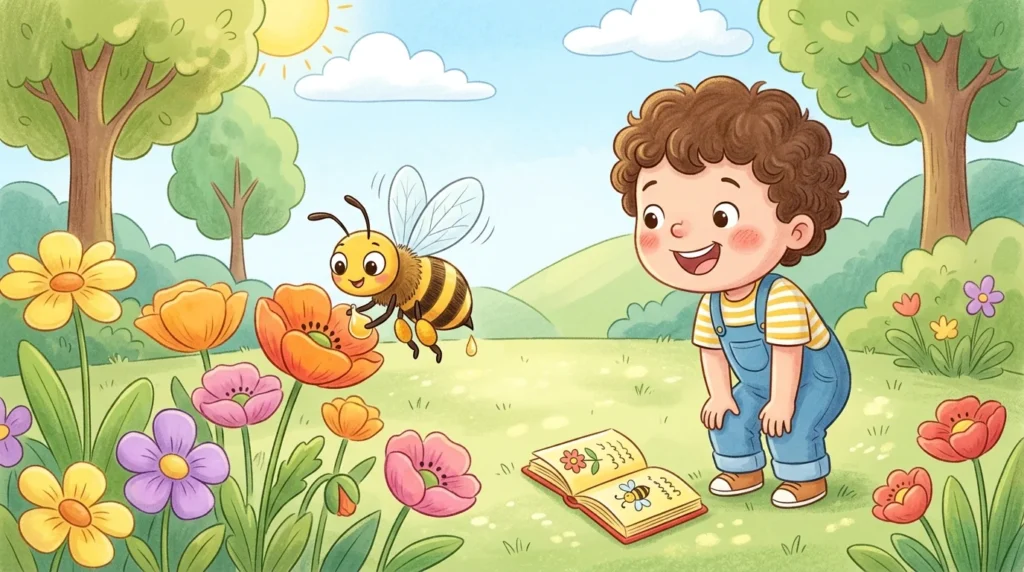
The Busy Bee — Work Like a Bee
Buzz, buzz, goes the busy bee,
Working happily near the tree.
I work like a bee when I clean,
Keeping my little garden green!
- Word-by-word meaning: Work means doing a task; a bee is a hardworking insect.
- Idiomatic meaning: To work very hard.
- Example sentence: Maya worked like a bee on her school project.
- Common error: The expression does not mean working like an actual insect.
- Usage note: Use it when describing someone who works hard.
Reach for the Stars — Reach for the Stars
I dream of flying high and far,
Beyond the moon, beyond each star.
I’ll reach for the stars and do my best,
With hope and courage, I’ll pass each test!

- Word-by-word meaning: Reach means stretch toward something; stars are shining objects in space.
- Idiomatic meaning: Aim high and try to achieve great things.
- Example sentence: Reach for the stars and believe in your abilities.
- Common error: You don’t need to reach for actual stars.
- Usage note: This inspirational expression encourages children to follow their dreams.
A Piece of Cake — A Piece of Cake
I solved my sums and shouted, “Hooray!”
That tricky puzzle was easy today.
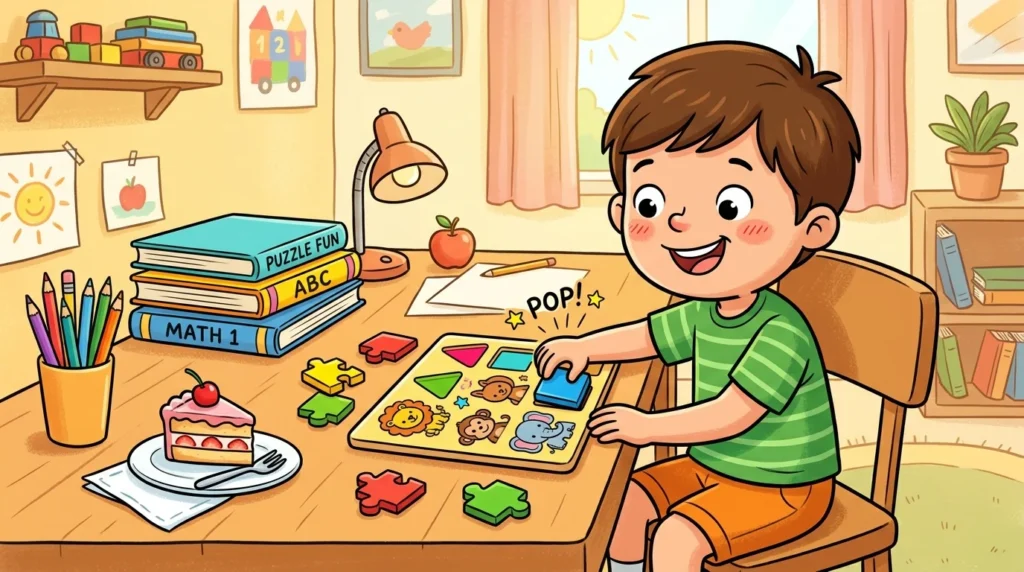
It was a piece of cake for me,
Now I’ll solve the next one happily!
- Word-by-word meaning: A piece is a portion; cake is a sweet dessert.
- Idiomatic meaning: Something very easy to do.
- Example sentence: The spelling quiz was a piece of cake.
- Common error: The phrase describes difficulty, not a real dessert.
- Usage note: Use it informally when a task feels easy.
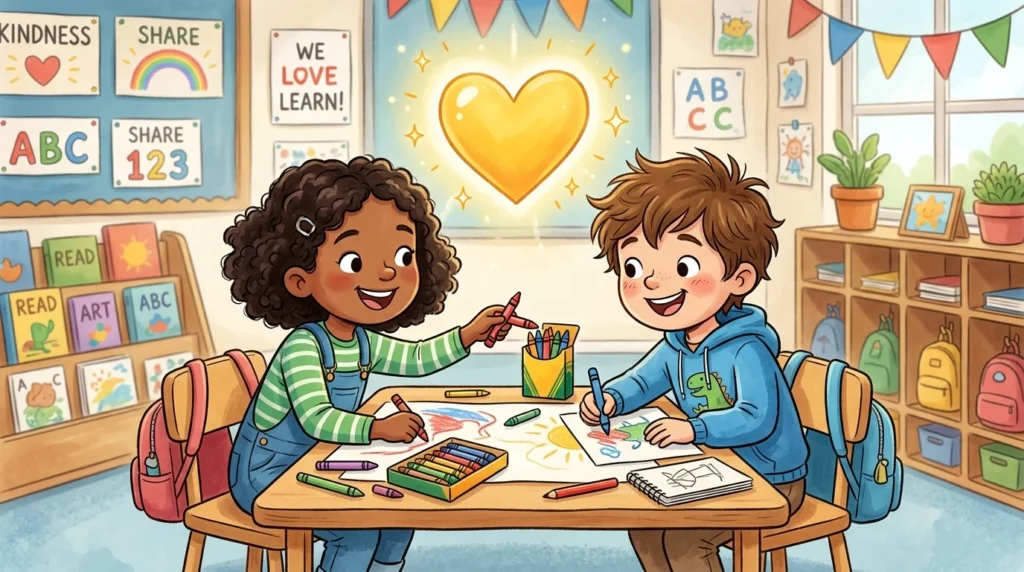
The Big Heart — Have a Heart of Gold
My friend shared crayons with a smile,
And helped a classmate all the while.
She has a heart of gold, I know,
Her kindness makes our friendship grow!
- Word-by-word meaning: A heart is an organ; gold is a precious metal.
- Idiomatic meaning: To be very kind and caring.
- Example sentence: Our teacher has a heart of gold.
- Common error: It doesn’t mean someone has a golden heart physically.
- Usage note: Use this expression to praise someone’s kindness.
The Cool Cat — Cool as a Cucumber
The class was loud, the clock ticked fast,
But Sam stayed calm until the last.
Cool as a cucumber, he smiled,
And finished his work, relaxed and mild!
- Word-by-word meaning: Cool means slightly cold; a cucumber is a green vegetable.
- Idiomatic meaning: Remaining calm in a stressful situation.
- Example sentence: Lina stayed cool as a cucumber before her recital.
- Common error: It isn’t a statement about the temperature of a vegetable.
- Usage note: Use it when someone stays calm under pressure.
The Early Bird — The Early Bird Catches the Worm
I woke up early with the sun,
And finished all my chores for fun.
The early bird catches the worm,
So now I’m ready to read and learn!
- Word-by-word meaning: An early bird wakes early; a worm is a small animal.
- Idiomatic meaning: People who act early may get the best opportunities.
- Example sentence: We arrived early because the early bird catches the worm.
- Common error: The expression is advice, not a promise of success.
- Usage note: Teach children the value of preparation.
Under the Weather — A Rainy Day
I missed my game and stayed in bed,
With a tired feeling in my head.
I’m feeling under the weather today,
So I’ll rest before I go out to play.
- Word-by-word meaning: Under means below; weather means outdoor conditions.
- Idiomatic meaning: Feeling slightly ill or unwell.
- Example sentence: Ali felt under the weather this morning.
- Common error: It doesn’t mean standing beneath a cloud.
- Usage note: This is a common expression in everyday English.
Spill the Beans — The Birthday Secret
We planned a party, quiet and sweet,
With balloons and treats for all to eat.
Don’t spill the beans before the day,
Or our surprise might slip away!
- Word-by-word meaning: Spill means accidentally drop; beans are edible seeds.
- Idiomatic meaning: Reveal a secret.
- Example sentence: Please don’t spill the beans about my surprise.
- Common error: The phrase isn’t about dropping food.
- Usage note: Use it when discussing secrets or surprises.
When Pigs Fly — The Silly Promise
My brother said he’d clean his room,
Before the flowers began to bloom.
“I’ll do it soon, when pigs can fly!”
We laughed and watched the clouds roll by.
- Word-by-word meaning: Pigs are farm animals; fly means move through the air.
- Idiomatic meaning: Something that is extremely unlikely to happen.
- Example sentence: He’ll tidy his room when pigs fly!
- Common error: It isn’t a literal prediction about flying pigs.
- Usage note: This humorous expression is often used for impossible or unlikely events.
Break the Ice — A New Friend
I saw a classmate standing alone,
So I said hello in a friendly tone.
We broke the ice and started to play,
Now we’re good friends every day!
- Word-by-word meaning: Break means crack; ice is frozen water.
- Idiomatic meaning: Make people feel comfortable when meeting for the first time.
- Example sentence: A friendly question helped break the ice.
- Common error: It doesn’t necessarily involve real ice.
- Usage note: Use it when talking about starting a conversation.
Hold Your Horses — Wait a Minute
I ran to the door to start my race,
But Dad said, “Slow down and keep your pace!”
“Hold your horses; check your shoe,”
Then off I went when all was through.
- Word-by-word meaning: Hold means keep still; horses are animals used for riding.
- Idiomatic meaning: Wait or slow down.
- Example sentence: Hold your horses; we aren’t ready yet.
- Common error: It doesn’t require holding real horses.
- Usage note: This informal phrase can sound playful or impatient, depending on the tone.
A Helping Hand — Lend a Hand
My friend dropped books across the floor,
So I helped pick up a few more.
I lent a hand, and we were through,
Kindness is a wonderful thing to do!
- Word-by-word meaning: Lend means give temporarily; a hand is part of the body.
- Idiomatic meaning: Help someone with a task.
- Example sentence: Can you lend me a hand with these books?
- Common error: It doesn’t mean giving away your actual hand.
- Usage note: This expression is useful for teaching cooperation.
The Missing Key — In a Nutshell
I searched the room from wall to wall,
Behind the sofa, near the hall.
In a nutshell, here’s what I knew:
I found my bag, but lost my shoe!
- Word-by-word meaning: A nutshell is the hard outer covering of a nut.
- Idiomatic meaning: To explain something briefly.
- Example sentence: In a nutshell, we need to finish our homework.
- Common error: It doesn’t mean squeezing a whole story inside a nut.
- Usage note: Use it before a short summary.
The Little Chef — Cook Up a Storm
I mixed the flour and stirred the pot,
Making pancakes nice and hot.
I cooked up a storm with a happy grin,
And shared my tasty treats with kin!
- Word-by-word meaning: Cook means prepare food; a storm is rough weather.
- Idiomatic meaning: Cook a lot of food or cook with great energy.
- Example sentence: Grandma cooked up a storm for the family picnic.
- Common error: It doesn’t mean creating a real storm in the kitchen.
- Usage note: This informal phrase often describes enthusiastic cooking.
Curiosity and the Cat — Curiosity Killed the Cat
A little cat heard a sound,
And searched every corner around.
Curiosity killed the cat, they say,
So think before you explore that way!
- Word-by-word meaning: Curiosity means wanting to know; a cat is a small animal.
- Idiomatic meaning: Being too curious can sometimes lead to trouble.
- Example sentence: Curiosity made him open the box without asking.
- Common error: The expression is a warning, not a literal rule about cats.
- Usage note: Explain that asking questions is good, but children should respect safety and privacy.
Have Your Cake and Eat It Too — The Two Choices
I wanted to play and study all day,
And eat my cake without giving it away.
I wanted both, but time said no,
Sometimes we choose which way to go!
- Word-by-word meaning: Have means possess; cake is a dessert; eat means consume food.
- Idiomatic meaning: Want two things that are difficult to enjoy together.
- Example sentence: You can’t have your cake and eat it too.
- Common error: It isn’t advice about how to eat dessert.
- Usage note: Use this expression when explaining competing choices.
Turn Over a New Leaf — A Fresh Start
I used to leave my books untidy,
And finish my homework rather shoddily.
I’ll turn over a new leaf today,
And try a better, brighter way!
- Word-by-word meaning: Turn means change position; a leaf grows on a plant.
- Idiomatic meaning: Start behaving better or make a fresh start.
- Example sentence: This term, I will turn over a new leaf.
- Common error: It doesn’t mean turning an actual leaf on a tree.
- Usage note: This is an encouraging idiom for positive changes.
Two Heads Are Better Than One — Teamwork
I built a tower, my friend built two,
Together we found what we needed to do.
Two heads are better than one,
Working together makes learning fun!
- Word-by-word meaning: Heads are body parts; better means more helpful or effective.
- Idiomatic meaning: Two people working together can solve a problem more easily.
- Example sentence: Let’s solve this puzzle together; two heads are better than one.
- Common error: It doesn’t mean that people need two physical heads.
- Usage note: Use it to encourage teamwork and sharing ideas.
Hit the Books — Time to Study
My books were waiting on the shelf,
I opened one and challenged myself.
It’s time to hit the books tonight,
And learn each lesson until it’s right!
- Word-by-word meaning: Hit means strike; books contain written information.
- Idiomatic meaning: Begin studying seriously.
- Example sentence: I’ll hit the books before my English test.
- Common error: Never interpret this as physically hitting books.
- Usage note: This informal expression is common among students.
All’s Well That Ends Well — A Happy Ending
Our kite got stuck up in a tree,
But Dad helped bring it down for me.
All’s well that ends well, hooray!
We flew our kite another day!
- Word-by-word meaning: Well means good or satisfactory; ends refers to how something finishes.
- Idiomatic meaning: A difficult experience can feel worthwhile when it finishes happily.
- Example sentence: We missed the bus but arrived safely later; all’s well that ends well.
- Common error: It doesn’t mean that every ending will be perfect.
- Usage note: Use it when a problem eventually has a satisfactory outcome.
Top 10 Poems for Kids to Read and Recite
Children often enjoy poems that have simple words, a steady rhythm, and a positive message. These ten original poem ideas are suitable for classroom recitals, reading practice, and family activities.
| Poem title | Main lesson |
|---|---|
| The Brave Little Turtle | Be brave |
| Dream Big, Little Star | Follow your dreams |
| The Busy Ant | Work hard |
| The Honest Boy | Tell the truth |
| The Lost Puppy | Show kindness |
| The Clever Fox | Think creatively |
| The Little Girl and the Rain | Enjoy nature |
| The Little Bird | Appreciate freedom |
| The Sharing Bear | Share with others |
| The Happy Dog | Find joy in simple things |
These are suggested poem titles and themes, not a ranking of established famous poems. Teachers can turn each idea into a short rhyming verse and include an idiom to reinforce vocabulary.
Good Idioms for Kids
The best idioms for beginners are easy to remember and useful in everyday conversations.
- Reach for the stars — Aim high.
- Work like a bee — Work hard.
- A piece of cake — Something easy.
- Have a heart of gold — Be kind.
- Break the ice — Make people feel comfortable.
- Lend a hand — Help someone.
- Hit the books — Study seriously.
- Under the weather — Feel unwell.
- Spill the beans — Reveal a secret.
- Turn over a new leaf — Make a fresh start.
A useful classroom activity is to ask children to choose one idiom, explain its meaning, and write two rhyming lines using it.
10 Examples of Idioms in Everyday Sentences
| Idiom | Meaning | Example sentence |
|---|---|---|
| It’s raining cats and dogs | Raining heavily | It’s raining cats and dogs, so let’s stay inside. |
| Once in a blue moon | Very rarely | We eat at that restaurant once in a blue moon. |
| The ball is in your court | It’s your turn to act | I’ve shared my idea; now the ball is in your court. |
| Cost an arm and a leg | Be very expensive | That toy costs an arm and a leg. |
| Keep an eye on | Watch carefully | Please keep an eye on my schoolbag. |
| On cloud nine | Very happy | Sara was on cloud nine after winning the prize. |
| Bite your tongue | Stop yourself from speaking | I had to bite my tongue to avoid interrupting. |
| Better late than never | Doing something late is better than not doing it | You finally finished your drawing—better late than never! |
| Get cold feet | Become nervous about doing something | He got cold feet before the school performance. |
| Out of the blue | Unexpectedly | Out of the blue, my cousin came to visit. |
How to Teach Idioms Through Poetry
Parents and teachers can make poetry practice more effective with a few simple activities.
- Read aloud: Read the poem slowly, emphasizing the idiom.
- Explain the meaning: Discuss what the expression means in everyday English.
- Act it out: Let children perform the literal meaning first, then explain the figurative meaning.
- Create a rhyme: Ask children to write two or four lines using the idiom.
- Practice reciting: Encourage them to read their poem to family members or classmates.
These activities connect vocabulary, speaking, reading, and creative writing without making learning feel like memorization.
Frequently Asked Questions
1. Can you give me some examples of idiom poems?
Yes! “A Piece of Cake,” “The Busy Bee,” and “Reach for the Stars” above are original examples. Each poem uses an idiom in a memorable situation and explains its figurative meaning.
2. What are the top 10 poems for kids?
Good choices for children’s poetry activities include poems about bravery, friendship, nature, honesty, dreams, teamwork, and kindness. The ten suggested titles in this article provide themes for short recitation poems.
3. What are some good idioms for kids?
Start with familiar expressions such as “a piece of cake,” “lend a hand,” “break the ice,” “hit the books,” and “reach for the stars.” Their meanings are easy to demonstrate with everyday examples.
4. Can children write their own poems with idioms?
Absolutely! Children can select one idiom, understand its meaning, and create a short poem with two to six lines. Rhyming words, illustrations, and familiar situations can make their poems more engaging.
5. Why are idioms useful in English poetry?
Idioms add color, humor, and emotion to poems. Learning them in context can help children understand figurative language and recognize these expressions in conversations, books, and classroom lessons.
Conclusion
Poems with idioms for kids offer a cheerful way to explore English, develop vocabulary, and build confidence in reading aloud. From the busy bee to reaching for the stars, every short rhyme introduces an expression that children can use in real life.
Start by choosing one poem, reading it together, and discussing what its idiom really means. Then invite your child or students to create their own verses using a favorite expression. With regular practice, poetry becomes more than a reading exercise—it becomes an opportunity to think creatively, express ideas, and enjoy learning English.
Keep reading, keep rhyming, and remember to reach for the stars!

“L.P. Hartley brings classic idioms to life on LearnIdom.com, helping readers explore language with wit, clarity, and timeless insight.”