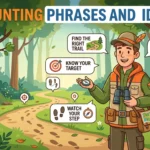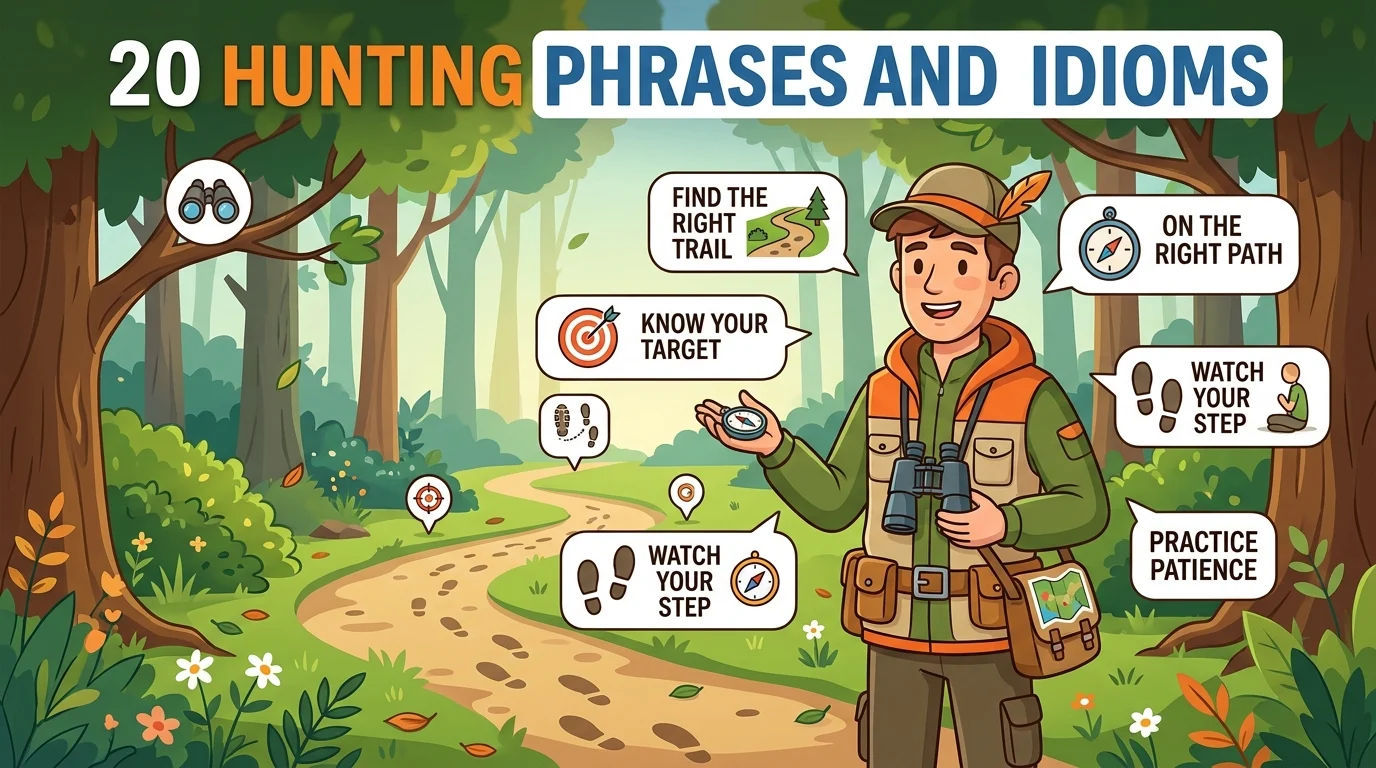
Hunting phrases and idioms can make English more colorful, especially when an expression uses ideas such as searching, tracking, chasing, finding, or catching something. Some expressions come directly from hunting, while others use hunting imagery to describe everyday situations. For example, when someone searches everywhere for a missing item, you might say they are hunting high and low. If a person is chasing something that is almost impossible to catch, the phrase a wild-goose chase may fit.
This guide explains useful hunting-related idiomatic expressions in simple English. Each expression includes its word-by-word meaning, figurative meaning, an example, a common mistake, and a practical usage note. You will also discover useful hunting words and answers to questions such as What are 10 idiomatic expressions?, What are some hunting words?, and What are some funny quotes about hunters?
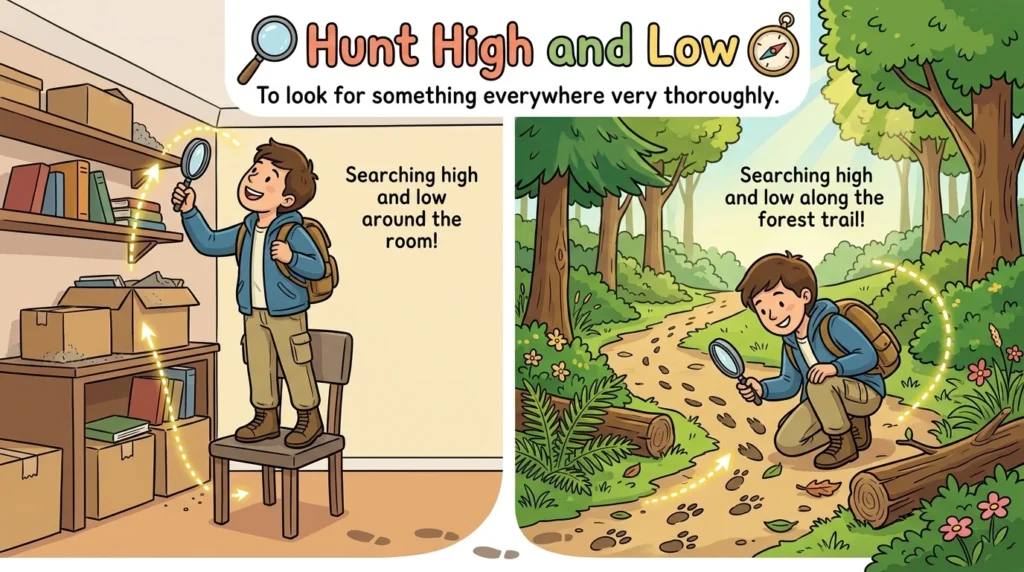
Hunt High and Low
Word-by-word meaning: Search in many high and low places.
Idiomatic meaning: To search everywhere for something or someone.
Example: I hunted high and low for my missing keys.
Common error: Do not use it only when literally hunting animals.
Usage note: This is useful for everyday situations involving a long or thorough search.
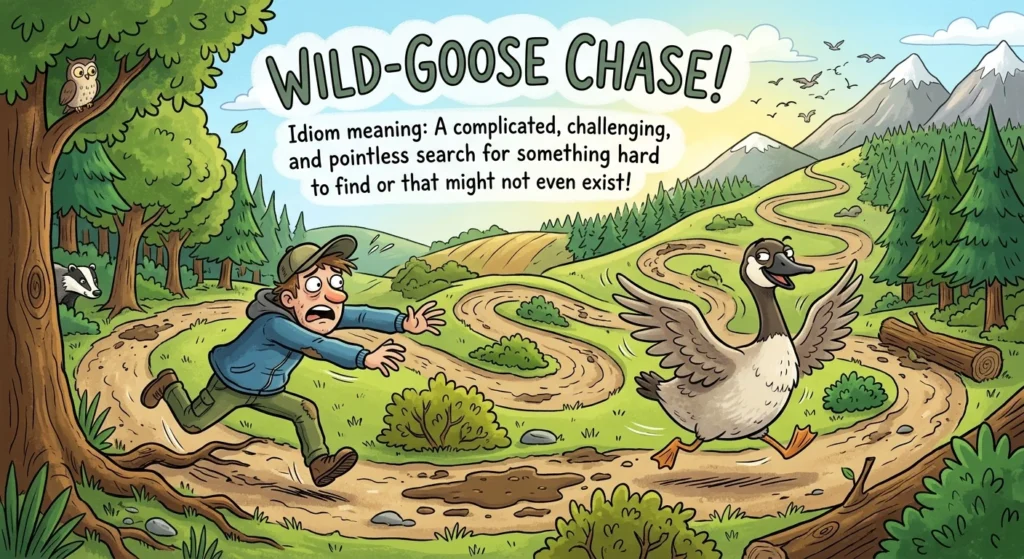
Go on a Wild-Goose Chase
Word-by-word meaning: Chase a wild goose.
Idiomatic meaning: To pursue something that is difficult, impossible, or unlikely to find.
Example: Looking for that old document without any clues became a wild-goose chase.
Common error: Avoid using it simply to mean an ordinary search.
Usage note: It often suggests that the search is wasting time.
Hunt Down
Word-by-word meaning: Hunt until something is found.
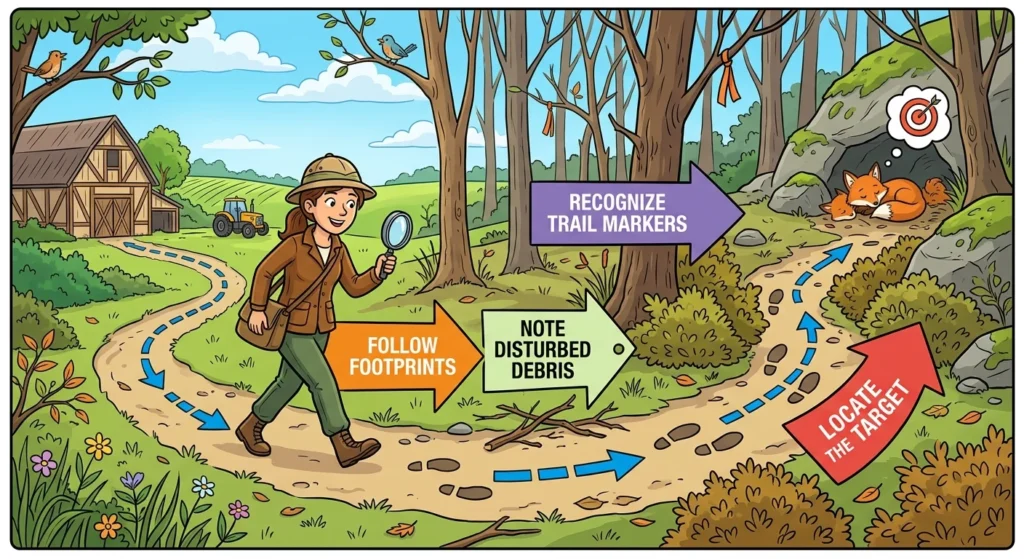
Idiomatic meaning: To find someone or something after searching carefully.
Example: She hunted down the book she needed for her project.
Common error: “Hunt down” does not always refer to animals.
Usage note: It can be used for objects, information, people, or solutions.
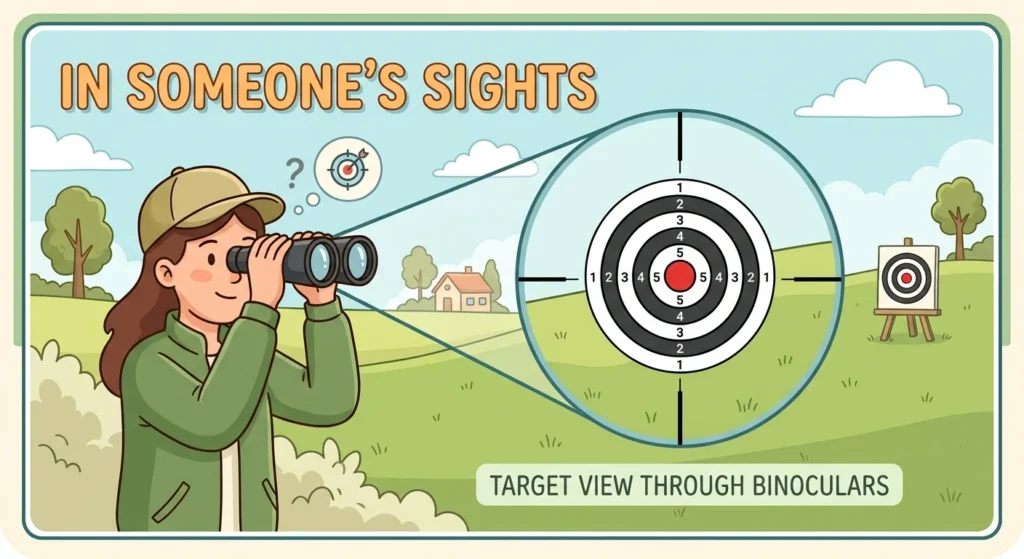
In Someone’s Sights
Word-by-word meaning: Something is visible through a hunter’s sights.
Idiomatic meaning: A person or thing is being closely targeted, watched, or considered.
Example: The championship is now in our sights.
Common error: The phrase does not necessarily mean physical danger.
Usage note: It is commonly used for goals, targets, opportunities, and competition.
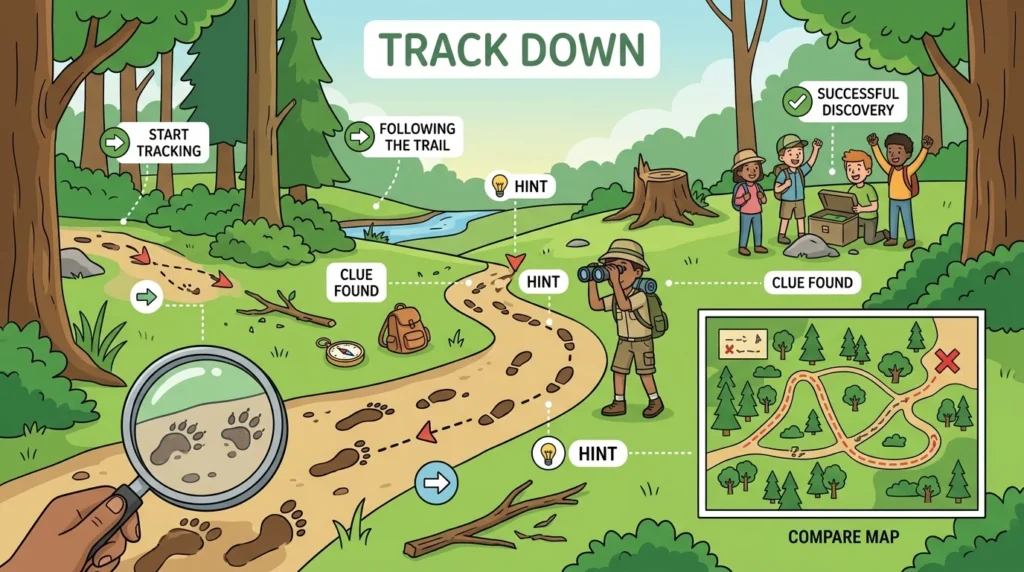
Track Down
Word-by-word meaning: Follow tracks until you find something.
Idiomatic meaning: Find someone or something by carefully following clues or information.
Example: The researcher tracked down the original document.
Common error: Do not assume “track down” always involves footprints.
Usage note: It works especially well when a search requires investigation.
Flush Out
Word-by-word meaning: Force something out of hiding.
Idiomatic meaning: To make a hidden person, problem, or piece of information become known.
Example: The discussion helped flush out several problems in the plan.
Common error: “Flush out” and “flesh out” have different meanings.
Usage note: Use flush out for revealing or forcing something into the open.
Stalk the Prey
Word-by-word meaning: Follow prey carefully and quietly.
Idiomatic meaning: To follow or observe someone or something closely while waiting for the right opportunity.
Example: The photographer patiently stalked the perfect moment for a wildlife photograph.
Common error: Do not use “stalk” casually for unwanted personal behavior toward someone.
Usage note: In wildlife contexts, the expression can describe careful observation.
Bag the Prize
Word-by-word meaning: Put a prize or hunted target into a bag.
Idiomatic meaning: Successfully obtain or win something desirable.
Example: After months of preparation, Maya finally bagged the top prize.
Common error: It does not mean that every prize is literally placed in a bag.
Usage note: This informal expression works well when talking about achievements or victories.
The Hunter Becomes the Hunted
Word-by-word meaning: The person doing the hunting becomes the target.
Idiomatic meaning: Someone who was pursuing another person suddenly becomes the person being pursued.
Example: The detective expected to question the suspect, but soon the hunter became the hunted.
Common error: Do not confuse it with an ordinary hunting situation only.
Usage note: It is especially effective in stories, competition, and dramatic situations.
On the Trail
Word-by-word meaning: Following a trail left by a target.
Idiomatic meaning: Following clues that may lead to a person, answer, or solution.
Example: The journalist was on the trail of an important story.
Common error: “On the trail” does not always require a physical path.
Usage note: It is useful when describing investigation or discovery.
Follow the Trail
Word-by-word meaning: Continue along a path or trail.
Idiomatic meaning: Follow clues, evidence, or information to discover an answer.
Example: We followed the trail of clues until we found the missing file.
Common error: Avoid repeating “trail” when a simple “follow the clues” would be clearer.
Usage note: This expression fits mystery, research, investigation, and problem-solving contexts.
Take Aim
Word-by-word meaning: Point a weapon toward a target.
Idiomatic meaning: Direct attention, effort, criticism, or action toward a particular target.
Example: The campaign took aim at the company’s outdated policy.
Common error: It does not always mean physically preparing to shoot.
Usage note: In everyday English, it can describe focused criticism or effort.
Hit the Mark
Word-by-word meaning: Strike the intended target.
Idiomatic meaning: Be accurate, successful, or exactly right.
Example: Her explanation really hit the mark.
Common error: Do not restrict the expression to archery or shooting.
Usage note: It is a useful expression for ideas, comments, decisions, and results.
Miss the Mark
Word-by-word meaning: Fail to hit the intended target.
Idiomatic meaning: Fail to achieve the intended effect or understand the real issue.
Example: His joke missed the mark because nobody understood it.
Common error: It does not necessarily mean making a completely wrong decision.
Usage note: Use it when something falls short of its intended purpose.
A Sitting Duck
Word-by-word meaning: A duck sitting still and easy to target.
Idiomatic meaning: A person or thing that is especially vulnerable or easy to attack or criticize.
Example: Without protection, the small company was a sitting duck for its competitors.
Common error: It is usually used figuratively rather than literally.
Usage note: This expression is informal and often describes a vulnerable situation.
A Red Herring
Word-by-word meaning: A strongly scented fish traditionally associated with confusing a trail.
Idiomatic meaning: A misleading clue or piece of information that distracts from the real issue.
Example: The strange message turned out to be a red herring.
Common error: A red herring is not simply any clue.
Usage note: It is common in mysteries, arguments, stories, and investigations.
Cast a Wide Net
Word-by-word meaning: Throw a large net over a wide area.
Idiomatic meaning: Search broadly or consider many possibilities.
Example: We cast a wide net when looking for qualified applicants.
Common error: It is not limited to fishing.
Usage note: The expression is useful when describing broad searches or recruitment.
Sniff Out
Word-by-word meaning: Detect something using the sense of smell.
Idiomatic meaning: Discover something hidden, secret, or difficult to notice.
Example: The editor quickly sniffed out the mistake.
Common error: It does not necessarily involve an actual smell.
Usage note: This informal phrase is often used when someone is good at discovering problems or secrets.
Leave No Stone Unturned
Word-by-word meaning: Check everywhere, even underneath stones.
Idiomatic meaning: Make every possible effort to find an answer or solve a problem.
Example: The team left no stone unturned while searching for the missing records.
Common error: Do not interpret the expression literally in normal conversation.
Usage note: It is useful for describing a thorough investigation or search.
Know Your Quarry
Word-by-word meaning: Understand the animal or target being hunted.
Idiomatic meaning: Understand the person, problem, objective, or target you are trying to reach.
Example: Before negotiating, you should know your quarry and understand what they want.
Common error: “Quarry” can have several meanings, so context matters.
Usage note: This expression has a strong hunting image and works best in figurative or strategic contexts.
What Are 10 Idiomatic Expressions?
Ten useful expressions from this list are:
- Hunt high and low
- Go on a wild-goose chase
- Hunt down
- In someone’s sights
- Track down
- Flush out
- Take aim
- Hit the mark
- Miss the mark
- Leave no stone unturned
These expressions are useful because many have moved beyond literal hunting situations and are now common in everyday English.
What Are Some Hunting Words?
If you are building hunting-related vocabulary, useful words include hunter, prey, quarry, trail, track, target, scope, aim, stalk, chase, trap, field, wildlife, pursuit, and tracking.
Some are specifically connected with hunting, while others can also be used metaphorically in everyday English. Learning both meanings can make your vocabulary more flexible.
What Are Some Funny Quotes About Hunters?
Funny hunting sayings often play with the contrast between patience, preparation, and unexpected results. For example:
- A good hunter knows when to wait and when to head home.
- Hunting requires patience, but storytelling requires imagination.
- The best hunting stories always seem to get longer with time.
- A hunter may miss the target but rarely misses a chance to tell the story.
These are best treated as original humorous sayings, rather than attributed quotations from famous people.
What Are Some Motivational Quotes About Hunting?
Hunting-themed motivation often focuses on patience, preparation, persistence, observation, and respect for nature. Original motivational lines include:
- Patience turns a long pursuit into a valuable lesson.
- Prepare carefully, stay focused, and respect the journey.
- The strongest pursuit begins with a clear goal.
- Success rewards patience, preparation, and persistence.
These ideas can also apply to studying, sports, work, and personal goals.
FAQs About Hunting Phrases and Idioms
What is a common hunting idiom?
Hunt high and low is a useful hunting-related expression that means searching everywhere for something.
Is “wild-goose chase” a hunting idiom?
It has hunting imagery, but today it is mainly an everyday idiom meaning a pointless or difficult search.
What does “hunt down” mean?
“Hunt down” means to find someone or something after searching carefully. It can be literal or figurative.
What does “hit the mark” mean?
“Hit the mark” means to be accurate, effective, or correct. It comes from the idea of successfully hitting a target.
Are all hunting words idioms?
No. Words such as prey, quarry, tracking, and stalking are hunting-related vocabulary. An idiom has a figurative meaning that cannot always be understood simply by interpreting each word literally.
Conclusion
Hunting phrases and idioms give English learners an interesting way to understand how everyday language develops from real-world activities. Expressions such as hunt high and low, track down, take aim, hit the mark, wild-goose chase, and leave no stone unturned show how hunting imagery can describe searching, planning, achieving goals, and solving problems.
The best way to remember these expressions is to use them in your own sentences. Pick five today, write a short example for each, and then try using them naturally in conversation or writing. With regular practice, hunting-related expressions can become a useful and memorable part of your English vocabulary.

“Elizabeth Bowen shares timeless idioms and language wisdom on LearnIdom.com, making learning phrases fun, easy, and unforgettable.”