Learning English idioms becomes much easier when you study them through real situations instead of memorizing definitions. Idioms lessons help learners understand expressions such as “break the ice” and “a piece of cake” in everyday conversations.
An idiom is an expression whose intended meaning is different from the literal meaning of its individual words. For example, “hit the books” does not mean hitting a book. It means studying seriously.
This guide explains important idioms with their meanings and sentences, common mistakes, and simple usage notes. It also includes practical learning methods for students, teachers, and adults looking for effective English idioms lessons.
How to Learn Idioms Effectively
The easiest way to learn an idiom is to connect it with a situation. Instead of memorizing only a definition, understand when people use the expression.
A simple learning routine is:
- Read the idiom and its meaning.
- Understand its literal and figurative meanings.
- Study an example sentence.
- Create your own sentence.
- Say the sentence aloud.
- Review the idiom later.
Learning five expressions at a time can be more manageable than trying to memorize a long list in one sitting.
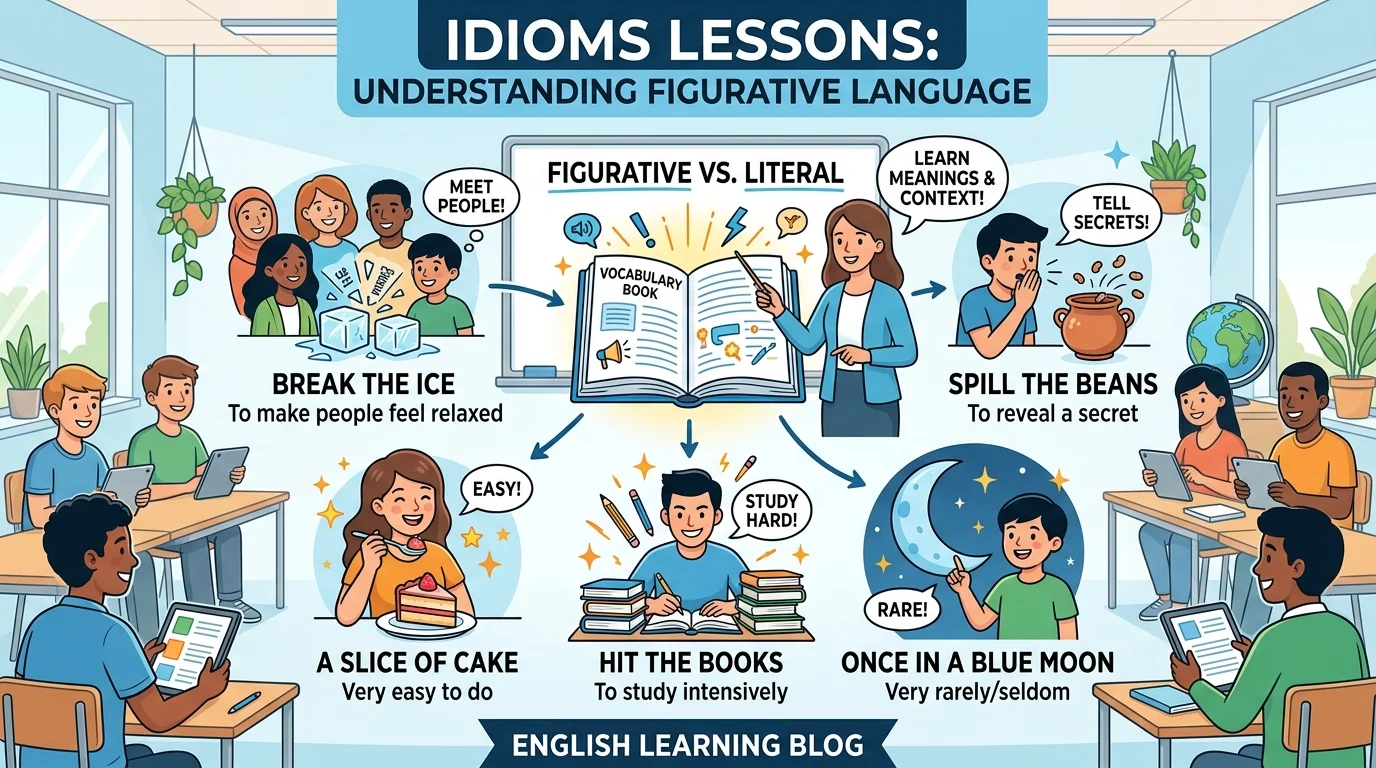
Break the Ice
Word-by-word meaning: To break physical ice.
Idiomatic meaning: To make people feel more comfortable when they meet or begin talking.
Example sentences:
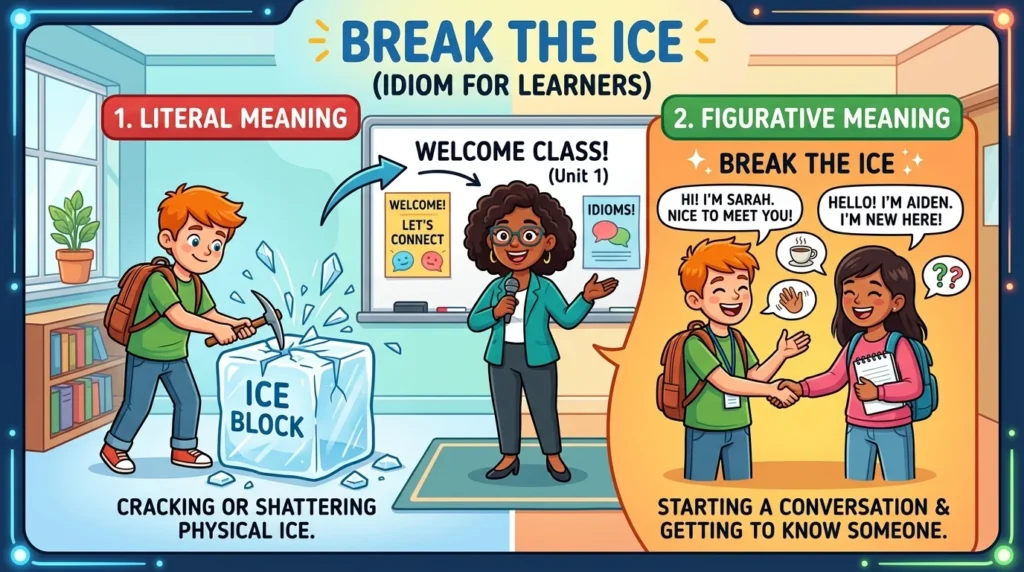
- The teacher told a joke to break the ice.
- Her friendly question helped break the ice.
Common error: Using it to mean ending a disagreement.
Usage note: Use this idiom when people are meeting for the first time or feel nervous in a social situation.
A Piece of Cake
Word-by-word meaning: A piece of a cake.
Idiomatic meaning: Something that is very easy.
Example sentences:
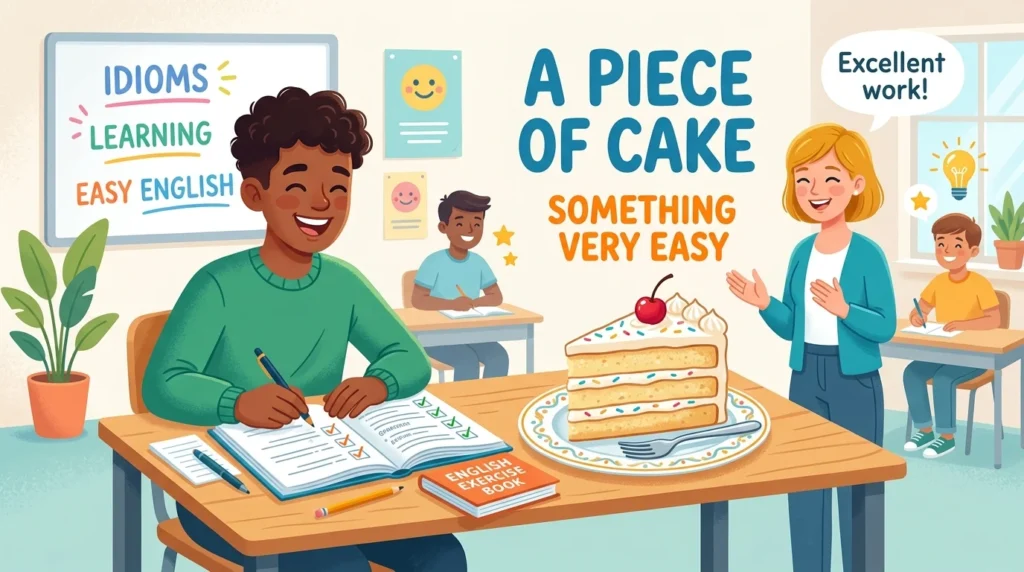
- The first exercise was a piece of cake.
- Once I understood the rules, the game was a piece of cake.
Common error: Assuming the phrase is always about food.
Usage note: This is an informal expression commonly used in everyday English.
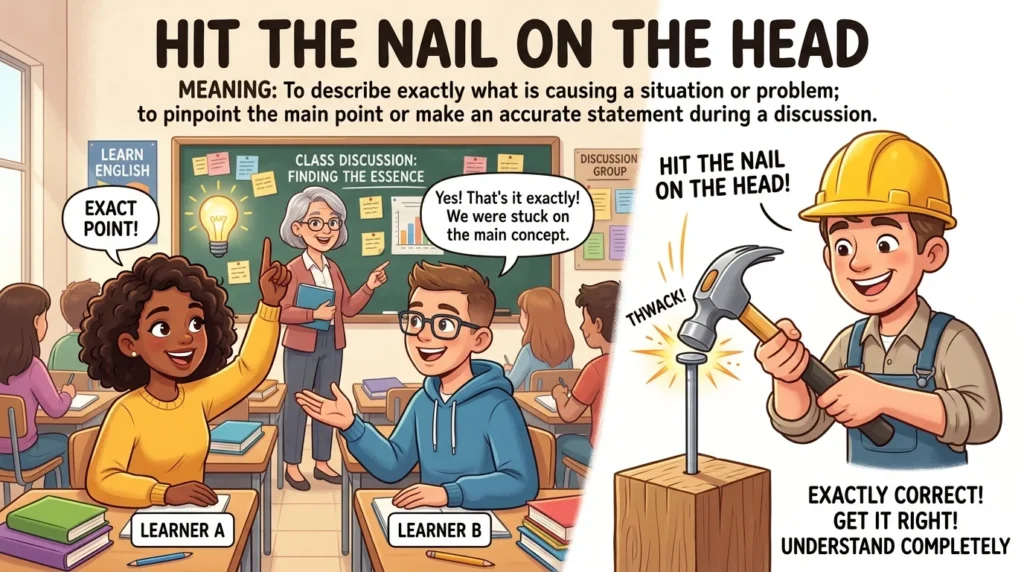
Hit the Nail on the Head
Word-by-word meaning: To hit the exact center of a nail.
Idiomatic meaning: To describe something accurately or identify the main point.
Example sentences:
- You hit the nail on the head with your explanation.
- Sara hit the nail on the head when she identified the real problem.
Common error: Shortening the expression to “hit the nail.”
Usage note: Use the complete idiom when someone gives an accurate observation.
Once in a Blue Moon
Word-by-word meaning: Something happening during a blue moon.
Idiomatic meaning: Something that happens very rarely.
Example sentences:

- We eat at that restaurant once in a blue moon.
- I watch television once in a blue moon.
Common error: Using it for something that happens frequently.
Usage note: It describes rarity rather than a specific date.
Spill the Beans
Word-by-word meaning: To spill beans.
Idiomatic meaning: To reveal secret information.
Example sentences:

- Don’t spill the beans about the surprise.
- Tom spilled the beans before the announcement.
Common error: Understanding the expression literally.
Usage note: It is informal and often appears in conversations about secrets.
Under the Weather
Word-by-word meaning: To be physically under the weather.
Idiomatic meaning: To feel slightly sick or unwell.
Example sentences:
- I’m feeling under the weather today.
- She stayed home because she was under the weather.
Common error: Using it to describe rainy or cloudy weather.
Usage note: The expression normally describes how a person feels.
Cost an Arm and a Leg
Word-by-word meaning: To cost someone’s arms and legs.
Idiomatic meaning: To be extremely expensive.
Example sentences:
- That phone cost an arm and a leg.
- The vacation didn’t cost an arm and a leg.
Common error: Using it for ordinary or inexpensive purchases.
Usage note: This informal idiom emphasizes a surprisingly high price.
Let the Cat Out of the Bag
Word-by-word meaning: To allow a cat to escape from a bag.
Idiomatic meaning: To reveal a secret, usually accidentally.
Example sentences:
- She let the cat out of the bag about the party.
- I didn’t want to let the cat out of the bag.
Common error: Confusing its meaning with a literal animal situation.
Usage note: It is similar to “spill the beans.”
Bite the Bullet
Word-by-word meaning: To bite a bullet.
Idiomatic meaning: To face a difficult or unpleasant situation with courage.
Example sentences:
- I decided to bite the bullet and finish the assignment.
- We need to bite the bullet and solve the problem.
Common error: Treating the phrase as a literal action.
Usage note: Use it when someone accepts that a difficult task or situation must be faced.
Beat Around the Bush
Word-by-word meaning: To move around a bush instead of approaching it directly.
Idiomatic meaning: To avoid discussing a subject directly.
Example sentences:
- Stop beating around the bush and tell me what happened.
- The manager did not beat around the bush.
Common error: Saying “beat around the tree.”
Usage note: This idiom is useful when talking about indirect communication.
Call It a Day
Word-by-word meaning: To call something a day.
Idiomatic meaning: To stop working or studying for the day.
Example sentences:
- We’ve finished enough work, so let’s call it a day.
- After two hours of studying, I called it a day.
Common error: Understanding “call” literally as naming something.
Usage note: It is especially common in work and study situations.
On the Same Page
Word-by-word meaning: To be on the same page of a book.
Idiomatic meaning: To have the same understanding, information, or goals.
Example sentences:
- Let’s discuss the plan so we’re on the same page.
- Everyone needs to be on the same page before the project begins.
Common error: Using it only when people are reading the same book.
Usage note: It is common in classrooms, workplaces, and group discussions.
Go the Extra Mile
Word-by-word meaning: To travel one additional mile.
Idiomatic meaning: To make an extra effort.
Example sentences:
- Our teacher goes the extra mile to help students.
- She went the extra mile to prepare for the presentation.
Common error: Using it only for physical travel.
Usage note: It can describe extra effort, helpfulness, or dedication.
Keep an Eye On
Word-by-word meaning: To keep an eye on something.
Idiomatic meaning: To watch or monitor something carefully.
Example sentences:
- Please keep an eye on my bag.
- Keep an eye on the time during the test.
Common error: Saying “keep your eye to.”
Usage note: This is one of the most practical expressions for everyday English.
In Hot Water
Word-by-word meaning: To be in hot water.
Idiomatic meaning: To be in trouble or difficulty.
Example sentences:
- He was in hot water after missing the deadline.
- You could be in hot water if you ignore the rules.
Common error: Assuming it simply refers to warm water.
Usage note: The figurative meaning depends on the surrounding context.
Better Late Than Never
Word-by-word meaning: Being late is better than never doing something.
Idiomatic meaning: Doing something late is better than not doing it at all.
Example sentences:
- I finally started learning English—better late than never.
- He apologized after several days, but better late than never.
Common error: Treating the phrase as a general synonym for “late.”
Usage note: It is often used to encourage someone who has completed something later than expected.
Actions Speak Louder Than Words
Word-by-word meaning: Actions are louder than spoken words.
Idiomatic meaning: What someone does can show their intentions more clearly than what they say.
Example sentences:
- She promised to help, but actions speak louder than words.
- His consistent effort proves that actions speak louder than words.
Common error: Changing the standard expression unnecessarily.
Usage note: This idiom is useful when behavior and promises do not match.
When Pigs Fly
Word-by-word meaning: At a time when pigs can fly.
Idiomatic meaning: Something is extremely unlikely to happen.
Example sentences:
- He says he’ll clean his room tomorrow—when pigs fly!
- They may agree to that plan when pigs fly.
Common error: Using it for an ordinary future event.
Usage note: It is generally humorous and informal.
The Ball Is in Your Court
Word-by-word meaning: A ball is in your part of a sports court.
Idiomatic meaning: It is now your responsibility to take the next step or make a decision.
Example sentences:
- I’ve explained the options, so the ball is in your court.
- We sent the proposal; now the ball is in their court.
Common error: Using the phrase when nobody is expected to act.
Usage note: It works well in conversations about decisions, responsibilities, and plans.
Hit the Books
Word-by-word meaning: To hit books physically.
Idiomatic meaning: To study seriously.
Example sentences:
- I have an exam tomorrow, so I need to hit the books.
- She hit the books all weekend before her test.
Common error: Taking the phrase literally.
Usage note: This informal idiom is particularly useful for students and study-related conversations.
Idioms Lessons for Adults
Idioms lessons for adults are most effective when expressions are connected to realistic situations. Workplace conversations, travel, social interactions, meetings, and everyday problems provide useful contexts.
Instead of asking adult learners to memorize a long vocabulary list, create short dialogues around each expression. Learners can then practice using the idiom naturally.
Useful activities include:
- Role-play conversations
- Idiom matching exercises
- Short dialogue practice
- Fill-in-the-blank activities
- Personal sentence writing
- Group discussion
- Review quizzes
This approach makes idioms more memorable and helps learners understand when an expression sounds natural.
100 Idioms and Their Meanings: A Better Study Method
Many learners search for 100 idioms and their meanings or 1000 English Idioms with Meanings. Large collections can be useful for reference, but studying too many expressions at once can make learning difficult.
Divide a large list into smaller groups:
| Group | Suggested focus |
|---|---|
| 1–20 | Everyday conversation |
| 21–40 | Work and study |
| 41–60 | Feelings and relationships |
| 61–80 | Success and challenges |
| 81–100 | Common conversational expressions |
For every new idiom, learn three things together: its meaning, a natural example, and the situation where it is appropriate.
How to Teach Idioms Effectively
So, what is the best way to teach idioms? Start with context rather than a dictionary definition.
A simple lesson can follow this pattern:
Introduce: Present the idiom through a short story or dialogue.
Explain: Give the literal and figurative meanings.
Demonstrate: Show two natural example sentences.
Practice: Ask learners to complete or create sentences.
Review: Use the expression again in a later conversation or activity.
This structure can easily become an idioms lesson plan PDF, classroom worksheet, or independent study routine.
Idioms Examples for Everyday English
Here are some quick idioms examples in natural sentences:
- The teacher told a joke to break the ice.
- The homework was a piece of cake.
- I need to hit the books tonight.
- We’ve worked enough, so let’s call it a day.
- I’m feeling under the weather today.
- Don’t spill the beans about the surprise.
- Please keep an eye on my bag.
- She went the extra mile to help us.
Seeing an idiom inside a complete sentence makes its meaning easier to understand and remember.
Frequently Asked Questions
What are 20 important idioms to learn in English?
Some useful everyday expressions include break the ice, a piece of cake, spill the beans, under the weather, call it a day, hit the books, go the extra mile, and the ball is in your court.
What are the 100 idioms and meanings with sentences?
A useful collection should include each idiom, its simple meaning, and a natural example sentence. Studying the expressions in smaller groups can make a large collection easier to learn.
What are 10 examples of idioms?
Ten common examples are break the ice, a piece of cake, hit the nail on the head, spill the beans, under the weather, call it a day, hit the books, keep an eye on, go the extra mile, and once in a blue moon.
Are idioms lessons useful for adults?
Yes. Adults can use idiom lessons to improve conversational English, workplace communication, reading comprehension, and confidence when speaking.
Can teachers create an idioms lesson plan PDF?
Yes. Teachers can organize idioms into lesson plans containing meanings, examples, practice exercises, speaking activities, and review questions.
Conclusion
Good idioms lessons are not about memorizing hundreds of expressions overnight. They are about understanding an idiom in context, recognizing how native speakers use it, and practicing it until the expression feels natural.
Start with these common idioms. Write your own sentences, use them in conversations, and review them regularly. Once you are comfortable with these expressions, gradually expand your vocabulary with larger collections such as 100 idioms and their meanings.
Whether you are a student, teacher, or adult English learner, consistent practice can turn unfamiliar idioms into useful everyday language.

“Wilkie Collins brings classic idioms to life on LearnIdom.com, making language learning engaging, memorable, and full of literary charm.”