Picture this: You’re at a party, and someone says they’re “feeling under the weather.” You look outside—it’s sunny. No rain. No storm. So why are they talking about the weather?
That’s the beauty of idioms! These colorful expressions don’t mean what the individual words suggest. Understanding the meaning of idioms in English is essential for sounding like a native speaker.
What is the meaning of idioms in English? Simply put, an idiom is a phrase whose literal meaning differs from its figurative meaning. You can’t understand it by translating word-for-word.
Idiom etymology reveals something fascinating: the word comes from Ancient Greek idioma, meaning “a peculiarity” or “private property.” And that’s exactly what idioms are—the peculiar language native speakers use naturally.
Here’s a quick example: If someone says “break a leg,” they’re not wishing physical harm. They’re saying “good luck!” This is why learning idioms examples helps you avoid confusion.
Break the Ice
Word-by-word meaning: To physically break frozen water.
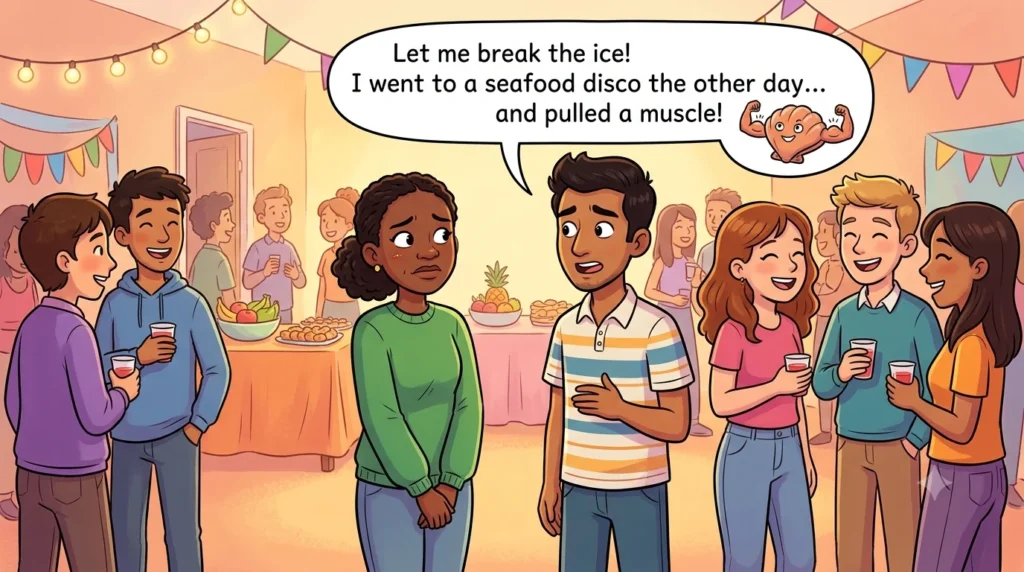
Idiomatic meaning: To start a conversation in a social setting.
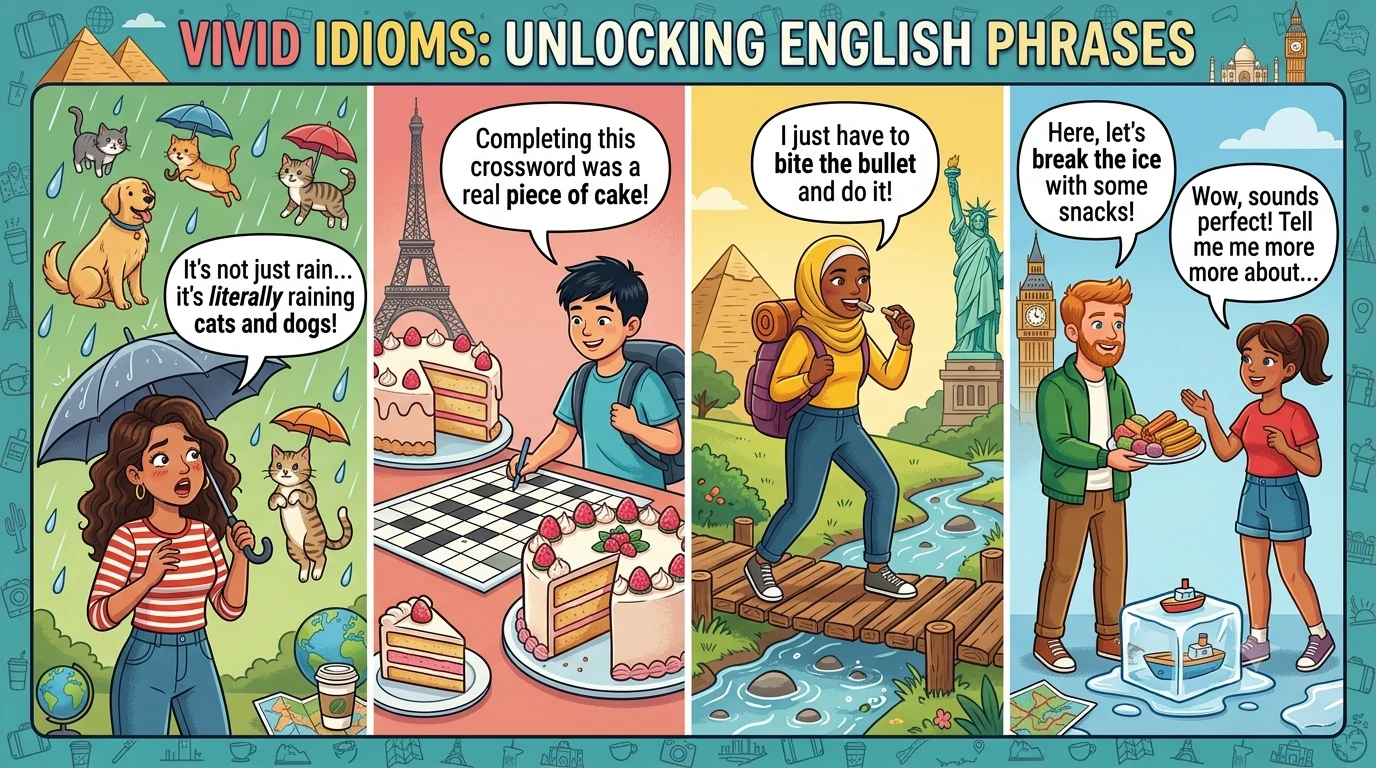
Example sentence: “I told a joke to break the ice at the meeting.”
Common error: Using it to mean “solve a problem.”
Usage note: Perfect for networking events and first dates.
Hit the Nail on the Head
Word-by-word meaning: To hit a nail precisely with a hammer.
Idiomatic meaning: To be exactly right about something.
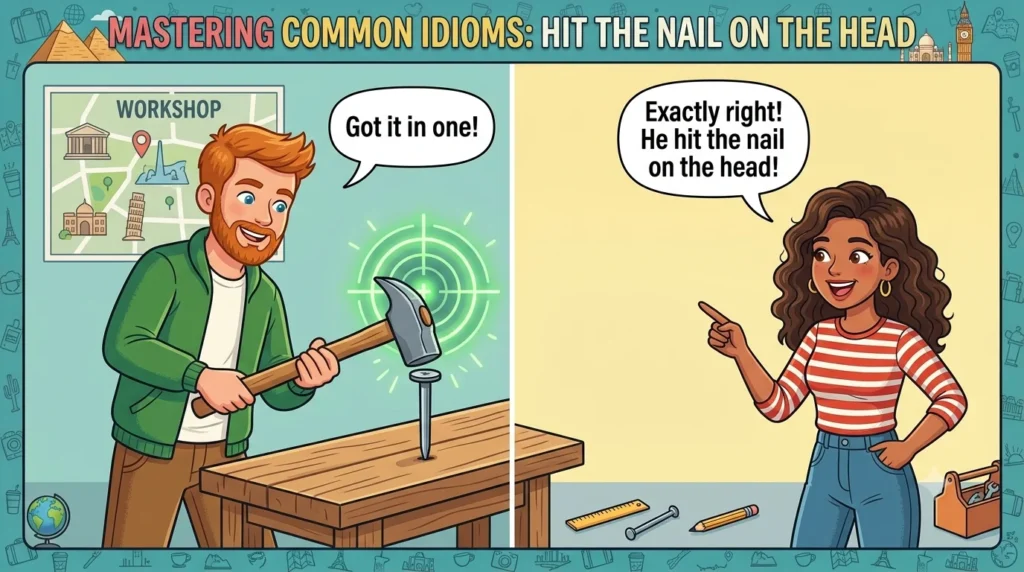
Example sentence: “You hit the nail on the head when you said she was overwhelmed.”
Common error: Saying “hit the head on the nail.”
Usage note: Use this when someone gives an accurate analysis.
Piece of Cake
Word-by-word meaning: A slice of cake.
Idiomatic meaning: Something very easy to do.
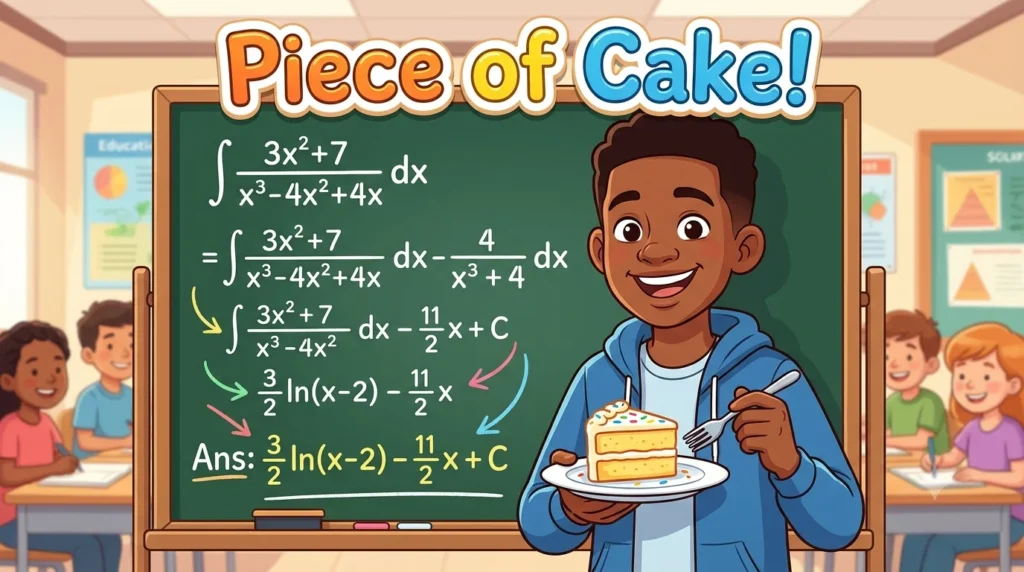
Example sentence: “The final exam was a piece of cake!”
Common error: Using it for anything merely “simple.”
Usage note: A close synonym is “as easy as pie.”
Let the Cat Out of the Bag
Word-by-word meaning: To allow a cat to escape from a bag.
Idiomatic meaning: To accidentally reveal a secret.
Example sentence: “He let the cat out of the bag about the surprise party.”
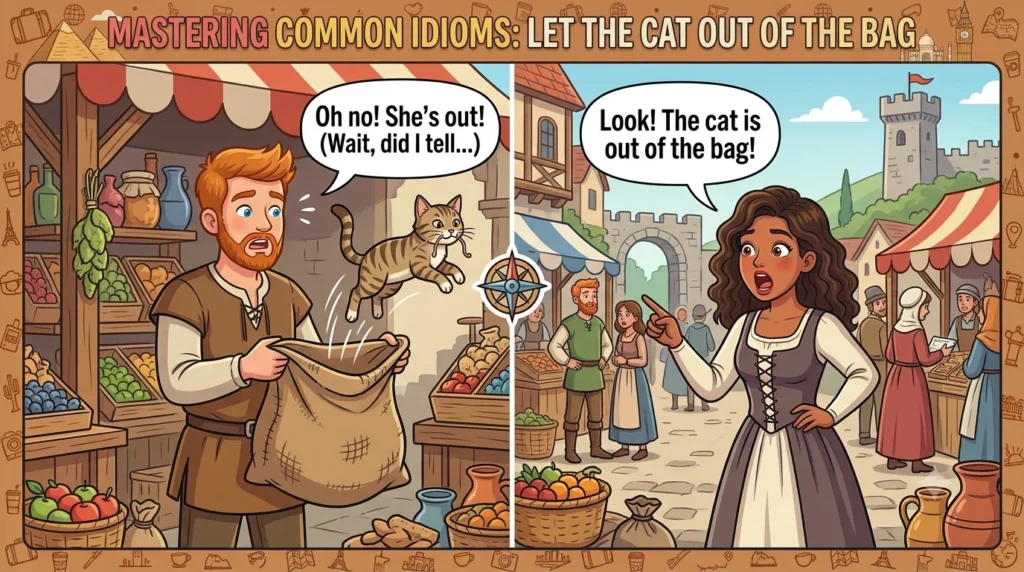
Common error: Using it for revealing good news intentionally.
Idiom etymology: Medieval traders would swap a piglet for a cat in a bag. When the buyer opened it, the “cat was out”!
Bite the Bullet
Word-by-word meaning: To bite down on a bullet.
Idiomatic meaning: To face a difficult situation with courage.
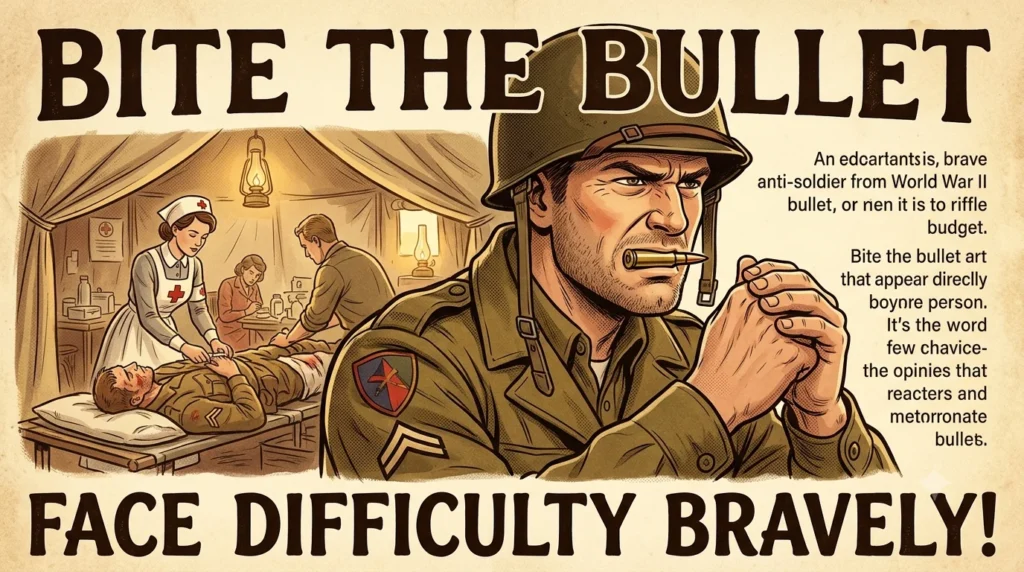
Example sentence: “I’m going to bite the bullet and apologize to my boss.”
Common error: Using it for merely annoying situations.
Idiom etymology: Before anaesthesia, soldiers bit bullets during surgery.
Caught Red-Handed
Word-by-word meaning: To be caught with red (bloody) hands.
Idiomatic meaning: To be caught in the act of doing something wrong.
Example sentence: “The thief was caught red-handed stealing from the store.”
Common error: Using it for being caught after the fact.
Cost an Arm and a Leg
Word-by-word meaning: To cost a bodily limb.
Idiomatic meaning: To be extremely expensive.
Example sentence: “That luxury car costs an arm and a leg!”
Common error: Using it for moderately priced items.
Spill the Beans
Word-by-word meaning: To tip over beans.
Idiomatic meaning: To reveal confidential information.
Example sentence: “Who spilled the beans about the promotion?”
Common error: Using it for accidentally revealing info.
Idiom etymology: In Ancient Greece, voting used beans to cast secret ballots.
Feel Under the Weather
Word-by-word meaning: To be below the weather.
Idiomatic meaning: To feel slightly ill or unwell.
Example sentence: “I’m not coming to work today; I’m feeling under the weather.”
Common error: Using it for serious illness.
Beat Around the Bush
Word-by-word meaning: To hit around a bush.
Idiomatic meaning: To avoid directly addressing the main topic.
Example sentence: “Stop beating around the bush and tell me the truth!”
Common error: Thinking it’s a positive quality.
Cut to the Chase
Word-by-word meaning: To skip to the chase scene.
Idiomatic meaning: To get to the point without wasting time.
Example sentence: “Just cut to the chase—did we get the contract?”
Common error: Using it in formal writing.
Burn the Midnight Oil
Word-by-word meaning: To burn oil at midnight.
Idiomatic meaning: To work late into the night.
Example sentence: “I’ve been burning the midnight oil to finish this project.”
Kill Two Birds with One Stone
Word-by-word meaning: To kill birds with a single stone.
Idiomatic meaning: To achieve two goals with one action.
Example sentence: “Walking the dog while listening to podcasts kills two birds with one stone.”
When Pigs Fly
Word-by-word meaning: At a time when pigs fly.
Idiomatic meaning: Never—something that will never happen.
Example sentence: “I’ll clean my room when pigs fly!”
A Dime a Dozen
Word-by-word meaning: Worth ten cents per dozen.
Idiomatic meaning: Very common and not special.
Example sentence: “Writers are a dime a dozen these days.”
The Ball Is in Your Court
Word-by-word meaning: The ball is on your side of the court.
Idiomatic meaning: It’s your turn to take action.
Example sentence: “I’ve made my offer—now the ball is in your court.”
Barking Up the Wrong Tree
Word-by-word meaning: A dog barking at an empty tree.
Idiomatic meaning: Looking for something in the wrong place.
Example sentence: “If you think I stole your phone, you’re barking up the wrong tree.”
Through Thick and Thin
Word-by-word meaning: Through dense forest and sparse terrain.
Idiomatic meaning: Through all circumstances, good and bad.
Example sentence: “We’ve stayed friends through thick and thin for twenty years.”
Once in a Blue Moon
Word-by-word meaning: When a blue moon appears.
Idiomatic meaning: Very rarely.
Example sentence: “He visits us once in a blue moon.”
Let Sleeping Dogs Lie
Word-by-word meaning: Allow sleeping dogs to remain asleep.
Idiomatic meaning: To avoid stirring up old problems.
Example sentence: “I decided to let sleeping dogs lie about the old conflict.”
In a Nutshell
Word-by-word meaning: Inside a nutshell.
Idiomatic meaning: Summarized concisely.
Example sentence: “Just give me the facts in a nutshell.”
Poker Face
Word-by-word meaning: A face used in poker.
Idiomatic meaning: An expressionless face showing no emotion.
Example sentence: “She kept a perfect poker face during negotiations.”
Back to Square One
Word-by-word meaning: Return to the first square on a game board.
Idiomatic meaning: Start all over again from the beginning.
Example sentence: “After the computer crashed, we were back to square one.”
Pulling Someone’s Leg
Word-by-word meaning: Pulling someone’s leg.
Idiomatic meaning: Joking with someone; teasing lightly.
Example sentence: “Don’t worry, I’m just pulling your leg!”
A Dead Ringer
Word-by-word meaning: A bell that rings.
Idiomatic meaning: Someone who looks exactly like someone else.
Example sentence: “Maria’s new boyfriend is a dead ringer for Mel Gibson.”
Down in the Dumps
Word-by-word meaning: Down in the garbage dump.
Idiomatic meaning: Feeling sad or depressed.
Example sentence: “He’s been down in the dumps since losing his job.”
Between a Rock and a Hard Place
Word-by-word meaning: Stuck between a rock and a hard place.
Idiomatic meaning: Faced with two equally bad options.
Example sentence: “I’m stuck between a rock and a hard place.”
Shoot the Breeze
Word-by-word meaning: To shoot at the wind.
Idiomatic meaning: To chat casually.
Example sentence: “Drop by later and we’ll shoot the breeze.”
Two-Faced
Word-by-word meaning: Having two faces.
Idiomatic meaning: Hypocritical; pretending to be something you’re not.
Example sentence: “He says nice things but talks behind my back—he’s so two-faced.”
Walk the Talk
Word-by-word meaning: To walk while talking.
Idiomatic meaning: To practice what you preach.
Example sentence: “If you give advice, you need to walk the talk.”
Types of Idioms Explained Simply
Understanding types of idioms helps you recognize patterns in idioms examples. According to linguistic experts, idioms can be classified in several ways.
Semantic Classification
1. Phraseological Fusions (Completely Fixed)
The meaning has nothing to do with individual words.
- Example: “kick the bucket” (to die)
- Example: “pull someone’s leg” (to tease)
2. Phraseological Unities (Partly Understandable)
The meaning can be understood from one component.
- Example: “skate on thin ice” (to take a risk)
- Example: “burn the candle at both ends” (to work too hard)
3. Phraseological Collocations (Transparent)
Words that often appear together naturally.
- Example: “fall in love”
- Example: “lose your temper”
Structural Classification
By Grammatical Function:
| Type | Examples |
|---|---|
| Verbal | “Talk through one’s hat” |
| Substantive | “White lie,” “tall order” |
| Adjectival | “High and mighty” |
| Adverbial | “In cold blood” |
| Interjectional | “My God!” |
These types of idioms help you understand their role in sentences and recognize them more easily.
Idioms Pronunciation and Etymology How to Pronounce “Idioms” Correctly
The pronunciation of “idioms” is straightforward: /ˈɪd.i.əmz/.
Break it down:
- ID (like the word “id”)
- ee (like the letter E)
- uhmz (like “ums” with a z sound)
Pronunciation tips:
- Stress the first syllable: ID-ee-umz
- The final sound is a “z” not an “s”
- Don’t say “id-EE-ums” or “id-ee-UMS”
Practice tip: Record yourself saying “idioms” and compare to native speakers. The correct idioms pronunciation will come naturally with practice!
The Fascinating Etymology of “Idiom”
The idiom etymology journey is truly fascinating:
- Ancient Greek: idioma (“a peculiarity”)
- Late Latin: idioma (same meaning)
- French: idiome
- English: idiom (entered in 1580s)
The Greek root idios means “one’s own” or “private.” This makes perfect sense—idioms are the private, insider language of native speakers!
Here are some interesting idiom etymologies:
| Idiom | Origin |
|---|---|
| “Raining cats and dogs” | Possibly from Norse mythology or 17th-century England |
| “Pulling someone’s leg” | 19th-century slang in England |
| “Spill the beans” | Ancient Greek voting practices |
Learning idiom etymology not only helps you remember the meaning but also makes the language come alive!
How to Use Idioms in a Sentence Correctly
Using idioms in a sentence takes practice. Here’s a complete guide to using them naturally.
The Dos and Don’ts
DO:
- ✅ Use idioms in casual conversation
- ✅ Practice one new idiom each day
- ✅ Pay attention to context
- ✅ Study idioms examples from native speakers
- ✅ Keep a journal of new idioms
DON’T:
- ❌ Overuse idioms (you’ll sound unnatural)
- ❌ Translate idioms from your native language
- ❌ Use idioms in formal academic writing
- ❌ Take idioms literally
- ❌ Force idioms where they don’t fit
Context Makes the Difference
Here are idioms examples showing how to use them naturally:
| Context | Idiom | Sentence |
|---|---|---|
| Work | “Hit the nail on the head” | “Maria hit the nail on the head with her strategy.” |
| Social | “Break the ice” | “The host played a game to break the ice.” |
| Encouragement | “Bite the bullet” | “You need to bite the bullet and ask for help.” |
| Advising caution | “Let sleeping dogs lie” | “Don’t bring up old issues—let sleeping dogs lie.” |
| Decision-making | “The ball is in your court” | “I’ve made my offer—now the ball is in your court.” |
Common Mistakes to Avoid
Mistake 1: Mixing Up Similar Idioms
- ❌ “I’m feeling over the weather” (Wrong)
- ✅ “I’m feeling under the weather” (Correct)
Mistake 2: Using the Wrong Preposition
- ❌ “I’m in the same boat like you” (Wrong)
- ✅ “I’m in the same boat as you” (Correct)
Mistake 3: Incorrect Word Order
- ❌ “The cat out of the bag is let” (Wrong)
- ✅ “He let the cat out of the bag” (Correct)
Mistake 4: Overusing Idioms
- ❌ “Piece of cake, I’m in the same boat, let’s kill two birds with one stone, and don’t beat around the bush!” (Too many!)
- ✅ Use one or two idioms per conversation naturally
People Also Ask About Idioms
Here are the most common questions about 100 idioms and their meanings and related topics.
What is the meaning of idioms in English?
The meaning of idioms in English refers to fixed expressions whose meaning cannot be understood from the literal words. They carry a figurative meaning that native speakers understand through common usage. For example, “break the ice” doesn’t mean smashing frozen water—it means to start a conversation.
How many idioms are there in the English language?
According to linguistic research, there are over 25,000 idioms in English. Learning 100 idioms and their meanings gives you a strong foundation for understanding about 90% of everyday conversations. The idioms wiki english suggests focusing on the most common ones first.
What are the most common types of idioms?
The main types of idioms are:
- Verbal idioms (verb-based): “break the ice”
- Noun-based idioms: “a piece of cake”
- Adjectival idioms: “high and mighty”
- Adverbial idioms: “in cold blood”
- Interjectional idioms: “Good heavens!”
These types of idioms help you understand how to use them grammatically.
How can I learn idioms effectively?
The best way to learn idioms and their meanings is:
- Read and listen: Engage with native content
- Practice daily: Create your own sentences
- Keep a journal: Write down new idioms
- Speak naturally: Use idioms in conversation
- Study etymology: Learning origins helps you remember
The correct idioms pronunciation will improve with listening practice.
Are idioms important for English fluency?
Absolutely! Knowing idioms in a sentence shows you understand the culture and can communicate naturally. While you don’t need to know all 100 idioms, learning common ones helps you sound fluent and connect with native speakers.
How do idioms differ from proverbs?
Idioms are fixed expressions with figurative meanings. Proverbs are traditional sayings that give advice or moral lessons. For example, “kick the bucket” (idiom) vs. “A stitch in time saves nine” (proverb).
Conclusion
Learning 100 idioms and their meanings is a journey, not a destination. The beauty of idioms is that they bring color, personality, and cultural depth to your English.
What you’ve learned today:
- ✅ The meaning of idioms in English
- ✅ 30+ idioms examples with clear explanations
- ✅ The types of idioms and how to recognize them
- ✅ Correct idioms pronunciation and idiom etymology
- ✅ How to use idioms in a sentence naturally
- ✅ Common mistakes to avoid
Your challenge:
Pick five idioms from this list of 100 idioms and their meanings. Use each one in a conversation this week. You’ll be surprised how naturally they’ll start flowing!
Next steps for mastery:
- Read books and watch shows in English
- Listen to podcasts and note down new idioms
- Practice with a language partner
- Keep adding to your idiom journal
- Review the idioms wiki english for more expressions
The more you practice, the more natural these expressions will feel. Soon you’ll be using idioms examples like a native speaker!

“Rose Macaulay shares the charm of idioms on LearnIdom.com, making language learning delightful, insightful, and full of wit for every reader.”