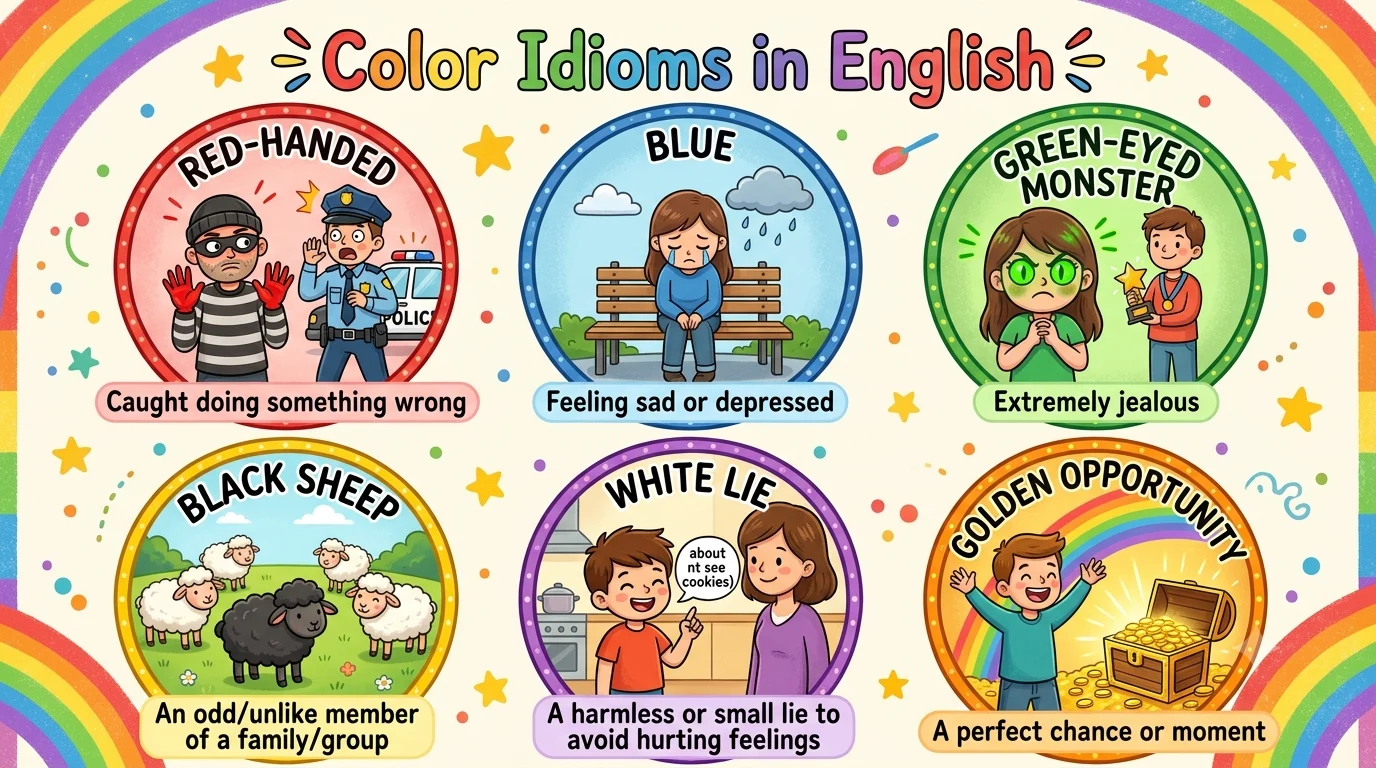
Have you ever felt blue on a Monday morning? Or caught someone red-handed eating your chocolate? Did a friend turn green with envy when you showed off your new phone?
Color idioms are everywhere in English. Native speakers use them daily without thinking. But for learners, these expressions can be confusing. A “white lie” isn’t about color. Being “in the red” has nothing to do with paint.
Learning these idioms is essential. They help you sound natural, understand native speakers, and express yourself more vividly. In fact, studies show that using idioms makes you appear 40% more fluent to native listeners.
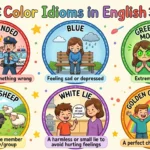
In this guide, you’ll learn 20 essential color idioms in English. Each one includes:
- Clear meaning
- Real example sentences
- Common mistakes to avoid
- Cultural context
Let’s make your English more colorful!
Red Idioms
Red idioms often express strong emotions or warnings. Here are the most useful ones.
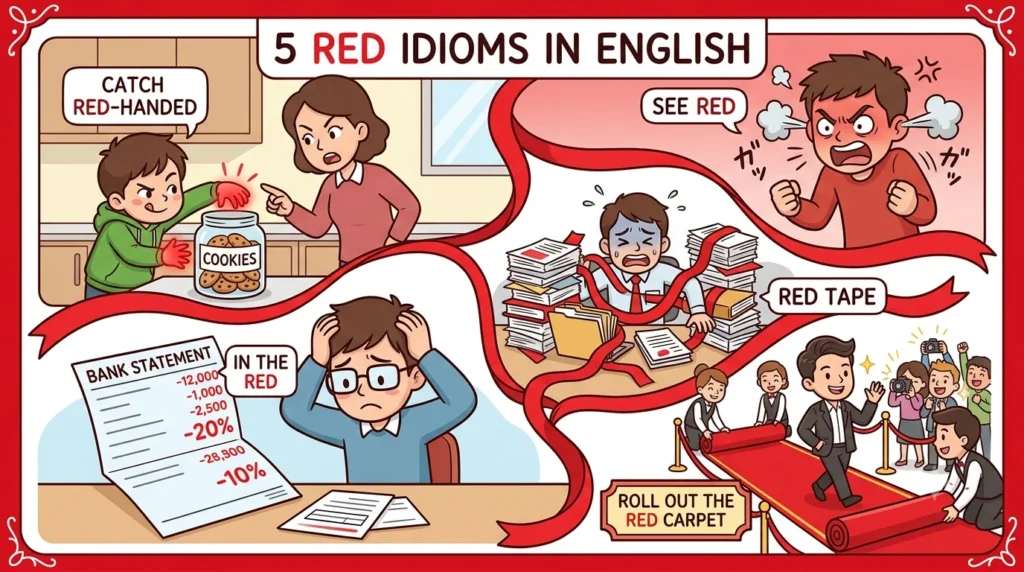
Catch Someone Red-Handed
Meaning: To discover someone doing something wrong at the exact moment they’re doing it.
Example:
“The children were caught red-handed stealing cookies from the jar.”
“I caught my brother red-handed reading my diary.”
Common Mistake: ❌ “She was caught red hand.”
Correct: ✅ “She was caught red-handed.”
Origin: This idiom comes from 15th-century Scotland. A murderer was found with the victim’s blood still on his hands. Today, it’s used for any wrongdoing—from minor mischief to serious crimes.
Usage Tip: Use this when you have proof. You can’t use it for suspected actions. You must see the person in the act.
See Red
Meaning: To become extremely angry.
Example:
“I saw red when that driver cut me off in traffic.”
“Cruelty to animals makes me see red.”
Common Mistake: ❌ “I saw red at him.”
Correct: ✅ “I saw red when I saw him.”
Origin: This comes from ancient battle flags. Red flags signaled soldiers to prepare for combat. The color red has been associated with aggression for thousands of years.
Usage Tip: Use this for explosive anger—not mild irritation. If someone steps on your foot, you don’t see red. If someone crashes your car, you probably do.
In the Red
Meaning: Owing money; having negative bank balance.
Example:
“After buying the house, we were in the red for two years.”
“My account is in the red again.”
Common Mistake: ❌ “My account is in red.”
Correct: ✅ “My account is in the red.”
Origin: Banks used red ink for negative balances and black ink for positive ones. If you’re in the red, you’ve spent more than you earned.
Usage Tip: The opposite is “in the black” (having money). Companies report their financial status using these terms. This idiom is common in business English.
Red Tape
Meaning: Excessive bureaucracy and paperwork that delays things.
Example:
“We couldn’t open the restaurant due to all the red tape.”
“Applying for a visa involves so much red tape.”
Common Mistake: ❌ “There’s red tape in government.”
Correct: ✅ “There’s too much red tape in government.”
Origin: In the 16th century, official documents were tied with red ribbon. The more red ribbon, the more bureaucracy.
Usage Tip: This is always negative. Nobody likes red tape. Use it when frustrated with administrative delays.
Roll Out the Red Carpet
Meaning: To give someone special treatment.
Example:
“The hotel rolled out the red carpet for the celebrity guests.”
“My grandmother rolls out the red carpet whenever we visit.”
Common Mistake: ❌ “We red carpeted him.”
Correct: ✅ “We rolled out the red carpet for him.”
Origin: The first movie premiere red carpet was in 1922. But the tradition goes back to ancient Greece, where kings walked on red floors.
Usage Tip: Use this for VIP treatment, celebrations, or special occasions. It shows you’re going above and beyond.
Blue Idioms
Blue idioms express emotions and unexpected events. They’re very common in daily conversation.
Feel Blue / Have the Blues
Meaning: To feel sad or depressed.
Example:
“I always feel blue during the winter months.”
“Fred has been feeling blue since his dog passed away.”
Common Mistake: ❌ “I’m blue today.”
Correct: ✅ “I’m feeling blue today.”
Origin: The color blue has been associated with sadness since the 17th century. Some say it comes from sailors who looked blue after being at sea for too long.
Usage Tip: This describes mild sadness, not clinical depression. It’s a gentle way to express unhappiness.
Once in a Blue Moon
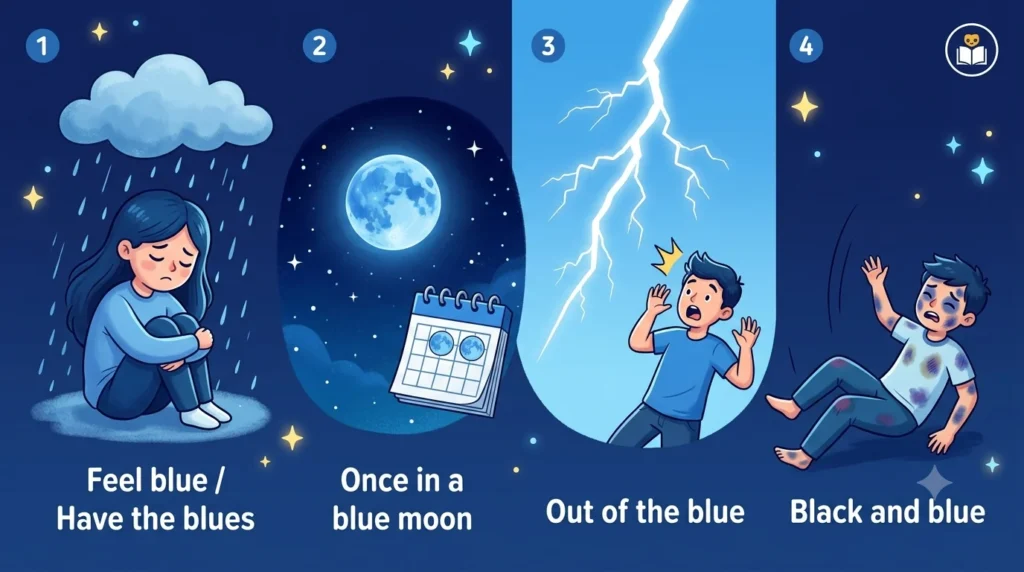
Meaning: Very rarely; almost never.
Example:
“We only go out for dinner once in a blue moon.”
“I see my cousins once in a blue moon.”
Common Mistake: ❌ “Once in the blue moon.”
Correct: ✅ “Once in a blue moon.”
Origin: A “blue moon” is a second full moon in one calendar month. This happens about every 2-3 years. So when something happens once in a blue moon, it’s very rare.
Usage Tip: Use this for special occasions. Don’t use it for things that happen regularly.
Out of the Blue
Meaning: Unexpectedly; without warning.
Example:
“She called me out of the blue after five years.”
“The job offer came completely out of the blue.”
Common Mistake: ❌ “Out of a blue.”
Correct: ✅ “Out of the blue.”
Origin: This comes from “out of the blue sky.” It compares unexpected events to lightning from a clear sky.
Usage Tip: Use this for surprising news or events. It can be positive or negative.
Black and Blue
Meaning: Covered in bruises.
Example:
“After the fall, his arm was black and blue.”
“The fight left him black and blue.”
Common Mistake: ❌ “He was black-and-blue.”
Correct: ✅ “He was black and blue.”
Usage Tip: This is physical, not emotional. Use it when someone has visible bruises.
Green Idioms
Green idioms connect to nature and growth. They’re surprisingly common in business and daily life.
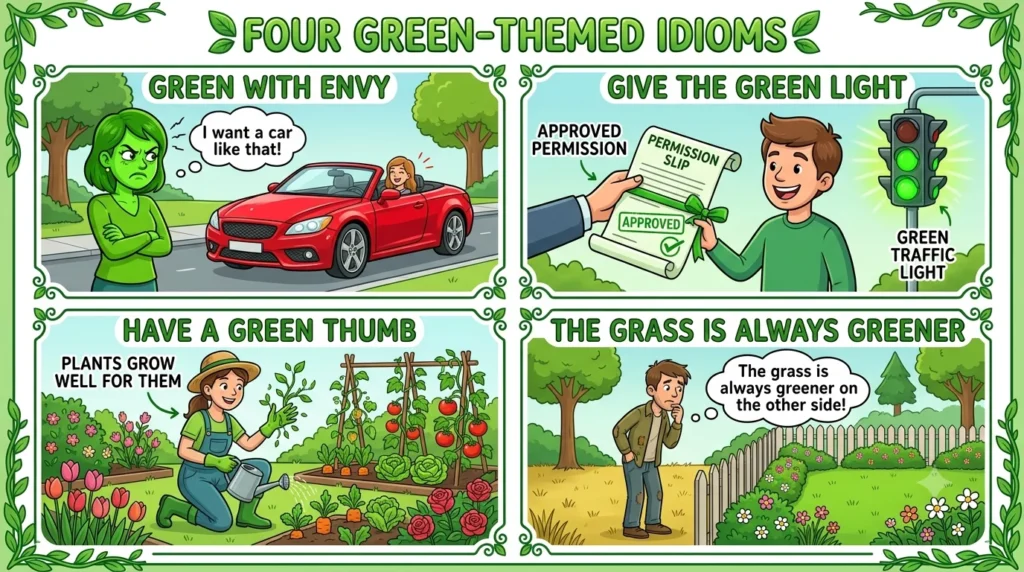
Green with Envy
Meaning: Very jealous.
Example:
“I was green with envy when my friend bought a new car.”
“She’s green with envy about my promotion.”
Common Mistake: ❌ “I have green envy.”
Correct: ✅ “I’m green with envy.”
Origin: Shakespeare coined the phrase “the green-eyed monster” in Othello. The color green has been linked to jealousy for centuries.
Usage Tip: This expresses strong jealousy. It’s often used in a lighthearted, joking way.
Give Someone the Green Light
Meaning: Give permission to proceed.
Example:
“The boss gave us the green light to start the project.”
“We’re waiting for the city to give the green light.”
Common Mistake: ❌ “We received green light.”
Correct: ✅ “We received the green light.”
Origin: Green traffic lights mean “go.” Railroads used green signals in the 1800s.
Usage Tip: This is common in business. It means formal approval.
Have a Green Thumb
Meaning: Skilled at gardening.
Example:
“Your garden looks amazing. You have a green thumb.”
“My grandmother has a green thumb. Everything grows for her.”
Common Mistake: ❌ “He has green fingers.” (This is UK English!)
Correct: ✅ US: “She has a green thumb.” UK: “She has green fingers.”
Origin: If you garden often, your thumb gets stained green from plants. That’s why this idiom exists.
Usage Tip: Use this for anyone good with plants. It’s always positive.
The Grass Is Always Greener
Meaning: People always think others have it better.
Example:
“She keeps changing jobs, thinking the next will be perfect. The grass is always greener.”
“I wish I was single, but the grass is always greener.”
Common Mistake: ❌ “Grass is greener.”
Correct: ✅ “The grass is always greener.”
Origin: This comes from a 1920s American folk song. It’s a warning against envy.
Usage Tip: This is a proverb, so it’s used as a complete thought. It reminds us that appearances can be deceiving.
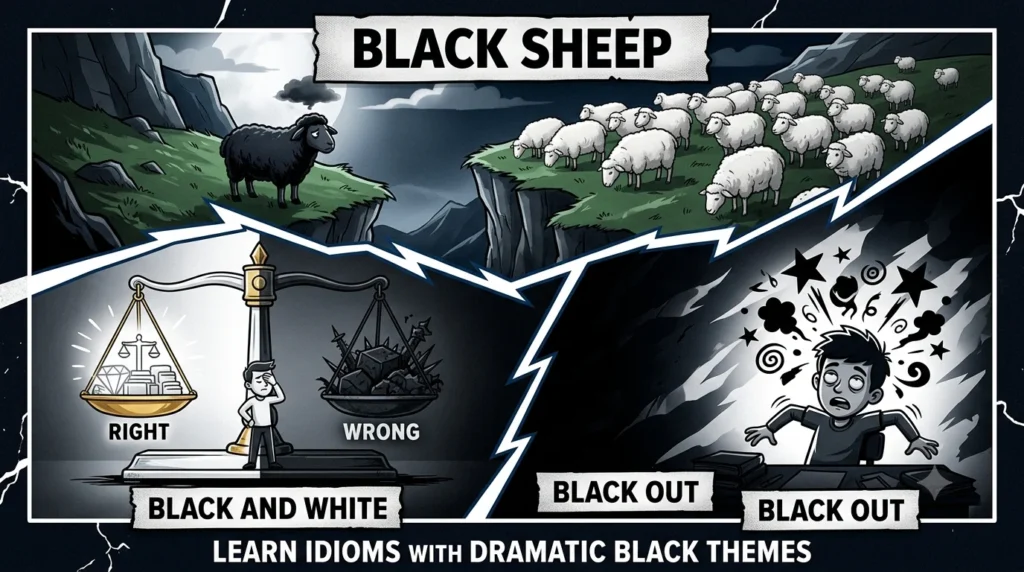
Black Idioms
Black idioms often carry serious meanings. They describe outsiders, clear rules, and unconsciousness.
Black Sheep
Meaning: A person who is an embarrassment to their family.
Example:
“My brother was the black sheep. He dropped out of school.”
“Being the black sheep, he was cut from the will.”
Common Mistake: ❌ “He’s the black sheep of the school.”
Correct: ✅ “He’s the black sheep of the family.”
Origin: Black sheep were less valuable because their wool couldn’t be dyed. They stood out in a negative way.
Usage Tip: This is usually about family. Use it for someone who doesn’t fit in.
Black and White
Meaning: Clear, straightforward, with no gray areas.
Example:
“The rules are black and white. No phones in class.”
“This situation isn’t black and white. There are exceptions.”
Common Mistake: ❌ “This is black-white.”
Correct: ✅ “This is black and white.”
Usage Tip: Use this when rules are absolute. It’s the opposite of a “gray area.”
Black Out
Meaning: To lose consciousness or memory.
Example:
“I blacked out at the sight of blood.”
“He blacked out and woke up in the hospital.”
Common Mistake: ❌ “He blacked.”
Correct: ✅ “He blacked out.”
Usage Tip: This describes temporary unconsciousness, often from alcohol or injury.
Other Color Idioms
White Lie
Meaning: A harmless lie to avoid hurting feelings.
Example:
“I told a white lie and said her cooking was delicious.”
“We told Grandma a white lie about the cake.”
Common Mistake: ❌ “He told a white lie to get out of trouble.”
Correct: ✅ “He told a white lie to spare her feelings.”
Origin: White represents purity and innocence. A white lie isn’t meant to harm.
Usage Tip: White lies are acceptable for social reasons. They protect people’s feelings.
Tickled Pink
Meaning: Very pleased or delighted.
Example:
“I was tickled pink when I got the promotion.”
“My mom was tickled pink with her birthday gift.”
Common Mistake: ❌ “I’m pink tickled.”
Correct: ✅ “I’m tickled pink.”
Origin: Pink was associated with good health and happiness in 17th-century England.
Usage Tip: This is informal and cheerful. Use it for good news and surprises.
With Flying Colors
Meaning: With great success.
Example:
“She passed the exam with flying colors.”
“We finished the project with flying colors.”
Common Mistake: ❌ “I passed with flying.” (Missing “colors”)
Correct: ✅ “I passed with flying colors.”
Origin: Ships returned to port with their flags flying to show victory.
Usage Tip: Use this for tests, reviews, or any challenge you’ve excelled at.
Golden Opportunity
Meaning: A perfect, rare chance.
Example:
“This job offer is a golden opportunity.”
“House prices are low. It’s a golden opportunity to buy.”
Common Mistake: ❌ “It’s a gold opportunity.”
Correct: ✅ “It’s a golden opportunity.”
Usage Tip: Use this for chances that don’t come often. It implies you should seize it.
Practice Worksheet
Fill in the blanks with the correct idiom:
- She was __________ with envy when she saw Jim’s new car.
- The kids were caught __________ stealing cookies.
- We only go out for dinner __________ in a blue moon.
- I always __________ blue during winter.
- The boss gave us the __________ to start the project.
- My mom was tickled __________ with her gift.
- He’s the __________ sheep of the family.
- She passed her exam with flying __________.
Answers:
- green
- red-handed
- once
- feel
- green light
- pink
- black
- colors
Frequently Asked Questions
Q: What are the most common color idioms in English?
The most commonly used color idioms include “feel blue” (sad), “green with envy” (jealous), “catch someone red-handed” (catch doing wrong), “black sheep” (outsider), and “white lie” (harmless lie). These appear most frequently in daily conversation.
Q: How can I learn color idioms effectively?
Start with 5-10 common idioms. Use them in conversations. Watch movies and note how native speakers use them. Complete practice worksheets and download idiom PDFs. The more you use them, the more natural they become.
Q: Are color idioms used in business English?
Yes! “In the red” (losing money), “give the green light” (approve), and “red tape” (bureaucracy) are very common in business. They show you understand professional English culture.
Q: Do all cultures use the same color symbolism?
No. In Western cultures, white symbolizes purity. In some Eastern cultures, white symbolizes mourning. Always learn the cultural context. This is why idioms don’t always translate directly.
Q: Where can I practice more?
Visit websites like the British Council or Cambridge Dictionary. They offer free exercises. Search for “idioms with colours exercises” online. Many language learning apps also have idiom sections.
Conclusion
Color idioms make English more vivid. They help you express emotions, describe situations, and sound natural. Native speakers use them constantly. Understanding them is key to fluency.
Start with 5 idioms today. Use them in one conversation. Notice how people react. Tomorrow, try 5 more. Within a month, you’ll be using color idioms naturally.
Your challenge: Use three color idioms in the next 24 hours. Write them down. Say them aloud. Notice how they change your communication. You might be tickled pink by the results!

“L.P. Hartley brings classic idioms to life on LearnIdom.com, helping readers explore language with wit, clarity, and timeless insight.”