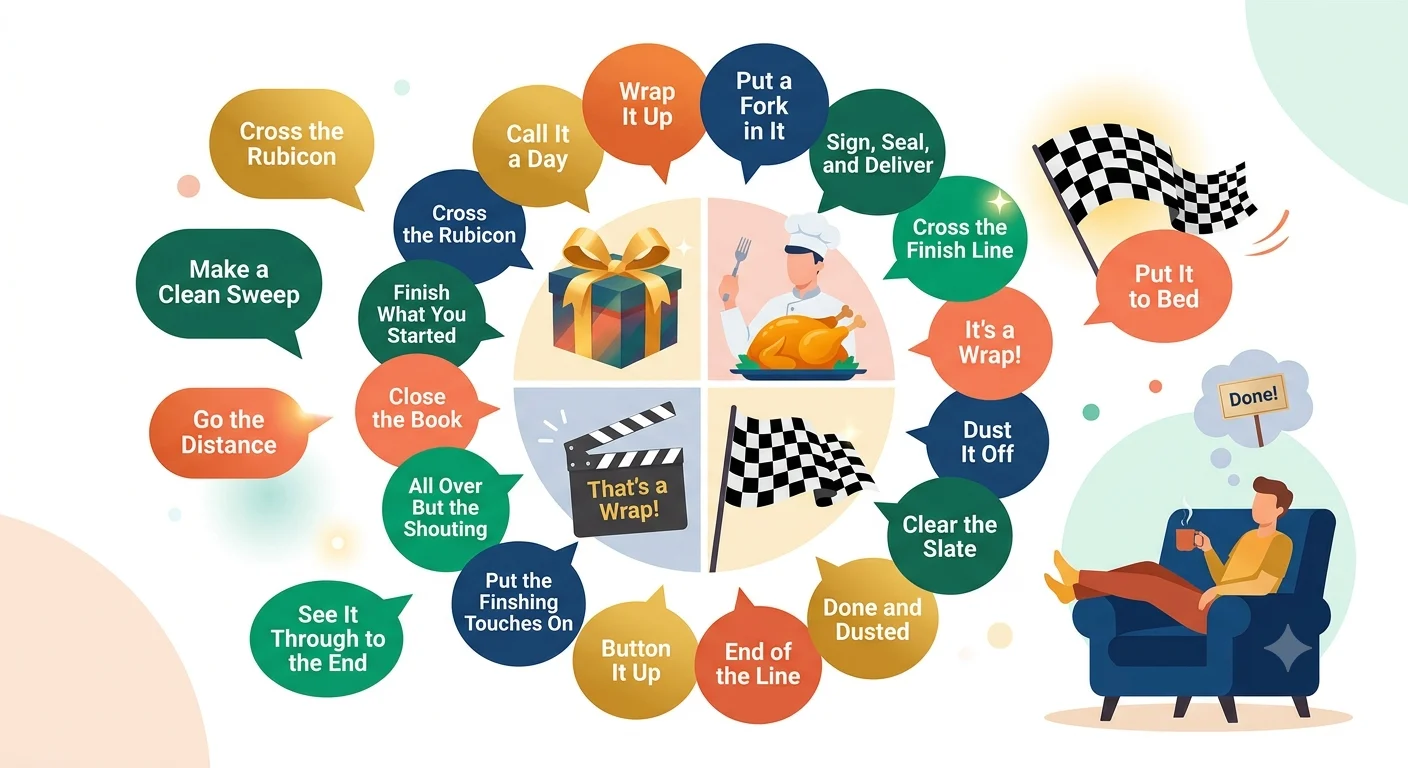
Have you ever completed a big project and struggled to find the perfect words? Native English speakers use colorful idioms for finishing something that make their speech vibrant and natural. These expressions go beyond simple words like “done” or “finished” to add personality, emotion, and cultural flair to your communication.
Idioms for finishing something are figurative phrases that describe completion, closure, or endings in creative ways. They help you express yourself more precisely and connect better with native speakers. Whether you’re wrapping up a work presentation, ending a relationship, or simply finishing your daily tasks, these idioms will elevate your English to new heights.
Call It a Day
Word-by-Word Meaning: To declare that today’s work is complete.
Idiomatic Meaning: This popular phrase means to stop working for the rest of the day, whether or not you’ve finished everything. It’s one of the most common idioms for finishing something in workplace settings.

Example Sentences:
- “We’ve been coding for eight hours. Let’s call it a day and continue fresh tomorrow morning.”
- “The kids are exhausted from their exams. I think we should call it a day and order pizza.”
Common Error: Don’t use this when you’ve completely finished a project. Use it when you’re pausing work and plan to continue later.
Usage Note: Perfect for professional environments and daily routines. This phrase works beautifully in both British and American English.
Done and Dusted
Word-by-Word Meaning: Completed and cleared of dust particles.
Idiomatic Meaning: To have completely finished something with all loose ends tied up. This satisfying idiom for completing a task implies thoroughness and finality.
Example Sentences:

- “After three months of renovation, our kitchen is finally done and dusted!”
- “The annual report is done and dusted—now we can enjoy the weekend.”
Common Error: Avoid using this for tasks that still have pending issues. It means total completion only.
Usage Note: Popular in British English but understood globally. Use this when you want to express genuine relief and satisfaction.
That’s a Wrap
Word-by-Word Meaning: The filming has concluded.
Idiomatic Meaning: Something has been successfully finished and concluded. This phrase for finishing something originated in the movie industry and now applies to any completed activity.
Example Sentences:

- “Alright everyone, that’s a wrap on today’s photoshoot. Great teamwork!”
- “I just submitted my final thesis chapter. That’s a wrap for my master’s degree!”
Common Error: Save this for substantial achievements, not minor daily tasks.
Usage Note: This expression adds a touch of Hollywood glamour to your completions. It’s one of the most memorable idioms for finishing something important.
Stick a Fork in It
Word-by-Word Meaning: Insert a fork into meat to check doneness.
Idiomatic Meaning: To indicate that something is completely finished, often with humor. This funny idiom for finishing something comes from cooking.
Example Sentences:
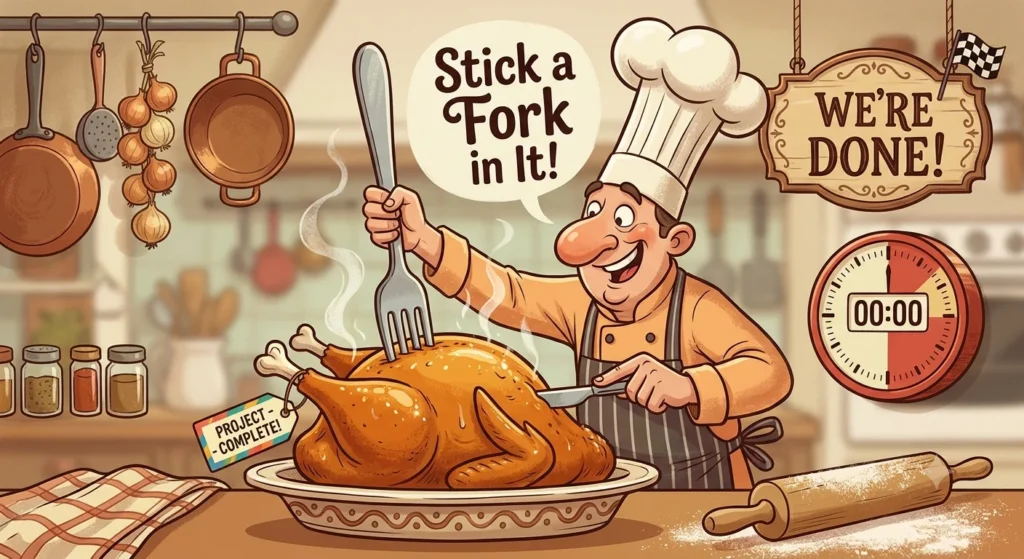
- “The negotiations have dragged on for weeks. Stick a fork in it—we’re finally done.”
- “After failing three times, stick a fork in my piano lessons. I give up!”
Common Error: This can sound sarcastic, so use carefully in formal situations.
Usage Note: Among idioms for finishing something funny, this ranks highest for its visual, memorable quality. Perfect for casual conversations.
Finish on a High Note
Word-by-Word Meaning: End with a musical tone that’s high and pleasing.
Idiomatic Meaning: To complete something successfully and impressively, ending at a peak moment. This positive idiom for ending a relationship with a project emphasizes excellence.
Example Sentences:
- “She decided to finish her career on a high note by winning the championship.”
- “Let’s finish this presentation on a high note with our best statistics.”
Common Error: This implies ending well, not just ending. Don’t use it for average or poor completions.
Usage Note: Excellent for professional achievements and personal milestones. Use when you want to emphasize success.
End of the Line
Word-by-Word Meaning: The final stop on a railway route.
Idiomatic Meaning: The point where it’s no longer possible to continue. This phrase for the end of something implies finality with no options remaining.
Example Sentences:
- “If we don’t get this investment, it’ll be the end of the line for the startup.”
- “Our relationship reached the end of the line after years of struggle.”
Common Error: This suggests no hope of revival. Don’t use for temporary pauses.
Usage Note: Among idioms for ending a relationship, this one is particularly powerful for describing final breakups.
Last Hurrah
Word-by-Word Meaning: A final celebration or festive effort.
Idiomatic Meaning: A final effort or achievement, especially at the end of a long career. This sentimental phrase for the end of something carries emotional weight.
Example Sentences:
- “The reunion concert was the band’s last hurrah before retiring.”
- “This final project will be my last hurrah in academia.”
Common Error: Reserve this for significant final events, not everyday tasks.
Usage Note: One of the more emotional idioms for finishing something important in life.
Break Off With
Word-by-Word Meaning: To snap or separate from something.
Idiomatic Meaning: To end a relationship, typically romantic. This is one of the most direct idioms for ending a relationship.
Example Sentences:
- “She finally decided to break off with her toxic boyfriend.”
- “After months of conflict, they broke off with each other peacefully.”
Common Error: Always use “with,” not “from” in this construction.
Usage Note: Specifically for relationships, not tasks or projects.
Finish With
Word-by-Word Meaning: To complete engagement with something.
Idiomatic Meaning: To complete something or no longer be involved with it. This versatile phrase for completing a task can also mean ending a relationship.
Example Sentences:
- “When you finish with that newspaper, can I read it?”
- “I’ve given her enough chances. I’m finished with her now.”
Common Error: In the relationship sense, this implies strong finality—use carefully.
Usage Note: This has multiple meanings depending on context. Pay attention to your audience.
Draw to a Close
Word-by-Word Meaning: To pull toward an ending point.
Idiomatic Meaning: To formally end something, especially official activities. This is among the more formal phrases for the end of something.
Example Sentences:
- “I think we’ll draw this meeting to a close now.”
- “The wedding ceremony was drawn to a close with a beautiful song.”
Common Error: This is formal—avoid in casual conversation.
Usage Note: Perfect for professional settings and formal ceremonies.
Finish Off
Word-by-Word Meaning: To complete the final portion.
Idiomatic Meaning: To add a final touch or to complete something thoroughly. This can also mean to defeat someone or use up the last of something.
Example Sentences:
- “I like to finish off this pasta with fresh parmesan cheese.”
- “Let’s finish off these snacks before the movie starts.”
Common Error: When used for defeating someone, ensure the context is clear.
Usage Note: One of the most practical phrases for completing a task.
The Dying Moments
Word-by-Word Meaning: The final seconds before death.
Idiomatic Meaning: The last few seconds or minutes of an event, especially sports. This dramatic phrase for the end of something adds tension.
Example Sentences:
- “In the dying moments, the striker scored the winning goal.”
- “The tension was unbearable in the dying moments of the final match.”
Common Error: This is dramatic—reserve for tense situations.
Usage Note: Commonly used in sports commentary and thrilling narratives.
Death Knell
Word-by-Word Meaning: The bell rung to announce death.
Idiomatic Meaning: Evidence that something is ending and will be replaced. This serious idiom for finishing something is quite powerful.
Example Sentences:
- “The opening of the mega-mall will sound the death knell for small shops.”
- “This policy marks the death knell for traditional farming.”
Common Error: This implies permanent end, not temporary setback.
Usage Note: One of the more serious expressions for endings.
Finish Up
Word-by-Word Meaning: Complete the final portion.
Idiomatic Meaning: To complete something, especially projects or tasks. This is one of the most common idioms for finishing a task in daily speech.
Example Sentences:
- “I just need to finish up this email before we leave.”
- “Let’s finish up the cleaning and go home.”
Common Error: Similar to “finish off,” but “up” emphasizes the ending process.
Usage Note: Very common in everyday conversations.
Wrap Up
Word-by-Word Meaning: To cover or enclose.
Idiomatic Meaning: To complete or finalize something, especially meetings or events. This essential phrase for finishing something is crucial for workplace communication.
Example Sentences:
- “Let’s wrap up this meeting with action items.”
- “I need to wrap up this project by Friday.”
Common Error: Don’t confuse with “that’s a wrap,” which signals completion of the entire event.
Usage Note: Essential for professional environments.
Wind Up
Word-by-Word Meaning: To twist or coil something.
Idiomatic Meaning: To bring something to an end, especially gradually. This similar idiom to wrap up is slightly more informal.
Example Sentences:
- “The speaker wound up his lecture with a Q&A session.”
- “Let’s wind up this discussion and make a decision.”
Common Error: Can also mean to tighten, so ensure context is clear.
Usage Note: Good for informal professional settings.
Put a Lid On It
Word-by-Word Meaning: Place a cover on a container.
Idiomatic Meaning: To finish or control something, often to stop a situation. This phrase for finishing something often implies a desire to stop.
Example Sentences:
- “The meeting ran too long, so the manager decided to put a lid on it.”
- “That’s enough debate—put a lid on it for today.”
Common Error: Can mean to keep quiet as well—context matters.
Usage Note: Often used when you want to stop rather than naturally conclude.
End in Itself
Word-by-Word Meaning: An ending that serves as the purpose.
Idiomatic Meaning: Something done for its own sake, not as a means to something else. This philosophical idiom for completing a task is more thoughtful.
Example Sentences:
- “For her, winning was an end in itself, not just the prize money.”
- “Learning should be an end in itself, not only for grades.”
Common Error: This describes purpose, not an action.
Usage Note: More philosophical than other idioms for finishing something.
Give the Push
Word-by-Word Meaning: To push someone away.
Idiomatic Meaning: To fire someone from a job or end a relationship. This is a British idiom for finishing a relationship.
Example Sentences:
- “The boss gave him the push after repeated mistakes.”
- “She gave her boyfriend the push last week.”
Common Error: Primarily British—may not be understood in American English.
Usage Note: Among idioms for ending a relationship, this is quite informal.
Finish in Second Place
Word-by-Word Meaning: To complete a race behind the winner.
Idiomatic Meaning: To achieve second position in any competition. This is among the more literal phrases for completing a task.
Example Sentences:
- “Our team finished in second place in the competition.”
- “She finished second in the national spelling bee.”
Common Error: This is literal, not figurative.
Usage Note: Good for competitive contexts.
How to Use These Idioms Naturally
Choose Based on Your Situation
For Work Projects:
- Use “done and dusted” or “wrap up” for completed tasks
- Use “call it a day” when stopping work temporarily
For Relationships:
- Use “break off with” or “give the push” for endings
- Use “finish with” to express finality
For Achievements:
- Use “finish on a high note” for success
- Use “last hurrah” for significant final efforts
For Humorous Situations:
- Use “stick a fork in it” for casual settings
- Use “that’s a wrap” for creative completions
Pro Tips for Natural Usage
- Listen to native speakers in movies, podcasts, and conversations
- Practice with friends or language exchange partners
- Start with 3-5 idioms and master them before learning more
- Match the tone to the situation—formal for business, casual for friends
- Don’t overuse the same idiom—vary your expressions
Reference Table
| Situation | Best Idiom | Formality |
|---|---|---|
| Ending work day | Call it a day | Casual |
| Completed project | Done and dusted | Informal |
| Meeting ending | Wrap up | Professional |
| Relationship end | Break off with | Neutral |
| Sports victory | Finish on a high note | Neutral |
| Humorous ending | Stick a fork in it | Very casual |
Common Mistakes to Avoid
Mistake 1: Using Formal Idioms Casually
Wrong: “I’m going to draw this pizza to a close.”
Right: “I’m going to finish off this pizza.”
Mistake 2: Wrong Prepositions
Wrong: “She broke off from her boyfriend.”
Right: “She broke off with her boyfriend.”
Mistake 3: Mixing Up Similar Idioms
Wrong: “Let’s wrap up the project” (when you mean stop temporarily)
Right: “Let’s call it a day” (for stopping temporarily)
Right: “Let’s wrap up the project” (for completing it)
Mistake 4: Using Humorous Idioms in Serious Situations
Wrong: “Stick a fork in our relationship.”
Right: “Our relationship has reached the end of the line.”
Mistake 5: Overusing One Idiom
Problem: Saying “call it a day” for everything
Solution: Use “wrap up,” “finish up,” and “done and dusted” for variety
Frequently Asked Questions
What is the idiom for completing a task?
Several idioms express task completion effectively. “Done and dusted” implies thorough completion, “wrap up” suggests finalizing details, and “finish up” is perfect for everyday tasks. For formal contexts, use “bring to a close” or “draw to a conclusion.”
What are common phrases using finish?
Common phrases include “finish up,” “finish off,” “finish with,” and “finish on a high note.” Each has slightly different meanings. “Finish up” emphasizes the process, “finish off” suggests adding a final touch, and “finish with” can mean ending involvement with something or someone.
How do you say done in a cool way?
You can say “done and dusted,” “stick a fork in it,” or “that’s a wrap” to sound more interesting and conversational. “Game over” is also popular in casual settings. For a professional edge, try “completed” or “finalized” with a confident tone.
What are the top 10 idioms for endings?
The top 10 idioms include: “call it a day,” “done and dusted,” “that’s a wrap,” “stick a fork in it,” “finish on a high note,” “end of the line,” “last hurrah,” “break off with,” “finish with,” and “draw to a close.” These cover work, relationships, achievements, and daily activities.
How do you say “the end” professionally?
In professional settings, use “draw to a close,” “bring to a conclusion,” or “reach completion.” These formal phrases sound polished and appropriate for business contexts. “Wrap up” is also acceptable in less formal professional environments.
Can I use these idioms in writing?
Absolutely! These idioms work well in emails, reports, social media posts, and creative writing. However, avoid overly casual idioms like “stick a fork in it” in formal business documents. Choose idioms that match your audience and purpose.
Conclusion
Learning idioms for finishing something transforms your English from basic to brilliant. These expressions add color, personality, and cultural depth to your communication. Whether you’re completing a project, ending a relationship, or simply finishing your day, you now have a rich vocabulary to express yourself naturally.
Your Action Plan:
- Choose 3 idioms from this list that resonate with you
- Practice them in conversations this week
- Pay attention to how native speakers use these expressions
- Gradually expand your collection as you grow more confident
- Share your favorite idioms with fellow English learners
Remember, becoming fluent in idioms takes time and practice. Be patient with yourself and celebrate each small victory. With consistent effort, you’ll soon sound like a native speaker in any situation involving completion or endings.
Ready to take your English further? Start by using one new idiom each day for the next 20 days. Before you know it, these phrases will become second nature!

“Iris Murdoch explores the beauty of language and idioms on LearnIdom.com, making learning phrases engaging, memorable, and fun for everyone.”