Have you ever waited for a friend who was “fashionably late” and felt like the minutes stretched into hours? Or sat through a meeting that seemed to last an eternity? We’ve all been there.
In English, we have a treasure trove of colorful idioms for a long time to describe these experiences. Instead of simply saying, “It took a long time,” you can say, “It took for ages,” or, “I’ve been waiting since the dawn of time.”
Using these idioms for time passing slowly or when talking about a long duration will instantly make your English sound more natural and engaging. This guide explores the most common and quirky expressions, breaking them down so you can start using them today. Mastering these idioms for a long time will transform your English from basic to brilliant! Let’s dive in!
What is the Idiom for a Very Long Time?
There isn’t just one! The best idiom depends on the context—whether you’re talking about waiting, a long-lasting friendship, or a boring event. Some of the most versatile idioms for a long time include:
- For ages: This is the go-to phrase for any long period. “I haven’t seen you for ages!”
- An eternity: Use this to exaggerate a long wait. “The movie felt like an eternity.”
- Since the dawn of time: This is a hyperbole, meaning from the very beginning. “People have told stories since the dawn of time.”
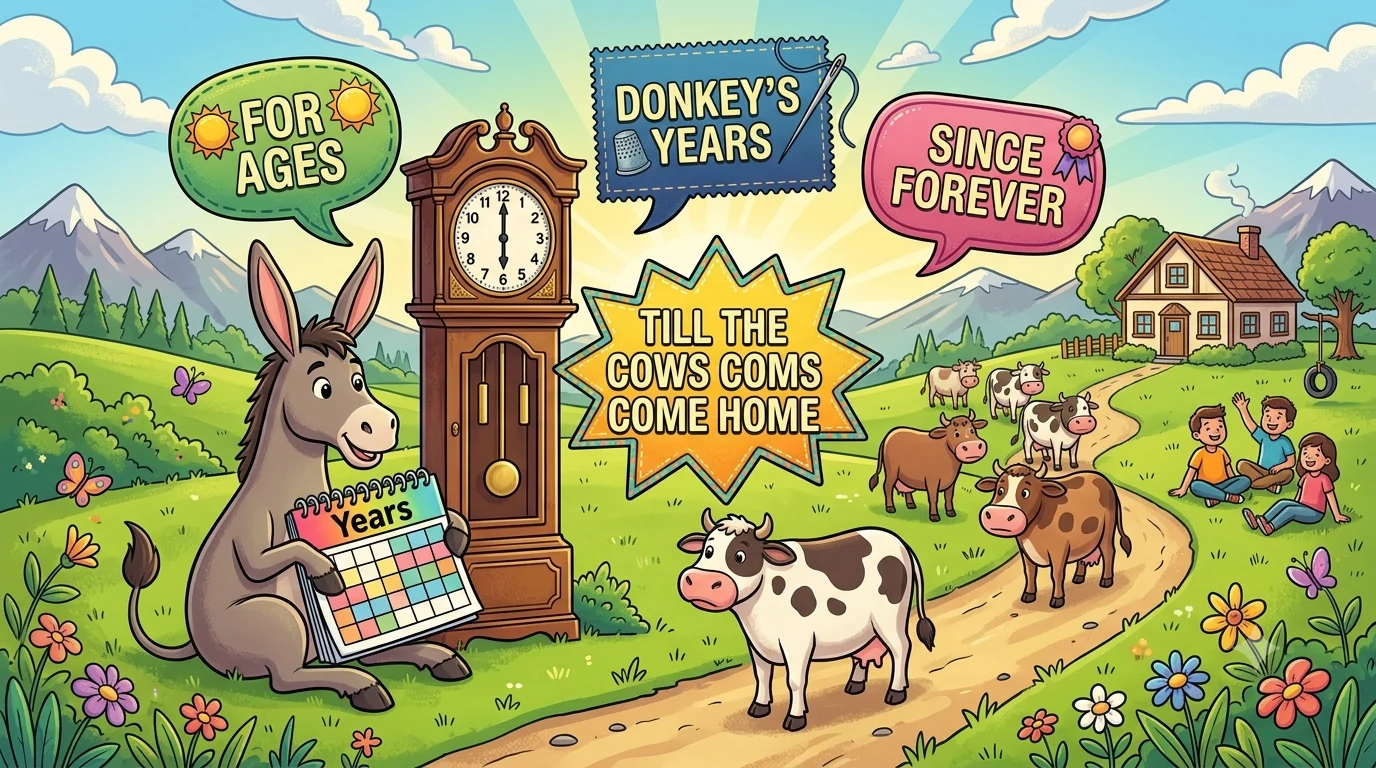
- For donkey’s years: A quirky British phrase meaning for many years. “He’s lived in that house for donkey’s years.”
These popular idioms for a long time are used daily by native speakers across the globe. Let’s explore them in detail!
For Ages
Word-by-word meaning: For a period of time that is very long, like an “age” in history.
Idiomatic Meaning: For a very long time.
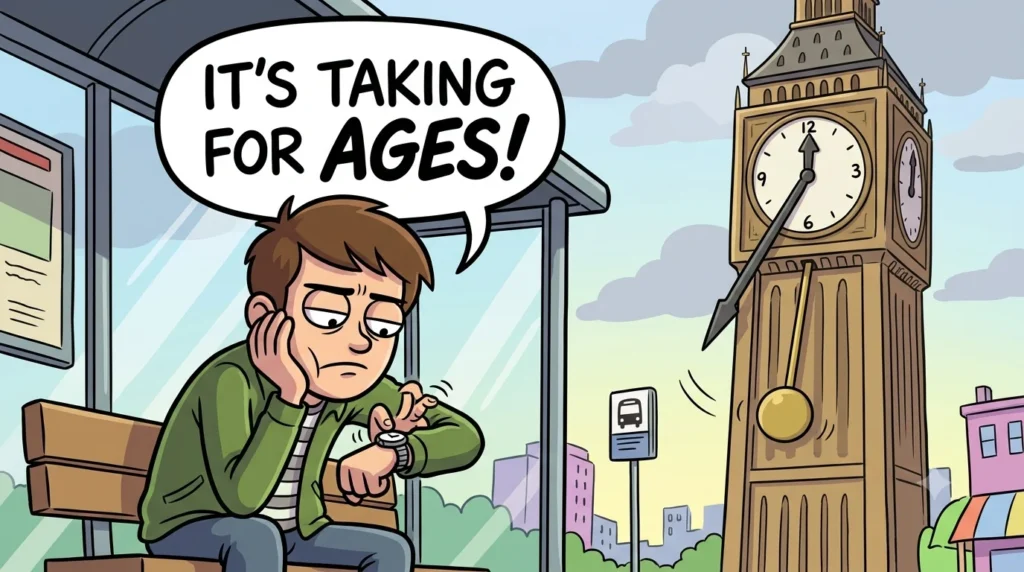
Example Sentences: “We waited for ages at the restaurant.” / “I haven’t seen you for ages!”
Common Error: Saying “for an age” is acceptable, but “for ages” is much more common.
Usage Note: Used for almost any situation where time feels prolonged. This is one of the most versatile idioms for a long time.
For Donkey’s Years
Word-by-word meaning: The phrase is a pun! It’s a play on “donkey’s ears” (which are long) and “years.”
Idiomatic Meaning: For a very long time, usually many years.
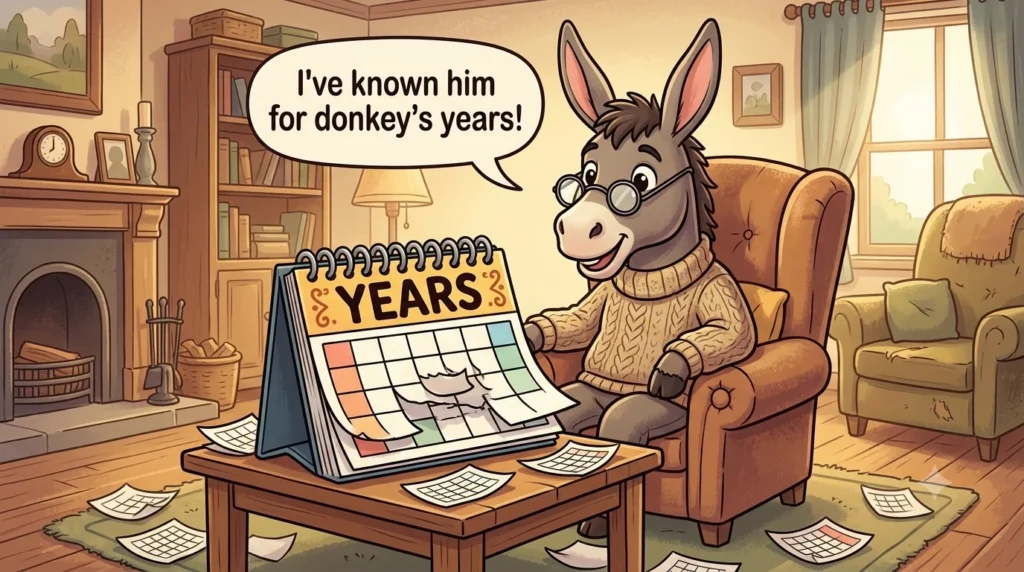
Example Sentences: “I’ve known him for donkey’s years—we went to school together.” / “I haven’t been to that store in donkey’s years.”
Common Error: It’s always donkey’s years, not “donkeys years.”
Usage Note: Informal and a little humorous. Common in British English. Among all idioms for a long time, this one is the most playful!
Since the Dawn of Time
Word-by-word meaning: From the “dawn” or beginning of all time.
Idiomatic Meaning: For a very, very long time, since the beginning of existence. Used for emphasis.

Example Sentences: “These mountains have stood here since the dawn of time.” / “People have been curious since the dawn of time.”
Common Error: Using it for something that only started a few years ago (unless it’s a joke).
Usage Note: Very dramatic and hyperbolic. Perfect when you want to emphasize something ancient.
Till the Cows Come Home
Word-by-word meaning: Until the cows return to the barn in the evening.
Idiomatic Meaning: For a very long time, possibly forever.
Example Sentences: “You can argue till the cows come home, but I’m still right.” / “We could sit here and chat till the cows come home.”
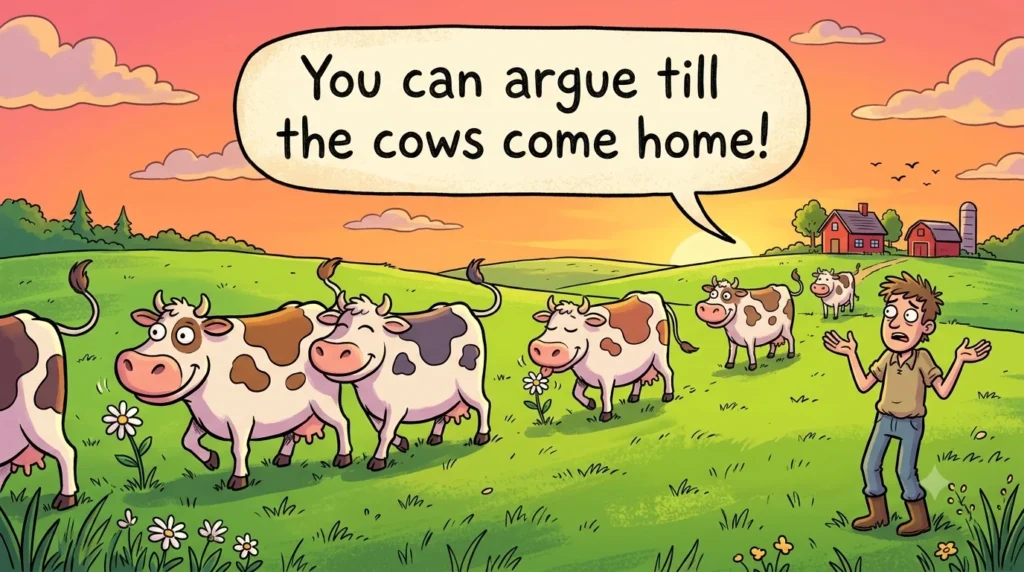
Common Error: Sometimes used incorrectly to mean “something is about to happen.” It actually means “an activity can go on for a long, long time.”
Usage Note: Used to emphasize that an action could continue endlessly. This is one of the most humorous idioms for a long time you’ll ever hear!
An Eternity
Word-by-word meaning: An endless or infinite amount of time.
Idiomatic Meaning: A very long time, often used to describe a tedious or anxious wait.
Example Sentences: “It felt like an eternity in the waiting room.” / “The school year is taking an eternity.”
Common Error: Saying “a eternity.” Use “an” because “eternity” starts with a vowel sound.
Usage Note: The word itself is a noun, but it’s often used idiomatically to exaggerate a long wait.
In the Long Run
Word-by-word meaning: In the long distance of a race (a marathon) or a journey.
Idiomatic Meaning: Over a long period of time; eventually.
Example Sentences: “In the long run, eating healthy is better.” / “This investment will pay off in the long run.”
Common Error: Using it for short-term benefits.
Usage Note: Focuses on long-term outcomes, not just duration. This is one of the most practical idioms for a long time.
For the Long Haul
Word-by-word meaning: For the entire journey or trip.
Idiomatic Meaning: For a long time, with a commitment to see something through.
Example Sentences: “She’s in this project for the long haul.” / “We knew this was going to be a tough job, but we’re here for the long haul.”
Common Error: Confusing it with “in the long run.”
Usage Note: Implies endurance, effort, and commitment over a long period.
Since Forever
Word-by-word meaning: From the beginning of “forever,” which is impossible.
Idiomatic Meaning: For as long as anyone can remember.
Example Sentences: “We’ve been best friends since forever.” / “That shop has been there since forever.”
Common Error: Using it in formal writing.
Usage Note: Very informal and emphasizes the length of time. Young people love using this among other idioms for a long time.
Time and Time Again
Word-by-word meaning: Again and again.
Idiomatic Meaning: Repeatedly over a long period.
Example Sentences: “I’ve told you time and time again to clean your room.” / “They’ve won time and time again.”
Common Error: Forgetting the “again.”
Usage Note: Emphasizes the repetition of an action, not just its length.
A Lifetime
Word-by-word meaning: The duration of a person’s life.
Idiomatic Meaning: A very long time.
Example Sentences: “I’ve waited a lifetime to go to this concert.” / “It took a lifetime to finish that book.”
Common Error: Using it too casually.
Usage Note: Often used for things that feel monumental or significant.
Since the Year Dot
Word-by-word meaning: Since the “dot” in a date, meaning the beginning.
Idiomatic Meaning: For a very, very long time; since the beginning.
Example Sentences: “I’ve known her since the year dot.”
Common Error: Mostly used in British English.
Usage Note: Very informal and emphasizes an extremely long duration. This is one of those quirky idioms for a long time that Brits love!
From Way Back
Word-by-word meaning: From a long time in the past.
Idiomatic Meaning: From a long time ago.
Example Sentences: “They’ve been friends from way back.” / “I know him from way back.”
Common Error: Often, “way back when” is used in a similar context.
Usage Note: Casual way to describe a long-standing relationship or fact.
Since Time Began
Word-by-word meaning: Since the creation or start of time.
Idiomatic Meaning: Always.
Example Sentences: “People have used fire since time began.”
Common Error: Overusing it for trivial things.
Usage Note: Similar to “since the dawn of time,” very dramatic.
In the Mists of Time
Word-by-word meaning: In the fog or haze of the past, making it hard to see.
Idiomatic Meaning: So long ago that it’s hard to remember.
Example Sentences: “The story began in the mists of time.” / “That rule was made in the mists of time.”
Common Error: Using it for recent events.
Usage Note: Poetic and used to describe ancient history or forgotten origins.
Through Thick and Thin
Word-by-word meaning: Through dense forest (“thick”) and sparse forest (“thin”).
Idiomatic Meaning: For a long time, even during hard times.
Example Sentences: “We’ve been friends through thick and thin.” / “They’ve stayed together through thick and thin.”
Common Error: Thinking it only means “over time,” forgetting the “good times and bad” part.
Usage Note: Describes loyalty and endurance over a long period.
Since I Can Remember
Word-by-word meaning: From the period that I have memory of.
Idiomatic Meaning: For as long as I have memory.
Example Sentences: “I’ve loved music since I can remember.”
Common Error: Using it as “since I remember,” which is ungrammatical.
Usage Note: Personal and emphasizes a lifelong affinity for something.
Ages and Ages
Word-by-word meaning: “Ages” repeated for emphasis.
Idiomatic Meaning: A really, really long time.
Example Sentences: “We’ve been waiting for ages and ages.”
Common Error: Overly emphatic.
Usage Note: The repetition adds dramatic effect.
From Generation to Generation
Word-by-word meaning: From one generation of people to the next.
Idiomatic Meaning: Passed down over many years.
Example Sentences: “This recipe has been shared from generation to generation.”
Common Error: Using it for a single person’s lifetime.
Usage Note: Used for traditions, stories, and heirlooms.
From the Stone Age
Word-by-word meaning: From the prehistoric Stone Age.
Idiomatic Meaning: From a very long time ago, usually meaning “outdated.”
Example Sentences: “That phone looks like it’s from the stone age.” / “His ideas are from the stone age.”
Common Error: Taking it literally.
Usage Note: It’s often used as an insult to mean something is old-fashioned, not just old. This is one of the funniest idioms for a long time you can use jokingly!
From the Cradle to the Grave
Word-by-word meaning: From a person’s crib (baby) to their tomb (death).
Idiomatic Meaning: All through a person’s life.
Example Sentences: “They supported him from cradle to grave.”
Common Error: Using it for short-term projects.
Usage Note: A dramatic and complete way to describe a lifelong commitment or situation.
Funny Idioms for a Long Time That Will Make You Laugh
Let’s face it—sometimes learning idioms can be boring. But these funny idioms for a long time will bring a smile to your face!
Since the Year Dot
Imagine someone asking, “When did you start working here?” and you reply, “Since the year dot!” It’s a charmingly old-fashioned way to say “forever.”
From the Stone Age
When your grandfather uses a phone that looks older than you, you can tease him: “Dad, that phone is from the Stone Age!” It’s a playful insult that means “incredibly old.”
Till the Cows Come Home
Picture this: You’re arguing with a friend, and you say, “You can argue till the cows come home, I’m still right!” It’s humorous because it paints a silly picture of cows taking their sweet time.
For Donkey’s Years
This phrase makes people chuckle because it plays on the image of a donkey having long ears—like long years! It’s one of the most lovable idioms for a long time.
Since the Ark
A funny variation of “since the dawn of time,” referencing Noah’s Ark. “I’ve had this car since the ark!” implies the car is ancient.
When Dinosaurs Roamed the Earth
This exaggerated phrase means a very long time ago. “I last went to that restaurant when dinosaurs roamed the earth!” It’s dramatic and humorous.
Idioms for When Time is Moving at a Snail’s Pace
Sometimes, time doesn’t just pass slowly—it crawls! Here are 10 powerful idioms for time passing slowly that describe the agony of waiting.
Time Hangs Heavy
Meaning: Time moves slowly, especially when one is bored.
Example: “Time hangs heavy on all of us in those dull corporate meetings.”
Usage: Perfect for describing boredom at work or school.
Like Watching Paint Dry
Meaning: An activity that is agonizingly slow and boring.
Example: “Waiting in line at the DMV was like watching paint dry.”
Usage: This is a universally understood simile among all idioms for time passing slowly.
As Slow as Molasses
Meaning: Extremely slow (molasses is thick syrup that pours slowly).
Example: “The internet connection was as slow as molasses today.”
Usage: Common in American English, especially in the South.
Time Drags On
Meaning: Time feels like it’s moving slowly.
Example: “In that boring class, time just drags on.”
Usage: One of the simplest and most common idioms for time passing slowly.
At a Snail’s Pace
Meaning: Moving extremely slowly, like a snail.
Example: “The project is progressing at a snail’s pace.”
Usage: Used for anything slow, not just time itself.
A Slow Drip
Meaning: A process that is painfully slow and prolonged.
Example: “Getting approval from the committee was a slow drip.”
Usage: Emphasizes frustration with the slowness.
The Clock is Ticking
Meaning: Time is passing slowly and anxiously.
Example: “I kept checking my watch while the clock was ticking in that meeting.”
Usage: Often implies impatience.
Every Second Feels Like an Hour
Meaning: Time is passing extremely slowly.
Example: “During the final exam, every second felt like an hour.”
Usage: A dramatic way to express boredom or anxiety.
Crawling at a Snail’s Pace
Meaning: Very, very slow.
Example: “The line at the grocery store was crawling at a snail’s pace.”
Usage: Emphasizes extreme slowness.
Like Watching Grass Grow
Meaning: Incredibly slow and boring.
Example: “This presentation is like watching grass grow.”
Usage: A humorous simile often used in casual conversation.
More Popular Time Idioms You Must Know
While we’re focusing on idioms for a long time, it’s essential to know these classic time idioms that everyone uses.
Time and Tide Wait for No One
Meaning: Time passes whether we like it or not; we can’t stop it.
Example: “Don’t procrastinate! Time and tide wait for no one.”
Usage: A famous proverb emphasizing the importance of not delaying.
Time Flies
Meaning: Time passes quickly.
Example: “Time flies when you’re having fun!”
Usage: One of the most common time idioms, opposite of time moving slowly.
Beat the Clock
Meaning: To finish something before a deadline.
Example: “We worked hard to beat the clock and submit the project on time.”
Usage: Used in competitive or deadline-driven situations.
Against the Clock
Meaning: Rushing to meet a deadline.
Example: “We were working against the clock to finish the report.”
Usage: Similar to “beat the clock” but emphasizes the pressure.
Time is Money
Meaning: Time is valuable and should not be wasted.
Example: “Let’s get started immediately—time is money!”
Usage: Common in business settings.
British vs American Time Idioms: A Quick Comparison
One of the most interesting aspects of idioms for a long time is the difference between British and American English. Let’s look at some variations.
| British Idioms | American Equivalents | Meaning |
|---|---|---|
| For donkey’s years | For ages | For a very long time |
| Since the year dot | Since forever | From a very long time ago |
| Mists of time | Ancient history | Very old/distant past |
| From the ark | From the Stone Age | Very outdated |
| For yonks | For ages | For a very long time |
Yonks
Meaning: A very long time (British slang).
Example: “I haven’t been to the cinema in yonks!”
Since Hector Was a Pup
Meaning: A very long time ago (British).
Example: “I’ve known that joke since Hector was a pup!”
From the Ark
Meaning: Very old (British).
Example: “This jumper is from the ark!”
These regional differences among idioms for a long time make English more colorful. If you’re speaking to a British friend, use “donkey’s years.” For an American audience, stick with “for ages.”
Common Mistakes to Avoid with Time Idioms
Even native speakers make mistakes! Here are some common errors to watch out for when using idioms for a long time.
Mistake #1: Confusing “In the Long Run” and “For the Long Haul”
Incorrect: “We’re in this project in the long run.”
Correct: “We’re in this project for the long haul.”
Explanation: “In the long run” means eventually, while “for the long haul” means committed for a long time.
Mistake #2: Using “Since Forever” Formally
Incorrect: “The organization has existed since forever.”
Better: “The organization has existed for a very long time.”
Explanation: “Since forever” is informal and should be avoided in business writing.
Mistake #3: Misplacing “Ages”
Incorrect: “I haven’t seen you ages.”
Correct: “I haven’t seen you for ages.”
Explanation: You need the preposition “for” before “ages.”
Mistake #4: Using “Till the Cows Come Home” Incorrectly
Incorrect: “The party will start till the cows come home.”
Correct: “We could party till the cows come home.”
Explanation: This phrase means the action can continue for a long time, not that something will start.
Mistake #5: Saying “A Eternity”
Incorrect: “It took a eternity to finish.”
Correct: “It took an eternity to finish.”
Explanation: “Eternity” starts with a vowel sound, so use “an.”
Time Idioms in Pop Culture
English idioms for a long time appear everywhere—in movies, songs, and books. Recognizing them in pop culture will help you remember them better!
In Movies
- “For the long haul” – Used in countless films about relationships and careers.
- “Since the dawn of time” – Overused in superhero movies like The Matrix.
In Songs
- “Time after time” – A famous song by Cyndi Lauper (though this means “repeatedly”).
- “Against the clock” – Featured in many rap songs about hustling.
In Literature
- “Through thick and thin” – Appears in classic novels like Pride and Prejudice.
- “Mists of time” – Used in fantasy novels to describe ancient legends.
In Daily Conversation
Native speakers use these idioms for a long time so naturally that you’ll hear them everywhere—on TV shows, podcasts, and even in the workplace.
FAQs on Idioms for a Long Time
1. What is the idiom for “after a long time”?
There isn’t a single perfect idiom for “after a long time.” The most common way to say it is “after all this time.” You can also use phrases like “in the long run” to talk about something that happened “after a long time” of waiting.
2. What can I say instead of “for a long time”?
You have many options! Instead of “for a long time,” you can say “for ages,” “for donkey’s years,” “for hours on end,” “since forever,” or “since the dawn of time.” The best choice depends on the context.
3. What is a metaphor for a long time?
A metaphor is a direct comparison. For time passing, you might say “time is a thief,” “time is a river,” or “time is an old friend fading.” For a long duration, saying something is “as old as the hills” is a common metaphor.
4. Is “for a long time to come” an idiom?
Yes, it is considered an idiom. It means that an event that happened in the past will have effects for a long time in the future. For example: “The decision to go to war will have a lasting impact for a long time to come.”
5. What is the idiom for “time and tide wait for no one”?
“Time and tide wait for no man” is the full proverb. It means that time passes regardless of our actions, so we shouldn’t delay important things. This is one of the most famous English proverbs about time.
Conclusion: It’s About Time You Started Using These!
Learning idioms for a long time is a fantastic way to make your English more colorful and expressive. From the playful “donkey’s years” to the dramatic “since the dawn of time,” you now have over 55 tools to describe any lengthy duration.
Don’t just memorize them—try using them! The next time you find yourself waiting for a friend or recalling a childhood memory, use an idiom to tell your story. It will make your English sound more natural and fun.
Challenge yourself: Can you use different idioms for a long time in one conversation today? Write them down, practice them with a friend, and watch your fluency grow!
Pro Tip: Create a habit of using at least one new idiom every day. Within a month, you’ll have mastered all 55+ phrases, and native speakers will be impressed by your colorful English!
So, go on, practice them till the cows come home! And don’t forget—time and tide wait for no one, so start using these idioms today!

“Rose Macaulay shares the charm of idioms on LearnIdom.com, making language learning delightful, insightful, and full of wit for every reader.”