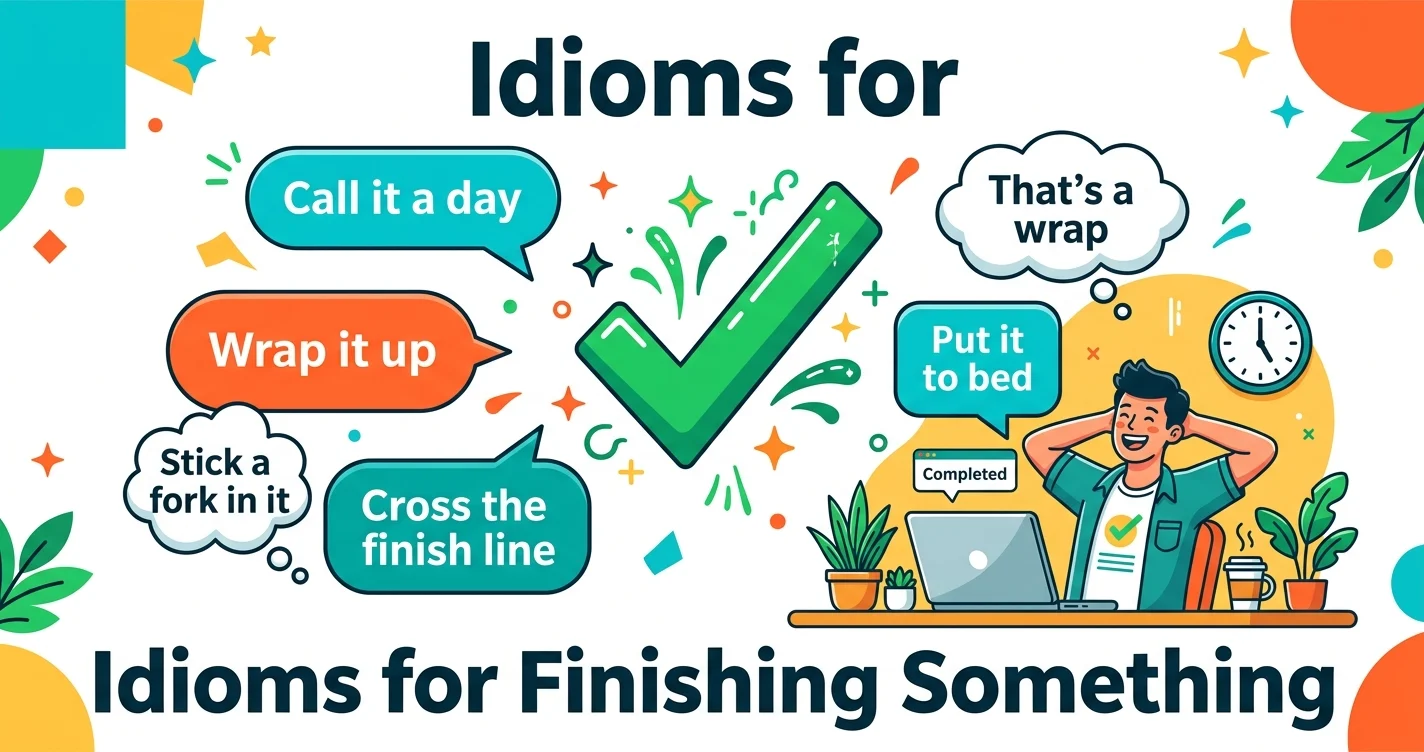
Ever finished a long workday and wanted to say something more exciting than “I’m done”? Native English speakers rarely use boring phrases. Instead, they have colorful idioms for finishing something that make conversations lively and natural.
Think about it—when was the last time a colleague said “Let’s conclude our work”? Probably never! They’d say “Let’s call it a day” or “Time to wrap it up.” These small phrases make your English sound fluent, confident, and native-like.
In this guide, you’ll learn essential idioms for ending something—from completing daily tasks to ending relationships. Each idiom includes:
Let’s transform your English today! 🚀
Everyday Work & Task Idioms
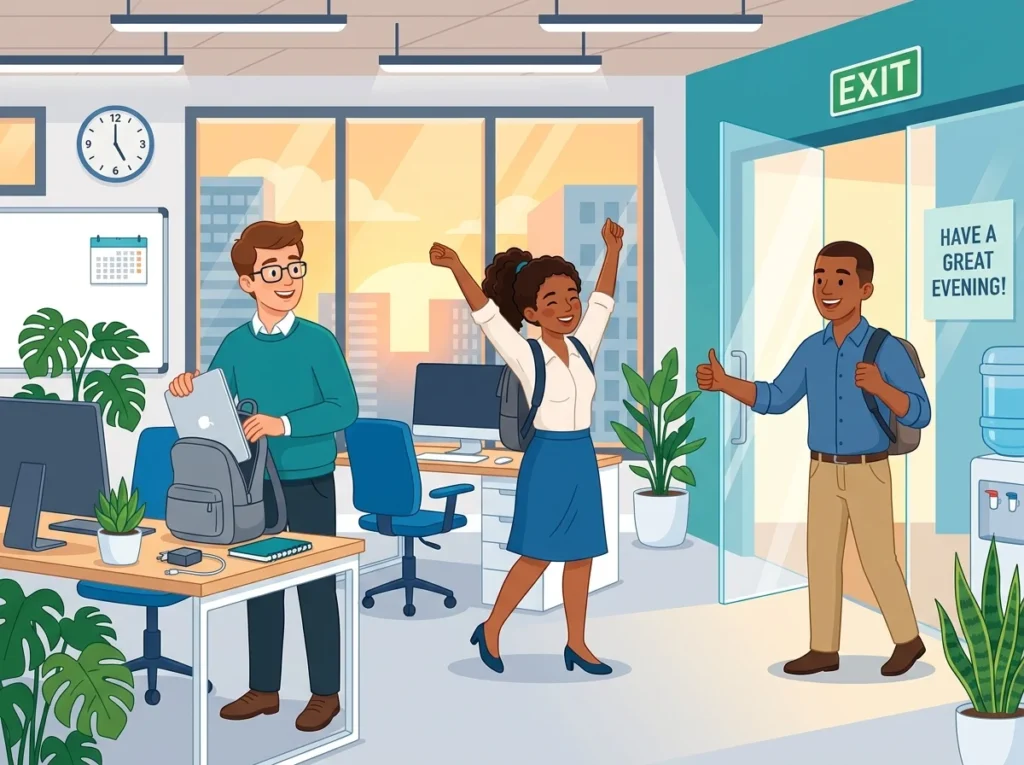
Call It a Day 🏁
Word-by-Word Meaning: “Call” = declare/decide, “it” = the activity, “a day” = working period.
Figurative Meaning: To stop working for the rest of the day—either because you’ve finished or because you’re exhausted.
Example Sentences:
- “We’ve been editing this video for six hours. Let’s call it a day and finish tomorrow morning.”
- “The team finished all major tasks, so the manager told everyone to call it a day and go home early.”
Common Error: ❌ “Let’s call it as a day” → ✅ “Let’s call it a day”
Formality Level: 🟢 Neutral (works in offices and with friends)
Usage Note: This is among the most popular phrases for the end of something in professional settings. Use it when you want to suggest stopping work without sounding lazy.
Wrap It Up 🎁
Word-by-Word Meaning: “Wrap” = cover/enclose, “it up” = completeness (like wrapping a gift).
Figurative Meaning: To finish something, especially a task, presentation, or event. Suggests bringing things to a natural conclusion.
Example Sentences:
- “The speaker started to wrap it up when she noticed the audience checking their watches.”
- “We need to wrap it up in ten minutes—the next meeting is waiting for this room.”
Common Error: ❌ “Let’s wrap up it” → ✅ “Let’s wrap it up” (object pronoun goes between “wrap” and “up”)
Formality Level: 🟢 Neutral (common in business and casual settings)
Usage Note: You’ll often hear professors say “Let me wrap it up” at the end of lectures. It’s one of the most versatile idioms for finishing something in English.
Finish Up ✅
Word-by-Word Meaning: “Finish” = complete, “up” = adds emphasis on finality.
Figurative Meaning: To complete the final parts of something.
Example Sentences:
- “I just need to finish up this email, then I’ll join you for lunch.”
- “She finished up her painting and proudly signed her name in the corner.”
Common Error: ❌ “Finish up it” → ✅ “Finish it up” or “Finish up [object]”
Formality Level: 🟢 Neutral (works anywhere)
Usage Note: This is the most basic phrase for finishing something and works in every context—from casual chats to professional emails.
Wind Down 🌅
Word-by-Word Meaning: “Wind” = turn/coil, “down” = decrease.
Figurative Meaning: To gradually come to an end, especially after busy activity.
Example Sentences:
- “The party started to wind down around midnight as guests headed home.”
- “After the busy holiday season, business usually winds down in January.”
Common Error: ❌ “The party winded down quickly” → ✅ “The party wound down” (irregular verb)
Formality Level: 🟢 Neutral (describes natural, gradual endings)
Usage Note: Unlike other idioms for ending something, this describes a slow, natural process—not an abrupt stop. Perfect for events, seasons, or busy periods.
Cross the Finish Line 🏃
Word-by-Word Meaning: Literally passing over the line marking the end of a race.
Figurative Meaning: To complete a challenging task or reach a significant goal after sustained effort.
Example Sentences:
- “After months of training, she was thrilled to finally cross the finish line in the marathon.”
- “Writing this book has been difficult, but I can finally see myself crossing the finish line.”
Common Error: ❌ “Cross finish line” → ✅ “Cross the finish line” (always use ‘the’)
Formality Level: 🟢 Neutral to Motivational
Usage Note: This is a powerful idiom for completing a task that emphasizes the journey and the feeling of accomplishment.
Get It Over With 😰
Word-by-Word Meaning: “Get” = experience/do, “it over” = finish, “with” = idiomatic particle.
Figurative Meaning: To complete something unpleasant or difficult as quickly as possible so you can move on.
Example Sentences:
- “I hate visiting the dentist, but I just want to get it over with so I can stop worrying.”
- “The exam was terrifying, but I’m glad I finally got it over with.”
Common Error: ❌ “Get over it” (means recover from something) → ✅ “Get it over with” (means finish something unpleasant)
Formality Level: 🟢 Neutral to Casual
Usage Note: Among the most common phrases for the end of something you don’t enjoy. Carries relief—the feeling of “finally, that’s done!”
Idioms for Completing Projects
Run Its Course 🏃
Word-by-Word Meaning: To run along a natural path or route.
Figurative Meaning: To continue until it finishes naturally, without outside interference.
Example Sentences:
- “They let the small argument run its course, and it faded by evening.”
- “The illness had to run its course; no medication could stop it faster.”
Common Error: ❌ “Run it’s course” → ✅ “Run its course” (possessive, NOT contraction)
Formality Level: 🟢 Neutral (describes natural, unstoppable processes)
Usage Note: This suggests something cannot be rushed or interrupted—it must end in its own time. Common for illnesses, relationships, trends, and natural processes.
Close the Book on It 📖
Word-by-Word Meaning: Closing a book after finishing reading it.
Figurative Meaning: To finish or stop something for good, with no intention of revisiting it.

Example Sentences:
- “After the final court decision, they could finally close the book on the lawsuit.”
- “Let’s have one conversation about this and then close the book on it forever.”
Common Error: ❌ “Close a book on it” → ✅ “Close the book on it” (always ‘the’)
Formality Level: 🟡 Formal to Neutral
Usage Note: Implies finality—once you close the book, you never open it again. Use for arguments, disputes, or chapters of life that are truly finished.
Be Over With 📋
Word-by-Word Meaning: “Over” = finished, “with” = completes the phrase.
Figurative Meaning: To be completely finished, often implying relief.
Example Sentences:
- “Now that the exam is over with, I can finally relax.”
- “Once the presentation is over with, we can celebrate all our hard work.”
Common Error: ❌ “Over with it” → ✅ “Over with” (no object needed—it’s implied)
Formality Level: 🟢 Neutral (often expresses relief)
Usage Note: This is a relief-focused ending—you’ll hear it when people are glad something difficult is finally behind them. Perfect for exams, presentations, and stressful events.
At the End of the Day 🌅
Word-by-Word Meaning: Literally, when the day finishes.
Figurative Meaning: When everything is considered and all factors are weighed; ultimately.
Example Sentences:
- “At the end of the day, trust matters more than fancy words.”
- “We can argue all we want, but at the end of the day, we must choose the safest option.”
Common Error: ❌ “At the end of day” → ✅ “At the end of the day”
Formality Level: 🟢 Neutral (very common in everyday speech)
Usage Note: One of the most common English idioms—not just for finishing, but for summarizing a conclusion. It’s like saying “when all is said and done.”
Relationship & Partnership Idioms
Call It Quits 🙅
Word-by-Word Meaning: “Call” = decide, “it” = the activity, “quits” = equal/even (historically from settling debts).
Figurative Meaning: To decide to stop doing something, often because it’s not working or you’ve had enough.
Example Sentences:
- “After trying to fix the old car for months, John decided to call it quits and buy a new one.”
- “We called it quits after playing video games for three hours—our eyes were hurting.”
Common Error: ❌ “Call it quit” → ✅ “Call it quits” (always with ‘s’)
Formality Level: 🟢 Neutral to Casual
Usage Note: Can be used for small things (stopping a game) or big things (ending a business partnership). Carries a slight sense of giving up—use carefully in professional contexts.
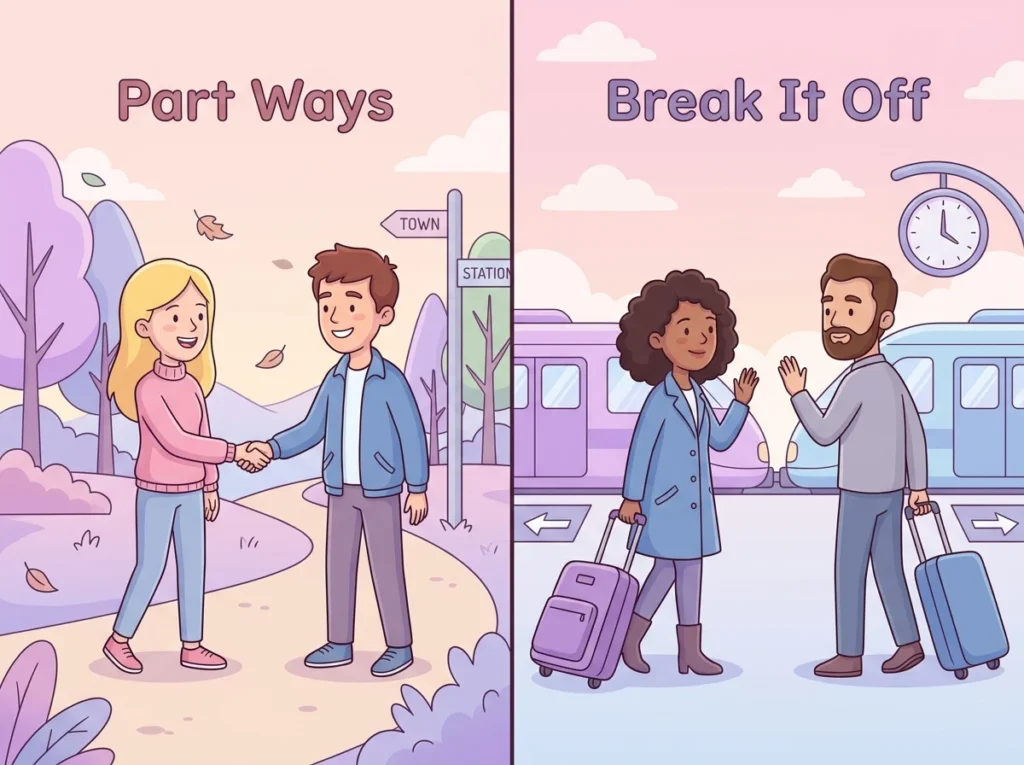
Break It Off 💔
Word-by-Word Meaning: “Break” = separate/end, “off” = indicates sudden stop.
Figurative Meaning: To end a relationship, engagement, or agreement.
Example Sentences:
- “They broke it off after constant arguing and realized they weren’t compatible.”
- “The two companies broke it off and stopped their partnership entirely.”
Common Error: ❌ “Break off it” → ✅ “Break it off”
Formality Level: 🟡 Formal to Neutral
Usage Note: This is specifically for idioms for ending a relationship—romantic or professional. Suggests a mutual or one-sided decision to stop. Always use it with relationships, not tasks.
Part Ways 👋
Word-by-Word Meaning: “Part” = separate, “ways” = paths or directions.
Figurative Meaning: To end a relationship or collaboration and go in different directions.
Example Sentences:
- “After working together for five years, they decided to part ways amicably.”
- “The couple parted ways when they realized their life goals were too different.”
Common Error: ❌ “Part way” → ✅ “Part ways” (always plural)
Formality Level: 🟡 Formal (very polite way to describe separation)
Usage Note: This is the most diplomatic idiom for ending a relationship. It suggests mutual agreement and no hard feelings. Perfect for business emails and polite conversations.
Funny & Colorful Finishing Idioms
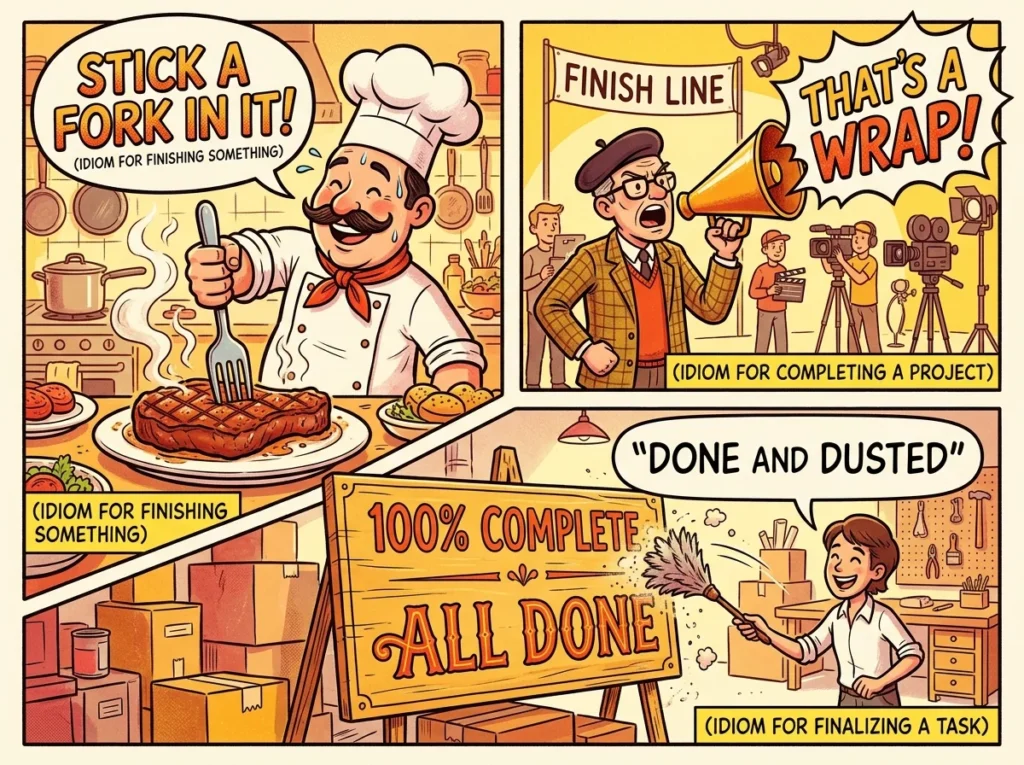
Stick a Fork in It 🍴
Word-by-Word Meaning: Literally inserting a fork into food to test if it’s cooked.
Figurative Meaning: To indicate something is completely finished, over, or no longer viable—used with humor.
Example Sentences:
- “The team was down 10-0 in the first quarter. You can stick a fork in it; the game is over.”
- “After months of trying to revive the project, management decided to stick a fork in it.”
Common Error: ❌ “Stick a fork in that” → ✅ “Stick a fork in it” (always ‘it’)
Formality Level: 🟠 Casual to Slang (fun, conversational)
Usage Note: This originated from American cooking shows in the mid-20th century—chefs stuck a fork into meat to check if it was fully cooked. Today, it’s a fun way to say something is done, especially when the outcome was predictable. One of the best idioms for finishing something funny!
It’s a Wrap 🎬
Word-by-Word Meaning: From filmmaking—when shooting is complete, the director says “That’s a wrap!”
Figurative Meaning: To announce something is completely finished.
Example Sentences:
- “Everyone cheered when the director shouted ‘That’s a wrap!’ on the final day of shooting.”
- “The event is over—it’s a wrap! Let’s clean up and go home.”
Common Error: ❌ “It’s wrap” → ✅ “It’s a wrap”
Formality Level: 🟠 Casual to Slang
Usage Note: One of the most fun phrases for the end of something. Perfect for projects, events, and creative work. It’s celebratory and energetic!
Done and Dusted 🧹
Word-by-Word Meaning: “Done” = finished, “dusted” = cleaned off (like dusting furniture after cleaning).
Figurative Meaning: Completely finished—sometimes with a sense of finality or relief.
Example Sentences:
- “The report is done and dusted—I’m sending it to the manager right now.”
- “After three weeks of renovations, the kitchen is finally done and dusted.”
Common Error: ❌ “Done and dusting” → ✅ “Done and dusted”
Formality Level: 🟠 Casual (British English origin but used globally)
Usage Note: This British idiom has become popular worldwide. It’s one of the clearest idioms for finishing something with meaning—it literally means “completely finished.”
Serious & Dramatic Ending Idioms
Pull the Plug 🔌
Word-by-Word Meaning: Physically removing a plug from a socket, stopping electrical power.
Figurative Meaning: To stop something completely and abruptly, usually by withdrawing support or funding.
Example Sentences:
- “The TV network pulled the plug on the show after only one season due to low ratings.”
- “The investors pulled the plug on the startup when they realized it wasn’t profitable.”
Common Error: ❌ “Pull the plug of the project” → ✅ “Pull the plug on the project”
Formality Level: 🟡 Formal to Neutral
Usage Note: Implies an external decision to end something—often used for projects, shows, or initiatives that others have “authority” over. Among serious idioms for ending something.
End of the Road 🛣️
Word-by-Word Meaning: The physical point where a road stops.
Figurative Meaning: The final point; no more chances or options remaining.
Example Sentences:
- “It was the end of the road for the old laptop when it wouldn’t even turn on anymore.”
- “The team reached the end of the road in the playoffs, losing in the semifinals.”
Common Error: ❌ “End of road” → ✅ “End of the road”
Formality Level: 🟢 Neutral to Serious
Usage Note: Often carries a slightly sad or serious tone—something has come to a definitive end with no going back.
Throw in the Towel 🥊
Word-by-Word Meaning: Literally throwing a towel into the boxing ring to signal surrender.
Figurative Meaning: To give up or admit defeat.
Example Sentences:
- “She threw in the towel when she couldn’t fix the toy after three hours.”
- “The CEO threw in the towel and admitted the company couldn’t compete with the tech giants.”
Common Error: ❌ “Throw the towel in” → ✅ “Throw in the towel” (more common)
Formality Level: 🟢 Neutral
Usage Note: This idiom for complete defeat implies you’ve tried hard but now accept you can’t succeed. It’s honest and shows humility—not weakness.
Bite the Dust 💀
Word-by-Word Meaning: To fall to the ground, literally “biting dust.”
Figurative Meaning: To fail or come to an end, especially in a dramatic way.
Example Sentences:
- “My old phone finally bit the dust after surviving five years of drops and spills.”
- “His winning streak bit the dust when he faced a stronger opponent.”
Common Error: ❌ “Bite dust” → ✅ “Bite the dust”
Formality Level: 🟠 Casual to Slang
Usage Note: Originally from Homer’s Iliad, meaning dying in battle. Today, it’s dramatic and slightly humorous. Use for things that have “died” or “expired”—like old gadgets, failed plans, or ended streaks. One of the most memorable phrases for the end of something.
Common Mistakes 🚨
💡 How to Choose the Right Idiom
| Situation | Best Idiom |
|---|---|
| Ending a workday | Call it a day |
| Finishing a presentation | Wrap it up |
| Completing final details | Finish up |
| Gradual ending | Wind down |
| Unpleasant task | Get it over with |
| Relationship breakup | Break it off / Part ways |
| Giving up | Throw in the towel |
| Celebrating completion | It’s a wrap / Done and dusted |
⚠️ Top 5 Mistakes to Avoid
- Mixing up “call it a day” and “call it quits”
- Call it a day = stop for now (return tomorrow)
- Call it quits = stop forever (permanent end)
- Forgetting “the” in idioms
- ❌ “Cross finish line” → ✅ “Cross the finish line”
- ❌ “End of road” → ✅ “End of the road”
- Using “break it off” for tasks
- ❌ “I broke off my homework” → ✅ “I finished my homework”
- Use “break it off” ONLY for relationships
- Wrong word order with pronouns
- ❌ “Wrap up it” → ✅ “Wrap it up”
- ❌ “Finish up it” → ✅ “Finish it up”
- Confusing “get over with” and “get over”
- Get it over with = finish something unpleasant
- Get over = recover from (emotional pain, illness)
Frequently Asked Questions ❓
Q1: What is the most common idiom for completing a task?
The most common is “wrap it up” or “finish up” for completing tasks, and “call it a day” for ending work. These are used daily in both American and British English.
Q2: What are common phrases using “finish”?
Common phrases include: finish up, finish off, finish with, finish doing something, and finish by [time]. For example: “I finished off my dinner” or “I finished up my homework.”
Q3: How do you say “done” in a cool way?
Try “stick a fork in it” (casual/humorous), “it’s a wrap” (celebratory), “done and dusted” (British/fun), or “cross the finish line” (achievement-focused).
Q4: What are the top 10 idioms for finishing something?
The top 10 are:
- Call it a day
- Wrap it up
- Finish up
- Wind down
- Get it over with
- Cross the finish line
- Call it quits
- Break it off
- Done and dusted
- It’s a wrap
Q5: Can I use these idioms in formal writing?
Some are formal enough—“wrap it up,” “call it a day,” “part ways,” “pull the plug” are acceptable in business emails. Avoid “stick a fork in it,” “bite the dust,” and “it’s a wrap” in formal writing—they’re too casual.
Q6: What’s the difference between “call it a day” and “call it quits”?
Great question! “Call it a day” means you’re stopping work for now but will likely continue tomorrow. “Call it quits” means you’re stopping permanently because it’s not working. Use them correctly!
Q7: Which idioms are British vs. American?
- 🇬🇧 “Done and dusted” (British origin, now global)
- 🇺🇸 “Stick a fork in it” (American, from cooking shows)
- 🌍 “Call it a day,” “wrap it up,” “finish up” (used everywhere)
Conclusion & Practice Challenge 🎯
Congratulations! You’ve just learned powerful idioms for finishing something that will transform your English conversations!
Here’s your 7-day challenge:
- Day 1-2: Master “call it a day,” “wrap it up,” and “finish up” — use them at work or school
- Day 3-4: Learn “get it over with” and “cross the finish line” — use them for unpleasant or long tasks
- Day 5-6: Practice relationship idioms — “break it off,” “part ways,” and “call it quits”
- Day 7: Have fun with “stick a fork in it,” “it’s a wrap,” and “done and dusted”
Pro Tip: Keep a small notebook. Every time you finish something, write which idiom you used. This builds muscle memory!
Remember, idioms are the secret sauce that makes English fun! Native speakers will be impressed when you casually say “Let’s stick a fork in it” instead of just “Let’s stop.”
Now go forth and finish something—in style! 💪✨
Question for you: Which idiom from this list will you use today? Share in the comments below! 👇

“L.P. Hartley brings classic idioms to life on LearnIdom.com, helping readers explore language with wit, clarity, and timeless insight.”