
Have you ever used the same idiom three times in one conversation? Maybe you said “it’s raining cats and dogs” twice in five minutes. Or perhaps “piece of cake” became your go-to phrase for everything easy.
Native English speakers rarely repeat the same idiom. They use synonyms for idioms and phrases to keep their language fresh, engaging, and natural. When you know multiple ways to say the same thing, you sound more fluent and confident.
Example: Instead of always saying “spill the beans,” you can say “let the cat out of the bag” or “let on.” Each has a slightly different nuance. Choosing the right one shows true mastery of the language.
What Makes an Idiom Different from a Phrase?
Many learners confuse these two terms. Let’s clear this up once and for all.
The Simple Definition
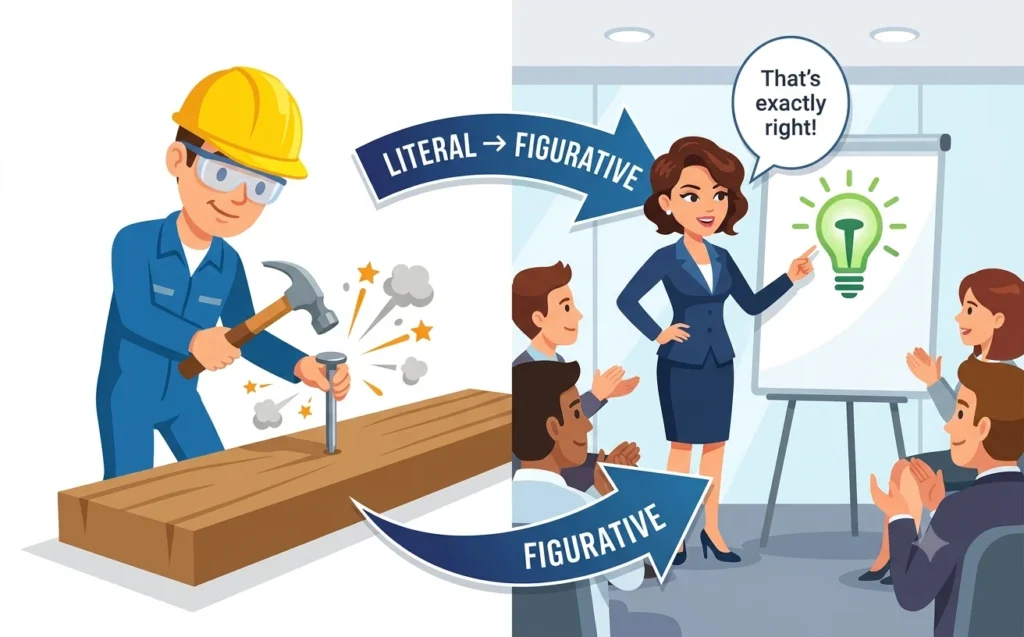
An idiom is a group of words whose figurative meaning differs from its literal meaning. You cannot understand an idiom by translating each word individually [1].
A phrase, however, is simply a group of words that function as a unit. Phrases can be literal.
Quick Comparison
| Feature | Idiom | Phrase |
|---|---|---|
| Meaning | Figurative (non-literal) | Can be literal or figurative |
| Translation | Often impossible word-for-word | Usually translatable |
| Culture | Often culture-specific | Can be universal |
| Example | “Kick the bucket” (to die) | “The big red ball” (literal) |
All idioms are phrases, but not all phrases are idioms. When you consult an idiom dictionary, you will find only figurative expressions listed.
How to Pronounce “Idiom” Correctly
Before we dive deeper, let us get the pronunciation right.
The word idiom is pronounced as /ˈɪd.i.əm/ [2]. Here is the breakdown:
- Id (like the first part of “identity”) – stressed syllable
- i (like the “ee” in “see”) – unstressed
- um (like the “um” in “umbrella”) – unstressed
Common mistakes:
- ❌ “Eye-dee-um” (wrong stress)
- ❌ “Id-ee-ome” (wrong ending)
✅ Correct: “ID-ee-um” (rhymes with “medium”)
Practice saying it aloud three times: ID-ee-um, ID-ee-um, ID-ee-um.
The Power of Idiom Synonyms and Antonyms
Understanding idiom synonyms and antonyms separates intermediate learners from advanced speakers.
What Are Idiom Synonyms?
Idiom synonyms are different idioms that share the same or similar figurative meaning. Knowing them helps you reformulate your sentences and avoid repetition.
Example:
- “Spill the beans” = “Let the cat out of the bag” (both mean “reveal a secret”)
- “As busy as a bee” = “Up to one’s ears” (both mean “very busy”)
What Are Idiom Antonyms?
Idiom antonyms are idioms with opposite meanings. They help you create contrast and express yourself more precisely.
Example:
- “Make a mountain out of a molehill” (exaggerate) ↔ “Make light of something” (treat as unimportant)
- “Spill the beans” (reveal) ↔ “Keep under wraps” (hide)
Real-Life Example
Imagine you are in a meeting:
Without synonyms: “We need to break the ice. Then we should break the ice again. Breaking the ice is important.”
With synonyms: “We need to break the ice. Then we should warm up the conversation. Creating a friendly atmosphere is important.”
The second version sounds natural and fluent because it uses synonyms for idioms and phrases.
Here are the most useful idioms you need to know, organized by category. Each entry includes the figurative meaning, example sentences, and common alternatives.
Hit the Nail on the Head
Meaning: To be exactly right about something.
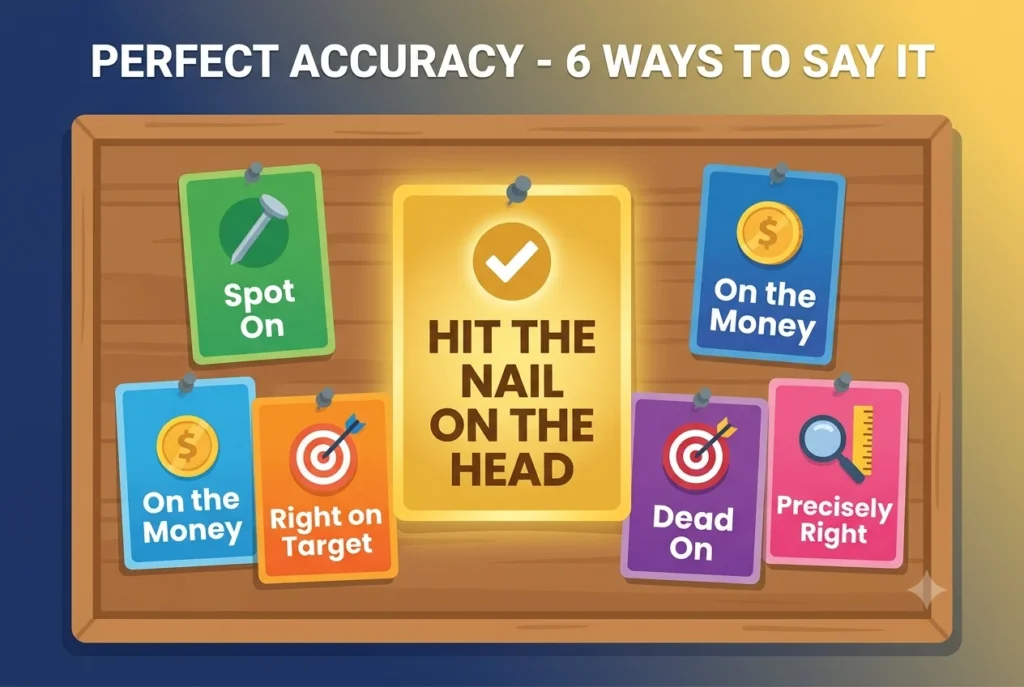
Example: “You hit the nail on the head with your analysis.”
Synonym: “Spot on”
Antonym: “Way off the mark”
Barking Up the Wrong Tree
Meaning: To pursue a mistaken course of action.
Example: “If you think I stole your money, you are barking up the wrong tree.”
Synonym: “On the wrong track”
Antonym: “On the right path”
A Piece of Cake
Meaning: Extremely easy.
Example: “The exam was a piece of cake.”

Synonym: “A walk in the park”
Antonym: “A tough nut to crack”
Cost an Arm and a Leg
Meaning: Very expensive.
Example: “That designer bag costs an arm and a leg.”

Synonym: “Cost a fortune”
Antonym: “A steal”
Kill Two Birds with One Stone
Meaning: To accomplish two things with one action.
Example: “I will drop off the package and visit my mom—kill two birds with one stone.”

Synonym: “Two birds, one stone”
Antonym: “Spinning your wheels”
Spill the Beans
Meaning: To reveal a secret.
Example: “Who spilled the beans about the surprise party?”
Synonym: “Let the cat out of the bag”
Antonym: “Keep under wraps”
Let the Cat Out of the Bag
Meaning: To accidentally or deliberately reveal a secret.
Example: “The email let the cat out of the bag about the merger.”
Synonym: “Spill the beans”
Antonym: “Keep it hush-hush”
Beat Around the Bush
Meaning: To avoid talking about the main topic.
Example: “Stop beating around the bush and tell me what happened.”
Synonym: “Dance around the issue”
Antonym: “Get straight to the point”
Drop a Brick
Meaning: To say something embarrassing or tactless.
Example: “She dropped a brick when she asked about his ex-wife.”
Synonym: “Put your foot in your mouth”
Usage: More common in British English
Read Between the Lines
Meaning: To understand the hidden meaning.
Example: “His email seemed friendly, but reading between the lines, he was angry.”
Synonym: “See the hidden meaning”
Antonym: “Take things literally”
Under the Weather
Meaning: Feeling slightly ill.
Example: “I am feeling a bit under the weather, so I will stay home.”
Synonym: “Out of sorts”
Antonym: “Fit as a fiddle”
Once in a Blue Moon
Meaning: Very rarely.
Example: “We only go out for dinner once in a blue moon.”
Synonym: “Hardly ever”
Antonym: “All the time”
Steal Someone’s Thunder
Meaning: To take attention away from someone else.
Example: “She stole my thunder by announcing her engagement.”
Synonym: “Take the spotlight”
Antonym: “Share the spotlight”
Walking on Eggshells
Meaning: To be extremely careful not to upset someone.
Example: “I have been walking on eggshells around him since the argument.”
Synonym: “Treading carefully”
Antonym: “Speak freely”
The Elephant in the Room
Meaning: An obvious problem everyone ignores.
Example: “The budget deficit is the elephant in the room.”
Synonym: “Unspoken issue”
Antonym: “Open discussion”
Burn the Midnight Oil
Meaning: To work late into the night.
Example: “We burned the midnight oil to meet the deadline.”
Synonym: “Pull an all-nighter”
Antonym: “Take it easy”
Cut Corners
Meaning: To do something cheaply, sacrificing quality.
Example: “The contractor cut corners, and now the roof is leaking.”
Synonym: “Take shortcuts”
Antonym: “Do it properly”
In the Same Boat
Meaning: Facing the same challenges.
Example: “We are all in the same boat regarding budget cuts.”
Synonym: “In the same situation”
Antonym: “In a different league”
The Ball Is in Your Court
Meaning: It is your turn to decide or act.
Example: “I have made my offer. Now the ball is in your court.”
Synonym: “The decision is yours”
Antonym: “Pass the buck”
Nip It in the Bud
Meaning: To stop a problem before it develops.
Example: “We need to nip this conflict in the bud.”
Synonym: “Stop it early”
Antonym: “Let it fester”
Raining Cats and Dogs
Meaning: Pouring rain heavily.
Example: “We cancelled the picnic because it was raining cats and dogs.”
Synonym: “Bucketing down”
Antonym: “Dry as a bone”
Break the Ice
Meaning: To start a conversation and ease tension.
Example: “A funny joke helped break the ice at the party.”
Synonym: “Warm up the conversation”
Antonym: “Freeze someone out”
Weather the Storm
Meaning: To survive a difficult situation.
Example: “The company weathered the storm during the recession.”
Synonym: “Ride it out”
Antonym: “Give up”
A Storm in a Teacup
Meaning: A small problem blown out of proportion.
Example: “The media created a storm in a teacup over a minor issue.”
Synonym: “Much ado about nothing”
Antonym: “A legitimate crisis”
Under the Weather
Meaning: Feeling ill.
Synonym: “Off color”
Antonym: “Fit as a fiddle”
How to Use an Idiom Dictionary Effectively
An idiom dictionary is one of the most powerful tools for improving your English. Many learners do not know how to use it properly.
Step-by-Step Guide
- Search by keyword: If you hear an idiom, look it up by the main word. For “spill the beans,” search “spill.”
- Check the context: Look at example sentences to understand the situations where the idiom is used.
- Find synonyms: Most good dictionaries list synonyms for idioms and phrases under each entry.
- Note the formality: Some idioms are informal, while others suit business writing.
Recommended Sources
- Cambridge Dictionary of Idioms: Clear definitions with examples for learners [3]
- Merriam-Webster Idioms Dictionary: Great for American English [4]
- The Free Dictionary: Comprehensive and free online [5]
Idioms and Their Meanings: Quick Reference
Here is a categorized list of idioms and their meanings for quick reference. Save this for your studies.
Business Idioms
| Idiom | Meaning |
|---|---|
| In the pipeline | In development |
| Back to the drawing board | Start over |
| On the same page | Agree with someone |
| Low hanging fruit | Easy wins |
| Touch base | Brief contact |
| Get the ball rolling | Start something |
| Call it a day | Stop working |
| Raise the bar | Set higher standards |
| Cut corners | Reduce quality |
| Go the extra mile | Put in extra effort |
| Think outside the box | Be creative |
| The bottom line | The main point |
| Miss the boat | Miss an opportunity |
| Play hardball | Be aggressive |
| Blue-sky thinking | Creative thinking |
| On your radar | In your awareness |
| Game changer | Major innovation |
| Learning curve | Time to learn |
| Win-win situation | Beneficial to all |
| Take it offline | Discuss privately |
Relationship Idioms (20)
| Idiom | Meaning |
|---|---|
| Love at first sight | Instant attraction |
| Tie the knot | Get married |
| Kiss and make up | Reconcile |
| Match made in heaven | Perfect couple |
| Pop the question | Propose marriage |
| On the rocks | Having problems |
| Through thick and thin | In good and bad times |
| Wear the trousers | Be dominant |
| Shoulder to cry on | Emotional support |
| Get along like a house on fire | Be close friends |
| See eye to eye | Agree |
| Bury the hatchet | End a conflict |
| Like two peas in a pod | Very similar |
| Walk all over someone | Take advantage |
| Get on your nerves | Annoy you |
| Bend over backwards | Try very hard |
| Drop someone a line | Send a message |
| Keep in touch | Stay connected |
| Give someone the cold shoulder | Ignore someone |
| Meet someone halfway | Compromise |
Money Idioms
| Idiom | Meaning |
|---|---|
| Cost a pretty penny | Expensive |
| In the red | In debt |
| In the black | Profitable |
| Break the bank | Cost too much |
| Penny-wise, pound-foolish | Save small, waste big |
| Money talks | Money has influence |
| Cash cow | Reliable money source |
| On a shoestring | With very little money |
| Drop in the bucket | A small amount |
| Pay through the nose | Pay too much |
| Tighten your belt | Spend less |
| Pick up the tab | Pay the bill |
| Foot the bill | Pay for something |
| Nest egg | Savings |
| Gravy train | Easy money |
| Burning a hole in your pocket | Money you want to spend |
| Funny money | Questionable money |
| In the money | Rich |
| Make ends meet | Manage financially |
| Money for jam | Money earned easily |
Health Idioms
| Idiom | Meaning |
|---|---|
| Fit as a fiddle | Very healthy |
| Under the weather | Sick |
| Out of sorts | Not feeling well |
| On your last legs | About to collapse |
| Black and blue | Bruised |
| Broken-hearted | Very sad |
| Clean bill of health | Health clearance |
| Sick as a dog | Very ill |
| Alive and kicking | Healthy and active |
| Wake-up call | A warning |
| Feel like a million | Feel great |
| Bite the dust | Die or fail |
| Go under the knife | Have surgery |
| In bad shape | Poor condition |
| Bitter pill to swallow | Unpleasant truth |
| Just what the doctor ordered | Exactly what was needed |
| Get something off your chest | Confess problems |
| Keep your chin up | Stay cheerful |
| Picture of health | Perfect health |
| Back on your feet | Recovered |
Time Idioms
| Idiom | Meaning |
|---|---|
| Once in a blue moon | Rarely |
| In the nick of time | Just in time |
| Against the clock | Hurrying |
| Time flies | Time passes quickly |
| Waste of time | Useless |
| Better late than never | Late is better than absent |
| Call it a day | Stop work for the day |
| Crack of dawn | Very early morning |
| Eleventh hour | Last minute |
| For the time being | Temporarily |
| From time to time | Occasionally |
| In the long run | Eventually |
| Make up for lost time | Compensate |
| Old as the hills | Very old |
| Out of date | Obsolete |
| Pressed for time | In a hurry |
| Race against time | Try to finish before deadline |
| Rough time | Difficult period |
| Time and again | Repeatedly |
| Time heals all wounds | Recovery takes time |
Practical Tips for Mastering Idioms
1. Create Your Own Idiom Notebook
Keep a notebook organized by:
- Category (business, health, emotions, etc.)
- Synonyms (list multiple idioms that mean the same thing)
- Antonyms (list opposite expressions)
2. Practice Reformulating Sentences
When you read or hear an idiom, challenge yourself to reformulate it using a synonym.
Example:
Original: “She spilled the beans about the promotion.”
Reformulated: “She let the cat out of the bag about the promotion.”
3. Use Spaced Repetition
Do not learn 100 idioms in one day. Use spaced repetition:
- Day 1: Learn 10 idioms
- Day 3: Review and learn 10 new ones
- Day 7: Review all 20 and learn 10 new ones
4. Watch Movies and TV Shows
Pay attention to how native speakers use idioms in context. Write down new ones you hear.
5. Practice with a Partner
Use idioms in daily conversations. Practice makes permanent.
6. Read Widely
Different genres use different idioms. Business articles, novels, and news reports all have their own expressions.
Common Mistakes to Avoid
Mistake 1: Forcing Idioms into Every Sentence
Problem: Using too many idioms makes you sound unnatural.
Solution: Use idioms sparingly. One or two per conversation is plenty.
Mistake 2: Using the Wrong Register
Problem: Using informal idioms in formal writing.
Solution: Pay attention to context. Business emails need professional language.
Mistake 3: Literal Translation
Problem: Translating idioms from your native language directly into English.
Solution: Learn idioms in English context. Do not assume they translate.
Mistake 4: Confusing Similar Idioms
Problem: “Make a clean breast of it” vs. “Make a clean break.”
Solution: Look up idioms in a dictionary to understand exact meanings.
Frequently Asked Questions (FAQs)
What is a synonym for “idiom”?
A synonym for “idiom” includes “phrase,” “expression,” “locution,” “saying,” “proverb,” and “figure of speech.” In language learning, “idiomatic expression” is also common.
Are all idioms phrases?
Yes, all idioms are phrases, but not all phrases are idioms. The key difference is that an idiom has a figurative meaning that cannot be understood from its literal words. A phrase can be completely literal.
How can I find synonyms for a specific idiom?
You can use an idiom dictionary that lists related expressions, search online for “synonyms for [idiom name],” use a thesaurus, or listen to native speakers and note alternatives.
What is the difference between an idiom and slang?
Idioms are established figurative expressions found in dictionaries. Slang is informal, trendy vocabulary that may not appear in standard dictionaries and often goes out of fashion quickly. Slang can become idioms if widely accepted.
How many idioms are there in English?
Estimates suggest over 25,000 idioms exist in English. However, a native speaker typically uses about 500-600 regularly. You only need to master the most common 100 idioms and their meanings to sound fluent.
What does “reformulate” mean with idioms?
To reformulate means to express the same idea using different words or idioms. For example, reformulating “spill the beans” as “let the cat out of the bag” shows understanding of both expressions.
Why learn idiom antonyms?
Learning idiom antonyms helps create contrast in writing, express yourself precisely, understand the full range of expressions, and pass proficiency exams testing vocabulary depth.
How can I remember idioms effectively?
Use these techniques: visualize the literal meaning, create a personal story, group by theme, practice aloud, and use spaced repetition.
Conclusion: Your Next Steps
You now have everything you need to become confident with English idioms. Remember these five steps:
- Start small: Focus on 10-20 idioms at a time
- Use synonyms: Learn multiple ways to say the same thing
- Practice daily: Use idioms in real conversations
- Review regularly: Revisit idioms you have learned
- Stay curious: Write down every new idiom you hear
The journey to mastering idioms is ongoing. But with the synonyms for idioms and phrases you have learned today, you are already ahead of most learners.

“Iris Murdoch explores the beauty of language and idioms on LearnIdom.com, making learning phrases engaging, memorable, and fun for everyone.”