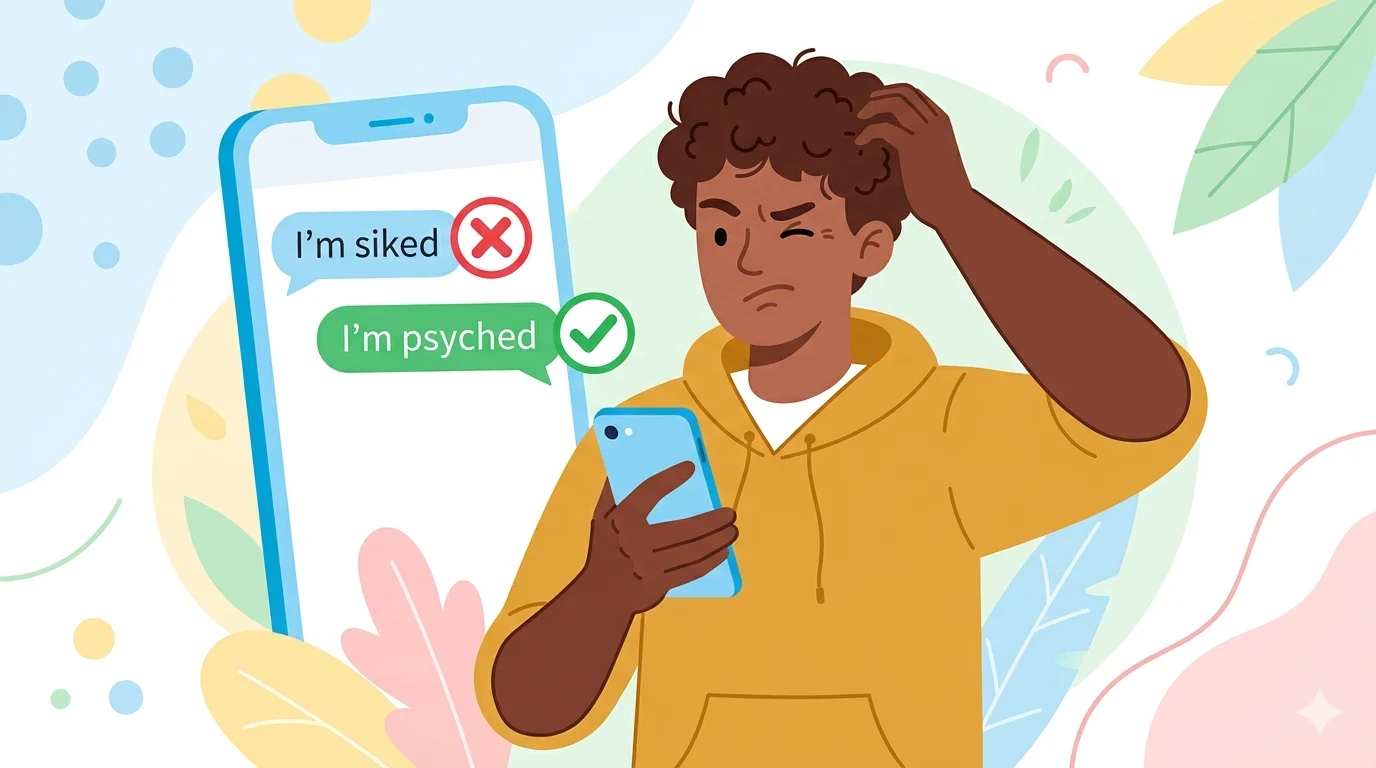
The correct spelling is “psyched.” The word “siked” is a common misspelling and is not recognized as standard English. Psyched means excited, enthusiastic, eager, or mentally prepared for something. For example, “I’m psyched for the concert tonight.” Understanding the difference between siked and psyched helps improve spelling accuracy, grammar, pronunciation, and everyday English usage.
Answer
- ✅ Psyched = Correct spelling
- ❌ Siked = Incorrect spelling
What Does Psyched Mean?
The word psyched is commonly used in informal English to express excitement, enthusiasm, or mental readiness.
Examples:
- I’m psyched for my vacation.
- The players are psyched before the big game.
- She’s psyched about her new job.
Why Do People Write “Siked”?
Many people spell psyched as siked because the word is pronounced like “siked.” However, the correct spelling comes from the word psychology, which is why it begins with psych- rather than sik-.
Pronunciation
Psyched is pronounced:
/saɪkt/ (sounds like “siked”)
This pronunciation often causes confusion and leads to the misspelling.
Common Usage Tip
Use psyched whenever you want to describe excitement, motivation, anticipation, or mental preparation.
Correct: I’m psyched to start college.
Incorrect: I’m siked to start college.
Siked or Psyched 🎯
The short answer: Both spellings appear in English.
The long answer: “Psyched” (with “psy”) is the standard and correct spelling. “Siked” (with “si”) is a common misspelling that has become popular online.
Think of it like this:
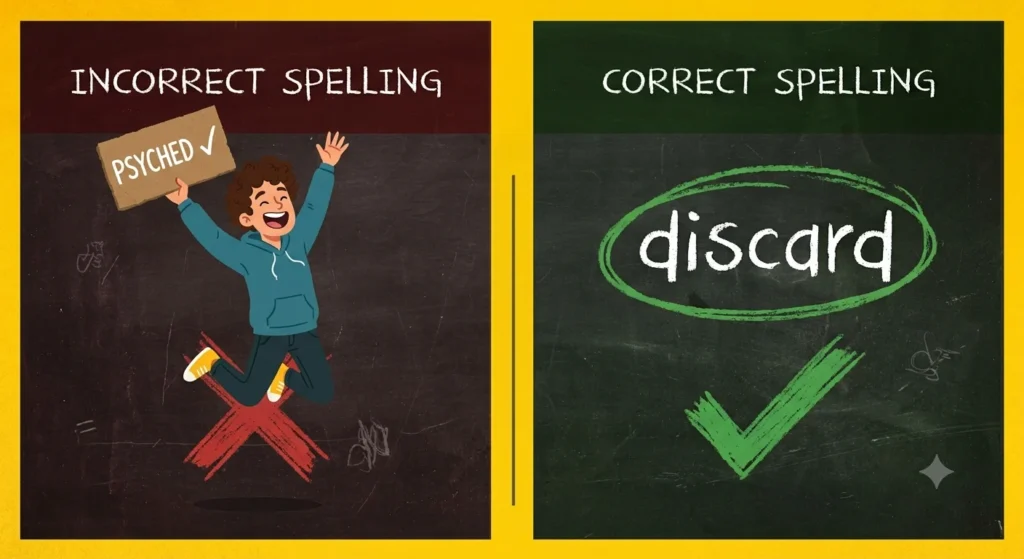
- ✅ Standard English: “I’m psyched for the concert!”
- 📱 Online Slang: “I’m siked for the concert!” (Common, but not correct)
Both are pronounced the same way: sykd (rhymes with “liked” or “hiked”).
Simple rule: If you’re writing for school, work, or anything professional → use “psyched”. If you’re texting friends or posting on social media → you can use either, but “psyched” is still safer.
The Real Story Behind “Psyched” 📜
The word comes from Greek mythology. “Psyche” (pronounced SY-kee) was the goddess of the soul. The Greek word meant “mind,” “spirit,” or “soul.”
Here’s how it evolved:
- 1600s: “Psyche” enters English
- 1800s: “Psychology” becomes a field of study
- 1960s: “Psychedelic” drugs become popular
- 1970s: People shorten “psychedelic” to “psyched” to mean “excited” or “mind-blown”
Today, “psyched” has lost its drug connection. It simply means excited, thrilled, or mentally ready for something.
Fun fact: The same Greek root gives us:
- Psychology
- Psychiatry
- Psychic
- Psychedelic
All start with “psych-“ . This is why “psyched” is the correct spelling.
Why Do People Spell It “Siked”? 🤷
It’s simple: pronunciation.
The “ps” in “psyched” sounds exactly like an “s” . The “p” is completely silent! So when people hear “sykd,” they naturally want to spell it “siked” .
This is called phonetic spelling – spelling words exactly how they sound.
Other examples of silent “p”:
- Psychology (you say “sy-kol-uh-jee”)
- Psychiatry (you say “sy-ky-uh-tree”)
- Psychic (you say “sy-kik”)
See the pattern? All start with a silent “p” but the correct spelling always includes it.
British vs American English 🇬🇧🇺🇸
Good news: Both British and American English agree on this!
| Feature | British English | American English |
|---|---|---|
| Correct Spelling | Psyched | Psyched |
| Misspelling | Siked | Siked |
| Meaning | Excited / Ready | Excited / Ready |
| Pronunciation | “sykd” | “sykd” |
Example sentences:
- 🇬🇧 “The crowd was psyched for the concert at Wembley.”
- 🇺🇸 “Fans are psyched about the Super Bowl halftime show.”
No difference at all! Both countries use “psyched” as the standard spelling.
Which Spelling Should You Use? ✍️
Your choice depends on where and who you’re writing for.
For Professional Writing 📝
Always use “psyched.”
This includes:
- Work emails
- School papers
- News articles
- Job applications
- Books and magazines
Example: “Our team is psyched about the new project.”
For Personal Writing 💬
“Psyched” is still preferred, but “siked” is common.
This includes:
- Text messages 📱
- Instagram captions
- Twitter posts
- Gaming chats
- Casual emails
Example: “so siked for the party tonight!!” (Okay for friends, but not professional)
For International Audiences 🌍
Always use “psyched.” It’s the standard spelling everywhere. Your readers will understand it. If you use “siked,” some people might think you made a mistake.
Expert Advice 🎓
Use “psyched” 100% of the time. It’s always correct. It never looks wrong. It shows you know proper English.
When in doubt, remember this trick: “Psychology” has “psy” → So does “psyched”
Common Mistakes People Make ❌
Mistake #1: Spelling It “Siked”
Wrong: “I’m so siked about my new job!”
Right: “I’m so psyched about my new job!”
Why: The word comes from “psyche,” not “sike.”
Mistake #2: Using “Sike” Instead of “Psych”
Wrong: “Sike! I was just joking.”
Right: “Psych! I was just joking.”
Note: “Sike” is an actual word in British English. It means a small stream or ditch. But that’s not what we’re talking about here!
Mistake #3: Mixing Up “Psyched Up” and “Psyched Out”
These mean completely different things! 😱
| Phrase | Meaning | Example |
|---|---|---|
| Psyched up | Excited and ready | “The coach psyched up the team before the game.” |
| Psyched out | Scared or confused | “The opponent psyched him out with their skill.” |
Mistake #4: Using “Siked Out”
Wrong: “The test siked me out.”
Right: “The test psyched me out.”
Always use “psyched” with both “up” and “out.”
“Psyched” in Real Life 📖
In Emails 💼
“Hi everyone, I’m psyched to share our Q4 results. Great work, team!”
In News Headlines 📰
“Fans Psyched for Taylor Swift’s New Album”
“Team Psyched Up for Championship Final”
On Social Media 📱
“Just got front row tickets!!! So psyched! 🎉🔥”
“Who else is psyched for the weekend? 🙌”
In Text Messages 💬
“Yo I’m so psyched for the game tonight!”
“She’s psyched about her new puppy 🐶”
In Formal Writing 📄
“The employees were psyched about the new benefits package, which improved workplace morale.”
In Everyday Talk 🗣️
“I’m psyched to see you! It’s been so long!”
“He’s psyched about starting his new job.”
Google Trends & Usage Data 📊
Where People Use “Psyched”
Most popular in:
- 🇺🇸 United States
- 🇬🇧 United Kingdom
- 🇨🇦 Canada
- 🇦🇺 Australia
Where People Use “Siked”
More common in:
- Gaming communities 🎮
- Social media (TikTok, Twitter, Instagram)
- Young people (teens and 20s)
- Text messages
When Searches Spike 🔍
Google searches for “siked or psyched” increase during:
- Major sports events 🏈
- Movie premieres 🎬
- Music festivals 🎵
- Holiday seasons 🎄
- New game releases 🎮
People want to spell it right when they’re excited about something big!
Real data: Google Trends shows “psyched” is searched 5x more than “siked” globally. “Psyched” is the clear winner.
Comparison Table: All Spellings 📋
| Spelling | Correct? | When to Use | Example |
|---|---|---|---|
| Psyched | ✅ Yes | Always | “I’m psyched for the game.” |
| Siked | ❌ No (informal) | Texting friends only | “I’m siked for the game.” |
| Psych | ✅ Yes | Short form / joking | “Psych! Just kidding!” |
| Sike | ❌ No (misspelling) | Never (unless British stream) | “Sike, I tricked you!” |
| Psyched up | ✅ Yes | Excited and ready | “He’s psyched up.” |
| Psyched out | ✅ Yes | Scared or confused | “She psyched him out.” |
| Psychedelic | ✅ Yes | Full word origin | “60s psychedelic music.” |
Frequently Asked Questions ❓
1. Is it siked or psyched?
Answer: Both appear in writing. Psyched is the standard, correct spelling. “Siked” is a common misspelling that’s popular in informal online use.
2. What does psyched mean?
Answer: It means excited, thrilled, enthusiastic, or mentally prepared for something. Example: “I’m psyched about my vacation!”
3. What does siked mean in slang?
Answer: “Siked” means the exact same thing as “psyched” – excited or hyped up. It’s just spelled differently. Many young people use “siked” in texts and social media posts.
4. Is it siked out or psyched out?
Answer: It’s “psyched out” in standard English. “Siked out” appears in casual slang but is considered incorrect. The correct phrase is “psyched out” (meaning scared or confused).
5. Is sike in the dictionary?
Answer: Yes, but not for “excited”! “Sike” is a British word meaning a small stream or ditch. For the slang meaning, “psych” is the dictionary entry.
6. What’s the difference between psych and psyched?
Answer: “Psych” (without “ed”) usually means to trick or confuse someone. Example: “I’m going to psych him out.” “Psyched” (with “ed”) means excited. Example: “I’m psyched for the party!”
7. How do you pronounce sike or psyched?
Answer: Both are pronounced /saɪkt/ – which rhymes with “liked” or “hiked.” The “p” in “psyched” is completely silent!
8. Is it waiving a fee or waving a fee?
Answer: Great question! Both are correct but mean different things:
- Waive = to give up a right (Example: “The bank waived the fee”)
- Wave = to move your hand side to side (Example: “She waved goodbye”)
Conclusion
You made it to the end. Great job. Now let’s lock in what you learned.
The number one rule: Use PSYCHED. That is the correct spelling for excitement. It works everywhere – texts, emails, social media, and even casual speeches.
The number two rule: Understand that siked is a common misspelling. It is not correct, but people use it. Don’t be angry when you see it. Just know the difference.
The number three rule: Do not mix up sike (just kidding) with psyched (excited). That is the biggest mistake.
**When you search siked or psyched urban dictionary, you will see funny examples. That’s fine for fun. But for real life, trust real dictionaries.
**When you read sike or psych Reddit threads, remember: Reddit is casual. Real writing requires real spelling.
**And finally, when you ask yourself “im siked or psyched” – stop asking. You know the answer now. I’m psyched.
Go ahead. Use your new knowledge. Text your friend. Write that email. Post that caption. And do it with confidence.
Because now, you are psyched – and you know how to spell it. ✅

“Rose Macaulay shares the charm of idioms on LearnIdom.com, making language learning delightful, insightful, and full of wit for every reader.”