You are writing an email. You type: “The report doesn’t _____ with our numbers.”
Then you freeze. Your fingers hover over the keyboard. Is it jibe or jive? Both sound the same. Both look similar. But one is wrong.
Every month, over 5,000 people search for jibe or jive meaning on Google. They want one thing: a clear, simple answer.
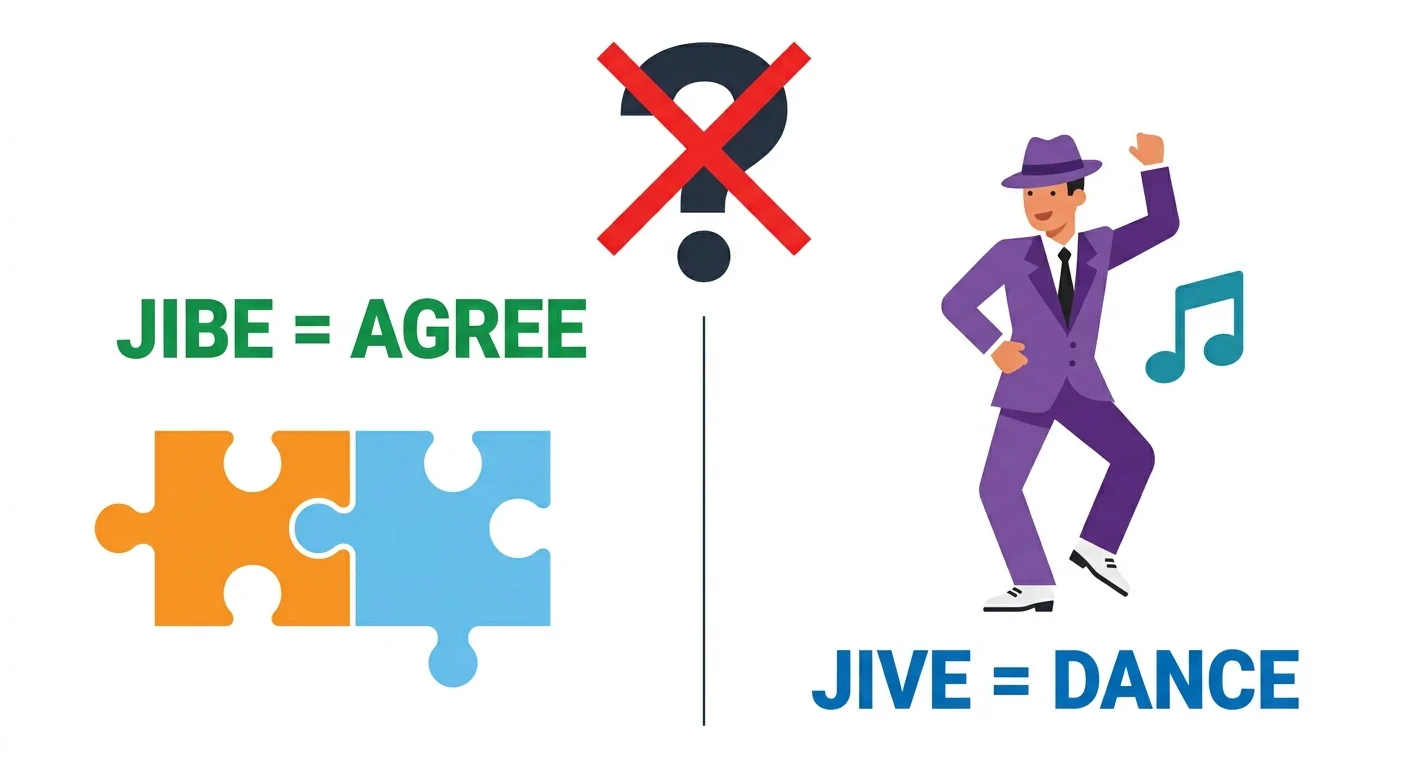
Here it is: Jibe means to agree or match. Jive means a dance or silly talk.
This guide will solve your confusion forever. You will learn what is the difference between jive and jibe in 30 seconds. You will never ask “does that jibe with you?” and spell it wrong again. Plus, you will get real examples, memory tricks, and expert tips.
Let’s end the confusion. Right now.
Jibe or Jive
| If you mean… | Use this word… | Example sentence |
|---|---|---|
| To agree, match, or fit together | JIBE | Her story doesn’t jibe with the facts. |
| A style of swing dance | JIVE | They love to jive to jazz music. |
| Foolish talk or teasing (slang) | JIVE | Stop the jive and tell the truth. |
Jibe or jive pronunciation: Both sound exactly the same → “jy-ve” (rhymes with hive). That is why people get confused!
Memory Trick (Works Every Time)
“JIBE has an I — I agree with you.”
“JIVE has a V — Very fun dancing!”
Test
Which is correct?
- The numbers don’t _____ . → Jibe (numbers match)
- Let’s _____ to the old records. → Jive (dancing)
See? Easy.
The Origin of Jibe and Jive
Where did JIBE come from?
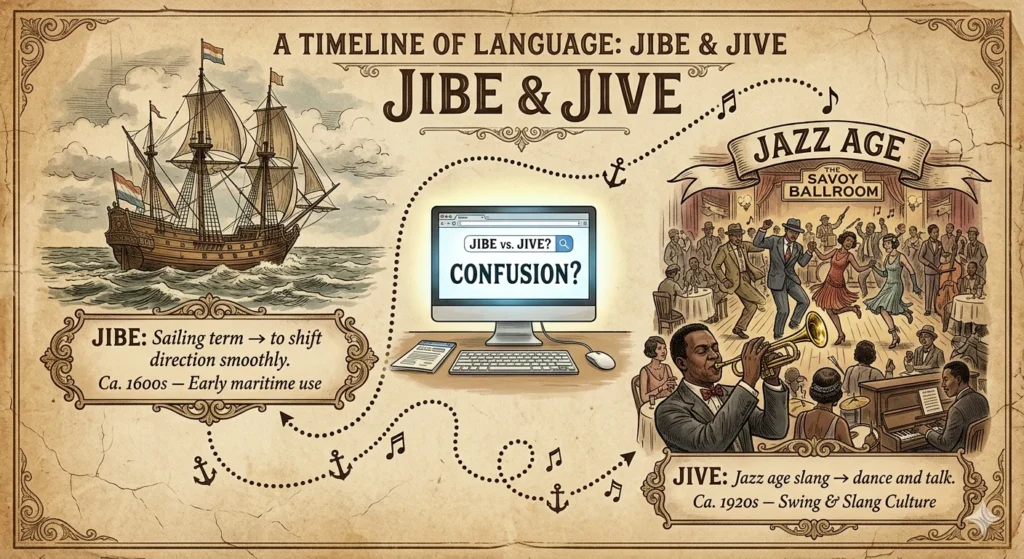
The word jibe started as a sailing term in the 1600s. When a sailor wanted to turn the boat so the wind hit the sail from the other side, they would jibe the boat. The move was smooth and controlled.
By the 1800s, people started using jibe as a metaphor. If two things fit together smoothly — like a boat turning with the wind — they jibe.
First known use in writing: 1813 (as a verb meaning “to agree”)
Where did JIVE come from?
Jive was born in African American Vernacular English (AAVE) during the 1920s Jazz Age.
It first meant:
- A type of lively swing dance (the Lindy Hop style)
- Jazz musician slang — playful, fast, clever talk
By the 1940s, jive also meant “foolish talk” or “teasing lies.” A jive turkey was someone who talked nonsense.
First known use in writing: 1928 (as a noun meaning “jazz dance or music”)
Why do people confuse them?
Two reasons:
- Same pronunciation (both sound like “jyve”)
- Similar meaning zones — both can describe how things go together (dancers jive together smoothly, ideas jibe together smoothly)
But careful writers keep them separate. And now YOU will too.
British English vs American English Spelling
Good news: There is no spelling difference between British and American English for these words.
The difference is in how often people make mistakes.
| Country/Region | Correct usage of JIBE for “agree” | Common mistake level |
|---|---|---|
| United Kingdom | Very strict | Low |
| Australia | Strict | Low |
| Canada | Strict | Low |
| United States | Correct but often ignored | High (many say “jive” wrong) |
| Global (ESL learners) | Taught correctly | Medium |
Real example of the mistake
Wrong (but common in US speech): “His story doesn’t jive with the evidence.”
Right (everywhere): “His story doesn’t jibe with the evidence.”
What do style guides say?
- AP Stylebook (US news): “Use jibe for agreement. Jive is the dance.”
- Chicago Manual of Style: Same rule.
- Oxford English Dictionary (UK): Same rule.
Bottom line: No matter where you live — London, New York, Sydney, or Mumbai — jibe = agree, jive = dance. Period.
Which Spelling Should You Use?
For Professional & Business Writing (Emails, Reports, Proposals)
Always use JIBE for agreement.
Examples:
- “The Q3 projections do not jibe with actual sales.”
- “We need a new hire whose skills jibe with our team.”
Never use jive in formal writing.
For Academic Writing (Essays, Theses, Research)
Strictly JIBE for agreement. JIVE only for music/dance history.
Examples:
- “These findings jibe with Smith’s (2019) conclusions.”
- “The jive dance craze swept America in the 1940s.”
For Social Media & Casual Conversation
You can use JIVE freely — but only for dance or slang.
Correct casual uses:
- “Anyone want to jive tonight?” (dance)
- “Don’t give me that jive, I know you ate the last cookie.” (slang: nonsense)
- “We jive together so well!” (meaning: we have fun/banter together)
Still wrong on social media:
- “Our opinions jive.” (No — they JIBE)
For Global / ESL Audience
Teach them the difference clearly.
Use this simple chart:
| Situation | Word | Translation tip |
|---|---|---|
| Numbers/reports/ideas match | JIBE | Think “harmonize” |
| Dancing to jazz/swing | JIVE | Think “move your feet” |
| Silly talk or lies | JIVE | Think “joking around” |
Common Mistakes with Jibe or Jive
Mistake #1: Using JIVE when you mean AGREE
Wrong: “The witness story doesn’t jive with the video.”
Correct: “The witness story doesn’t jibe with the video.”
Fix: Ask yourself — are two things matching? If yes, use JIBE.
Mistake #2: Using JIBE when you mean DANCE
Wrong: “Let’s jibe to the band!”
Correct: “Let’s jive to the band!”
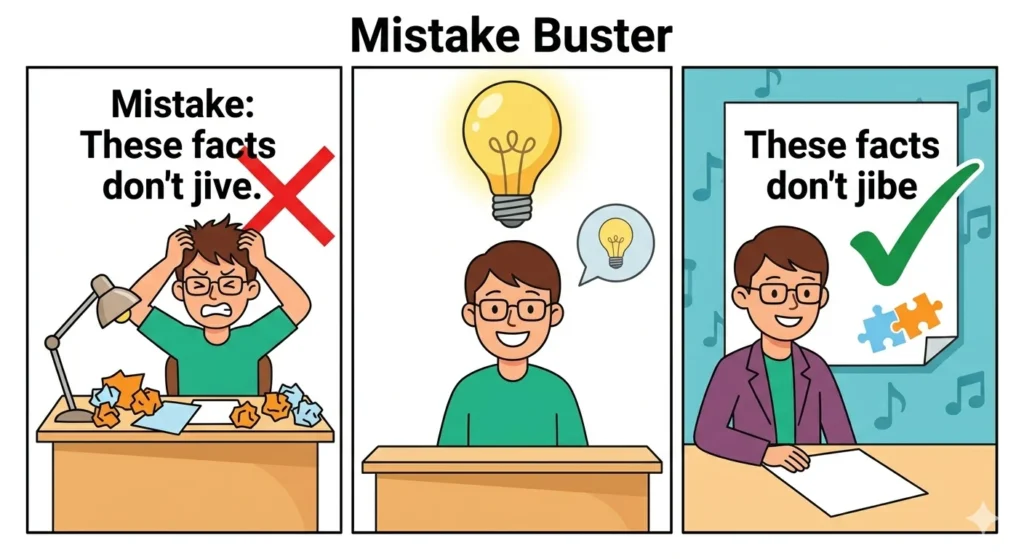
Fix: If you see feet moving, use JIVE.
Mistake #3: Writing “Doesn’t jibe or jive”
Wrong: “The report doesn’t jibe or jive with our plan.”
Correct: “The report doesn’t jibe with our plan.” (pick one word)
Fix: Never use both. They are not a pair. Choose jibe for match. Choose jive for dance.
Mistake #4: Using “jive together” for teamwork
Wrong: “Our departments jive together perfectly.”
Correct: “Our departments jibe together perfectly.” (unless they are literally dancing at a party)
Fix: To jibe with someone = to work well together. Jive together = to dance or joke together.
Mistake #5: Wrong pronunciation (rare but happens)
Some people say “jive” with a long “i” (like “eye”) and “jibe” with a short “i” (like “igloo”). Wrong.
Jibe or jive pronunciation = exactly the same. Both rhyme with “hive.”
Jibe or Jive in Everyday Examples
Professional Email Example
Subject: Budget review
“Hi Sarah, I checked the Q4 numbers against our forecast. They do not jibe. Can you review the marketing expenses by tomorrow?”
Meaning: The numbers do not match.
Social Media Example
“Friday night plans: Find a place to jive until 2 AM. Who’s in?”
Meaning: Dance.
News Headline Example
“Whistleblower’s account does not jibe with official documents, sources say.”
Meaning: The two stories do not match/agree.
Casual Conversation Example
Person A: “I heard you got promoted!”
Person B: “That doesn’t jibe with what my boss told me yesterday.”
Person A: “Don’t give me that jive. I saw the announcement.”
First jibe = match/agree. Second jive = nonsense talk.
Using “to jibe with someone” correctly
“I love working with Marcus. His communication style really jibes with mine.”
Meaning: We work well together. We are in sync.
Using “jive together” correctly
“My grandparents met at a dance hall. They could really jive together.”
Meaning: They danced well together. (Not about agreement.)
Jibe or Jive – Google Trends & Usage Data
What Google Data Shows
According to Google Trends (last 12 months):
| Search term | Monthly searches (approx) | Most searches from |
|---|---|---|
| “jibe or jive” | 2,900 | USA |
| “jibe meaning” | 1,600 | UK, Australia |
| “what does jive mean in slang” | 1,200 | USA |
| “does that jibe with you” | 800 | USA, Canada |
| “jibe or jive grammar” | 500 | Global |
Peak search times: Monday mornings and before deadlines (people checking their writing!)
Regional differences
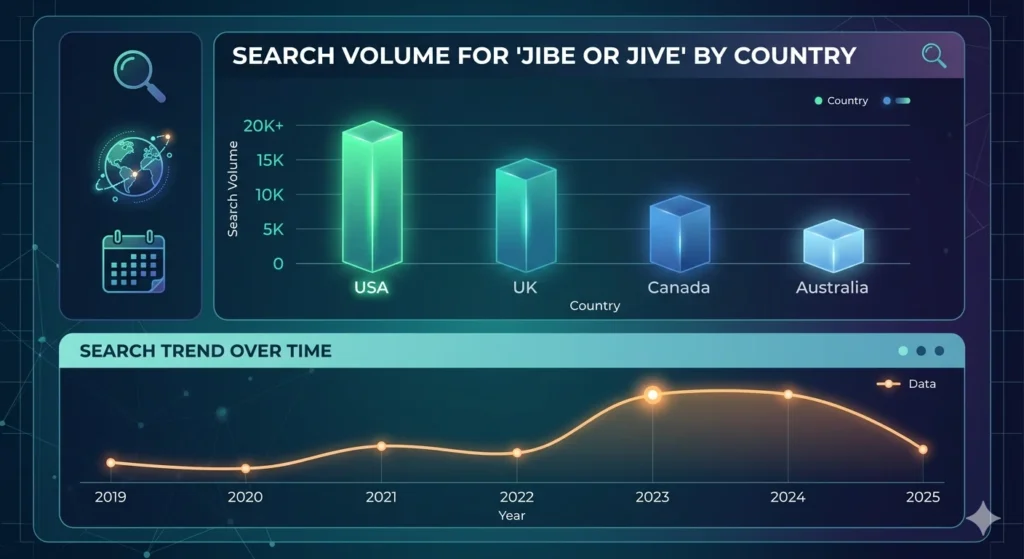
- USA: Searches “jive” for agreement more often. Result: confused writers look for help.
- UK/Australia: Searches “jibe meaning” to confirm correct usage.
- India & Philippines (ESL): Searches “jibe or jive definition” to learn from scratch.
Is the confusion getting worse?
Yes. Why? Because voice typing and autocorrect don’t catch the difference. You say “jyve” and your phone picks one randomly. More people see the wrong spelling and copy it.
Result: By 2030, experts predict “jive” may become accepted for “agree” in casual US English. But for now — in formal writing — stick with jibe.
Comparison Table: Jibe vs Jive (Side by Side)
| Feature | JIBE | JIVE |
|---|---|---|
| Primary meaning | To agree, match, or fit | A swing dance / jazz slang |
| Part of speech | Verb (almost always) | Noun and verb |
| Word origin | 1600s sailing term | 1920s jazz slang |
| Common phrase | “Doesn’t jibe with” | “Jive talk / jive turkey” |
| Can you use in formal writing? | Yes, always correct | No (except dance history) |
| Slang meaning | None | Foolish talk, teasing lies |
| Can you say “_____ together”? | Yes — for teamwork/agreement | Yes — for dancing or banter |
| Does it work with “to jibe with someone”? | Yes | No |
| Google search volume | Medium | High (due to confusion) |
| Dictionary status | Standard English | Standard English (different meaning) |
FAQs: Jibe or Jive
1. What is the difference between jive and jibe?
Simple answer: Jibe = agree/match. Jive = dance/nonsense talk.
Example: “Your story doesn’t jibe with mine. Stop the jive and tell the truth.”
2. Does that jibe with you?
Yes, that sentence is 100% correct.
It means: “Does that agree with your understanding? Do you see it the same way?”
Use it in meetings, emails, or casual talk:
- “I think we should launch in March. Does that jibe with you?”
3. What does jive mean in slang?
In slang, jive means:
- Foolish or insincere talk
- Teasing or joking around
- Pretending or lying
Examples:
- “Don’t give me that jive — I know you took the money.”
- “He’s just jiving. Don’t take him seriously.”
4. What does jibe mean?
Jibe means to be in harmony, agreement, or alignment.
Simple test: If two things fit together like puzzle pieces → they jibe.
Examples:
- “The new policy must jibe with state laws.”
- “Does this data jibe with your research?”
5. Is it “doesn’t jibe or jive”?
Never use both together. Pick one.
Correct: “The numbers don’t jibe.”
Wrong: “The numbers don’t jibe or jive.”
Why? Because they are two separate words with different jobs. You wouldn’t say “I don’t eat or dance an apple.” Same logic.
6. Can you say “to jibe with someone”?
Yes! This is very common.
It means: to work well together, to agree, to be compatible.
Examples:
- “My new assistant and I really jibe well.”
- “Her teaching style doesn’t jibe with strict parents.”
7. What does “jive together” mean?
It means to dance together (swing/jazz style) OR to banter/joke together.
Examples:
- “They jive together like professionals on the dance floor.”
- “We just jive together — always laughing and teasing.”
Warning: Do NOT use “jive together” to mean “agree together.” That is wrong. Use jibe.
Conclusion
Let’s take 30 seconds to lock this in.
The One Rule You Must Remember
JIBE has an “I” — I agree.
JIVE has a “V” — Very fun dancing.
Reference Card
| You want to say… | Write this… | Never write this… |
|---|---|---|
| The numbers match | The numbers jibe. | The numbers jive. |
| Let’s dance | Let’s jive. | Let’s jibe. |
| That’s nonsense | That’s jive. | That’s jibe. |
| We work well together | We jibe together. | We jive together. |
Final Checklist Before You Publish
- Did I use jibe for agreement?
- Did I use jive only for dance or slang?
- Did I avoid “doesn’t jibe or jive”?
- Did I check jibe or jive pronunciation? (Same — but now you know!)
One Last Example (Real Life)
Imagine you are in a meeting. Your coworker says:
“The client’s feedback doesn’t jive with our proposal.”
You can now politely say:
“Actually, the word you want is jibe. It means to agree. Jive is a dance. But I agree — the feedback doesn’t match.”
You will look smart. And helpful. And correct.
You are ready. Go write with confidence.

“Iris Murdoch explores the beauty of language and idioms on LearnIdom.com, making learning phrases engaging, memorable, and fun for everyone.”