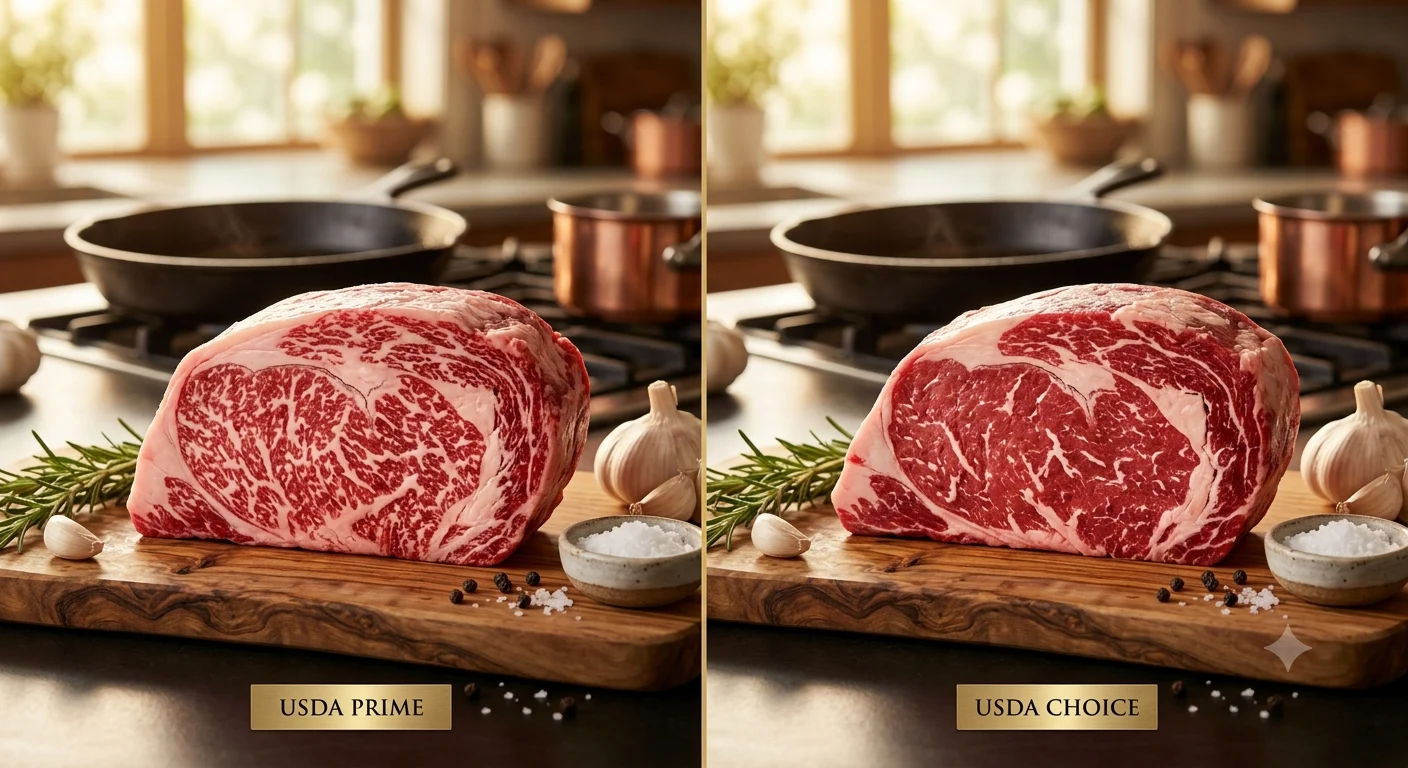
Walking through the meat aisle can feel overwhelming. You see beautiful steaks with different labels and prices. The biggest question most shoppers face is simple: Prime or Choice? 🤔
People search for this answer because they want the best steak without wasting money. Some think Prime is always better, while others believe Choice is just as good. The truth is more complex. Understanding the difference between USDA beef grades saves you money and makes you a smarter shopper. 💡
This guide clears up all the confusion. You will learn exactly what makes Prime special, why Choice is the smart buy for most meals, and how to pick the perfect steak every time. Whether you are grilling for a crowd or cooking a romantic dinner, this knowledge transforms your cooking. 🔥
Let’s end the debate once and for all. Which grade should you choose? The answer might surprise you! 🥩✨
Prime or Choice ⚡
Prime beef is better than Choice because it has more marbling (fat), making it juicier, more tender, and more flavorful. But Choice is the smarter buy for most people because it costs less and still tastes amazing.
Here is the simple truth 👇
- Prime = Top 2-3% of beef. Best flavor. Most expensive. Perfect for special occasions.
- Choice = Top 50% of beef. Great flavor. Affordable. Perfect for everyday meals.
- Select = Leaner. Less flavor. Cheapest. Best for slow cooking or marinating.
Real example: A Prime ribeye steak melts in your mouth like butter. A Choice ribeye is still incredibly delicious but has slightly less fat. Most people cannot even tell the difference in a blind taste test!
The Origin of USDA Beef Grades 📜
The United States Department of Agriculture (USDA) created this beef grading system back in the 1920s. The goal was simple: help farmers, butchers, and customers speak the same language about meat quality. Before this system, buying beef was confusing and risky. You never really knew what you were getting. 😕
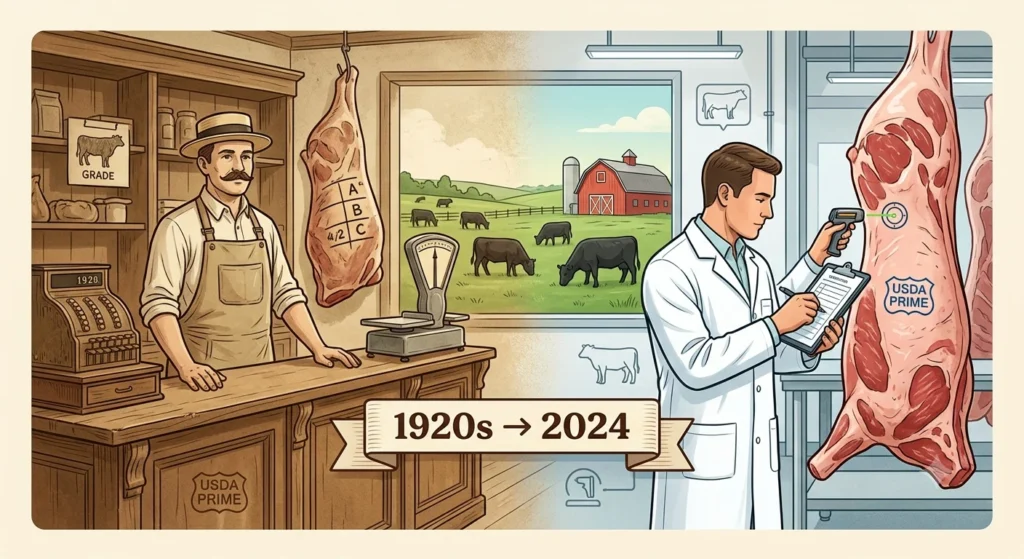
How Grading Works 🔬
USDA inspectors look at two main things:
- Marbling – The white flecks of fat inside the muscle
- Maturity – The age of the cattle when processed
Fun fact: More marbling = more tenderness, juiciness, and flavor. The fat melts during cooking and baste the meat from the inside. This is why Prime tastes so incredible! 🤤
Why Marbling Matters 🧈
Fat is flavor. When you cook a steak, the marbling melts and spreads throughout the meat. This creates that buttery, rich taste people pay top dollar for. A lean cut without marbling can become dry and tough, like chewing on a shoe. Not fun! 👟❌
The USDA Process 📝
Certified USDA graders evaluate every carcass. They check the ribeye muscle between the 12th and 13th ribs. This is the standard spot for inspection. Based on what they see, the beef receives its grade. This system has been trusted for over 100 years!
Prime vs Choice vs Select – Full Comparison 🔍
Understanding all three grades helps you make better decisions at the store. Let’s break it down clearly.
🥇 USDA Prime
- Marbling: Abundant (8-13% fat)
- Tenderness: Extremely high
- Flavor: Rich, buttery, intense
- Price: High ($25-$40 per pound)
- Availability: Rare (only 2-3% of all beef)
- Best for: Special occasions, holidays, birthdays, anniversaries 🎂
🥈 USDA Choice
- Marbling: Moderate (4-8% fat)
- Tenderness: High
- Flavor: Bold, beefy, satisfying
- Price: Mid ($15-$25 per pound)
- Availability: Common (about 50% of all beef)
- Best for: Weekend grilling, family dinners, meal prep 🍔
🥉 USDA Select
- Marbling: Slight (2-4% fat)
- Tenderness: Moderate
- Flavor: Mild, lean taste
- Price: Low ($10-$15 per pound)
- Availability: Common (about 25% of all beef)
- Best for: Stews, slow cooking, marinated dishes 🍲
Important: Select is not “bad” beef. It just needs more love in the kitchen. Marinades and slow cooking work wonders!
Choice vs Prime vs Angus – What’s the Difference? 🤔
This is one of the most confusing topics for shoppers. Let me clear it up right now.
The Simple Answer 💡
- Prime and Choice = USDA quality grades
- Angus = A specific breed of cattle
Think of it like cars:
- Prime vs Choice is like trim levels (luxury vs standard)
- Angus is like the brand (Toyota vs Honda)
What is Angus? 🐂
Angus is a Scottish breed of cattle known for consistent meat quality. Most Angus beef in America is Black Angus. This breed naturally produces well-marbled meat. But here is the catch:
Not all Angus is Prime. Not all Prime is Angus.
Can Angus be Choice? Yes! ✅
Most Angus beef you find in stores is Choice grade. It is good quality but not top-tier. Some Angus cattle produce Prime grade meat, but that is rare.
Which is Better: Choice Angus or Prime? 🏆
USDA Prime is always better than any Choice Angus. Even though Angus beef is good, Prime grade is the highest quality. Full stop.
Here is the hierarchy:
- USDA Prime (any breed) – The absolute best
- Prime Angus – Even better! (rare and expensive)
- Choice Angus – Great everyday beef
- Choice (non-Angus) – Still good
- Select – Lean but useful
What About Wagyu? 🐄
Wagyu is a Japanese breed with extreme marbling. It is a whole different level. Think of it as the Bugatti of beef. Very expensive, very special, very delicious.
Grades of Meat From Highest to Lowest 📊
Here is the complete USDA beef grading system from top to bottom:
| Rank | Grade | Quality | Common Use |
|---|---|---|---|
| 1 | Prime 🥇 | Best | Steaks, roasts, fine dining |
| 2 | Choice 🥈 | High | Steaks, burgers, roasts |
| 3 | Select 🥉 | Good | Lean cuts, marinated meats |
| 4 | Standard | Fair | Budget meats, ground beef |
| 5 | Commercial | Lower | Processed foods, stews |
| 6 | Utility | Low | Sausages, hot dogs |
| 7 | Cutter | Very Low | Canned meats, pet food |
| 8 | Canner | Lowest | Processed products |
What About “Prime Plus”? ⭐
Some beef is graded Prime Plus. This is even better than standard Prime. It has the highest marbling score possible. Only about 1% of beef reaches this level. It is extremely rare and expensive.
What About “No Roll” Beef? 📦
“No Roll” means the beef was not graded. It could be good or bad. Most restaurants buy No Roll to save money. Always check for the USDA stamp!
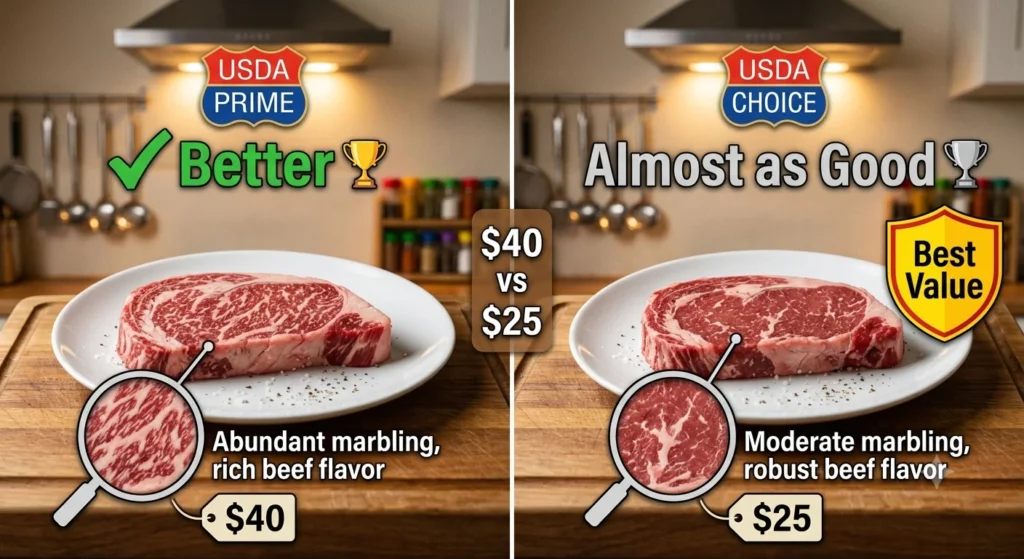
Is Prime Better Than High Choice? 🏅
The short answer is YES. Prime is always better than any Choice, even “High Choice.”
What is “High Choice”? 📈
High Choice (sometimes called Top Choice) is an unofficial term used in the meat industry. It means Choice beef that has excellent marbling. It is almost as good as Prime but costs less.
How to Spot High Choice 🔍
Look for fine, even flecks of fat throughout the meat. If a Choice steak looks very marbled, it might be High Choice. Many butchers label it this way to sell it faster.
The Difference in Taste 👅
Most people cannot tell the difference between Prime and High Choice in a blind taste test. Both are incredibly delicious. But for serious steak lovers, Prime always wins.
Rule of thumb: If you see High Choice and it costs less than Prime, BUY IT! It is an amazing value. 💰
Prime or Choice Reddit – What Real Users Say 💬
Reddit users love debating this topic. Here are real opinions from the community:
r/steak Community Thoughts 🥩
User u/SteakLover99 says:
“Prime is amazing, but Choice is 90% as good for 60% of the price. I buy Choice 90% of the time.”
User u/GrillMaster2023 says:
“Go to Costco and look for Choice with heavy marbling. Sometimes it looks better than Prime!”
User u/ButcherBuddy says:
“As a butcher, I tell customers: Buy Prime for birthdays and anniversaries. Buy Choice for Sunday dinners.”
r/AskCulinary Advice 🧑🍳
User u/ChefMama says:
“Cooking technique matters more than grade. A poorly cooked Prime steak is worse than a perfectly cooked Choice steak.”
The Reddit Consensus 📌
Most Reddit users agree:
- Prime is overhyped for the price
- Choice with good marbling is the sweet spot
- Buy Prime only for special occasions
- Cooking skill matters more than grade
- Costco and Sam’s Club have great Choice meat
Top Reddit Tips for Buying 🛒
- Look for fine, white fat flecks, not big chunks
- Check the sell-by date for freshness
- Ask your butcher for recommendations
- Try Prime once just to know the difference
- Don’t be afraid to buy Select for slow cooking
USDA Prime Near Me – Whee to Buy 🔍
Finding USDA Prime beef can be tricky. Here is your complete guide.
Best Places to Buy Prime Beef 🛒
1. Costco 🏪
- Best prices on Prime beef
- Look for the USDA Prime stamp
- Ask the butcher for help
- Bulk buying saves money
2. Sam’s Club 🏬
- Similar to Costco
- Good selection of Prime cuts
- Member discounts available
3. Local Butcher Shops 🔪
- Premium quality and service
- They can order specific cuts
- Build a relationship with your butcher
- Ask about “Prime-ish” Choice cuts
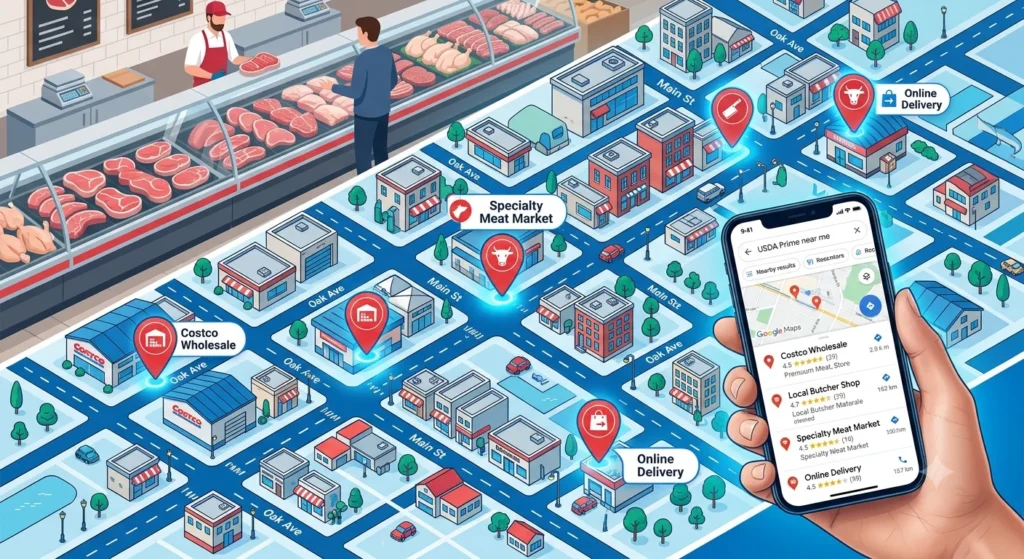
4. Specialty Meat Markets 🥩
- High-end stores
- Wide selection
- Expert advice
- Higher prices but better service
5. Online Retailers 📦
- Omaha Steaks
- Snake River Farms
- Crowd Cow
- ButcherBox
- Porter Road
How to Check if It’s Really Prime ✅
Look for the USDA Shield: The official USDA Prime label has a purple shield stamp. If it doesn’t have this, it’s not Prime.
Ask your butcher: Trusted butchers will tell you the truth.
Check the price: If it’s too cheap, it’s probably not Prime.
Prime Near Me – Search Tips 🗺️
Google Search:
- “USDA Prime near me”
- “Prime steak near me”
- “Best butchers near me”
Social Media:
- Check Reddit r/steak for local recommendations
- Join Facebook food groups
- Follow local foodies on Instagram
Phone Calls:
- Call local butcher shops
- Ask if they carry Prime
- Ask about availability
Prime, Choice Select Beef – Cooking Guide 🍳
Different grades need different cooking methods. Here is your complete guide.
How to Cook Prime Steak 🔥
Best Methods:
- Grilling (high heat) 🌡️
- Pan-searing
- Broiling
- Sous vide
Tips:
- Bring to room temperature first
- Season simply (salt and pepper) 🧂
- Cook hot and fast
- Aim for medium-rare (130-135°F)
- Rest 5-10 minutes before cutting
Why: Prime has enough fat to stay juicy during high-heat cooking.
How to Cook Choice Steak 🥩
Best Methods:
- Grilling
- Pan-searing
- Roasting
- Reverse sear
Tips:
- Use a meat thermometer 🌡️
- Don’t overcook
- Add butter at the end 🧈
- Rest before serving
Why: Choice needs careful cooking to stay moist.
How to Cook Select Beef 🍲
Best Methods:
- Slow cooking
- Braising
- Marinating (24+ hours)
- Stews and soups
Tips:
- Cook low and slow
- Use liquids for moisture
- Add vegetables for flavor
- Cook until fork-tender
Why: Select has less fat and needs extra help to become tender.
Grilling Guide by Grade 🌡️
| Grade | Best Temp | Cooking Time (1-inch steak) | Doneness |
|---|---|---|---|
| Prime | 450-500°F | 4-6 minutes per side | Medium-rare |
| Choice | 400-450°F | 5-7 minutes per side | Medium-rare |
| Select | 350-400°F | 6-8 minutes per side | Medium |
British English vs American English Spelling 🇬🇧🇺🇸
The USDA grading system is American. Here is how different countries talk about beef quality.
American System (USDA) 🇺🇸
- Prime
- Choice
- Select
- Standard
- Commercial
British/European System (EUROP) 🇬🇧🇪🇺
- E (Excellent)
- U (Very Good)
- R (Good)
- O (Fair)
- P (Poor)
Comparison Table 🌍
| American Grade | British Grade | Australian Grade | Japanese Grade |
|---|---|---|---|
| Prime | E (Excellent) | MSA 100+ | A5 (Best) |
| Choice | U (Very Good) | MSA 80-99 | A4 |
| Select | R (Good) | MSA 60-79 | A3 |
| Standard | O (Fair) | MSA 50-59 | A2 |
| Commercial | P (Poor) | MSA Below 50 | A1 |
Key Takeaway 📌
When buying beef internationally, ask for the local grading system. Most countries have their own standards. American terminology is widely understood but not always used.
Which Spelling Should You Use? ✍️
For American Readers 🇺🇸
Always use:
- Prime
- Choice
- Select
These are official USDA brand names. Capitalization matters!
For British/Commonwealth Readers 🇬🇧🇦🇺🇨🇦
Use American terms for US beef. Explain local equivalents for clarity.
Example:

“USDA Choice (similar to UK Grade U) is the most popular grade.”
For Global Audience 🌍
- Use American terms
- Explain briefly
- Add local comparisons
Example:
“USDA Prime (similar to Japan’s A5 or Australia’s MSA 100+) is the highest quality.”
Common Mistakes With Beef Grades ❌
Avoid these errors and become a smarter shopper! 💡
Mistake #1: Confusing “Prime Rib” with “Prime Grade” ❌
Wrong: “This prime rib must be USDA Prime.”
Correct: Prime Rib is a cut of meat, not a grade. It could be Choice or Select.
Example: A restaurant serving “Prime Rib” might use Choice beef. Always check the label!
Mistake #2: Thinking All Marbling is Good ❌
Wrong: “Any fat makes it Prime.”
Correct: Prime has fine, even marbling. Choice might have chunky fat.
Key difference:
- Prime = delicate spiderweb of fat 🕸️
- Choice = larger chunks of fat 🧩
Mistake #3: Overpaying for Select ❌
Wrong: “It says beef, so it must be good.”
Correct: Select is lean and needs careful cooking.
Better: Look for the grade stamp. Don’t assume all beef is good.
Mistake #4: Cooking All Grades the Same ❌
Wrong: “I cook every steak the same way.”
Correct: Different grades need different methods.
Rule:
- Prime = Hot and fast 🔥
- Choice = Medium heat 🌡️
- Select = Low and slow 🐢
Mistake #5: Ignoring the Stamp ❌
Wrong: “I trust the butcher’s word.”
Correct: Look for the official USDA purple shield.
Why: Some stores mislabel meat. Always check the official stamp! ✅
Mistake #6: Buying Too Much Prime ❌
Wrong: “I’ll buy Prime every week!”
Correct: Prime is for special occasions.
Better: Buy Choice for everyday. Save money for other things.
Mistake #7: Not Asking Your Butcher ❌
Wrong: “I just grab whatever looks good.”
Correct: Butchers are experts! Ask questions.
Questions to ask:
- “Is this really Prime?”
- “What grade do you recommend?”
- “What’s your best value?”
Prime or Choice in Everyday Examples 📝
On Social Media 📱
Instagram:
“Prime or Choice? Found this beautiful cut today! Look at that marbling 😍 #SteakLover #USDAPrime #GrillMaster”
Twitter/X:
“The eternal debate: Prime or Choice? I’m team Choice for weeknights, Prime for weekends. What about you? 🥩”
Reddit:
“Help me decide! Prime or Choice for my birthday steak dinner? Costco has both. What should I buy? 🎂”
TikTok:
“POV: You’re deciding between Prime and Choice at the store. Which one would you pick? 🤔”
In News and Food Writing 📰
Headline:
“USDA Prime vs Choice: What’s the Difference and Which Should You Buy?”
Example Article:
“When shopping for steak, you will see labels like USDA Prime, Choice, and Select. Prime beef has the most marbling, making it the most flavorful and tender option. However, Choice is more affordable and still delivers excellent quality for everyday meals.”
Magazine Feature:
“Grilling season is here! Learn the difference between Prime and Choice beef so you can impress your guests with the perfect steak.”
In Formal Writing 📄
Menu Description:
“USDA Prime New York Strip – Hand-cut, dry-aged for 21 days, served with herb butter and roasted garlic.”
Cookbook Recipe:
“For this recipe, we recommend using USDA Choice beef. It provides the perfect balance of flavor and affordability for this crowd-pleasing dish.”
Blog Post:
“Understanding the differences between Prime, Choice, and Select beef grades will transform your cooking and save you money at the grocery store.”
In Everyday Conversation 💬
At the Store:
“Excuse me, which of these steaks is better? Prime or Choice?”
At a Restaurant:
“Is this Prime or Choice? I want to know before I order.”
At a BBQ:
“These steaks are Choice, but they look like Prime! I got them at Costco.”
Family Dinner:
“I bought Prime steaks for this special occasion. Let’s celebrate!”
Prime or Choice – Google Trends & Usage Data 📊
Popularity by Country 🌍
| Country | Most Searched Term | Popularity Score |
|---|---|---|
| USA | “USDA Prime” | 100/100 |
| Canada | “Prime vs Choice” | 85/100 |
| UK | “US beef grades” | 60/100 |
| Australia | “MSA vs USDA” | 55/100 |
| Japan | “Wagyu vs Prime” | 70/100 |
Search Trends Over Time 📈
“USDA Prime” – Steadily growing. More people are learning about beef grades.
“Prime vs Choice” – Spikes during grilling season (May-September) 🌞
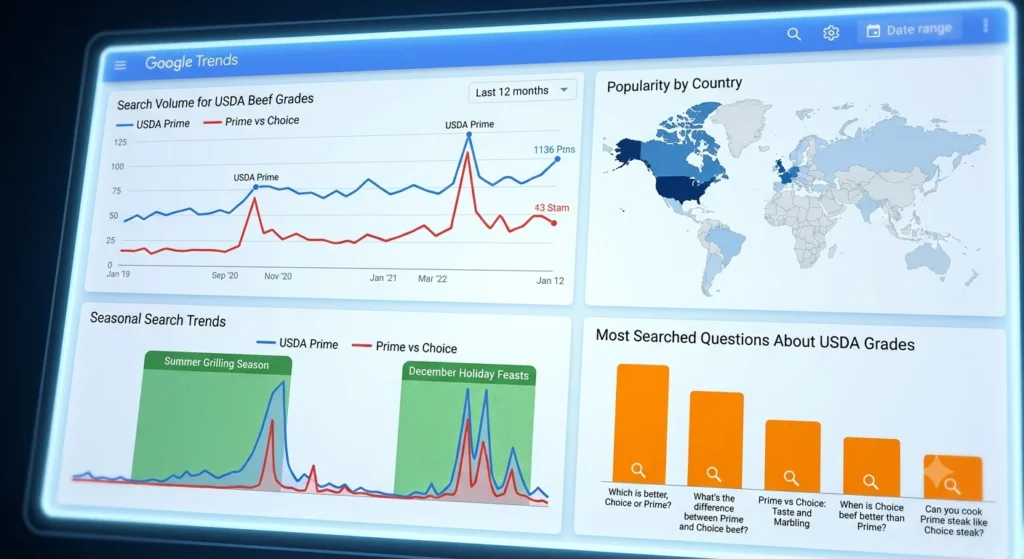
“USDA Prime near me” – Highest during holidays (December) 🎄
Who Searches for These Terms? 👥
- Home cooks (60%): Want to buy good meat
- Foodies (20%): Passionate about quality
- Restaurants (10%): Supply and menu planning
- Students (10%): Learning about food
Seasonal Peaks 🗓️
| Season | Search Volume | Reason |
|---|---|---|
| Summer | High | Grilling season 🍔 |
| December | High | Holiday dinners 🎄 |
| Valentine’s Day | Medium | Romantic dinners 💕 |
| Spring | Medium | BBQ preparation 🌸 |
| Fall | Low | Comfort food season 🍲 |
Most Asked Questions Online ❓
- “Which is better, choice or prime?” – Most asked
- “Is Choice Select or Prime better?”
- “Is Prime better than High Choice?”
- “What’s better, prime or top choice?”
- “USDA Prime near me?”
- “How much does Prime beef cost?”
- “What grade is Costco beef?”
Frequently Asked Questions (FAQs) ❓
1. Which is better, choice or prime? 🏆
Prime is better. It has more marbling, making it more tender, juicy, and flavorful. However, Choice is an excellent value and is better for most people’s budgets. Prime is for special occasions; Choice is for everyday cooking.
2. Is Choice Select or Prime better? 🤔
Prime is best, Choice is second best, Select is third. Prime has the most fat and flavor. Choice is the most popular grade because it balances quality and price. Select is lean and best for slow cooking or marinating.
3. Is Prime better than High Choice? ⭐
Yes. Prime is always the top grade. High Choice (Top Choice) is an unofficial term for Choice beef with very good marbling. High Choice is almost as good as Prime but costs less. If you find High Choice, it’s an amazing deal!
4. What’s better, prime or top choice? 💰
Prime is better in quality, but Top Choice is better in value. Prime costs 30-50% more but is only slightly better than Top Choice. For most people, Top Choice is the smarter buy. Save Prime for really special occasions.
5. Is Prime beef worth the extra money? 💵
Sometimes. Prime is worth it for:
- Birthdays and anniversaries 🎂
- Holidays and celebrations 🎄
- Impressing dinner guests 🍽️
- When you find a good sale 🏷️
Not worth it for:
- Everyday dinners
- Meal prep
- Recipes with strong sauces
- Budget cooking
6. Can I tell the difference between Prime and Choice? 👅
Most people cannot in a blind taste test. Prime is objectively better, but the difference is subtle. Cooking technique matters more. A perfectly cooked Choice steak beats a poorly cooked Prime steak every time.
7. Where can I buy USDA Prime near me? 🗺️
Best places to find Prime beef:
- Costco (best prices) 🏪
- Sam’s Club (good selection) 🏬
- Local butcher shops (premium quality) 🔪
- Specialty meat markets (expert service) 🥩
- Online retailers (convenience) 📦
Search “USDA Prime near me” on Google for local options.
8. What grade of beef does Costco sell? 🛒
Costco sells all grades: Prime, Choice, and Select. Their Prime beef is famous for excellent quality at reasonable prices. Their Choice beef is often High Choice (Top Choice) with great marbling. Costco is one of the best places to buy beef!
9. What is the highest grade of meat? 🏅
USDA Prime Plus is the highest. This is even better than standard Prime. Only about 1% of beef reaches this level. It has the most marbling possible. Restaurants and hotels compete to buy it.
10. Is Choice beef good quality? ✅
YES! Choice is excellent quality. It’s the most popular grade for a reason. Choice beef is flavorful, tender, and affordable. Most restaurants serve Choice beef. It’s perfect for everything from grilling to slow cooking.
11. What is “No Roll” beef? 📦
No Roll means the beef wasn’t graded. It could be good or bad quality. Most restaurants buy No Roll to save money. Always check for the USDA stamp when shopping. No Roll is a gamble.
12. What’s the best grade for burgers? 🍔
Choice is best for burgers. It has enough fat to stay juicy but won’t break the bank. Some people use Select for cheaper burgers. Prime is too expensive for burgers. Ground beef doesn’t need Prime quality.
13. How should I cook Prime vs Choice? 🍳
Prime: Cook hot and fast (grilling, pan-searing). Aim for medium-rare.
Choice: Cook at medium heat (grilling, roasting). Don’t overcook.
Select: Cook low and slow (stews, braising, marinating).
14. Why is Prime beef so expensive? 💸
Four reasons:
- Rarity – Only 2-3% of beef is Prime
- Demand – Restaurants buy most of it
- Quality – It truly tastes better
- Production – Raising Prime cattle costs more
15. What’s better, prime or top choice? 🏅
Prime is better quality. Top Choice is almost as good but costs less. Here is the ranking:
- Prime (best quality)
- Top Choice (best value)
- Choice (good quality)
For most people, Top Choice is the sweet spot!
Conclusion 🎯
After reading this guide, you now know everything about Prime or Choice beef. Let’s summarize the key takeaways.
The Final Verdict 🏆
Buy Choice for 90% of your cooking. It’s the best value. You get excellent quality at a fair price. Most people cannot tell the difference in a blind taste test. Choice works great for grilling, roasting, and everyday meals. It’s the smart, practical choice for families and budget-conscious cooks. 😊
Buy Prime for special occasions. Birthdays, anniversaries, holidays, and celebrations deserve the best. Prime is an experience, not just a meal. The extra marbling makes it buttery, tender, and unforgettable. If you have guests to impress or a milestone to celebrate, spend the extra money. You won’t regret it. 🎉
Buy Select for slow cooking. Lean meat works perfectly in stews, soups, and braised dishes. Marinades and long cooking times transform Select into tender, flavorful meals. Don’t overlook this budget-friendly option. 🍲

“Iris Murdoch explores the beauty of language and idioms on LearnIdom.com, making learning phrases engaging, memorable, and fun for everyone.”