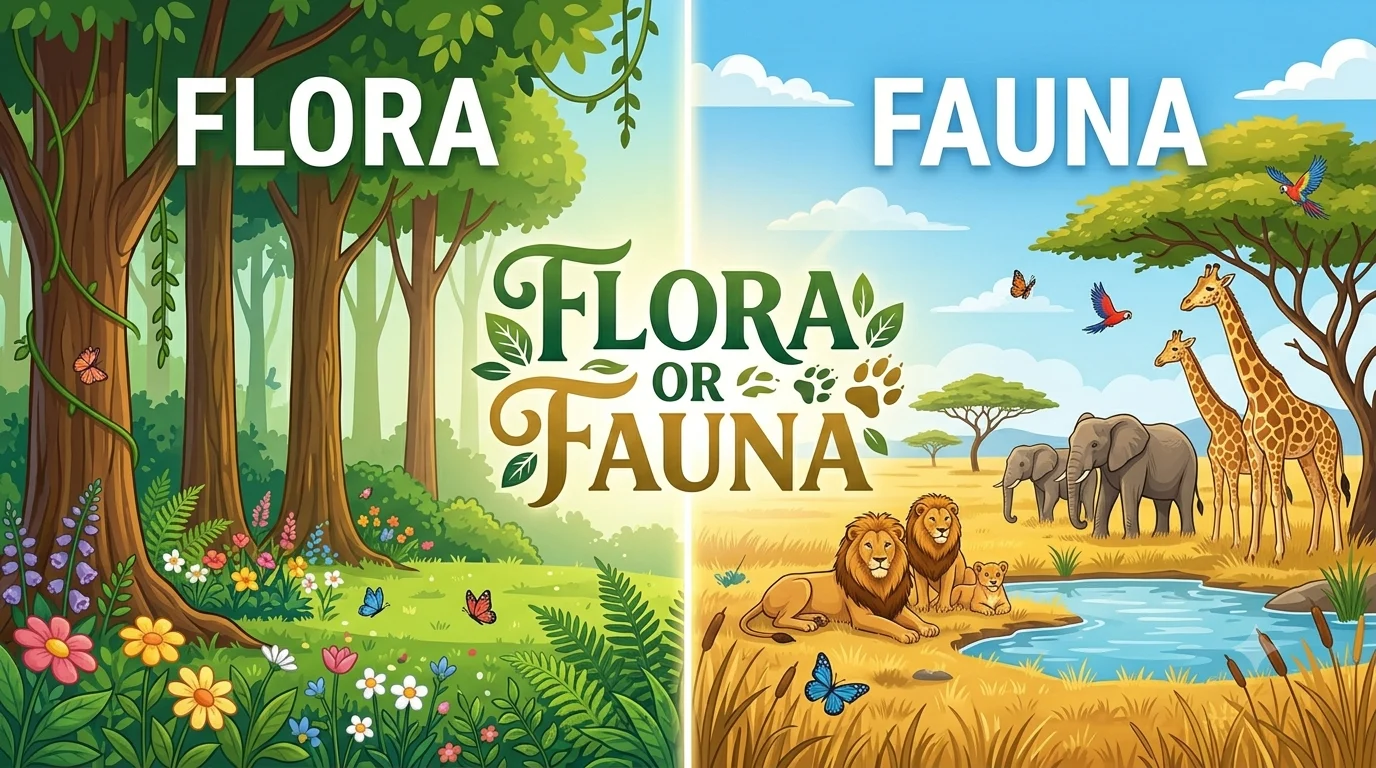
🌿 Have you ever walked through a forest and wondered about the difference between the trees around you and the animals moving through them? This is the fundamental question behind the terms flora and fauna.
These two simple words describe all living things on our planet, but they mean two entirely different things. People search for “flora or fauna” every day because they hear these terms in school, in nature documentaries, or while reading about the environment.
The confusion is always the same: which one means plants, and which one means animals? The answer is quick and easy to remember, but the full story behind these ancient words is even more fascinating. This guide will end the confusion forever and give you the confidence to use these terms like a professional.
Flora or Fauna
🌻 Flora refers to plant life. 🌿 Fauna refers to animal life. 🐾
The easiest way to remember: Think of flora like “flowers.” Think of fauna like “fawns” (baby deer). If you are talking about trees, grass, flowers, ferns, or mosses, you are talking about flora. If you are talking about birds, fish, mammals, reptiles, or insects, you are talking about fauna. This simple memory trick works every time and will help you avoid embarrassing mistakes in your writing and conversations.
For example:
- The flora of the Amazon rainforest includes giant kapok trees reaching over 200 feet tall, twisting vines that climb toward the sunlight, and vibrant orchids in every color imaginable.
- The fauna of the Amazon includes stealthy jaguars that hunt at night, colorful macaws that fly in noisy flocks, and massive anacondas that glide through murky waters.
When you see both words together, “flora and fauna,” it simply means “plants and animals” in a specific area, region, or time period. This beautiful phrase is used by conservationists, biologists, nature writers, and travelers worldwide. If you remember nothing else from this guide, remember this golden rule: flora = plants, fauna = animals. It is that simple.
The Origin of Flora and Fauna
📜 The story of these words is deeply rooted in ancient Roman mythology and centuries of scientific discovery. Understanding where these terms come from makes them much easier to remember and gives you a fascinating story to share with others.
Flora comes directly from the Latin language. In ancient Roman religion, Flora was the goddess of flowers, springtime, fertility, and new beginnings. Her festival, called the Floralia, was celebrated every year from April 28th to May 3rd with colorful games, theatrical performances, and beautiful decorations made of fresh flowers. The Roman people would wear bright, colorful clothing and throw flowers and beans into the crowds as gifts. The word was first used in a modern scientific context by a French-Swiss botanist named Jules Thurmann in the 19th century. He used “flora” to describe all the plant species found in a particular region or country.
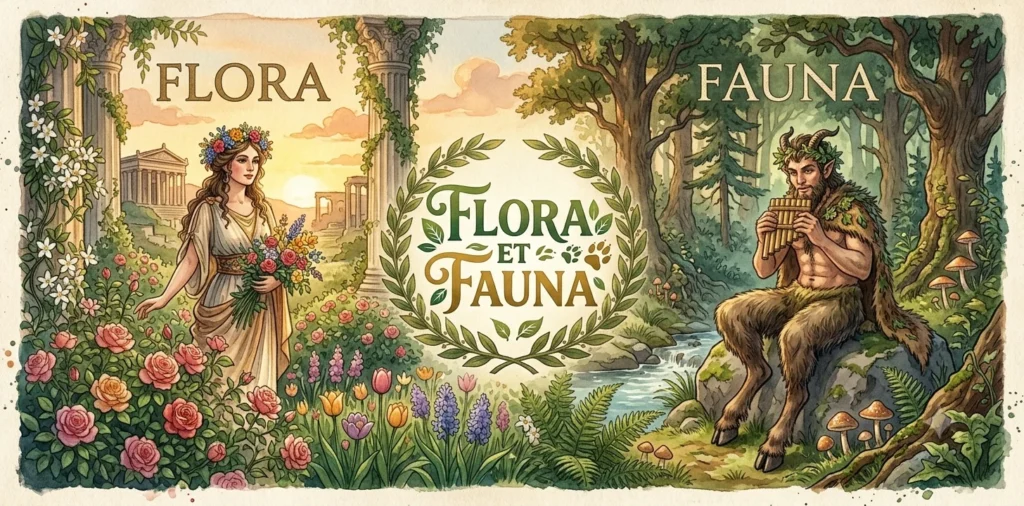
Fauna also comes from Latin. The name comes from Fauna, a Roman goddess of fertility, the earth, and wild nature. It is also closely linked to “Fauns,” which were gentle forest spirits in Roman mythology. These fauns were similar to the satyrs in Greek myths, half-human and half-goat, who protected forests, mountains, and wild animals. The famous Swedish scientist Carl Linnaeus, who created the modern system of naming living things, helped make “fauna” the official scientific term for animal life in a specific area or time period.
The reason we have two different words is simply because they come from two different mythological roots. Over the centuries, scientists and scholars adopted these ancient terms to categorize all living things for study, research, and education. While most people do not confuse the origins, they often mix up which word applies to plants versus animals. Knowing that Flora was the goddess of flowers and Fauna was the goddess of fertility gives you a mental picture that is hard to forget. This historical background makes the terms more meaningful and easier to remember for a lifetime.
British English vs American English Spelling
🇬🇧🇺🇸 Here is some excellent news that will make your writing life much easier: the spelling of “flora” and “fauna” is exactly the same in both British English and American English. There are no confusing differences like “colour” and “color” or “realise” and “realize” for these words. This consistency makes things much simpler for students, writers, and professionals everywhere.
However, there are a few small details to keep in mind to use these terms perfectly in your writing:
| Term | British English Spelling | American English Spelling |
|---|---|---|
| Flora | flora | flora |
| Fauna | fauna | fauna |
| Plural of Flora | floras or florae | floras or florae |
| Plural of Fauna | faunas or faunae | faunas or faunae |
| Adjective Form | floral (for flora) / faunal (for fauna) | floral (for flora) / faunal (for fauna) |
The only noticeable difference you might encounter is in how the words are used in a sentence structure. In British English, collective nouns like “flora and fauna” are often treated as plural. You might read or write “The flora and fauna are thriving in the new nature reserve.” In American English, it is more common to treat the phrase as a singular unit, so you might see “The flora and fauna is thriving.” Both forms are grammatically correct and widely accepted in their respective regions. The key is to be consistent throughout your writing and choose one style to follow.
It is also helpful to know that the adjective forms are used frequently in scientific and nature writing. “Floral” is commonly used to describe anything related to flowers or plants, like floral arrangements or floral patterns. “Faunal” is used less frequently but appears in scientific papers when describing animal-related characteristics or studies. Understanding these small details will make your writing more precise and professional.
Which Spelling Should You Use?
🧐 Since the spelling is identical in both major English dialects, this question is really about which word you should use in your writing or speech. The choice depends entirely on what you are trying to describe, and making the right choice shows your understanding of basic biology and ecology.
- Use Flora when you are talking about plants. This includes all types of plant life: towering trees, colorful flowers, green grasses, delicate ferns, ancient mosses, and even microscopic algae floating in the ocean. If it grows out of the ground, uses sunlight to make its own food through photosynthesis, and stays rooted in one place, it is almost certainly flora. For example, when describing a forest, you would talk about its rich flora, including oak trees, pine trees, wildflowers, and ground-covering mosses.
- Use Fauna when you are talking about animals. This includes everything from tiny insects like ants and butterflies to large mammals like elephants and whales. It also includes fish swimming in the ocean, birds flying in the sky, reptiles basking in the sun, and amphibians living near water. If it moves around, eats other living things for energy, and has a nervous system, it is fauna. For example, when describing a national park, you would talk about its diverse fauna, including deer, bears, eagles, and foxes.
- Use “Flora and Fauna” together when you want to describe all the living things in a specific area or ecosystem. This is a very common and elegant phrase used by scientists, nature writers, tour guides, and environmentalists. For example, “The Galapagos Islands are world-famous for their unique flora and fauna, which inspired Charles Darwin’s theory of evolution.” Or “The national park protects the rich flora and fauna of the region for future generations.”
Think carefully about your audience and purpose. If you are writing for an American audience, the rules are the same as for a British one. If you are writing for a global audience, using the full phrase “flora and fauna” is the clearest and safest way to ensure you are understood by everyone. In formal scientific writing, always use the full terms clearly defined in your introduction. In casual conversation or social media, you can use the terms more freely but still accurately.
Common Mistakes with Flora and Fauna
❌ Even native English speakers and experienced writers make mistakes with these terms. Here are the most frequent errors and how to avoid them permanently with confidence:
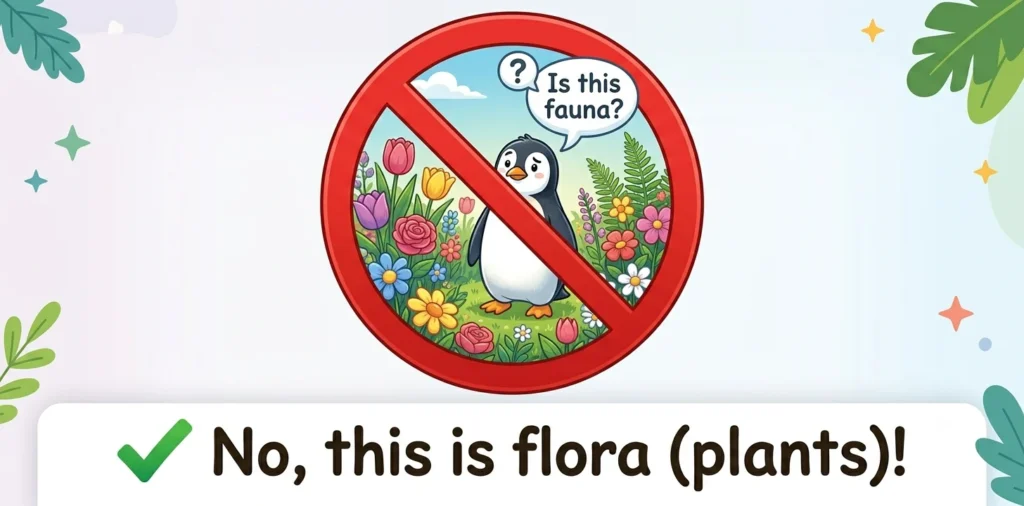
- Mistake: Calling plants “fauna.”
- Correction: This is the most common error by far. Fauna means animals. If you are talking about a beautiful garden filled with roses, tulips, and sunflowers, you are talking about flora. Saying “the garden’s fauna is beautiful” is incorrect and confusing to your readers or listeners. Always remember: fauna = animals.
- Mistake: Calling animals “flora.”
- Correction: Flora means plants. A lion roaming the savanna, an elephant walking through the jungle, or a butterfly fluttering in the meadow is definitely not flora. They are all fauna without exception. Never call an animal flora in your writing or speech.
- Mistake: Forgetting the difference when writing quickly.
- Correction: This happens to everyone when they are in a hurry. Use the powerful memory tricks: Flora = Flowers and Fauna = Fawns. This simple association will save you from embarrassing errors in emails, essays, social media posts, and professional reports.
- Mistake: Thinking “flora” only means flowers.
- Correction: Flora includes all plant life, not just colorful flowers. The grass in a field, the towering pine trees in a forest, the ferns along a riverbank, and even the microscopic algae in the ocean are all considered flora. Flowers are just one beautiful part of the plant kingdom.
- Mistake: Using “fauna” for bacteria and other microorganisms.
- Correction: In scientific contexts, bacteria and other microorganisms are usually grouped with flora. You will often hear the term “bacterial flora” or “gut flora” to describe the community of microbes living in a specific environment, like the human digestive system. They are not considered fauna because they are not animals.
- Mistake: Using the wrong plural form.
- Correction: Both “floras” and “florae” are acceptable plural forms of flora. Similarly, both “faunas” and “faunae” are acceptable for fauna. Choose one and be consistent. In modern writing, “floras” and “faunas” are more commonly used.
- Mistake: Forgetting the adjective forms.
- Correction: When you need an adjective, use “floral” for plants and “faunal” for animals. For example, “The floral diversity of the region is impressive” or “The faunal population has increased this year.”
Flora and Fauna in Everyday Examples
📧 Here is how these important terms appear in real-world contexts, from casual conversations to formal documents and everything in between:
In Professional Emails:
- “Could you please review the environmental impact report on the local flora? We need it for the city council meeting next week.”
- “The new conservation policy aims to protect the native fauna from the negative effects of urban expansion and road construction.”
- “I have attached the research findings on the flora and fauna of the coastal region for your review and feedback.”
In News Headlines and Articles:
- “The devastating bushfires have destroyed 90% of the native flora in the region, threatening many unique and endangered plant species.”
- “Wildlife officials are working around the clock to rescue the local fauna affected by the recent oil spill in the bay.”
- “Climate change poses a serious threat to the flora and fauna of the Arctic tundra, with some species facing extinction within decades.”
- “The new national park will protect the diverse flora and fauna of the mountain range for future generations.”
In Social Media Posts:
- “Spent the day exploring the incredible flora at the botanical gardens. Nature’s art is truly breathtaking! 🌷🌿🌸”
- “What an amazing safari adventure! The fauna in this wildlife reserve is absolutely spectacular. Spotted lions, elephants, and giraffes today! 🦁🐘🦒”
- “The flora and fauna on this tropical island are unlike anything I have ever seen. Truly a paradise on Earth. 🌴🐠🌺”
- “Learning about the local flora on my nature walk today. Did you know that some flowers only bloom at night? 🌙🌼”
In Formal Writing and Research:
- “The Galapagos Islands are world-renowned for their unique flora and fauna, which famously inspired Charles Darwin’s theory of evolution by natural selection.”
- “This research paper examines the effects of climate change on the flora and fauna of the Arctic tundra over the past fifty years.”
- “The study documents the rich flora and fauna of the Amazon rainforest, highlighting over 40,000 plant species and 1,300 bird species.”
- “Conservation efforts must focus on protecting both the flora and fauna of endangered ecosystems to maintain biodiversity.”
In Travel Writing and Blogs:
- “Visitors to Madagascar are often amazed by the island’s exceptional flora and fauna, with over 90% of its species found nowhere else on Earth.”
- “The national park offers guided tours that explain the fascinating flora and fauna of the region, perfect for nature lovers and families.”
- “From the colorful flora in the highlands to the unique fauna in the lowlands, this country is a nature lover’s dream destination.”
In Educational Settings:
- “Today in biology class, we learned about the flora and fauna of different ecosystems around the world.”
- “The students created beautiful projects showcasing the flora and fauna of their local environment.”
- “Understanding the relationship between flora and fauna is essential for studying ecology and environmental science.”
In Everyday Conversations:
- “I love hiking in the mountains because the flora is so diverse and beautiful.”
- “Did you see the documentary about the fauna in the Serengeti? It was amazing!”
- “The flora and fauna in my grandmother’s garden are so well cared for. It is like a small paradise.”
Flora and Fauna – Google Trends & Usage Data
📊 Data from Google Trends and other search analytics tools shows that “flora and fauna” is a consistently popular and stable search term around the world. It does not fade in and out of popularity like some trendy internet slang or fashion terms. Instead, it remains a steady, essential term that people search for every single day, year after year. This consistent search volume makes it an important keyword for educational and nature-related content.

By Country and Region:
- Interest in the term is highest in countries with extraordinary biodiversity and rich natural heritage. India consistently shows the highest search volume, followed closely by Australia, Brazil, Mexico, and South Africa. These countries are known for their incredible natural diversity, from the rainforests of Brazil to the unique wildlife of Australia.
- It is also very popular in major English-speaking countries like the United States, the United Kingdom, and Canada, especially in educational, travel, and environmental contexts.
- Interestingly, search interest spikes in countries like Kenya, Costa Rica, and Indonesia during peak travel seasons, as tourists plan visits to national parks and wildlife reserves.
By Context and Purpose:
- The term is most commonly searched for in an educational context. Students in middle school, high school, and college look for the definition and the difference between the two words for homework, essays, science projects, and exam preparation.
- It is also frequently searched by travelers and tourists planning trips to rainforests, coral reefs, national parks, and wildlife sanctuaries who want to understand what they will see and experience.
- Environmentalists, conservationists, and nature writers search for the term when preparing reports, articles, and presentations about biodiversity and ecosystem protection.
- Content creators and bloggers use the term when writing about nature, travel, science, and environmental topics.
By Related Searches:
- People who search for “flora or fauna” also frequently search for related terms like “what is flora,” “what is fauna,” “flora and fauna examples,” “flora and fauna meaning,” “flora and fauna essay,” “flora and fauna difference,” and “flora and fauna definition.” These related searches show that users are looking for clear explanations and practical examples.
- Seasonal trends show increased searches during Earth Day celebrations, World Environment Day, and when major nature documentaries are released.
The Verdict:
- The phrase “flora and fauna” is timeless, essential, and universally understood. It does not show any signs of declining in popularity because it is the standard, scientific term used to describe the plant and animal life of our planet. It is a term that will remain relevant for generations to come.
- For content creators and website owners, including “flora and fauna” and related terms in your content can attract a steady stream of educational and nature-loving visitors. The consistent search volume makes it a reliable keyword for long-term traffic.
Comparison Table: Flora vs Fauna
| Feature | Flora | Fauna |
|---|---|---|
| Basic Meaning | Plant life in a specific region or time | Animal life in a specific region or time |
| Etymology (Word Origin) | From Flora, Roman goddess of flowers and spring | From Fauna, Roman goddess of fertility |
| Common Examples | Trees, flowers, grass, ferns, mosses, algae | Birds, fish, mammals, insects, reptiles, amphibians |
| How They Get Food | Make their own food through photosynthesis (autotrophs) | Eat other organisms for food (heterotrophs) |
| Movement Ability | Generally stay rooted in one place | Generally move around freely |
| Cell Structure | Have a rigid cell wall made of cellulose | Do not have a cell wall |
| Growth Pattern | Continuous growth throughout life | Growth stops after reaching maturity |
| Role in Ecosystem | Primary producers (create food and oxygen) | Consumers (eat producers or other consumers) |
| Response to Stimuli | Slower, less obvious responses | Faster, more complex responses |
| Reproduction | Mostly through seeds, spores, or cuttings | Mostly through sexual reproduction |
| Life Span | Can live for thousands of years (like some trees) | Generally shorter life spans |
Frequently Asked Questions
1. What is the basic meaning of flora and fauna?
Flora means all the plant life in a specific area, region, country, or time period. This includes trees, flowers, grasses, ferns, mosses, and algae. Fauna means all the animal life in a specific area, region, country, or time period. This includes birds, fish, mammals, insects, reptiles, amphibians, and other animals. Together, they describe all the living things in an ecosystem or environment. 🌿🐾
2. What is the main difference between flora and fauna?
The main difference is that flora is plants and fauna is animals. They differ in several fundamental ways: how they get their food (plants make it through photosynthesis, animals eat other organisms), their ability to move (plants stay rooted in one place, animals move around freely), and their cell structure (plants have rigid cell walls made of cellulose, animals do not have cell walls). These differences are basic to biology and ecology.
3. Are bacteria and fungi considered flora or fauna?
Bacteria and microorganisms are usually considered part of the flora. In scientific terms, you will often see phrases like “bacterial flora” or “gut flora” to describe the community of microbes living in a specific environment, such as the human digestive system or soil. Fungi, like mushrooms and molds, are neither flora nor fauna. They belong to a completely separate biological kingdom called Fungi. Fungi are not plants because they do not make their own food through photosynthesis, and they are not animals because they have cell walls and absorb nutrients differently.
4. Why do people say “flora and fauna” together?
People say “flora and fauna” together as a convenient and elegant shorthand way to mean “all the living things” in a particular place. It is a simple, widely understood term used by scientists, writers, nature lovers, and travelers to describe an entire ecosystem, region, or habitat. For example, when someone says “the flora and fauna of the Amazon,” they mean all the plants and animals that live in the Amazon rainforest.
5. Can you give some common examples of flora and fauna from everyday life?
Examples of flora from everyday life include oak trees, pine trees, roses, sunflowers, bamboo, ferns, seaweed, grass in your lawn, and houseplants like ficus or snake plants. Examples of fauna from everyday life include dogs, cats, birds in your backyard, butterflies, fish in an aquarium, squirrels, deer, and even humans (yes, humans are considered fauna!). Every living thing you see in nature is either flora or fauna.
6. What is the meaning of flora and fauna in an ecosystem?
In any ecosystem, flora are the primary producers. They create food and oxygen through the process of photosynthesis, using sunlight, water, and carbon dioxide. Fauna are the consumers. They eat the flora or other fauna to get the energy they need to survive and grow. Flora and fauna are deeply interconnected and depend on each other. Flora produces the oxygen that fauna breathes, and fauna produces the carbon dioxide that flora needs for photosynthesis. Fauna also helps spread seeds, pollinate flowers, and fertilize the soil with their waste. This beautiful balance is what makes ecosystems work.
7. What is the difference between flora, fauna, and fungi?
Flora is plants, fauna is animals, and fungi (like mushrooms, molds, yeast, and lichens) are a completely separate kingdom of life. Fungi are not considered either flora or fauna. They have their own unique biological classification because they have characteristics that are different from both plants and animals. For example, fungi have cell walls like plants but do not perform photosynthesis. They absorb nutrients from decaying matter like animals but have a different cellular structure. This is why they are classified in their own kingdom.
8. How do flora and fauna depend on each other for survival?
Flora and fauna depend on each other completely in what is known as a symbiotic relationship. Flora produces the oxygen that all fauna breathes to survive. Fauna produces the carbon dioxide that all flora needs for photosynthesis. Fauna also helps flora by spreading seeds through their droppings, pollinating flowers (like bees and butterflies), and fertilizing the soil with their waste. Flora provides food, shelter, and protection for fauna. This balanced relationship is essential for the health and survival of our planet’s ecosystems. Without flora, fauna would not survive, and without fauna, flora would not thrive.
9. How can I remember the difference between flora and fauna easily?
Use these simple and effective memory tricks:
- Flora = Flowers: Both start with “Flo.” Think of colorful flowers, and you will remember that flora means plants.
- Fauna = Fawns: Both start with “Fau.” Think of baby deer (fawns) running through the forest, and you will remember that fauna means animals.
- Another trick: Flora has an “L” in it, and “L” stands for “leaves.” Fauna has a “U” in it, and “U” stands for “us” (humans are animals too).
These simple associations will help you never forget the difference again.
10. Why is understanding flora and fauna important?
Understanding flora and fauna is important for many reasons. First, it helps us understand basic biology and how life works on our planet. Second, it helps us appreciate the incredible diversity of nature and the complex relationships between different living things. Third, it is essential for environmental conservation and protecting endangered species. When we understand the flora and fauna of an area, we can better protect it. Fourth, it enriches our travel experiences, nature writing, and everyday conversations. Finally, it helps us teach future generations about the importance of biodiversity and caring for our planet Earth.
Conclusion
💡 To wrap it all up, understanding flora or fauna is simple once you master the basics. Flora means plants and comes from the Roman goddess of flowers. Fauna means animals and comes from the Roman goddess of fertility. The key to never making a mistake is to remember the simple tricks: Flora = Flowers and Fauna = Fawns. Using these terms correctly shows that you understand basic science and the natural world. Whether you are writing an essay, planning a trip, or having a conversation, you can now confidently use these words the right way every time. Protecting both the flora and fauna of our planet is more important than ever because they depend on each other for a healthy, balanced world. 🌍

“Iris Murdoch explores the beauty of language and idioms on LearnIdom.com, making learning phrases engaging, memorable, and fun for everyone.”