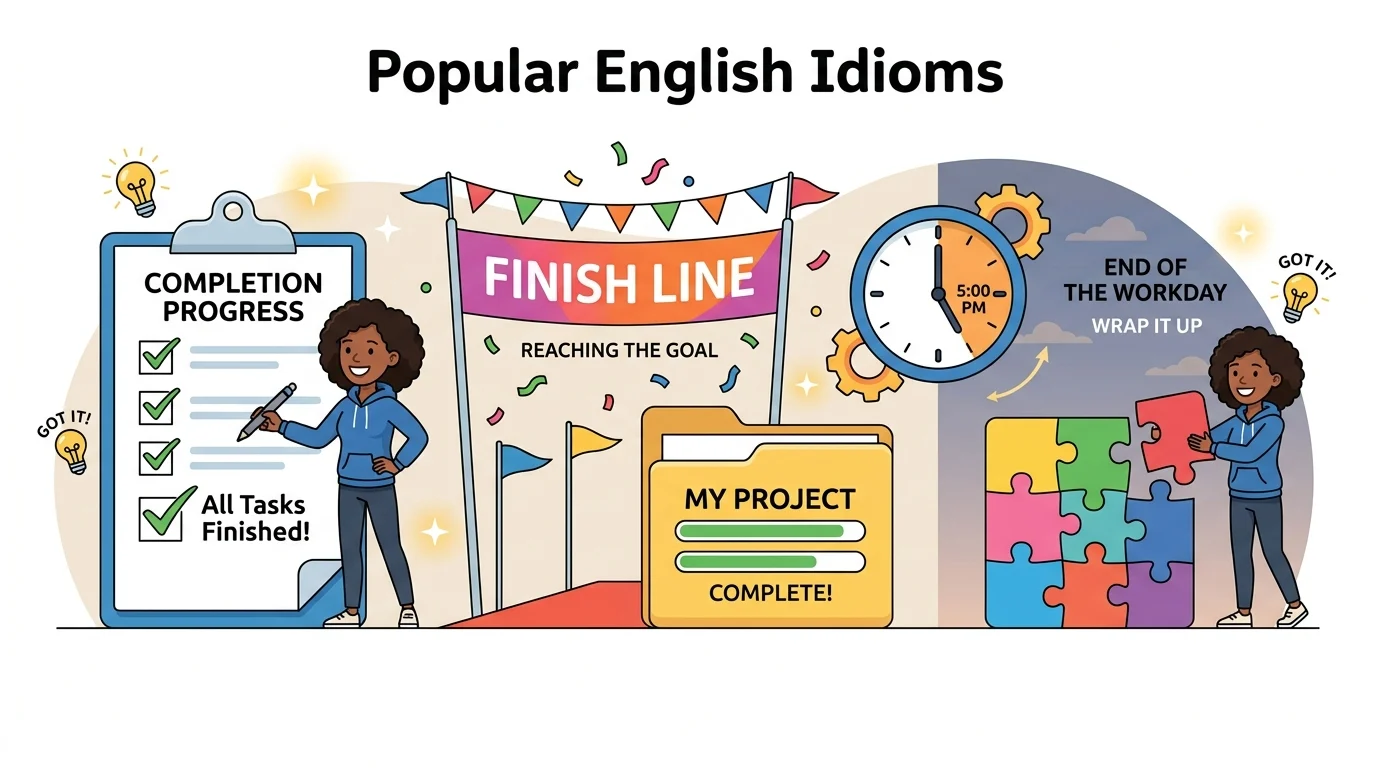
Finishing a task feels great, especially when you have spent hours working on it. But instead of always saying “I finished it” or “It is done,” English offers many natural and interesting idioms for finishing something. You can wrap things up when a meeting is ending, call it a day when you are finished working, or cross the finish line when you finally reach a difficult goal.
These expressions are useful for school, work, conversations, writing, and everyday situations. Some focus on completing a task, while others describe the final details, reaching the end of a project, or stopping an activity. In this guide, you will learn useful expressions with simple meanings, examples, common mistakes, and usage notes.
By the end, you will know exactly which phrase to choose when you want to talk naturally about finishing, completing, or ending something.
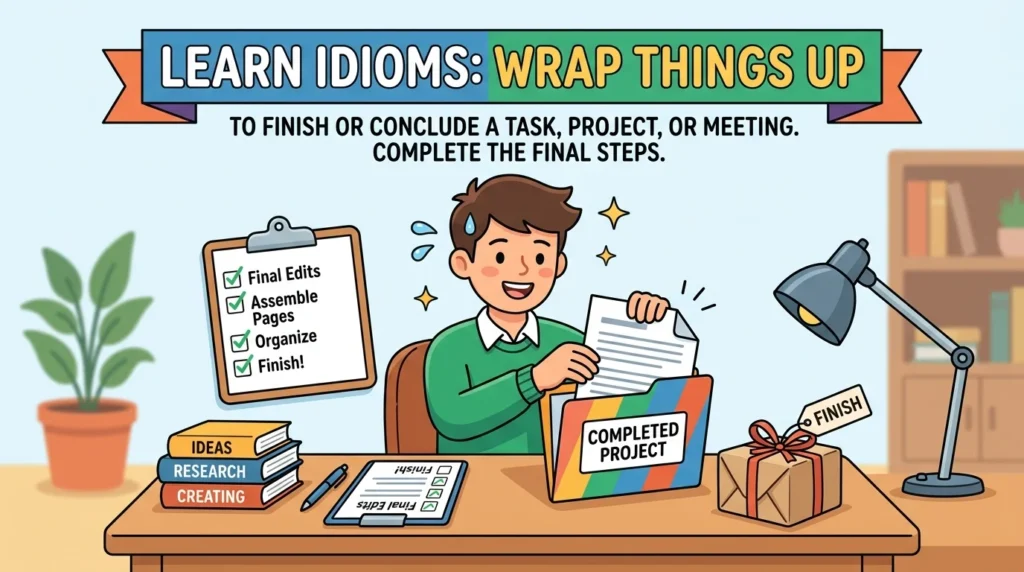
Wrap Things Up
Word-by-word meaning: To wrap something means to cover it.
Idiomatic meaning: To finish an activity, task, meeting, or discussion.
Example sentences:
- Let’s wrap things up before lunch.
- I need ten more minutes to wrap up my assignment.
Common error: Don’t use it when you mean that something has only just started.
Usage note: This is one of the most common casual expressions for bringing something to an end.
Call It a Day
Word-by-word meaning: Decide that the day’s work is finished.
Idiomatic meaning: Stop working on something for now.
Example sentences:
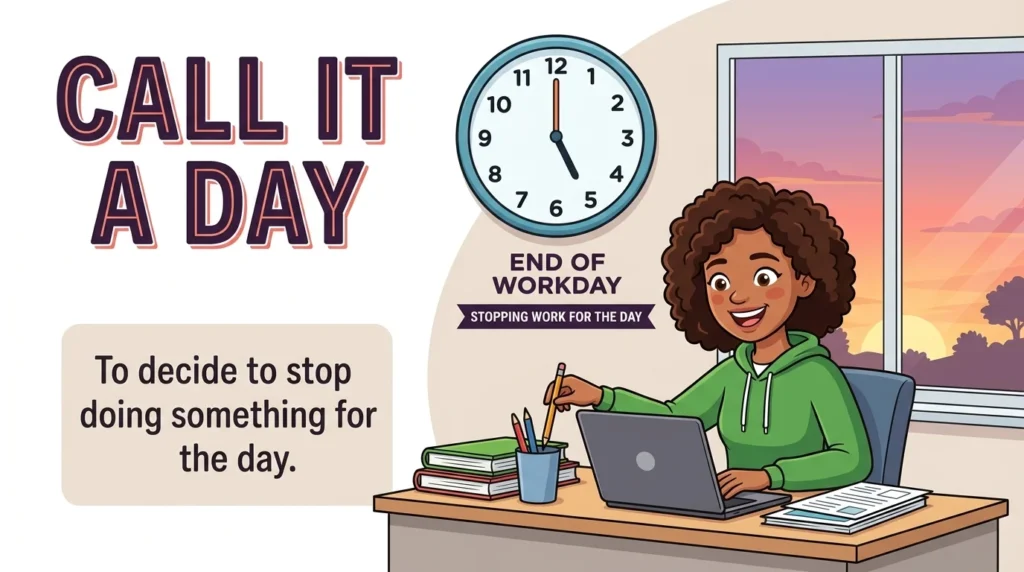
- We have done enough work. Let’s call it a day.
- I finished most of my homework, so I’m going to call it a day.
Common error: It does not necessarily mean the whole day is over.
Usage note: Use it mainly for work, study, or other activities.
Finish Something Off
Word-by-word meaning: Complete the final part of something.
Idiomatic meaning: Finish the remaining part of a task or activity.
Example sentences:
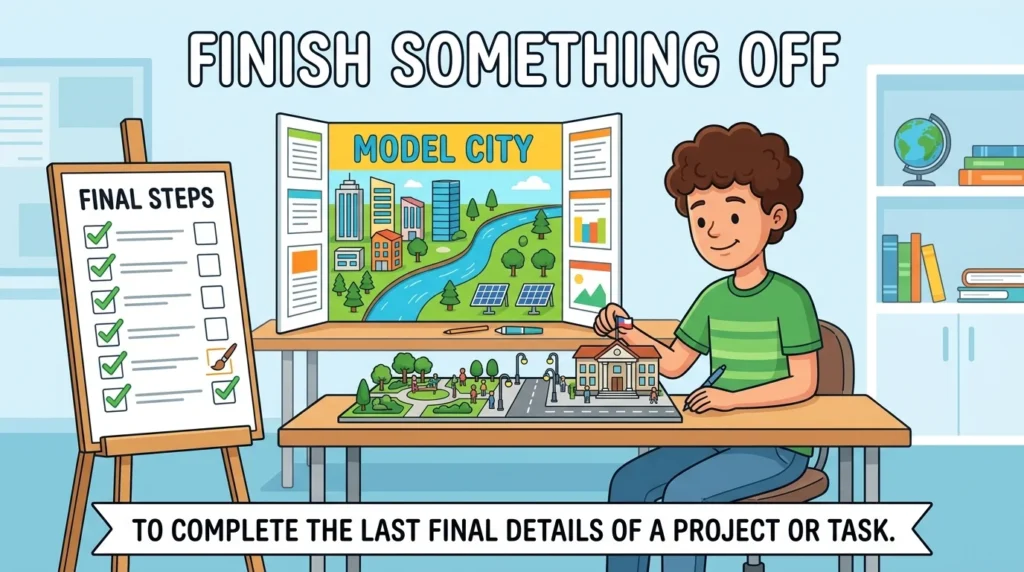
- I just need to finish off this report.
- She stayed late to finish off her presentation.
Common error: “Finish off” can refer specifically to the last part, rather than the whole process.
Usage note: This expression is especially useful when most of the work is already complete.
See Something Through
Word-by-word meaning: Continue something until the end.
Idiomatic meaning: Keep working until something is completely finished.
Example sentences:
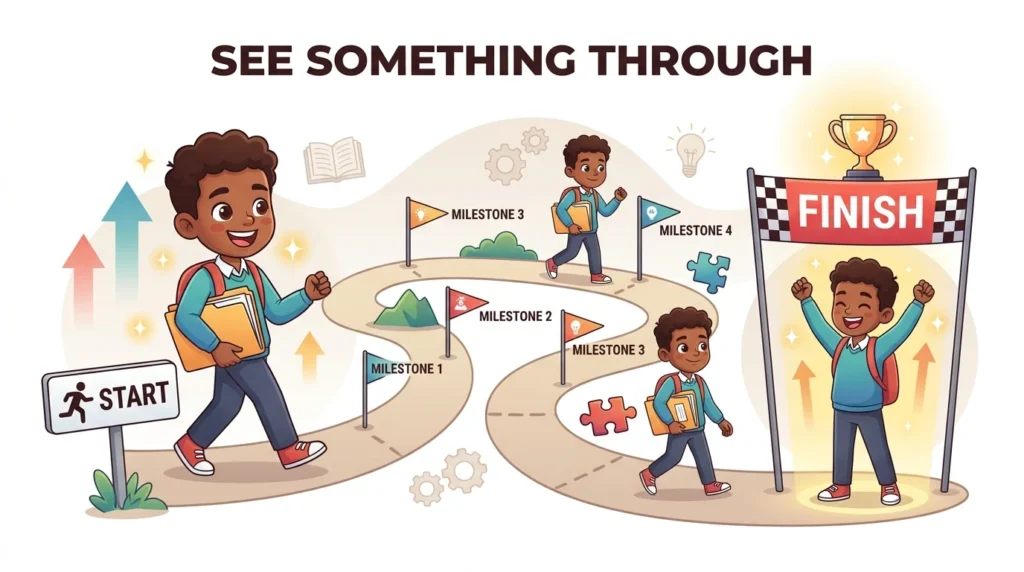
- You started the project, so you should see it through.
- She stayed focused and saw the assignment through.
Common error: Don’t confuse “see something through” with “see through something,” which can have a different meaning.
Usage note: Use this expression when persistence and commitment are important.
Get Something Done
Word-by-word meaning: Make something become finished.
Idiomatic meaning: Complete a task.
Example sentences:
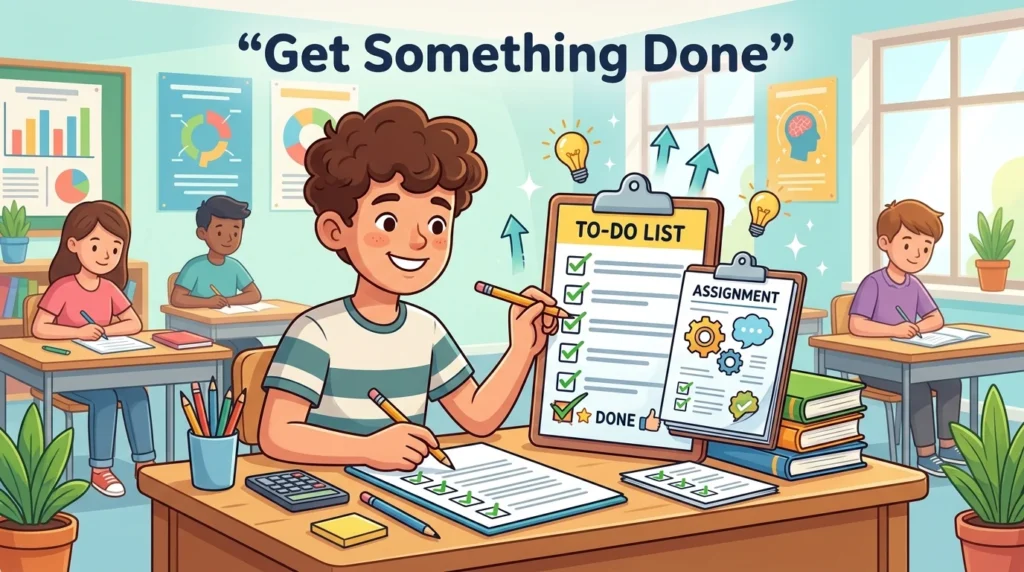
- I need to get this assignment done today.
- He always gets his work done on time.
Common error: “Get something done” focuses on achieving completion, while “do something” simply describes performing an action.
Usage note: This is one of the most natural everyday phrases for completing a task.
Finish Up
Word-by-word meaning: Finish completely.
Idiomatic meaning: Complete the remaining work.
Example sentences:
- I’ll finish up my homework before dinner.
- Please finish up your work before you leave.
Common error: Don’t add unnecessary words between “finish” and “up.”
Usage note: “Finish up” is short, natural, and common in casual English.
Tie Up Loose Ends
Word-by-word meaning: Secure things that are still loose.
Idiomatic meaning: Complete small remaining tasks or resolve unfinished details.
Example sentences:
- I need to tie up a few loose ends before the meeting.
- We stayed late to tie up the loose ends.
Common error: It usually refers to final details rather than the entire project.
Usage note: This is especially useful when a project is almost finished.
Put the Finishing Touches On
Word-by-word meaning: Add the final details.
Idiomatic meaning: Make the last improvements before something is completed.
Example sentences:
- I’m putting the finishing touches on my essay.
- She put the finishing touches on the presentation.
Common error: Use this when something is already nearly complete.
Usage note: It is an excellent phrase for finishing something when only final details remain.
Cross the Finish Line
Word-by-word meaning: Reach the final line in a race.
Idiomatic meaning: Successfully complete a difficult task, project, or goal.
Example sentences:
- We are almost ready to cross the finish line.
- After months of work, the team finally crossed the finish line.
Common error: It does not have to describe an actual race.
Usage note: It works particularly well for long-term goals.
In the Home Stretch
Word-by-word meaning: Be in the final section of a race.
Idiomatic meaning: Be close to finishing something.
Example sentences:
- We’re in the home stretch of the project.
- I’m in the home stretch with my final assignment.
Common error: It means nearly finished, not necessarily completely finished.
Usage note: Use it when only the final part remains.
Bring Something to an End
Word-by-word meaning: Move something toward its ending point.
Idiomatic meaning: Finish or stop something.
Example sentences:
- The teacher brought the discussion to an end.
- We need to bring the meeting to an end.
Common error: The natural structure is “bring something to an end.”
Usage note: This expression can sound more formal than “wrap it up.”
Come to a Close
Word-by-word meaning: Reach a closing point.
Idiomatic meaning: Finish or end naturally.
Example sentences:
- The event came to a close at midnight.
- The school year is coming to a close.
Common error: Say “come to a close,” not “come to close.”
Usage note: It works well for events, periods, meetings, and experiences.
Draw to a Close
Word-by-word meaning: Move toward a closing point.
Idiomatic meaning: Gradually approach an ending.
Example sentences:
- The meeting is drawing to a close.
- The festival drew to a close on Sunday.
Common error: Don’t use it when something is still at its beginning.
Usage note: This expression is useful when an ending happens gradually.
Call It Quits
Word-by-word meaning: Decide to stop.
Idiomatic meaning: Stop an activity or decide not to continue.
Example sentences:
- After several hours, we called it quits.
- We were tired, so we called it quits for the evening.
Common error: It does not always mean that everything was successfully completed.
Usage note: It often means stopping rather than completing every part.
Get It Over With
Word-by-word meaning: Make something be over.
Idiomatic meaning: Finish something unpleasant so you no longer have to deal with it.
Example sentences:
- I want to get my difficult homework over with.
- Let’s get the boring paperwork over with.
Common error: This phrase often carries a feeling of relief or impatience.
Usage note: It is very common in conversational English.
Finish Strong
Word-by-word meaning: Finish with strength.
Idiomatic meaning: Complete something with strong effort or a successful final performance.
Example sentences:
- We have one week left, so let’s finish strong.
- She finished strong and completed the project on time.
Common error: It is more conversational than formal.
Usage note: It works well for school, sports, projects, and personal goals.
Done and Dusted
Word-by-word meaning: Completely finished and cleared away.
Idiomatic meaning: Completely finished or taken care of.
Example sentences:
- The paperwork is done and dusted.
- Once the final review is complete, the project will be done and dusted.
Common error: This is informal, so avoid it in very formal writing.
Usage note: It is a fun way to say that something is completely finished.
Wind Things Up
Word-by-word meaning: Bring something toward its final point.
Idiomatic meaning: Finish or end an activity.
Example sentences:
- We should wind things up before it gets late.
- The speaker wound up the meeting with a final comment.
Common error: The pronunciation of “wind” changes depending on the meaning, so listen to the context.
Usage note: “Wind up” can be used when an activity is gradually coming to an end.
Put Something to Bed
Word-by-word meaning: Put something into bed.
Idiomatic meaning: Finish or settle something so it no longer needs attention.
Example sentences:
- Let’s put this issue to bed.
- We can put the project to bed after the final review.
Common error: This is informal and should be understood from context.
Usage note: It can describe finishing a project, issue, discussion, or decision.
End on a High Note
Word-by-word meaning: Finish with a high musical note.
Idiomatic meaning: Finish something in a positive or successful way.
Example sentences:
- The celebration ended on a high note.
- We want to end the school year on a high note.
Common error: It describes the positive quality of the ending, not simply the fact that something ended.
Usage note: Use it when you want to emphasize a good or memorable ending.
What Is the Idiom for Completing a Task?
There is no single idiom that fits every situation. Get something done, finish up, wrap things up, and see something through are all useful choices.
Use get something done for ordinary task completion. Use wrap things up when you are bringing an activity or discussion to an end. Use see something through when you want to emphasize continuing until the very end.
If only a few details remain, tie up loose ends or put the finishing touches on is more precise.
Common Phrases Using Finish
The word “finish” appears in many useful expressions:
- Finish up the work
- Finish something off
- Finish the job
- Finish what you started
- Finish on time
- Finish strong
- Finish for the day
- Finish with a smile
For example, “I need to finish up my homework” is natural in everyday conversation. “The team completed the project” is slightly more formal.
How Do You Say Done in a Cool Way?
If “I’m done” feels too plain, try one of these casual expressions:
- That’s a wrap!
- Job done!
- Mission accomplished!
- Consider it done!
- Done and dusted!
- We’re all set!
For example, after completing a school project, you could say, “That’s a wrap!” It sounds more lively and conversational.
Idioms for Finishing Something Funny
Want to make the ending sound playful? Try:
That’s a wrap! — A cheerful way to announce that something is finished.
Done and dusted! — A fun, informal way to say everything has been taken care of.
Mission accomplished! — A playful expression for successfully completing a goal.
Call it a day! — A relaxed way to announce that you are stopping work.
Choose based on the situation. A funny phrase is great with friends, while simple language is usually better for formal communication.
Idioms for Ending a Relationship
Some expressions for ending things can also be used when discussing relationships.
Call it quits can mean deciding to stop a relationship or activity.
Go separate ways means two people decide to follow different paths.
The end of the road can describe a situation that has reached its final point.
For example:
After many conversations, they decided to go their separate ways.
Because relationship situations can be personal, direct and respectful language is often clearer than an idiom.
To Complete Something Synonym
If you need a to complete something synonym, these words are useful:
| Synonym | Common use |
|---|---|
| Finish | Everyday tasks and activities |
| Complete | Tasks and projects |
| Finalize | Plans, documents, and decisions |
| Conclude | Meetings, speeches, and discussions |
| Accomplish | Goals and achievements |
| Fulfill | Duties, requirements, and promises |
| End | Activities, events, and situations |
“Finish” is very common in everyday English, while “complete” can sound slightly more formal.
Phrases for the End of Something
Different situations need different expressions:
| Situation | Useful phrase |
|---|---|
| Finishing a task | Get it done |
| Finishing a meeting | Wrap it up |
| Stopping work | Call it a day |
| Completing final details | Tie up loose ends |
| Nearly finished | In the home stretch |
| Reaching a difficult goal | Cross the finish line |
| Ending gradually | Draw to a close |
| Ending positively | End on a high note |
| Completely finished | Done and dusted |
| Stopping an activity | Call it quits |
Choosing the expression that matches the situation makes your English sound much more natural.
Common Mistakes to Avoid
Don’t treat every expression as identical. “In the home stretch” means you are nearly finished, while “done and dusted” means something is already finished.
Don’t use informal expressions in every situation. “That’s a wrap!” is friendly and casual, while “The project is complete” is more suitable for formal writing.
Don’t overuse idioms. One well-chosen expression usually sounds better than several idioms in one paragraph.
Learn the exact structure. Say “bring something to an end,” “put the finishing touches on something,” and “tie up loose ends.”
What Are the Top 10 Idioms?
If you want to remember only ten expressions, start with:
- Wrap things up
- Call it a day
- Finish something off
- See something through
- Get something done
- Tie up loose ends
- Put the finishing touches on
- Cross the finish line
- Get it over with
- Done and dusted
Practice two or three at a time instead of trying to memorize everything in one sitting.
FAQs About Idioms for Finishing Something
What is the idiom for completing a task?
Get something done, finish up, wrap things up, and see something through are useful expressions for completing a task.
What are common phrases using finish?
Common expressions include finish up, finish something off, finish the job, finish what you started, and finish strong.
How do you say done in a cool way?
You can say “That’s a wrap!”, “Job done!”, “Mission accomplished!”, or “Done and dusted!” in casual situations.
What is an idiom for completing something difficult?
See something through, cross the finish line, and finish strong can describe completing something that required sustained effort.
What is an idiom for the end of something?
Come to a close, draw to a close, and the end of the road can all describe an ending, depending on the context.
Conclusion
Learning different idioms for finishing something gives you more natural ways to talk about completing tasks, projects, goals, and activities. Instead of repeatedly saying “finish” or “done,” you can wrap things up, finish something off, tie up loose ends, or cross the finish line.
The best way to remember these expressions is to use them in your own sentences. When you complete your homework, you can say, “I finally got it done.” When only a few details remain, you can say, “I’m in the home stretch.”
Start with a few expressions and practice them regularly. Soon, they will feel natural in everyday English. Whether you are talking about school, work, projects, meetings, or personal goals, these useful phrases can help you express completion clearly and confidently.

“Elizabeth Bowen shares timeless idioms and language wisdom on LearnIdom.com, making learning phrases fun, easy, and unforgettable.”