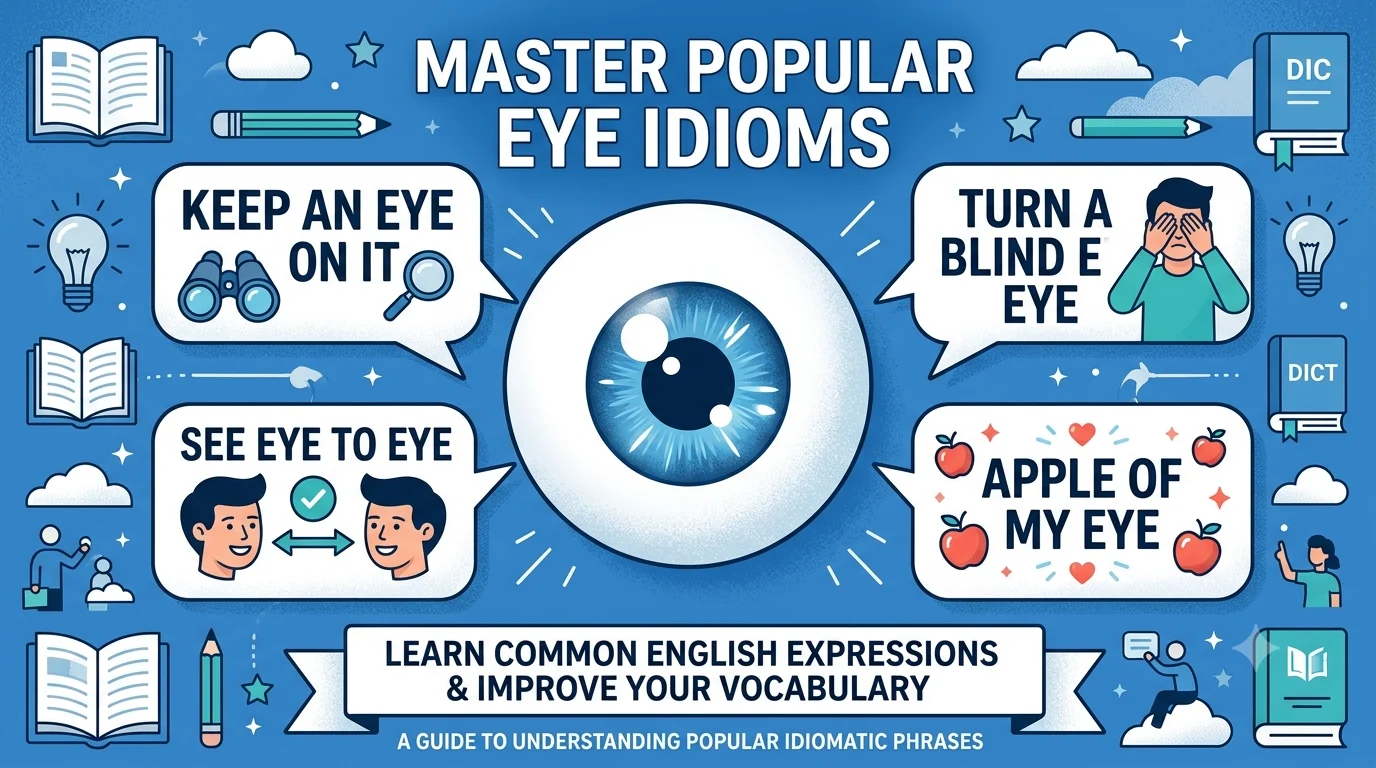
Have you ever heard someone say “keep an eye on it” or “see eye to eye” and wondered what they really meant? These expressions are called eye idioms, and they are used every day by native English speakers.
Learning idioms eyes meaning helps you understand movies, books, conversations, and professional English much better. In this complete guide, you’ll discover the most popular eye idioms with meaning, practical examples, common mistakes, and easy explanations that make learning fun.
Whether you’re a student, English learner, blogger, or preparing for IELTS, this guide covers everything about idioms eyes in English.
What Are Eye Idioms?
Eye idioms are expressions that contain the word eye or eyes, but their meanings are different from the literal meaning.
For example,
Keep an eye on the baby.
It doesn’t mean holding your eye on someone.
It means:
Watch carefully.
This is why understanding eye idioms with meaning is essential for speaking natural English.
Why Learn Eye Idioms?
Learning eye idioms can help you:
- Speak like native English speakers
- Improve IELTS and TOEFL vocabulary
- Understand movies and TV shows
- Write better English
- Make conversations more natural
- Increase your English confidence
Keep an Eye on
Word-by-word Meaning
Keep = continue
Eye = vision
On = focused
Idiomatic Meaning
Watch someone or something carefully.
Example Sentences
- Please keep an eye on my bag.
- Can you keep an eye on the kids?
- I’ll keep an eye on the weather.
Common Error
❌ Keep eye on it.
✅ Keep an eye on it.
Usage Note
Used when asking someone to watch or monitor something.
See Eye to Eye
Word-by-word Meaning
See = understand
Eye = viewpoint
Idiomatic Meaning
To agree completely.
Example Sentences

- We see eye to eye on most issues.
- My parents and I don’t always see eye to eye.
- They finally saw eye to eye.
Common Error
❌ See eyes to eyes.
✅ See eye to eye.
Usage Note
Common in business and relationships.
Turn a Blind Eye
Word-by-word Meaning
Turn = ignore
Blind = unable to see
Eye = attention
Idiomatic Meaning
Ignore something intentionally.
Example Sentences
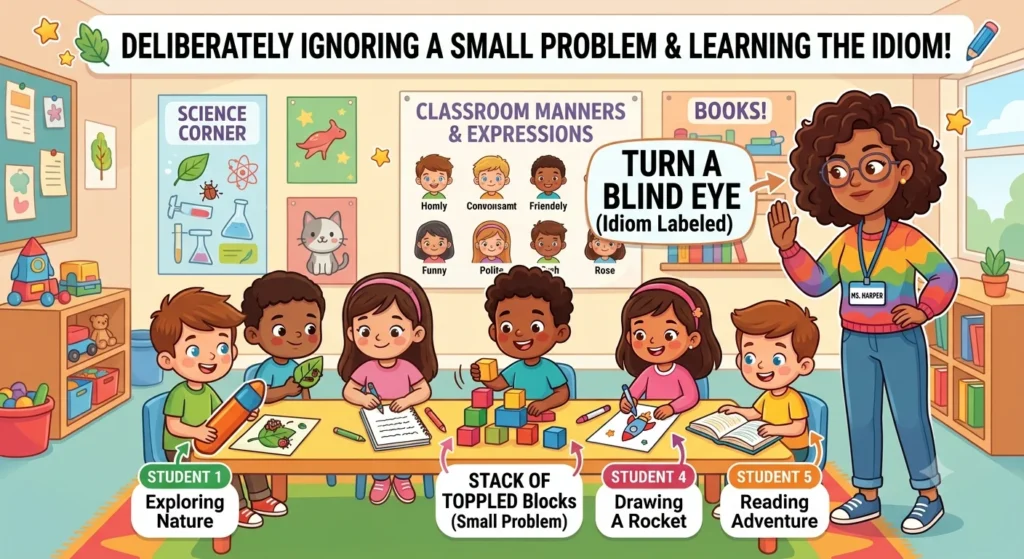
- The teacher turned a blind eye to the mistake.
- Don’t turn a blind eye to bullying.
- Management turned a blind eye to complaints.
Common Error
Don’t use it for accidental ignorance.
It means deliberate ignoring.
In the Blink of an Eye
Word-by-word Meaning
Blink = close eyes quickly
Eye = vision
Idiomatic Meaning
Very quickly.
Example Sentences

- Everything changed in the blink of an eye.
- The bird disappeared in the blink of an eye.
- Time passes in the blink of an eye.
Usage Note
Often used in storytelling.
Apple of One’s Eye
Word-by-word Meaning
Apple = treasured object
Eye = affection
Idiomatic Meaning
Someone loved very much.
Example Sentences
- His daughter is the apple of his eye.
- My dog is the apple of my eye.
- She’s always been her grandfather’s apple of his eye.
Common Error
Don’t confuse with the fruit.
It means someone special.
Eye-opener
Word-by-word Meaning
Eye = awareness
Opener = something that opens
Idiomatic Meaning
Something surprising that teaches an important lesson.
Example Sentences
- The documentary was an eye-opener.
- Traveling abroad was an eye-opener.
- The seminar became an eye-opener.
More Than Meets the Eye
Word-by-word Meaning
Meet = appear
Eye = vision
Idiomatic Meaning
Something is deeper than it looks.
Example Sentences
- This story has more than meets the eye.
- The project isn’t as simple as it seems.
- There’s more than meets the eye.
Eye for an Eye
Word-by-word Meaning
Eye exchanged for eye.
Idiomatic Meaning
Revenge equal to the harm received.
Example Sentences
- An eye for an eye leaves everyone suffering.
- Many people disagree with the eye for an eye approach.
- History teaches that revenge rarely solves problems.
Usage Note
Many learners ask, “What is the idiom of eye for an eye?” It refers to equal retaliation, though today it is often discussed as a warning against endless revenge rather than advice to follow.
Eyes in the Back of Your Head
Word-by-word Meaning
Having extra eyes.
Idiomatic Meaning
Always noticing everything around you.
Example Sentences
- Moms have eyes in the back of their heads.
- My teacher notices everything.
- Security guards seem to have eyes everywhere.
Cry Your Eyes Out
Word-by-word Meaning
Cry heavily.
Idiomatic Meaning
Cry a lot.
Example Sentences
- She cried her eyes out.
- He cried his eyes out after losing his pet.
- The emotional movie made everyone cry.
Have an Eye for Something
Word-by-word Meaning
- Have = possess
- Eye = ability to notice
- For = regarding something
Idiomatic Meaning
To naturally recognize quality, beauty, talent, or value.
Example Sentences
- She has an eye for fashion.
- My father has an eye for detail.
- He has an eye for good photography.
Common Error
❌ Have eyes for fashion.
✅ Have an eye for fashion.
Usage Note
Often used for art, design, photography, decorating, and talent.
Catch Someone’s Eye
Word-by-word Meaning
- Catch = attract
- Eye = attention
Idiomatic Meaning
To attract someone’s attention.
Example Sentences
- The red dress caught my eye.
- That advertisement caught everyone’s eye.
- A beautiful painting caught her eye.
Common Error
Don’t confuse it with making eye contact. It means attracting attention, not simply looking at someone.
Usage Note
This is one of the most common catchy eye phrases used in daily English.
Eagle Eye
Word-by-word Meaning
- Eagle = bird with excellent vision
- Eye = eyesight
Idiomatic Meaning
Someone who notices very small details.
Example Sentences
- My editor has an eagle eye.
- She spotted the mistake with her eagle eye.
- Teachers often develop an eagle eye for errors.
Common Error
❌ Eagle eyes person.
✅ He has an eagle eye.
Usage Note
Frequently used in workplaces and proofreading.
Eye Candy
Word-by-word Meaning
- Eye = vision
- Candy = something enjoyable
Idiomatic Meaning
Someone or something that is visually attractive.
Example Sentences
- The luxury car is real eye candy.
- The garden is eye candy in spring.
- The movie features plenty of eye candy.
Common Error
Use it carefully because it often refers to appearance rather than personality.
Usage Note
This expression appears in casual conversations.
Keep Your Eyes Peeled
Word-by-word Meaning
- Keep = continue
- Eyes = attention
- Peeled = fully open
Idiomatic Meaning
Stay alert and watch carefully.
Example Sentences
- Keep your eyes peeled for the bus.
- Keep your eyes peeled for discounts.
- Keep your eyes peeled while driving.
Common Error
❌ Keep your eyes opened.
✅ Keep your eyes peeled.
Usage Note
Very common in spoken English.
Open Someone’s Eyes
Word-by-word Meaning
- Open = make aware
- Eyes = understanding
Idiomatic Meaning
Help someone realize the truth.
Example Sentences
- The documentary opened my eyes.
- Traveling opened his eyes.
- Reading books can open your eyes.
Common Error
Don’t use it literally unless talking about waking someone up.
Usage Note
Often used for life-changing experiences.
Look Someone in the Eye
Word-by-word Meaning
- Look = face
- Eye = direct eye contact
Idiomatic Meaning
Face someone honestly and confidently.
Example Sentences
- Look me in the eye and tell the truth.
- She looked the interviewer in the eye.
- He couldn’t look her in the eye.
Usage Note
Common when discussing honesty and confidence.
Eyes Bigger Than Your Stomach
Word-by-word Meaning
- Eyes = desire
- Stomach = eating capacity
Idiomatic Meaning
Taking more food than you can eat.
Example Sentences
- My eyes were bigger than my stomach.
- I ordered too much because my eyes were bigger than my stomach.
- He couldn’t finish his meal.
Common Error
Used mostly for food, not shopping.
Make Eyes at Someone
Word-by-word Meaning
- Make eyes = give meaningful looks
Idiomatic Meaning
To flirt by looking at someone.
Example Sentences
- He kept making eyes at her.
- They were making eyes across the room.
- She smiled while making eyes at him.
Usage Note
Usually found in informal conversations or novels.
All Eyes on
Word-by-word Meaning
- All = everyone
- Eyes = attention
Idiomatic Meaning
Everyone is watching or focusing on someone or something.
Example Sentences
- All eyes were on the singer.
- During the final match, all eyes were on the captain.
- As she entered the stage, all eyes turned toward her.
Common Error
❌ All eyes in.
✅ All eyes on.
Usage Note
Many learners ask, “What is the idiom of all eyes?” The expression all eyes on means everyone is paying close attention to a person or event.
Beautiful Eyes Idioms
Although English does not have many idioms that literally describe beautiful eyes, these expressions are commonly associated with admiration and attention:
- Apple of my eye
- Catch someone’s eye
- Stars in your eyes
- Eyes sparkle with joy
- Bright-eyed and bushy-tailed
These beautiful eyes idioms are frequently used in literature and everyday conversations.
Catchy Eye Phrases
Some popular catchy eye phrases include:
- Keep an eye on
- Catch my eye
- All eyes on
- Eyes wide open
- See eye to eye
- Eagle eye
- In the blink of an eye
- More than meets the eye
Idioms About Seeing
If you’re searching for idioms about seeing, these are among the most useful:
- See eye to eye
- Turn a blind eye
- Keep your eyes peeled
- Open your eyes
- Look someone in the eye
- More than meets the eye
- Eyes in the back of your head
- Catch someone’s eye
These expressions improve both spoken and written English.
Sayings About Eyes
Some famous sayings about eyes include:
- The eyes are the window to the soul.
- Beauty is in the eye of the beholder.
- Keep your eyes on the prize.
- An eye for an eye makes the whole world blind.
- Seeing is believing.
Frequently Asked Questions (FAQs)
1. What is the idiom of all eyes?
All eyes on means everyone is watching or paying attention to one person, place, or event.
2. What is slang for eyes?
Common informal slang includes peepers, blinkers, and orbs, though these are much less common than standard English.
3. What are 10 idioms and their meanings?
Some popular eye idioms include:
- Keep an eye on
- See eye to eye
- Turn a blind eye
- Apple of one’s eye
- Eagle eye
- Catch someone’s eye
- Eye-opener
- In the blink of an eye
- More than meets the eye
- Open someone’s eyes
4. What is the idiom of eye for an eye?
Eye for an eye refers to equal revenge or punishment for a wrong done. Today, it is often used when discussing justice, fairness, or the consequences of revenge.
5. Why should I learn eye idioms?
Learning idioms eyes in English helps you understand native speakers, improve fluency, perform better in exams like IELTS, and communicate more naturally.
Conclusion
Eye idioms make English more expressive, natural, and engaging. By learning these 20 eye idioms with meaning, practicing their examples, and understanding their usage, you’ll sound more fluent and confident in everyday conversations.
Keep revising these expressions, use them in your speaking and writing, and soon they’ll become a natural part of your vocabulary. The more you practice, the easier it becomes to recognize and use these idioms eyes examples in real-life situations.

“Rose Macaulay shares the charm of idioms on LearnIdom.com, making language learning delightful, insightful, and full of wit for every reader.”