
Australian English is fun, colorful, and full of expressions that can confuse even fluent English speakers. If you’ve ever heard an Aussie say something like “No worries, mate” or “He’s flat out like a lizard drinking” and felt lost, you’re not alone. Australian idioms are deeply connected to daily life, humor, and culture in Australia.
When I first watched an Australian movie, I understood every word — yet somehow missed the meaning. That’s the power of idioms. Learning them helps you sound natural, understand conversations better, and connect with Australian culture on a deeper level.
In this guide, you’ll explore the 20 most famous Australian idioms, each explained clearly with word-by-word meanings, real-life examples, common mistakes, and usage tips. Let’s dive into Aussie English and have a bit of fun along the way!
No worries
Word-by-word meaning
No = none, worries = problems
Idiomatic meaning
Everything is fine; don’t stress
Example sentences
- “Thanks for your help!” — “No worries!”
- “Sorry I’m late.” — “No worries, mate.”
Common error
Using it only for serious problems
Usage note
Very common in casual Australian English
Fair dinkum
Word-by-word meaning
Fair = honest, dinkum = true
Idiomatic meaning
Genuine or real
Example sentences

- “Is this story fair dinkum?”
- “He’s a fair dinkum Aussie.”
Common error
Using it sarcastically without context
Usage note
Often used to show honesty or surprise
G’day
Word-by-word meaning
Good day
Idiomatic meaning
Hello
Example sentences
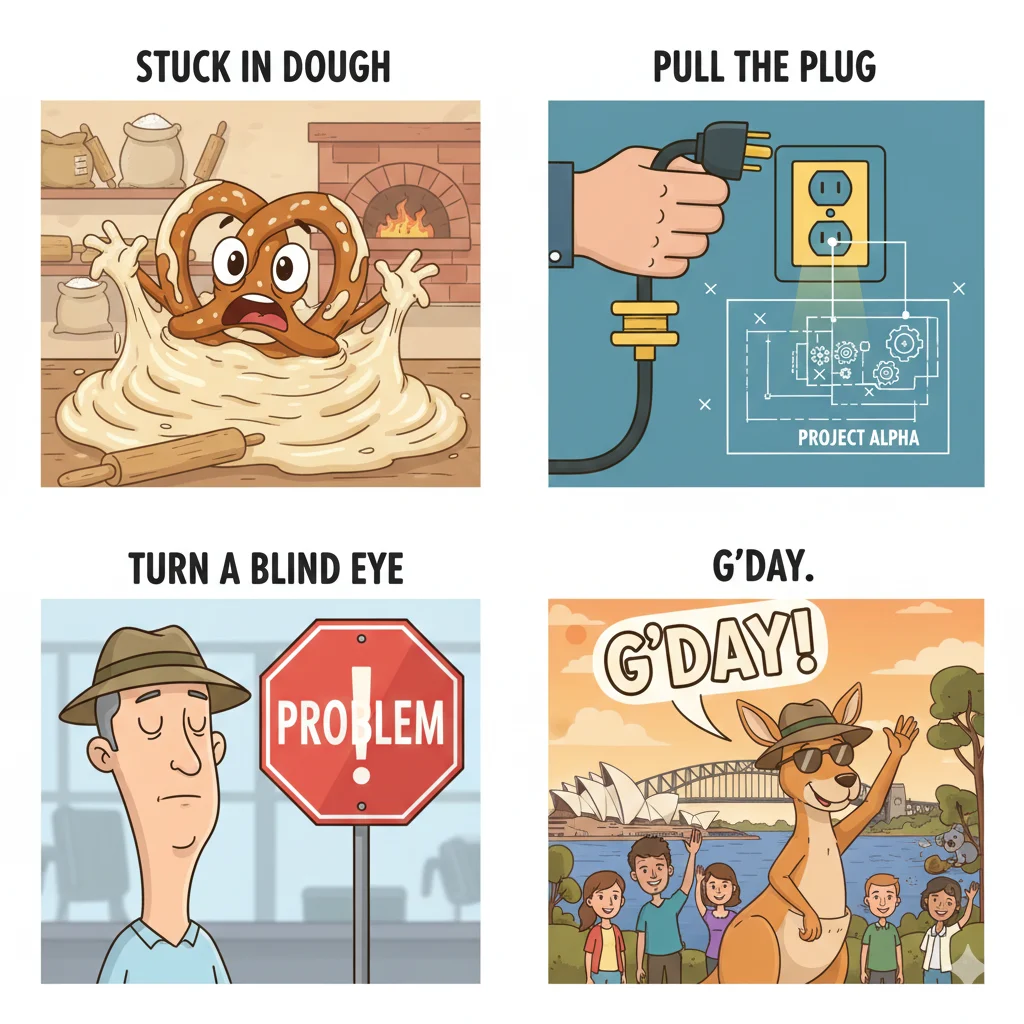
- “G’day! How’s it going?”
Common error
Using it in very formal writing
Usage note
Best for casual greetings
Arvo
Word-by-word meaning
Short form of afternoon
Idiomatic meaning
Afternoon
Example sentences

- “See you this arvo.”
Common error
Using it in formal emails
Usage note
Spoken English only
Mate
Word-by-word meaning
Friend
Idiomatic meaning
Friend, stranger, or polite address
Example sentences

- “Thanks, mate.”
- “Listen here, mate…”
Common error
Assuming it always means close friend
Usage note
Tone changes meaning
Flat out like a lizard drinking
Word-by-word meaning
Very busy
Idiomatic meaning
Extremely busy
Example sentences
- “I can’t talk — I’m flat out like a lizard drinking.”
Common error
Using it without humor
Usage note
Very informal and humorous
Chuck a sickie
Word-by-word meaning
Pretend to be sick
Idiomatic meaning
Skip work or school by faking illness
Example sentences
- “He chucked a sickie on Monday.”
Common error
Using it in professional settings
Usage note
Casual and slang-heavy
Hard yakka
Word-by-word meaning
Hard work
Idiomatic meaning
Physically demanding work
Example sentences
- “That job was hard yakka.”
Common error
Using it for mental work
Usage note
Often used for labor jobs
On the piss
Word-by-word meaning
Drinking alcohol
Idiomatic meaning
Going out drinking
Example sentences
- “We were on the piss last night.”
Common error
Using it around elders
Usage note
Very informal, avoid formal contexts
She’ll be right
Word-by-word meaning
Everything will be okay
Idiomatic meaning
No need to worry
Example sentences
- “Don’t stress — she’ll be right.”
Common error
Using it for serious problems
Usage note
Optimistic Aussie attitude
Give it a burl
Word-by-word meaning
Give = try, burl = an attempt
Idiomatic meaning
To have a go at something; try it out
Example sentences
- “I’ve never surfed before, but I’ll give it a burl.”
- “Give baking a burl — it’s fun!”
Common error
Assuming it means “to throw” or “to waste”
Usage note
Casual Australian English; used when encouraging someone
Deadset
Word-by-word meaning
Dead = absolute, set = certain
Idiomatic meaning
Completely serious; genuinely true
Example sentences
- “I’m deadset about moving to Melbourne.”
- “He’s deadset telling the truth.”
Common error
Using it to describe things, not statements or feelings
Usage note
Often used for emphasis in conversations
The bush
Word-by-word meaning
Bush = wild, rural area
Idiomatic meaning
Remote countryside or wilderness areas of Australia
Example sentences
- “We went camping out in the bush last weekend.”
- “He grew up in the bush, far from the city.”
Common error
Calling it a forest — bush refers to scrub or open land, not dense woods
Usage note
Frequently used to describe life outside cities
Not here to f*** spiders
Word-by-word meaning
Not here = not present for wasting time, spiders = nothing
Idiomatic meaning
Serious and focused; not here to mess around
Example sentences
- “Let’s start the project — we’re not here to f*** spiders.”
- “Come on, team, focus! We’re not here to f*** spiders.”
Common error
Using in polite/formal settings (it’s very casual and slightly vulgar)
Usage note
Use only in informal, friendly settings; emphasizes urgency or seriousness
Bog-standard
Word-by-word meaning
Bog = ordinary, standard = basic
Idiomatic meaning
Completely ordinary; plain; nothing special
Example sentences
- “It’s just a bog-standard car, nothing fancy.”
- “Her dress is bog-standard, but comfortable.”
Common error
Misunderstanding it as low quality — it simply means average
Usage note
Casual; often used humorously or descriptively
Blow-in
Word-by-word meaning
Blow = sudden arrival, in = into a place
Idiomatic meaning
A newcomer; someone arriving from somewhere else
Example sentences
- “He’s just a blow-in from Sydney.”
- “That blow-in doesn’t know the town yet.”
Common error
Assuming it means tourist — it can be a local stranger or new resident
Usage note
Friendly or neutral; sometimes slightly teasing
Up the duff
Word-by-word meaning
Up = pregnant, duff = slang for belly
Idiomatic meaning
Pregnant
Example sentences
- “Did you hear? She’s up the duff!”
- “He said congratulations — she’s up the duff.”
Common error
Using in formal writing — it’s slang
Usage note
Informal; often used humorously
Crook
Word-by-word meaning
Crook = sick, unwell
Idiomatic meaning
Ill, unwell, or in poor condition
Example sentences
- “I’m feeling crook today.”
- “That engine is crook, it won’t start.”
Common error
Confusing it with criminal — context matters
Usage note
Commonly used in everyday speech for sickness or malfunction
Ute
Word-by-word meaning
Ute = utility vehicle
Idiomatic meaning
Pickup truck or work vehicle
Example sentences
- “Load the gear in the ute.”
- “He drives a red ute around town.”
Common error
Thinking it’s a general car — it specifically refers to a truck
Usage note
Very common in Australia; especially in rural areas
Aussie salute
Word-by-word meaning
Salute = wave, Aussie = Australian
Idiomatic meaning
Waving away flies, especially during summer
Example sentences
- “I had to give the Aussie salute all day at the barbecue.”
- “She laughed while doing the Aussie salute in the garden.”
Common error
Thinking it’s a formal greeting — it’s humorous, informal
Usage note
Unique to Australia; often joked about in pop culture
FAQs About Australian Idioms
Q1: Are Australian idioms used in formal English?
No, most are informal and used in speech.
Q2: Should learners use Aussie idioms?
Yes, but only after understanding context.
Q3: Are Australian idioms similar to British ones?
Some are, but many are uniquely Australian.
Q4: Can idioms change meaning by tone?
Absolutely, tone matters a lot.
Conclusion
Learning Australian idioms is one of the fastest ways to sound natural and understand real conversations. Don’t try to memorize them all at once — pick a few, use them in sentences, and listen for them in movies or podcasts. With practice, Aussie English will feel less confusing and a lot more fun. No worries — you’ve got this!

“Iris Murdoch explores the beauty of language and idioms on LearnIdom.com, making learning phrases engaging, memorable, and fun for everyone.”