Imagine a friend arriving at your home after a long journey. Instead of simply saying “welcome,” you say, “Make yourself at home!” Suddenly, your greeting sounds warmer and more natural.
Welcome idioms are useful expressions for greeting people, inviting them into a group, making guests comfortable, and showing acceptance. In this guide, you’ll learn 20 popular welcome idioms and phrases with simple meanings, examples, origins, common errors, and practical usage tips.
What Are Welcome Idioms?
Welcome idioms are expressions used to greet, accept, invite, or make someone feel comfortable in a particular place or group.
Some are directly connected with welcoming, while others describe joining a group, becoming comfortable, or starting a new experience.
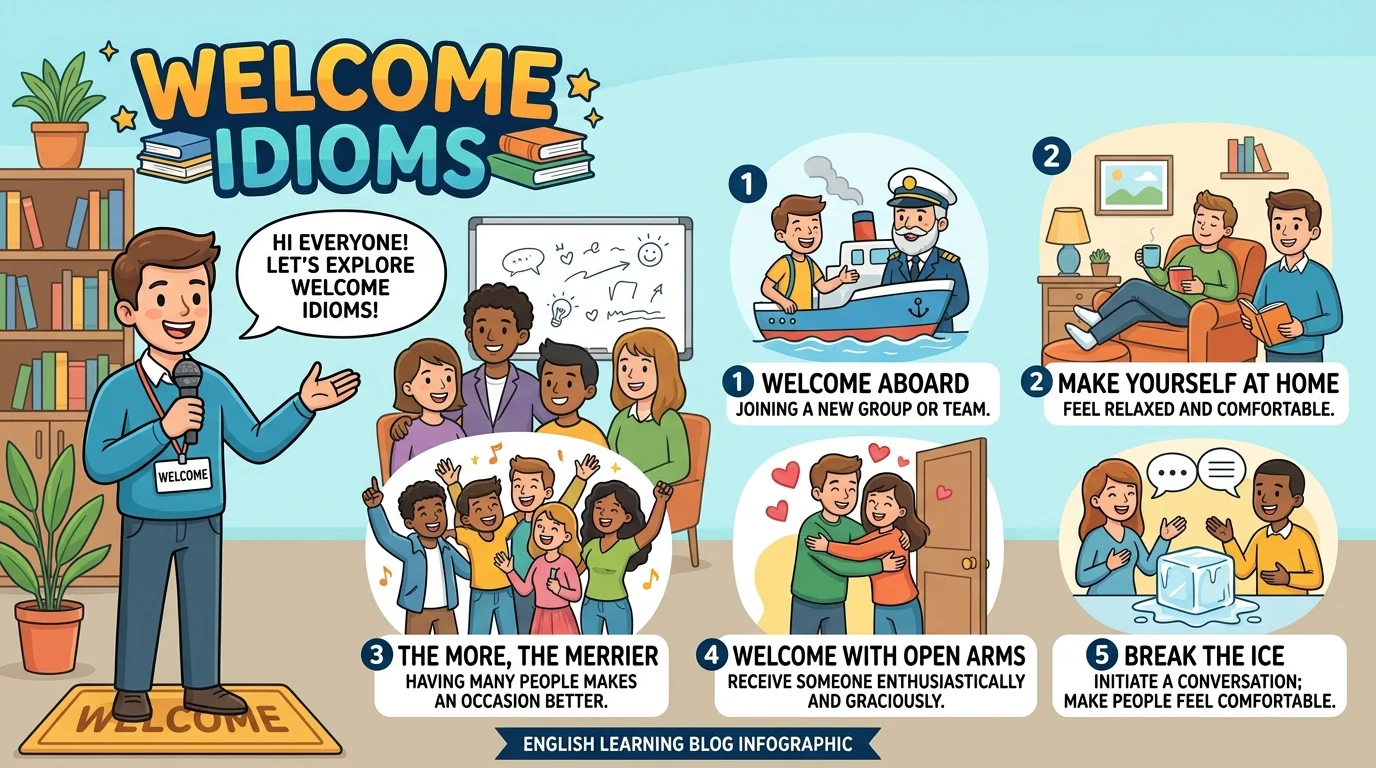
For example, make yourself at home tells a guest to relax, while welcome aboard welcomes someone who has joined a team or organization.
These expressions are especially useful for English learners because they make conversations sound less textbook-like and more natural.
Origin of Welcome Idioms
Many English welcome expressions developed from everyday activities, social customs, work, travel, and traditional hospitality.
For example, welcome aboard originally connects with ships and boats, where passengers or crew members were welcomed onto the vessel. Over time, English speakers began using it figuratively for people joining companies, teams, and organizations.
Similarly, make yourself at home reflects the traditional idea of hospitality: a guest should feel as comfortable in the host’s home as they would in their own.
Roll out the red carpet has associations with ceremonial and prestigious welcomes. Today, it can describe giving someone especially special treatment.
Understanding the origin or imagery behind an idiom can make it much easier to remember and use correctly.
Welcome Aboard
Word-by-word meaning: Welcome onto a boat, ship, or vessel.
Idiomatic meaning: A friendly way to welcome someone who has joined a team, company, organization, or project.
Example sentences:

- Welcome aboard! We’re happy to have you on the team.
- The manager smiled and said, “Welcome aboard.”
Common error: Using it only when talking about ships.
Usage note: It is very common in workplaces and organizations.
Make Yourself at Home
Word-by-word meaning: Behave as comfortably as you would in your own home.
Idiomatic meaning: Feel relaxed and comfortable in someone else’s home or space.
Example sentences:

- Come inside and make yourself at home.
- Our host told everyone to make themselves at home.
Common error: Thinking the expression means literally treating another house as your own.
Usage note: This is one of the most natural expressions for welcoming guests.
The More, the Merrier
Word-by-word meaning: More people bring more happiness.
Idiomatic meaning: Everyone is welcome because having more people can make an event more enjoyable.
Example sentences:
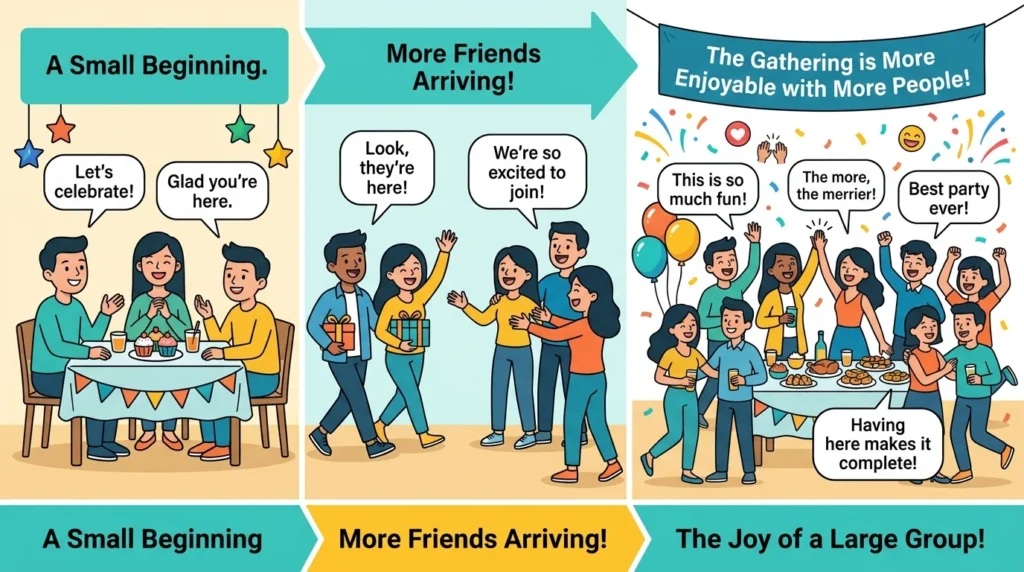
- Can I invite my classmates? Of course—the more, the merrier!
- Bring your friends. The more, the merrier.
Common error: Using it in highly formal communication.
Usage note: It works particularly well for parties, gatherings, and informal events.
Welcome with Open Arms
Word-by-word meaning: Welcome someone with open arms.
Idiomatic meaning: Accept someone warmly and enthusiastically.
Example sentences:
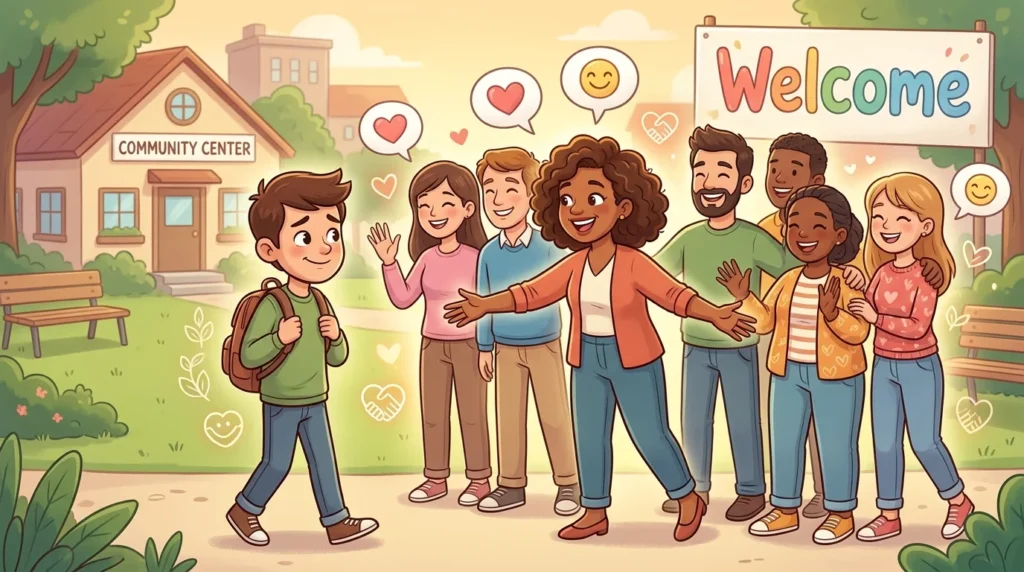
- The new student was welcomed with open arms.
- Her family welcomed the visitors with open arms.
Common error: Taking the expression completely literally.
Usage note: It can describe both physical hospitality and emotional acceptance.
Roll Out the Red Carpet
Word-by-word meaning: Put a red carpet down for a guest.
Idiomatic meaning: Give someone an especially impressive or special welcome.
Example sentences:

- The hotel rolled out the red carpet for its important guests.
- They really rolled out the red carpet for the visiting team.
Common error: Using it for an ordinary greeting.
Usage note: It suggests an unusually grand welcome or special treatment.
Welcome to the Club
Word-by-word meaning: Welcome into a club.
Idiomatic meaning: You now share an experience, situation, or problem with other people.
Example sentences:
- You forgot your homework too? Welcome to the club!
- You’re learning a new language? Welcome to the club.
Common error: Assuming an actual club must exist.
Usage note: It is often humorous or friendly.
Give Someone a Warm Welcome
Word-by-word meaning: Give someone a warm greeting.
Idiomatic meaning: Welcome someone in a friendly and enthusiastic manner.
Example sentences:
- Please give our new teacher a warm welcome.
- The audience gave the speaker a warm welcome.
Common error: Saying “make someone a warm welcome.”
Usage note: “Give someone a warm welcome” works in both casual and formal situations.
Come One, Come All
Word-by-word meaning: Everyone should come.
Idiomatic meaning: Everyone is invited to participate.
Example sentences:
- Come one, come all to our school festival!
- Come one, come all and enjoy the celebration.
Common error: Using it in very formal business writing.
Usage note: It has a cheerful, promotional, and sometimes old-fashioned tone.
Pull Up a Chair
Word-by-word meaning: Move a chair closer and sit down.
Idiomatic meaning: Join a conversation or group and make yourself comfortable.
Example sentences:
- Pull up a chair and join us.
- There’s room here, so pull up a chair.
Common error: Assuming the expression always requires someone to physically move a chair.
Usage note: It is friendly and informal.
Come on In
Word-by-word meaning: Enter the place.
Idiomatic meaning: A casual and friendly invitation to enter.
Example sentences:
- The door is open. Come on in!
- She smiled and said, “Come on in.”
Common error: Using it in very formal invitations.
Usage note: This phrase is extremely natural in everyday spoken English.
Feel at Home
Word-by-word meaning: Feel as if you are at your own home.
Idiomatic meaning: Feel comfortable, relaxed, and accepted in a new environment.
Example sentences:
- We hope you feel at home here.
- The friendly staff helped me feel at home.
Common error: Confusing “feel at home” with physically being at home.
Usage note: It can describe homes, schools, workplaces, communities, and other environments.
Open One’s Doors
Word-by-word meaning: Open the doors of a building.
Idiomatic meaning: Welcome people, provide access, or become available to visitors or a group.
Example sentences:
- The community center opened its doors to local families.
- The school opened its doors to new students.
Common error: Assuming it always refers to a literal door.
Usage note: This expression can sound more formal than “come in.”
Join the Family
Word-by-word meaning: Become part of a family.
Idiomatic meaning: Become a valued member of a group, company, community, or organization.
Example sentences:
- We’re delighted that you’ve joined the family.
- Welcome to the team—you’re now part of the family.
Common error: Thinking it always refers to a biological family.
Usage note: Companies and organizations often use this phrase to create a sense of belonging.
Welcome Back
Word-by-word meaning: Welcome someone who has returned.
Idiomatic meaning: A friendly greeting for someone coming back after an absence.
Example sentences:
- Welcome back! How was your trip?
- It’s great to see you again. Welcome back!
Common error: Using it when meeting someone for the first time.
Usage note: Use it when someone is returning to a place or activity.
Glad to Have You
Word-by-word meaning: Happy that you are present.
Idiomatic meaning: A warm way to show appreciation for someone’s presence or membership.
Example sentences:
- We’re glad to have you on our team.
- I’m glad to have you here today.
Common error: Leaving out the context when a more complete sentence is needed.
Usage note: It works particularly well in professional and friendly settings.
Happy to Have You With Us
Word-by-word meaning: Happy that you are with the group.
Idiomatic meaning: A warm expression showing that someone’s presence is appreciated.
Example sentences:
- We’re happy to have you with us today.
- Everyone is happy to have you with us.
Common error: Using it as though it were a fixed idiom in every situation.
Usage note: It is better described as a common welcoming phrase.
Make Room for Someone
Word-by-word meaning: Create physical space for someone.
Idiomatic meaning: Include someone in a group, activity, or situation.
Example sentences:
- Make room for our new classmates.
- We always make room for new members.
Common error: Thinking it only refers to physical space.
Usage note: It can communicate inclusion and acceptance.
Take Someone Under Your Wing
Word-by-word meaning: Place someone under your wing.
Idiomatic meaning: Help, guide, and support someone who is new or inexperienced.
Example sentences:
- My senior colleague took me under her wing.
- The coach took the new player under his wing.
Common error: Using it simply to mean “welcome.”
Usage note: This expression emphasizes guidance and support rather than just greeting.
Break the Ice
Word-by-word meaning: Break through ice.
Idiomatic meaning: Make people feel more relaxed when they meet for the first time or when a situation feels awkward.
Example sentences:
- The teacher told a joke to break the ice.
- We played a quick game to break the ice.
Common error: Thinking it means literally breaking ice.
Usage note: It is particularly useful when welcoming people into a new group.
Get the Ball Rolling
Word-by-word meaning: Start a ball moving.
Idiomatic meaning: Start an activity, discussion, meeting, or project.
Example sentences:
- Let’s get the ball rolling with introductions.
- She asked the first question to get the ball rolling.
Common error: Saying “get the ball roll.”
Usage note: This is more about starting something than welcoming someone, but it is useful when beginning a new group activity.
Welcome Idioms for Different Situations
The best expression depends on the situation.
| Situation | Useful expression |
|---|---|
| Welcoming a guest | Make yourself at home |
| Welcoming a new employee | Welcome aboard |
| Welcoming a returning person | Welcome back |
| Welcoming everyone | The more, the merrier |
| Showing acceptance | Welcome with open arms |
| Making a new group comfortable | Break the ice |
| Giving special treatment | Roll out the red carpet |
| Helping a newcomer | Take someone under your wing |
| Starting a group activity | Get the ball rolling |
| Creating a sense of belonging | Join the family |
Funny Welcome Idioms and Phrases
If you want welcome idioms that are funny, informal expressions can make your greeting more memorable.
Try phrases such as:
- Welcome to the club!
- The more, the merrier!
- Come on in!
- Pull up a chair.
- Make yourself at home.
For example, if a friend says they have finally joined a difficult class, you could jokingly say, “Welcome to the club!”
The humor comes from the situation and tone, so these expressions are best used with people who understand the context.
Welcome Phrases for New Beginnings
Welcome expressions are often connected with beginnings. When someone starts a new job, school, project, or community activity, phrases such as welcome aboard, welcome to the team, and glad to have you can make the person feel included.
Once the activity begins, expressions such as get the ball rolling can help describe starting the next step.
This gives English learners a useful progression:
Welcome → Join → Start → Participate → Finish
When something eventually ends, you might say wrap things up, call it a day, or finish on a high note.
Phrases for the End of Something
Although the main topic here is welcoming people, English has many useful expressions for endings too.
If you need phrases for the end of something, consider:
- Come to an end — finish.
- Wrap things up — finish an activity.
- Call it a day — stop working for now.
- Tie up loose ends — complete the remaining details.
- Finish on a high note — end positively.
These expressions are useful when you want a natural phrase for finishing something instead of repeatedly using the word “finish.”
What Is the Idiom for Completing a Task?
There is no single idiom that works in every situation.
For completing a task, these are particularly useful:
Wrap things up means to finish an activity.
Tie up loose ends means to complete small remaining details.
See something through means to continue until something is completed.
For example:
“I only have two details left to check, then I can wrap things up.”
These expressions are more suitable for completion than traditional welcome idioms.
How Do You Say “Done” in a Cool Way?
In casual English, you can replace “done” with expressions such as:
- That’s a wrap!
- Job done!
- All set!
- Mission accomplished!
- We’re good to go!
That’s a wrap! is especially useful after finishing an activity, project, recording, or event.
Frequently Asked Questions
What are welcome idioms?
Welcome idioms are expressions used to greet people, make them comfortable, show acceptance, or welcome them into a group.
What is the best idiom for welcoming someone?
There is no single expression for every situation. Welcome aboard, make yourself at home, and welcome with open arms are useful in different contexts.
What is a funny way to welcome someone?
Welcome to the club, the more, the merrier, and come on in can sound playful when used in the right situation.
What is an idiom for completing something?
Wrap things up, tie up loose ends, and see something through are useful idioms for completing or finishing something.
What are common phrases using “finish”?
Common expressions include finish up, finish off, finish strong, finish on time, and finish on a high note.
Conclusion
Learning welcome idioms can make your English sound warmer, more natural, and more expressive. Instead of using “welcome” in every situation, you can choose an expression that communicates comfort, acceptance, inclusion, or enthusiasm.
Start with five useful expressions: welcome aboard, make yourself at home, the more, the merrier, welcome with open arms, and break the ice. Then practice using each one in a real sentence.
Once these expressions become familiar, expand your vocabulary with phrases for starting and finishing activities too. Expressions such as get the ball rolling, wrap things up, and finish on a high note will help you describe an experience from beginning to end naturally.

“Wilkie Collins brings classic idioms to life on LearnIdom.com, making language learning engaging, memorable, and full of literary charm.”