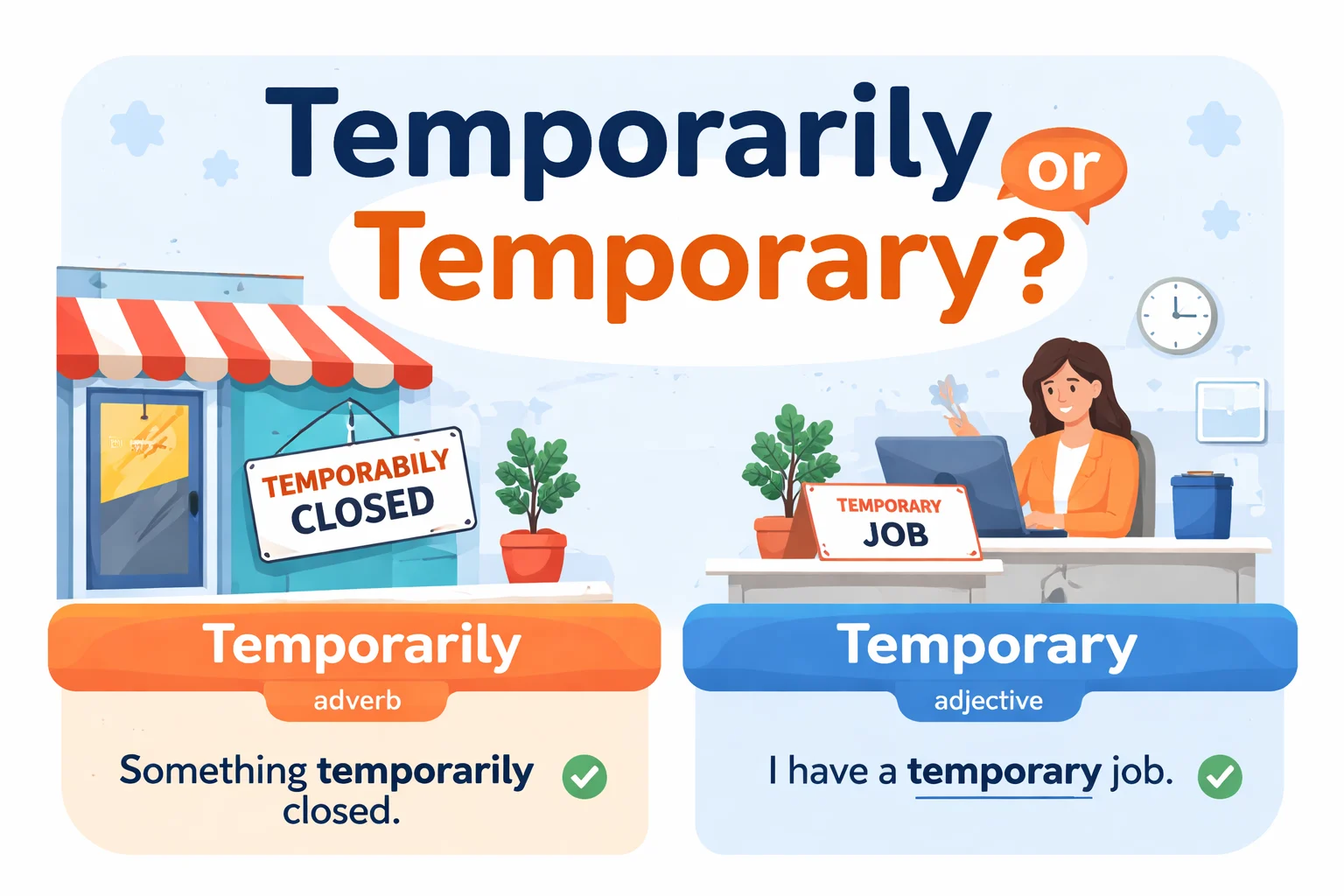
Temporarily vs temporary is a common English grammar question. The difference between temporary and temporarily is that temporary is an adjective used to describe something that lasts for a limited time, while temporarily is an adverb used to describe an action or condition that exists for a short period.
If you’re unsure whether to use temporary or temporarily, understanding their meanings, parts of speech, grammar rules, and sentence examples can help you avoid common mistakes. Learning the correct usage of these words can improve your writing, speaking, and overall English grammar accuracy.
Temporarily or Temporary
The difference is simple once you know their roles in grammar.
Temporary is an adjective. It describes a noun (a person, place, thing, or idea).
Temporarily is an adverb. It describes a verb or action.
Simple Definition
Temporary → lasting for a short time
Temporarily → happening for a short time
Examples
- The company hired a temporary employee.
- The store is temporarily closed.
- This is only a temporary solution.
- The system is temporarily unavailable.
Temporarily Pronunciation
Temporarily is pronounced:
tem-puh-RAIR-uh-lee
Phonetic form:
/ˌtɛm.pəˈrer.ə.li/
Temporarily Meaning
The temporarily meaning is for a limited time or not permanently.
Example:
“The website is temporarily down for maintenance.”
Temporarily or Temporary Synonym
Common synonyms include:
| Word | Meaning |
|---|---|
| Short-term | Lasting a limited time |
| Brief | Very short duration |
| Interim | Between two periods |
| Provisional | Temporary but official |
| Momentary | Lasting only a moment |
These synonyms can sometimes replace temporary or temporarily depending on the sentence.
Temporarily or Temporary Grammar Rules
Understanding temporarily or temporary grammar is the key to using these words correctly.
Rule 1: Temporary is an Adjective
Adjectives describe nouns.
Examples:
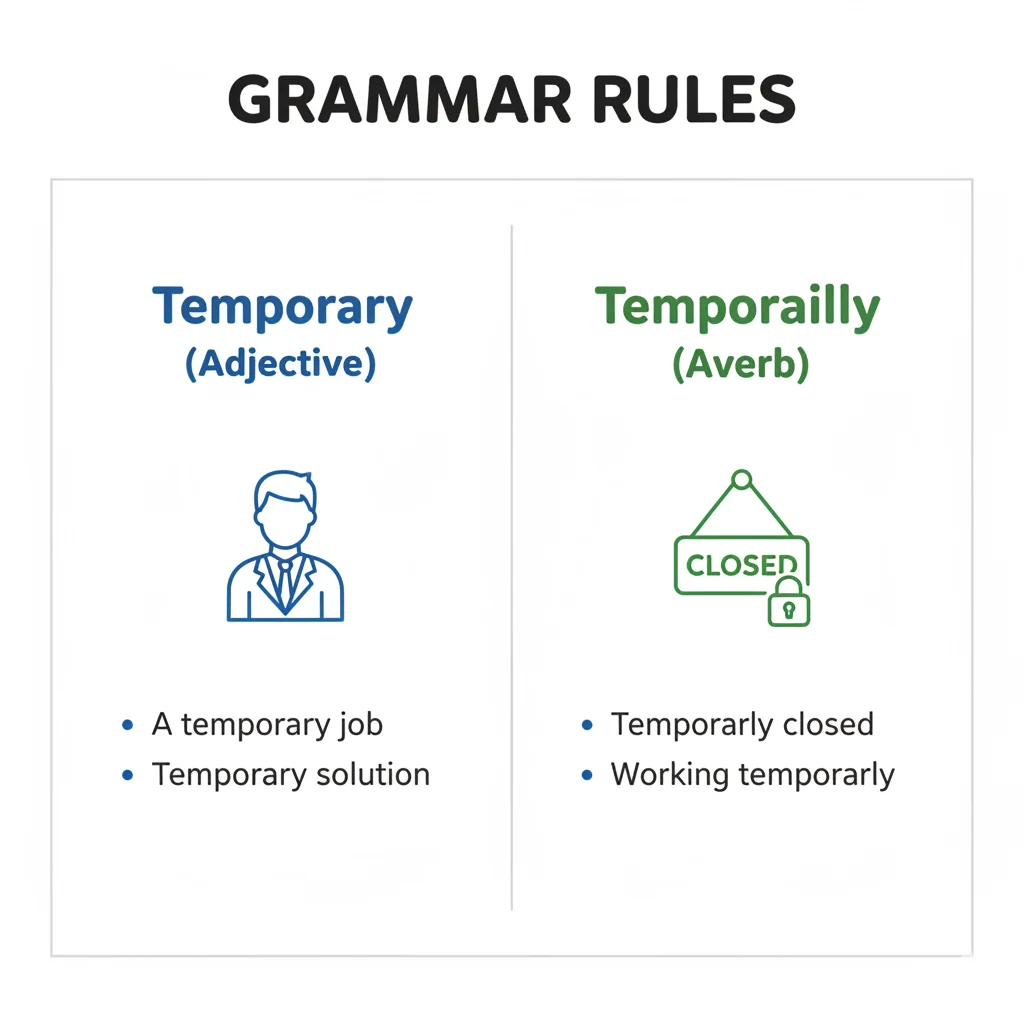
- Temporary office
- Temporary contract
- Temporary worker
Sentence example:
“The company offered a temporary position.”
Rule 2: Temporarily is an Adverb
Adverbs describe verbs, actions, or conditions.
Examples:
- Temporarily closed
- Temporarily unavailable
- Temporarily suspended
Sentence example:
“The airport is temporarily closed.”
Rule 3: Temporary Comes Before a Noun
Correct:
- Temporary job
- Temporary housing
Incorrect:
- Temporarily job
Rule 4: Temporarily Modifies an Action
Correct:
“The website is temporarily down.”
Incorrect:
“The website is temporary down.”
Rule 5: Check the Sentence Structure
Ask yourself:
Is the word describing a thing? → Use temporary
Is it describing an action or state? → Use temporarily
The Origin of Temporary and Temporarily
The words temporary and temporarily come from the Latin word “tempus,” which means time.
The English word temporary appeared in the 16th century. It described something that existed only for a limited period.
Later, English grammar created temporarily by adding the suffix “-ly.”
The “-ly” suffix often turns adjectives into adverbs.
Examples:
| Adjective | Adverb |
|---|---|
| Quick | Quickly |
| Slow | Slowly |
| Temporary | Temporarily |
This explains why the two words look similar but function differently.
British English vs American English Spelling
Unlike words like color/colour, the spelling of temporary and temporarily is the same in both British and American English.
However, usage context may vary.
Examples
American English:
“The website is temporarily unavailable.”
British English:
“The railway service is temporarily suspended.”
Comparison Table
| Feature | British English | American English |
|---|---|---|
| Spelling | Temporary | Temporary |
| Spelling | Temporarily | Temporarily |
| Example | Temporarily closed | Temporarily closed |
| Writing style | Formal reports | News and announcements |
So the spelling does not change by country.
Which Spelling Should You Use?
Many writers ask:
How to use temporary and temporarily?
The answer depends on grammar and sentence structure.
Use Temporary When Describing a Noun
Examples:
- Temporary office
- Temporary housing
- Temporary employee
Sentence:
“The company hired a temporary assistant.”
Use Temporarily When Describing an Action
Examples:
- Temporarily closed
- Temporarily paused
- Temporarily unavailable
Sentence:
“The platform is temporarily offline.”
Audience-Based Advice
| Audience | Recommendation |
|---|---|
| United States | Use standard grammar rules |
| UK / Commonwealth | Same usage applies |
| Global readers | Use simple sentences |
Correct grammar works for all English audiences.
Common Mistakes with Temporarily or Temporary
Many learners make similar grammar mistakes when using these words.
Mistake 1
Incorrect:
“The shop is temporary closed.”
Correct:
“The shop is temporarily closed.”
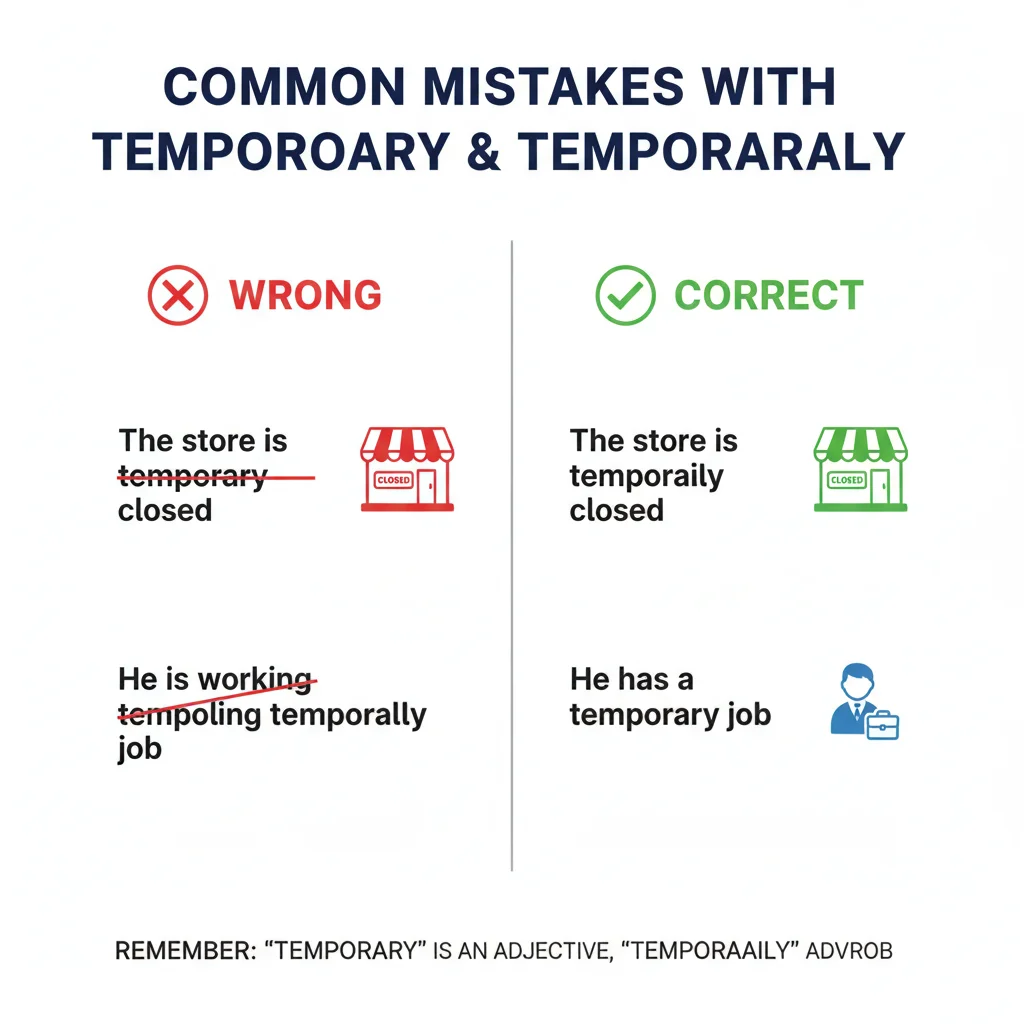
Mistake 2
Incorrect:
“This is a temporarily job.”
Correct:
“This is a temporary job.”
Mistake 3
Incorrect:
“The service is temporary unavailable.”
Correct:
“The service is temporarily unavailable.”
Mistake 4
Incorrect:
“The road is temporary blocked.”
Correct:
“The road is temporarily blocked.”
Grammar Tip
If the word describes a thing, use temporary.
If it describes an action, use temporarily.
Temporarily or Temporary in Everyday Examples
Understanding real-life usage helps improve writing and speaking.
Temporarily or Temporary in a Sentence
- The company hired temporary staff during the holidays.
- The website is temporarily offline.
- The bridge closure is temporary.
- Flights are temporarily delayed.
Email Example
Subject: Service Update
“Our support system is temporarily unavailable due to maintenance.”
News Example
“Authorities announced that the highway will be temporarily closed for repairs.”
Social Media Example
“My account is temporarily locked.”
Formal Writing Example
“The organization appointed a temporary director until the position is permanently filled.”
Temporarily or Temporary Closed – Correct Usage
One of the most searched phrases is:
temporarily or temporary closed
Correct phrase:
Temporarily closed
Example signs:
- “Store temporarily closed for renovation.”
- “Office temporarily closed due to maintenance.”
Why?
Because closed is an action or condition, so it requires an adverb.
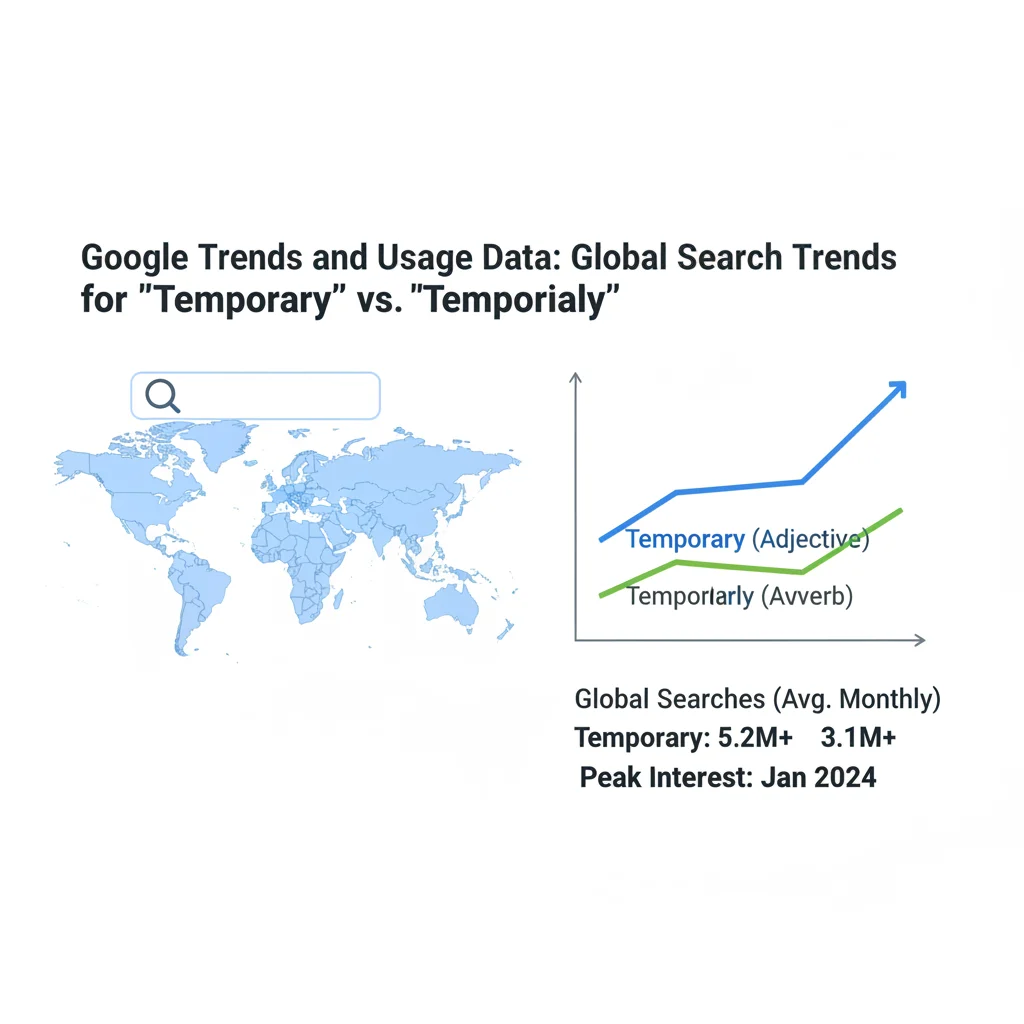
Google Trends and Usage Data
Search behavior shows many users look for:
- temporarily meaning
- temporarily pronunciation
- temporarily or temporary grammar
- temporary examples
- temporary use vs temporarily use
These searches are common in countries where English is a second language.
Countries with High Search Interest
| Country | Reason |
|---|---|
| United States | Grammar clarification |
| India | English learning |
| Pakistan | Writing and exam preparation |
| Philippines | Academic use |
| United Kingdom | Professional writing |
This shows the topic has strong global search demand.
Comparison Table: Temporary vs Temporarily
| Word | Part of Speech | Meaning | Example |
|---|---|---|---|
| Temporary | Adjective | Lasting a short time | Temporary job |
| Temporarily | Adverb | For a short time | Temporarily closed |
| Temporariness | Noun | Quality of being temporary | The temporariness of the situation |
Expert Tip for Correct Usage
Language experts recommend a simple rule:
Temporary describes nouns.
Temporarily describes actions.
Using the correct form improves clarity, professionalism, and grammar accuracy in writing.
FAQs
1. Which means temporary?
The word temporary means something that lasts for a short time and is not permanent.
Example:
“A temporary office was set up after the renovation.”
2. What is the temporarily meaning?
Temporarily means for a limited period of time.
Example:
“The system is temporarily offline.”
3. How to use temporary and temporarily?
Use temporary before nouns and temporarily before verbs or actions.
Example:
Temporary job
Temporarily closed
4. Is it temporarily use or temporary use?
Correct phrase: temporary use
Example:
“This building is for temporary use.”
5. How to use temporarily?
Use it when describing a temporary action or condition.
Example:
“The road is temporarily blocked.”
6. What are some temporary examples?
Examples include:
- temporary housing
- temporary job
- temporary solution
- temporary office
7. Can temporarily be used in formal writing?
Yes. It is common in news reports, official announcements, emails, and professional writing.
Example:
“The service is temporarily suspended.”
Conclusion
Understanding the difference between temporary and temporarily helps improve both written and spoken English. While the two words come from the same root related to time, they serve different roles in grammar.
The word temporary is an adjective used to describe nouns. It explains that something is not permanent and exists only for a short period. Examples include temporary job, temporary housing, and temporary solution.
On the other hand, temporarily is an adverb used to describe actions or conditions. It explains that something is happening for a limited time. Common phrases include temporarily closed, temporarily unavailable, and temporarily suspended.
Many people search for temporarily or temporary meaning, grammar rules, pronunciation, and sentence examples because the difference can seem confusing at first. However, once you remember the simple rule — temporary describes things and temporarily describes actions — using these words becomes easy.
Whether you are writing emails, academic papers, business messages, or online content, choosing the correct word will make your communication clearer and more professional. With practice and attention to grammar structure, you can confidently use temporary and temporarily in everyday English.

“Rose Macaulay shares the charm of idioms on LearnIdom.com, making language learning delightful, insightful, and full of wit for every reader.”