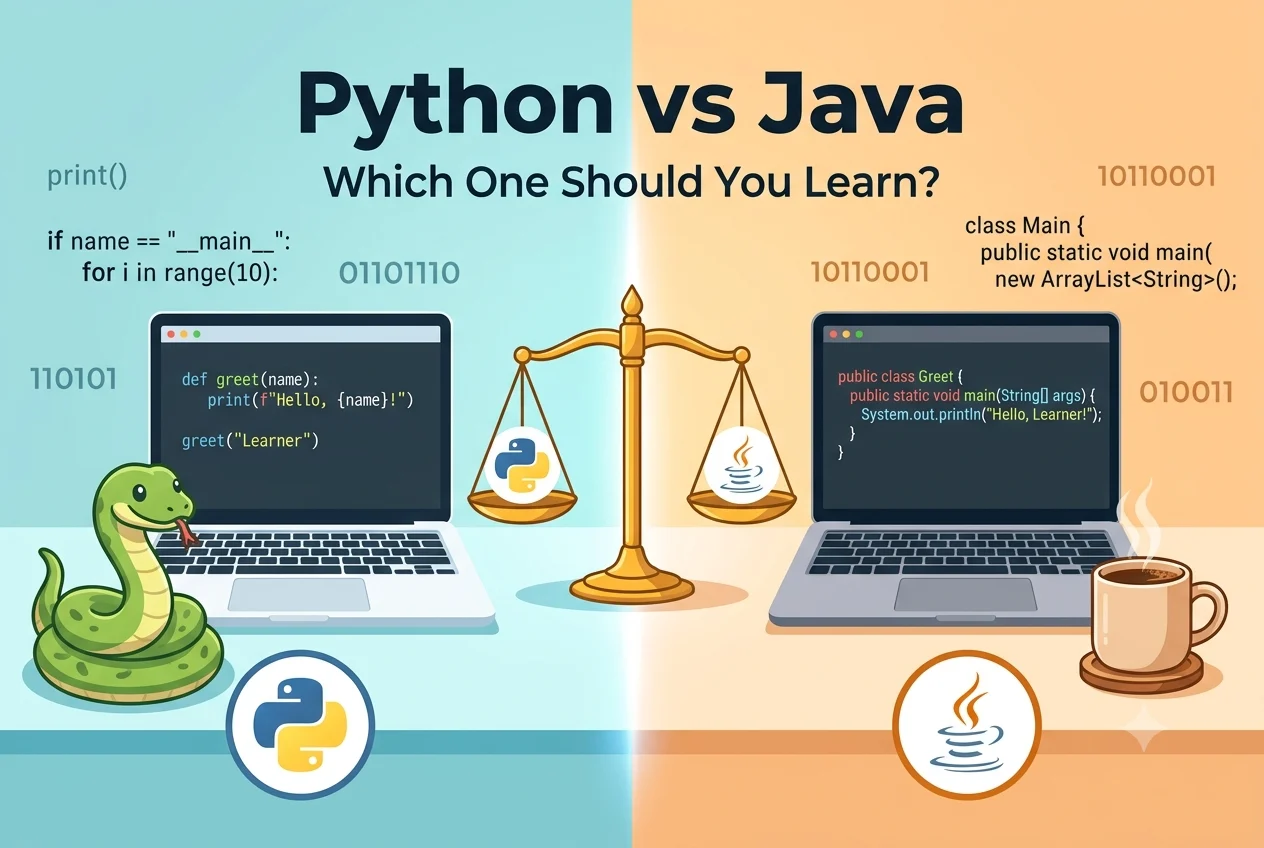
Learning to code is one of the best decisions you can make in 2026. But here is the big question that stops most beginners: Python or Java? Which one should you pick? Which offers better jobs? Which is easier to learn? These questions confuse thousands of new programmers every single day.
The truth is, both Python and Java are powerful languages used by top companies worldwide. But they serve different purposes. Python is simple, clean, and perfect for beginners. Java is fast, secure, and widely used in big companies. Choosing the wrong one can slow down your learning or even make you quit coding.
This guide solves your confusion. We compare Python vs Java in plain English. You will learn their history, real-world uses, salary expectations, and future demand. By the end, you will know exactly which language fits your goals. Let’s settle the debate once and for all.
Python or Java
Python is easier to learn and faster to write code in. It is perfect for beginners, data science, artificial intelligence, and automation tasks. Java is more structured and runs faster than Python. It is ideal for large business applications, Android app development, and backend enterprise systems.}
The Bottom Line
Choose Python if you want quick results, easy learning, and a gentle start to programming. Choose Java if you want enterprise-level job opportunities and want to build strong programming fundamentals. Both languages are excellent, but they serve different purposes.
The Origin of Python and Java
Python’s Origin Story
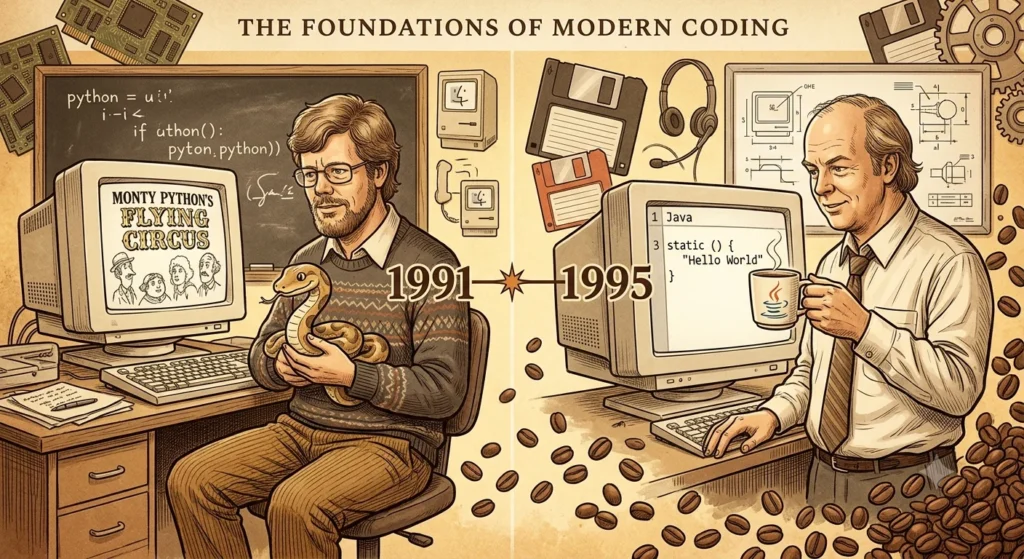
Python was created in 1991 by Guido van Rossum, a Dutch computer programmer. He wanted to design a programming language that was easy to read and actually fun to use. He named it after “Monty Python’s Flying Circus”, a famous British comedy show from the 1970s. This is why Python has a playful and friendly image in the coding community. The language emphasizes code readability and reduces unnecessary complexity. Python was designed to be simple, powerful, and enjoyable for developers of all skill levels.
Java’s Origin Story
Java was created in 1995 by James Gosling and his team at Sun Microsystems. It was originally called “Oak” but later renamed to “Java”, inspired by Java coffee from Indonesia. Java was designed with the famous motto “Write Once, Run Anywhere.” This means you can write Java code on one computer system and run it on any other system without making any changes. Java was built for large-scale, enterprise applications that require reliability, security, and high performance.
Understanding Spelling Confusion
Some people write “Java” and “Python” incorrectly. Common mistakes include writing “javascipt” instead of Java, or “javascript” which is a completely different language. Always remember that Java is a programming language. JavaScript is a completely different language used for web browsers. They are not related to each other. Python and Java are both programming languages, but they have different purposes and audiences.
Python vs Java: Key Differences
| Feature | Python | Java |
|---|---|---|
| Ease of Learning | Very easy, beginner-friendly | Moderate, more complex syntax |
| Code Length | Shorter, fewer lines needed | Longer, more verbose code |
| Execution Speed | Slower execution speed | Faster execution speed |
| Typing System | Dynamically typed (flexible) | Statically typed (strict) |
| Best Applications | AI, Data Science, Web Apps | Android, Enterprise, Banking |
| Companies Using | Google, Netflix, Spotify | Uber, Amazon, LinkedIn |
| Average Salary (US) | $120,000 per year | $115,000 per year |
| Learning Curve | Gentle and gradual | Steep and challenging |
| Job Demand (2026) | Very High demand | High demand |
| Community Support | Huge and active community | Huge and established community |
This table clearly shows the main differences between Python and Java. Python wins in ease of learning and speed of development. Java wins in execution speed and enterprise stability. Neither language is better overall. They are tools for different jobs.
Which Language Should You Choose?
Your choice of Python or Java depends entirely on who you are and what you want to achieve. Here is detailed advice for different situations.
If You Are a Complete Beginner
Choose Python without any hesitation. Python code reads like plain English. You do not need to understand complex programming rules to start building projects. You can create useful programs within days of learning. This keeps you motivated and excited. Python helps you learn programming logic without getting stuck on confusing syntax.
If You Are a Student
Choose Python if you are studying data science, artificial intelligence, or research fields. Choose Java if you are studying computer science or software engineering. Java teaches you discipline and forces you to understand data types, memory management, and object-oriented design principles.
If You Are Switching Careers
Choose Python. It is the most in-demand skill for non-technical professionals. Many marketers, financial analysts, and managers learn Python for automation and data analysis. Python opens doors in many industries, not just technology.
If You Want a Corporate Job
Choose Java. Large banks, insurance companies, and government agencies rely heavily on Java. These jobs offer stability, good benefits, and long-term career growth. Java is the backbone of enterprise software.
If You Want to Work in Startups
Choose Python. Startups move fast and need quick results. Python allows rapid development and easy testing. It is perfect for small teams with tight deadlines and limited resources.
If You Want to Build Mobile Apps
Choose Java for Android development. Java is the official language for Android app development. Python cannot match Java in mobile performance and native capabilities.
If You Want to Build Websites
Both languages are good choices. Python has Django and Flask frameworks. Java has Spring Boot. Both are powerful and widely used in web development.
Common Mistakes People Make
Mistake 1: Thinking One Language is Better
Neither Python nor Java is better than the other. They are different tools for different jobs. A hammer is not better than a screwdriver. It depends on what you are building and what you need.
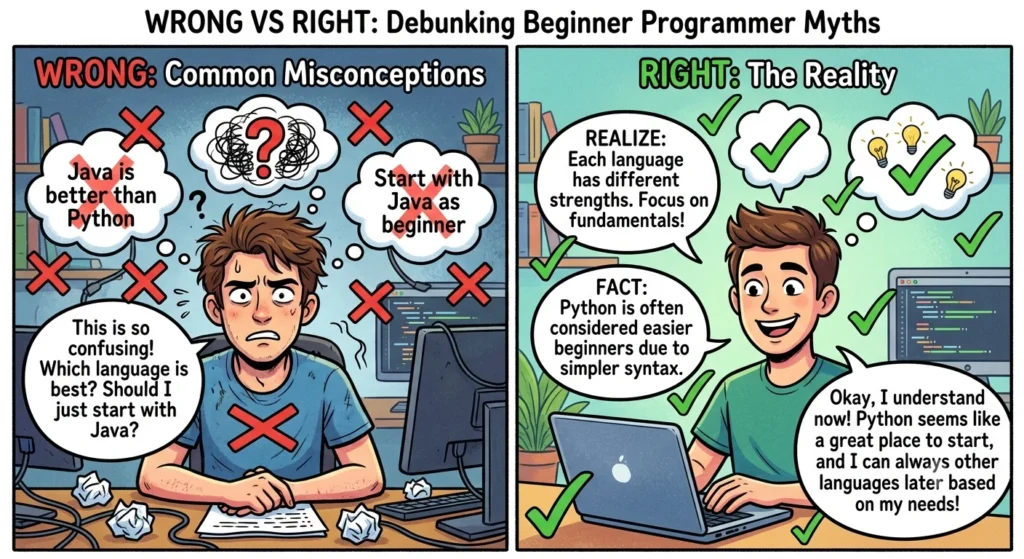
Mistake 2: Starting with Java as a Beginner
Java can be very frustrating for absolute beginners. Many people quit programming entirely because of Java’s steep learning curve. Start with Python to build confidence and basic skills.
Mistake 3: Ignoring Local Job Market Trends
Many people choose a language without researching job opportunities in their city or country. Some regions prefer Java, others prefer Python. Always check local job postings before deciding.
Mistake 4: Thinking Python Cannot Handle Big Projects
This is completely false. Google, Instagram, and YouTube use Python. It can handle massive scale if the system is designed properly. Python is not just for small projects.
Mistake 5: Not Practicing Enough
Many beginners watch hours of tutorials but never write a single line of code. Whether you choose Python or Java, you must code every day. Practice matters more than which language you pick.
Mistake 6: Overlooking Community Support
Both Python and Java have huge communities. But Python’s community is more beginner-friendly. Java communities can be more technical and less welcoming to new programmers.
Python or Java in Everyday Use
In Professional Emails
“Dear team, we are hiring developers who know Python or Java. Please share this with your network.” “Our new AI project requires strong Python skills. Java developers are also welcome to apply.”
In News Headlines
“Python overtakes Java as the most popular programming language according to recent surveys.” “Java remains the backbone of enterprise software worldwide despite competition from newer languages.”
On Social Media Platforms
Reddit is full of debates about Python or Java. Beginners frequently ask, “Python or Java for beginners?” Experienced developers share their honest opinions. Many suggest learning both languages over time rather than choosing just one.
In Formal Business Documents
“Software engineers must be proficient in at least one object-oriented programming language such as Java or Python.” “Candidates with Python or Java experience will be given priority.”
In Job Descriptions
“Looking for a software engineer with 3+ years of experience in Python or Java.” “Data scientists must have strong Python skills for analysis and modeling.” “Java developers needed for enterprise banking applications.”
In Academic Settings
“Computer science students are required to learn either Python or Java as their first programming language.” “Research projects prefer Python for data analysis and visualization.”
Google Trends & Usage Data
According to recent data and industry reports, here is the current landscape for Python and Java:
Python’s Dominance
Python is the number one programming language for data science and artificial intelligence. It holds approximately 40% of the data science market share. Python dominates in the United States, United Kingdom, and Western Europe. The language has grown 30% in popularity over the last three years. This growth is driven by artificial intelligence, machine learning, and data analysis needs.
Java’s Stability
Java is the second most used programming language in enterprise environments. It powers approximately 70% of Fortune 500 companies’ backend systems. Java is more popular in India, China, and Brazil, where IT outsourcing is strong. Java remains stable with slow but steady growth. It is not declining, but it is not growing as fast as Python.
Why Python is Rising
Artificial Intelligence and Machine Learning are experiencing huge growth. Data analysis is becoming essential in every industry worldwide. Automation is saving companies millions of dollars in operational costs. Python has the best libraries and frameworks for all these fields. This explains why Python’s popularity continues to increase.
Why Java Endures
Legacy enterprise systems cannot easily migrate to newer languages. Android app development still runs on Java. Banks and financial institutions trust Java for security and stability. Java developers are highly respected and well-compensated in the job market.
Country-Wise Popularity
- USA: Python leads in demand
- UK: Python leads in demand
- Europe: Python leads in demand
- India: Java leads in demand
- China: Java leads in demand
- Brazil: Java leads in demand
- Australia: Python leads in demand
Python or Java for Beginners
Python is the clear winner for beginners. Here is why in detail:
Why Python is Perfect for Beginners
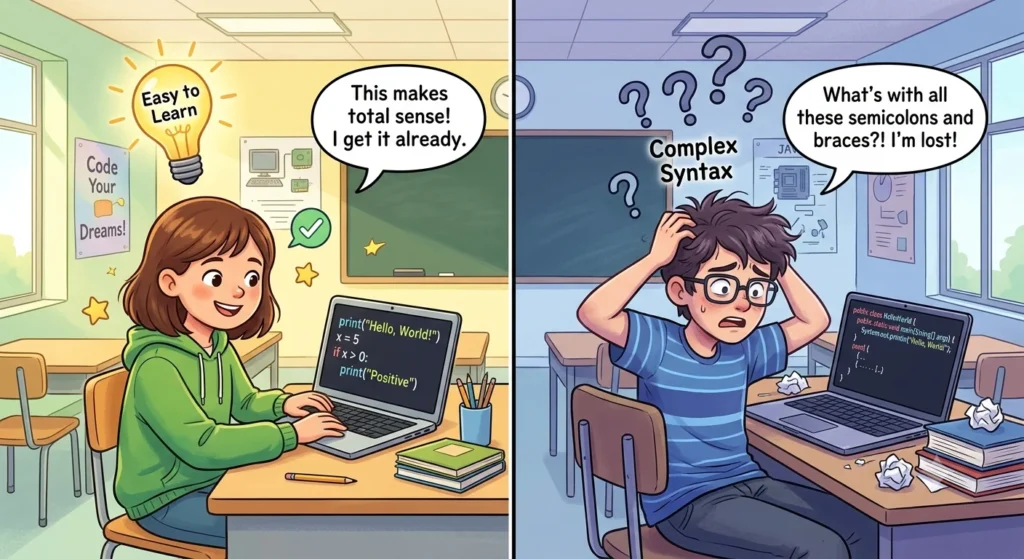
Python’s syntax is simple and reads like plain English. There are no semicolons, no curly braces, and no complex rules to remember. You can write your first program in five minutes. Immediate feedback keeps you engaged and motivated to learn more.
Why Java is Harder for Beginners
Java requires you to understand classes and methods from day one. The syntax is strict and unforgiving. Even small mistakes cause compilation errors. New learners get frustrated and often quit before they make meaningful progress.
The Best Path for New Programmers
Start with Python to learn basic programming logic, loops, functions, and problem-solving. Then learn Java to master object-oriented programming and software structure. This is the path that many successful developers follow. It gives you confidence first, then deep understanding.
Practical Learning Tips
Write code every single day. Start with small programs and gradually increase complexity. Join coding communities for support and feedback. Build real projects to apply what you learn. Practice matters more than which language you choose.
Python vs Java Salary Comparison
Global average salaries for Python and Java developers in 2026:
| Job Role | Python Salary | Java Salary |
|---|---|---|
| Junior Developer | $80,000 per year | $75,000 per year |
| Mid-Level Developer | $110,000 per year | $105,000 per year |
| Senior Developer | $150,000 per year | $140,000 per year |
| Data Scientist | $140,000 per year | $120,000 per year |
| AI Engineer | $160,000 per year | $130,000 per year |
| Enterprise Architect | $160,000 per year | $165,000 per year |
Key Salary Insights
Python salaries are slightly higher in artificial intelligence and data roles. Java salaries are higher in senior enterprise architecture roles. Both languages offer excellent earning potential. Your salary depends more on your experience, location, and company size than just the language you choose.
Location-Based Salary Variations
- United States: Highest salaries for both languages
- Europe: Good salaries, lower than US
- India: Lower salaries but growing rapidly
- Australia: Competitive salaries for both languages
Skills That Increase Salary
Understanding cloud computing (AWS, Azure) increases earning potential. Knowledge of databases and SQL is essential. Experience with frameworks (Django, Spring) adds value. Soft skills and communication matter for senior roles.
Python or Java: Future Scope
Both programming languages have bright futures, but they are moving in different directions.
Python’s Future
Artificial Intelligence and Machine Learning will continue to grow exponentially over the next decade. Automation will replace repetitive tasks across all industries. Data Science will enter every sector, from healthcare to agriculture. Python will lead all these fields because it has the best libraries and community support.
Python’s Growth Areas
- Artificial Intelligence and Deep Learning
- Machine Learning and Predictive Modeling
- Data Analysis and Business Intelligence
- Automation and Scripting
- Web Development with Django and Flask
- Internet of Things (IoT) applications
- Scientific Computing and Research
Java’s Future
Android apps will continue using Java and Kotlin for the foreseeable future. Banking and finance industries will not change their systems quickly. Government systems run on Java and require long-term maintenance. Java developers will always be needed for these stable, mission-critical systems.
Java’s Growth Areas
- Android App Development
- Enterprise Backend Systems
- Banking and Financial Services
- Government and Public Sector
- Insurance and Healthcare Systems
- Large-Scale E-commerce Platforms
- Big Data Technologies
The Final Verdict
If you want to work on cutting-edge technology and innovation, choose Python. If you want job stability and enterprise roles, choose Java. Both languages will remain relevant and in-demand for many years. The best choice depends on your personal interests and career goals.
Python or Java vs C++
Many beginners wonder how C++ fits into the Python or Java debate. Here is a complete comparison:
| Language | Best Applications | Difficulty Level | Learning Time |
|---|---|---|---|
| Python | AI, Data Science, Automation | Easy | 3-6 months |
| Java | Enterprise, Android, Banking | Medium | 6-12 months |
| C++ | Games, Systems, Hardware | Hard | 12-24 months |
Which One Should You Learn?
Start with Python or Java depending on your goals. Learn C++ only if you need high performance, game development, or hardware programming. C++ is not recommended for beginners because it has complex memory management and strict rules.
Practical Advice
Most software engineers learn multiple languages over their careers. Your first language is just the beginning. Do not stress too much about making the perfect choice. Pick one, learn it well, and then expand your skills.
Frequently Asked Questions
1. Is Python easier than Java for complete beginners?
Yes, Python is much easier to learn and write for beginners. The syntax is simple and reads like plain English. Java requires understanding of classes, methods, and strict programming rules. Python lets you start building useful programs within days.
2. Can I learn both Python and Java at the same time?
Learning both simultaneously is not recommended for beginners. It can cause confusion because the languages have different syntax and rules. Start with one language, learn it well, then learn the other. This approach builds strong fundamentals.
3. Which programming language pays more in 2026?
Both languages pay well. Python roles in artificial intelligence and data pay slightly more at junior levels. Java roles in enterprise architecture pay equally well at senior levels. Your salary depends more on experience, location, and company.
4. Should I learn Python or Java in 2026 for a career?
Learn Python if you want artificial intelligence, data science, or automation careers. Learn Java if you want Android development, enterprise systems, or banking careers. Both are excellent choices with strong job markets.
5. Which language is better for web development?
Both languages are excellent for web development. Python has Django and Flask frameworks. Java has Spring Boot. Choose based on your comfort level and career goals. Both frameworks are powerful and widely used.
6. Can I get a good job knowing only Python?
Yes, many data scientists, automation engineers, and web developers work only with Python. However, learning additional skills like SQL, cloud computing, and version control helps you stand out in the job market.
7. Is Java dying as a programming language?
No, Java is not dying. It is a mature, stable language that continues to power millions of applications worldwide. While its growth has slowed, it remains essential for enterprise systems and Android development.
8. Which language is better for mobile app development?
Java is better for Android app development. It is the official language and has excellent tools and libraries. Python cannot match Java’s performance on mobile platforms.
9. How long does it take to learn Python or Java?
Python takes approximately 3 to 6 months to learn well. Java takes approximately 6 to 12 months. The exact time depends on how much you practice and your prior experience with programming.
10. Which language has better job opportunities in 2026?
Both languages have excellent job opportunities. Python is growing faster in artificial intelligence and data science. Java remains strong in enterprise and Android development. Your specific location and industry affect job availability.
11. Does NASA use Python or Java?
NASA uses both Python and Java. Python is heavily used in data analysis and mission planning. Java is used for some ground systems. This shows that both languages are trusted for critical applications.
12. What is the number one coding language in 2026?
Python is currently the number one coding language in terms of popularity and growth. However, “number one” depends on how you measure it. Java is number one for enterprise applications.
Conclusion
Choosing between Python or Java does not have to be stressful. Both languages are powerful, respected, and offer excellent career opportunities. The right choice depends on your personal goals and interests.
If you are new to coding, start with Python. It is friendly, forgiving, and quick to learn. You will build projects faster and stay motivated. If you want enterprise systems, Android apps, or banking careers, choose Java. It teaches discipline and strong fundamentals.
Remember, Python or Java is not a life-or-death decision. Many developers learn both over time. What matters most is consistent practice and a willingness to learn. Pick one, start coding today, and begin your journey into programming. Your future starts now.

“Iris Murdoch explores the beauty of language and idioms on LearnIdom.com, making learning phrases engaging, memorable, and fun for everyone.”