Ever wondered about the origins of phrases and idioms and where these expressions actually come from? Many common idioms used in English today have fascinating histories rooted in ancient traditions, literature, warfare, sailing, and everyday life.
For example, “spill the beans” comes from ancient voting methods, while “bite the bullet” has origins in old medical practices. Understanding the history behind idioms not only makes them easier to remember but also gives deeper insight into culture and language evolution. These phrases are widely used in daily conversations, books, movies, and professional communication, making them essential for fluency.
Many learners search for the meanings and origins of idioms to improve vocabulary and comprehension. In this guide, you’ll explore the true origins of popular phrases and idioms, along with simple explanations and real-life usage to help you understand and use them confidently.
Spill the Beans
Word-by-Word Meaning: Literally, to knock over a container of dried beans, causing them to scatter everywhere.
Idiomatic Meaning: To reveal a secret or disclose confidential information.
Example Sentences:
- “Who spilled the beans about the surprise party? Now Sarah knows everything!”
- “I accidentally spilled the beans when I mentioned the promotion during lunch.”
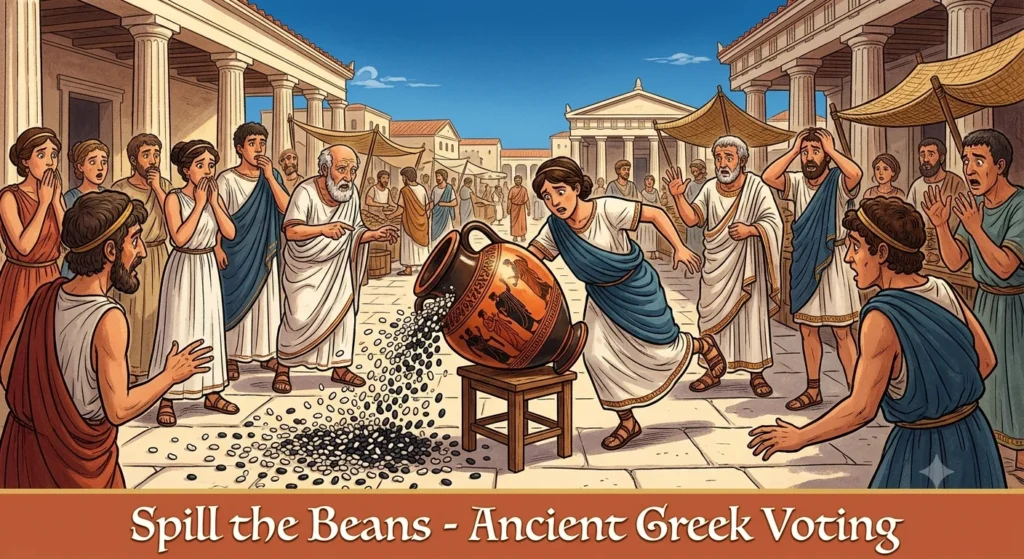
The Origin Story: Believe it or not, this phrase traces back to Ancient Greece! Back in the day, Greeks used beans to cast votes. Voters would drop a white bean into a jar for “yes” and a dark bean for “no.” The votes were meant to stay secret—but if someone knocked over the jar, well, everyone could see how the votes were leaning. This is one of the most surprising origins of popular sayings you’ll ever encounter.
Common Error: People sometimes say “spill the tea” interchangeably these days, which is a newer phrase.
Usage Note: Use this when someone reveals something confidential, whether by accident or on purpose. It’s informal and works in both casual and professional contexts.
Bite the Bullet
Word-by-Word Meaning: Literally, to clench your teeth on a small metal projectile.
Idiomatic Meaning: To face a difficult or unpleasant situation with courage and resolve.
Example Sentences:
- “I hate going to the dentist, but I’ll just have to bite the bullet and make an appointment.”
- “The team decided to bite the bullet and release the product, even though it wasn’t perfect.”
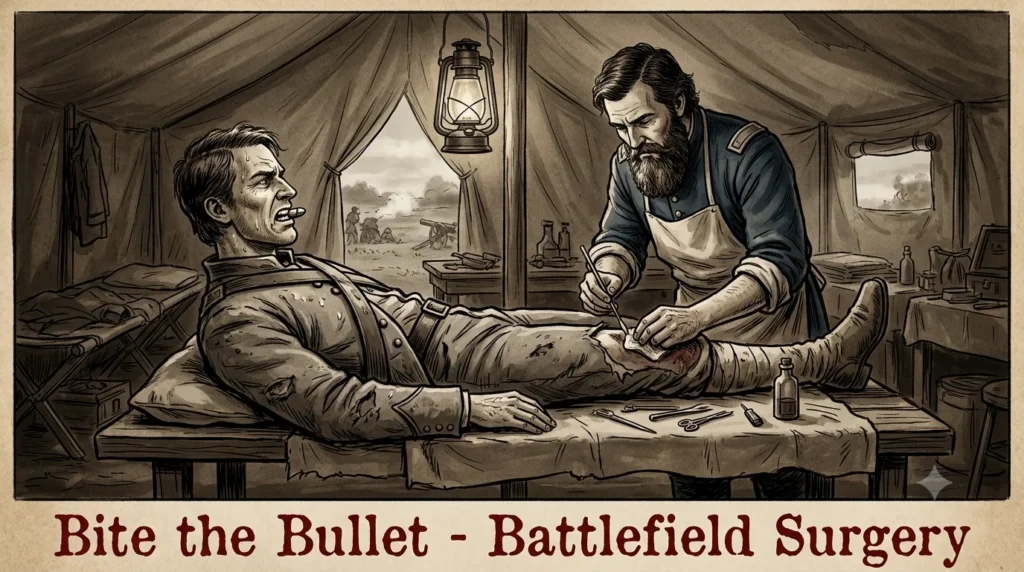
The Origin Story: Before modern anaesthesia, battlefield surgeons had to perform amputations and other gruesome procedures on wounded soldiers. To help patients endure the excruciating pain, they’d give them a bullet to bite down on—it gave them something to focus on besides the agony. This grim origin shows how phrases and idioms in English often come from humanity’s darkest moments.
Common Error: Don’t confuse this with “take the bullet” (taking a literal or metaphorical hit for someone else).
Usage Note: This phrase emphasizes bravery in the face of something inevitable and unpleasant. It’s perfect for motivating yourself or others before tackling a tough task.
Break the Ice
Word-by-Word Meaning: Literally, to smash frozen water on a surface.
Idiomatic Meaning: To initiate conversation in a social setting, reducing tension or awkwardness.
Example Sentences:

- “Playing a quick game of ‘Two Truths and a Lie’ is a great way to break the ice at parties.”
- “I tried to break the ice by asking about her dog, but she didn’t even look up.”
The Origin Story: This one comes from maritime history! Ships would send smaller boats ahead to break the ice in frozen harbours, allowing larger vessels to pass through safely. Figuratively, it’s the same principle—clearing the way for smoother communication. The origins of phrases and idioms like this remind us how everyday life shaped our language.
Common Error: People often forget it’s break, not melt the ice.
Usage Note: Common in business, education, and social settings. “Icebreakers” are activities designed specifically for this purpose.
Turn a Blind Eye
Word-by-Word Meaning: Literally, to rotate one’s head so a blind eye faces a certain direction.
Idiomatic Meaning: To deliberately ignore or overlook something you know is wrong.
Example Sentences:
- “The teacher turned a blind eye to the students passing notes during class.”
- “Many companies turn a blind eye to minor safety violations until someone gets hurt.”
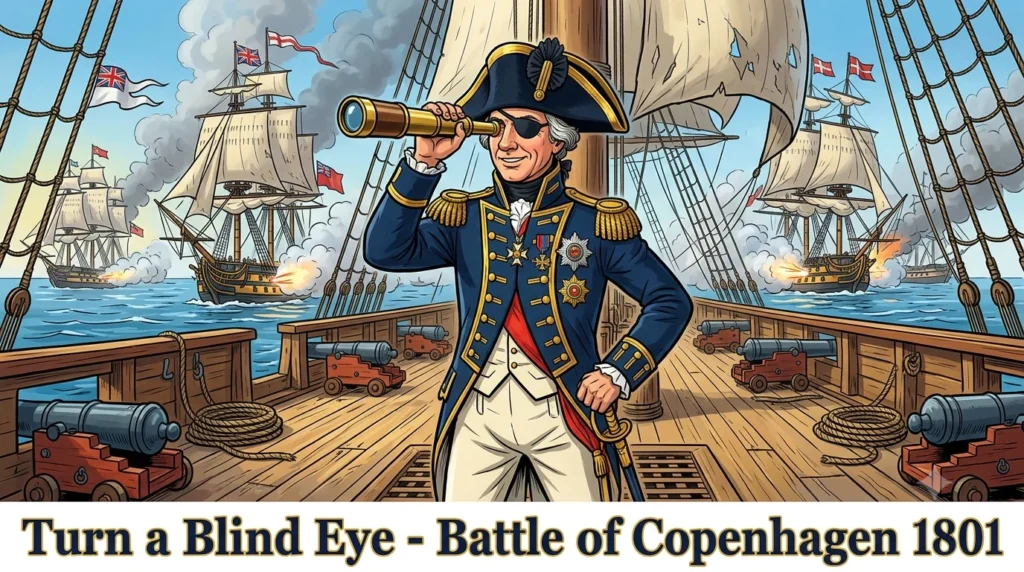
The Origin Story: This one’s pure British naval heroics—or maybe just stubbornness! During the Battle of Copenhagen in 1801, Admiral Horatio Nelson was ordered to retreat by his commanding officer. According to legend, Nelson—who was blind in one eye—raised his telescope to his bad eye and declared, “I really do not see the signal.” He then charged ahead and won the battle.
Common Error: Some mistakenly think it’s about literally being blind, rather than choosing not to see.
Usage Note: Often used critically—”turning a blind eye” is usually seen as a failure to act responsibly.
Raining Cats and Dogs
Word-by-Word Meaning: Literally, domestic pets falling from the sky.
Idiomatic Meaning: Very heavy rainfall.
Example Sentences:
- “We were planning a picnic, but it’s raining cats and dogs out there!”
- “Drive carefully—it’s raining cats and dogs and the roads are flooded.”
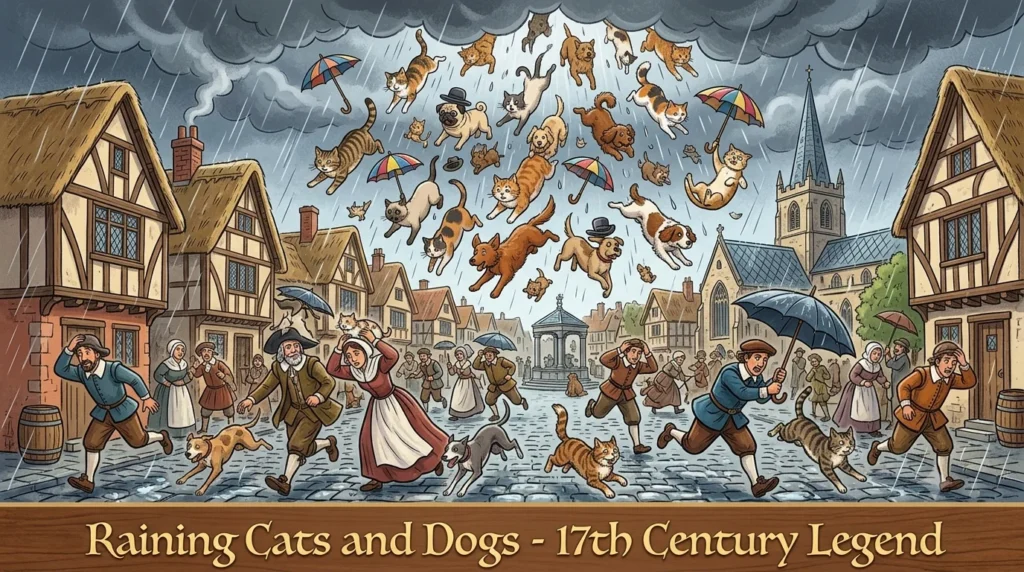
The Origin Story: The most plausible theory? This phrase dates back to 1661 when an English poet wrote about a freak storm where “cats and dogs” fell with the rain. But there’s another theory: in 17th-century England, heavy rain would wash dead animals (including cats and dogs) through the streets, making it look like they’d fallen from the sky. Grim, but memorable! Weather-related idioms and their origins are some of the most colorful in our language.
Common Error: No, it’s not “raining like cats and dogs”—just “raining cats and dogs.”
Usage Note: Purely informal. Perfect for everyday weather complaints.
Cat Got Your Tongue?
Word-by-Word Meaning: Literally, a feline has somehow stolen your ability to speak.
Idiomatic Meaning: A playful way to ask why someone is silent, especially when they seem reluctant to speak.
Example Sentences:
- “You’ve been quiet all morning—cat got your tongue?”
- “Come on, speak up! Cat got your tongue or what?”
The Origin Story: There are two main theories. One suggests it originated from the cat-o’-nine-tails—a whip used by the English Navy that caused such intense pain, victims were left speechless. The other theory points to Ancient Egypt, where liars and blasphemers supposedly had their tongues cut out and fed to cats as punishment. Take your pick!
Common Error: It’s a question, not a statement. Use it when you want someone to speak up.
Usage Note: Informal and slightly teasing. Use with friends or in casual settings.
Cost an Arm and a Leg
Word-by-Word Meaning: Literally, requiring a limb for payment.
Idiomatic Meaning: Extremely expensive.
Example Sentences:
- “That new phone costs an arm and a leg—I’ll stick with my old one.”
- “Great location, but the rent costs an arm and a leg.”
The Origin Story: One popular theory traces this to 18th-century portrait painting. Artists charged more for paintings that included arms and legs—a full-body portrait was pricier than just a headshot. Another theory suggests it refers to soldiers losing limbs in war—the ultimate cost of conflict. This is one of those surprising origins of popular sayings that makes you appreciate modern pricing!
Common Error: It’s costs an arm and a leg, not costs an arm or a leg.
Usage Note: Meant humorously, never literally.
Don’t Cry Over Spilled Milk
Word-by-Word Meaning: Literally, weeping over dairy that’s been knocked over.
Idiomatic Meaning: Don’t waste time worrying about something that’s already happened and can’t be undone.
Example Sentences:
- “I know you failed the test, but don’t cry over spilled milk—just study harder next time.”
- “We lost the contract, but crying over spilled milk won’t bring it back.”
The Origin Story: This phrase dates back to the 17th century. Milk was a daily staple—spilling it was a genuine inconvenience, but whining about it didn’t make the milk reappear. The wisdom behind this saying has endured for centuries.
Common Error: Sometimes shortened to “no use crying over spilt milk.” Both forms are correct.
Usage Note: Teaches resilience and forward-thinking. Great for consolation.
Kick the Bucket
Word-by-Word Meaning: Literally, to strike a pail with one’s foot.
Idiomatic Meaning: To die.
Example Sentences:
- “When I kick the bucket, I want my ashes scattered at sea.”
- “That old car finally kicked the bucket after 200,000 miles.”
The Origin Story: Gruesome but fascinating: when slaughtering animals, butchers would place a bucket under them and hang them on a pulley. The animal would sometimes kick the bucket during the process. Another theory suggests “bucket” refers to a beam from which something was suspended—and kicking it meant death.
Common Error: Never use this phrase in formal or sensitive contexts about someone’s actual passing. It’s humorous and informal.
Usage Note: Used humorously or casually, never respectfully. Avoid in serious situations.
Let the Cat Out of the Bag
Word-by-Word Meaning: Literally, to release a cat from a sack.
Idiomatic Meaning: To reveal a secret, usually by accident.
Example Sentences:
- “I let the cat out of the bag about the surprise trip—sorry!”
- “The journalist let the cat out of the bag about the celebrity’s secret wedding.”
The Origin Story: In medieval markets, unscrupulous merchants would sell a piglet in a bag. But some would substitute a cat instead—cheaper and easier to hide. If a buyer opened the bag, the cat would escape, revealing the deception. The origins of popular sayings like this show how everyday commerce shaped our language.
Common Error: Often confused with “spill the beans,” but “let the cat out of the bag” emphasizes accidentally revealing a secret.
Usage Note: Informal and slightly playful.
Saved by the Bell
Word-by-Word Meaning: Literally, rescued by the ringing of a bell.
Idiomatic Meaning: Rescued from an unpleasant situation at the very last moment.
Example Sentences:
- “I was about to give a terrible answer, but the fire alarm saved me by the bell.”
- “The judge was about to sentence him, but a phone call saved him by the bell.”
The Origin Story: Here’s a chilling one: in the 18th and 19th centuries, people feared being buried alive. So they were interred in special coffins with a string attached to a bell above ground. If the person woke up, they could ring the bell and be rescued. This is arguably the most startling among all surprising origins of popular sayings.
Common Error: No, it’s not about boxing, though boxing rounds do end with a bell!
Usage Note: Informal and often used humorously.
Butter Someone Up
Word-by-Word Meaning: Literally, to apply butter to someone.
Idiomatic Meaning: To flatter someone with the intention of gaining a favour.
Example Sentences:
- “He’s buttering me up because he wants to borrow my car.”
- “Stop buttering up the boss and just ask for the raise.”
The Origin Story: This likely comes from ancient Indian culture, where people would throw balls of ghee (clarified butter) at statues of the gods to seek their favour. The idea stuck—literal buttering became figurative flattery. Understanding idioms and their origins often means exploring fascinating cultural practices.
Common Error: Usually implies insincere flattery, not genuine compliments.
Usage Note: Informal and slightly cynical.
Give Someone the Cold Shoulder
Word-by-Word Meaning: Literally, to offer a cold piece of meat from the shoulder.
Idiomatic Meaning: To deliberately ignore or show indifference to someone.
Example Sentences:
- “After the argument, she gave me the cold shoulder for a week.”
- “I tried to be friendly, but he just gave me the cold shoulder.”
The Origin Story: In medieval England, hosts would serve a large meal to welcome guests. But if a guest overstayed their welcome, they’d be served a “cold shoulder of mutton”—a not-so-subtle hint that it was time to leave. These are the kinds of phrases and idioms in English that reveal historical social customs.
Common Error: Not to be confused with “giving someone the cold treatment” (though they mean the same thing).
Usage Note: Informal, describing social rejection.
The Whole Nine Yards
Word-by-Word Meaning: Literally, the full nine yards in length.
Idiomatic Meaning: Everything possible; the full extent of something.
Example Sentences:
- “When I plan a party, I go the whole nine yards—decorations, catering, entertainment.”
- “He gave it the whole nine yards but still lost the race.”
The Origin Story: There’s debate, but the most popular theory traces this to World War II fighter pilots. Their ammunition belts were supposedly nine yards long. “Giving it the whole nine yards” meant firing every bullet at a target. The origins of phrases and idioms from wartime are particularly vivid.
Common Error: There are many competing origin theories—this is the most widely accepted, but not definitively proven.
Usage Note: Casual and expressive.
Bury the Hatchet
Word-by-Word Meaning: Literally, to put a tool underground.
Idiomatic Meaning: To make peace after a conflict or argument.
Example Sentences:
- “After years of rivalry, they finally buried the hatchet and became friends.”
- “Let’s bury the hatchet and move forward.”
The Origin Story: This comes from Native American tradition. Chiefs would literally bury their weapons as a symbol of peace, particularly when forming alliances or ending conflicts. The history of idioms includes many such cross-cultural exchanges.
Common Error: This isn’t about forgetting—it’s about actively choosing peace.
Usage Note: Often used for long-standing feuds, not minor disagreements.
The Pot Calling the Kettle Black
Word-by-Word Meaning: Literally, a cooking vessel commenting on the colour of another.
Idiomatic Meaning: Accusing someone of a fault you yourself have.
Example Sentences:
- “She told me I was lazy—talk about the pot calling the kettle black!”
- “He criticized her smoking while holding a cigarette. Pot calling the kettle black, right?”
The Origin Story: The phrase appears in Thomas Shelton’s 1620 translation of Don Quixote. Both pots and kettles were made of cast iron and would turn black from soot on open fires. So a pot calling a kettle black was hypocritical—they were equally sooty.
Common Error: Often shortened to just “pot calling the kettle black”—the full version is clearer.
Usage Note: Casual and conversational.
Resting on Your Laurels
Word-by-Word Meaning: Literally, lying down on a wreath made from laurel leaves.
Idiomatic Meaning: Being satisfied with past achievements and not striving for more.
Example Sentences:
- “The company was resting on its laurels while competitors innovated.”
- “You can’t just rest on your laurels—keep learning and growing.”
The Origin Story: In Ancient Greece, winning athletes and military heroes were crowned with laurel wreaths. “Resting on your laurels” became a warning—celebrate your wins, but don’t stop there. The origins of popular sayings often carry timeless wisdom.
Common Error: Often used negatively.
Usage Note: More formal than many idioms on this list.
Moment of Truth
Word-by-Word Meaning: Literally, a time for truth.
Idiomatic Meaning: A critical, decisive moment where the outcome is determined.
Example Sentences:
- “The election results will be the moment of truth for the new policy.”
- “The exam is the moment of truth—all my studying comes down to this.”
The Origin Story: This phrase comes from Spanish—”hora de la verdad”—the final moment of a bullfight when the matador delivers the killing blow. Exploring idioms and their origins often means uncovering dramatic cultural traditions.
Common Error: Often used for any important moment, not just life-or-death situations.
Usage Note: Formal enough for professional contexts.
The Writing on the Wall
Word-by-Word Meaning: Literally, a message inscribed on a wall.
Idiomatic Meaning: A clear sign that something bad is going to happen.
Example Sentences:
- “The declining sales were the writing on the wall for the struggling company.”
- “He ignored the writing on the wall and kept spending until he was bankrupt.”
The Origin Story: This one’s biblical. In the Book of Daniel, King Belshazzar saw mysterious writing on a wall foretelling his kingdom’s fall. That night, he was killed, and the prophecy came true. The history of idioms is deeply intertwined with religious texts.
Common Error: Often confused with “seeing the signs” generally—but this specifically warns of disaster.
Usage Note: Serious in tone.
Long Time No See
Word-by-Word Meaning: Literally, it’s been a long time since we saw each other.
Idiomatic Meaning: A greeting used after a long separation.
Example Sentences:
- “Hey, buddy! Long time no see! How have you been?”
- “We ran into each other after years and I blurted out, ‘Long time no see‘.”
The Origin Story: This phrase likely originated from Chinese Pidgin English—a simplified language used for trade. The Chinese phrase “hǎo jiǔ bù jiàn” (好久不见) translates literally to “long time no see.” It’s a perfect example of how English has absorbed expressions from other languages.
Common Error: It’s informal—don’t use in very formal written communications.
Usage Note: Warm and friendly. Best used in person or in informal messages.
The History of Idioms Through the Ages
The history of idioms is as rich and varied as human civilization itself. Idioms have been around as long as language has existed, evolving with every generation and culture.
Ancient Times: Early civilizations used proverbs and sayings to pass down wisdom. Ancient Egyptian texts contain idioms that still resonate today. The Greeks and Romans contributed countless expressions that found their way into modern languages.
Medieval Period: Tradespeople and craftsmen created specialized jargon that became idioms. Guilds, farming, and religious practices all contributed to the growing pool of expressions. Many phrases and idioms in English from this era reflect daily medieval life.
The Shakespearean Era: The Bard invented over 1,700 words and phrases we still use today. Expressions like “break the ice” and “in a pickle” come from his plays. The origins of popular sayings from this period are some of the most well-documented.
Industrial Revolution: New machines and processes birthed fresh expressions. “Steamroller,” “get the ball rolling,” and “full steam ahead” all come from industrial innovations.
Modern Times: The 20th and 21st centuries brought idioms from technology, pop culture, and global communication. “Spill the tea,” “ghost someone,” and “slide into DMs” are just a few examples of how idioms and their origins continue to evolve.
Understanding the history of idioms helps us appreciate how language is a living, breathing entity—constantly changing and absorbing influences from every culture it touches.
Business Idioms Exercises for Professionals
Idioms aren’t just for casual conversation—they’re everywhere in the workplace. Here are some business idioms exercises to sharpen your corporate vocabulary and understand how phrases and idioms in English function in professional settings.
Exercise 1: Match the Business Idiom
| Idiom | Correct Meaning |
|---|---|
| Touch base | Reconnect briefly with someone |
| Ballpark figure | A rough estimate |
| Get the ball rolling | Start a project or process |
| Think outside the box | Be creative and innovative |
| On the same page | Agree on something |
| Cut corners | Do something poorly to save time/money |
| Win-win situation | An outcome beneficial to everyone |
Exercise 2: Fill in the Blanks
Complete these sentences with the correct business idiom:
- “Let’s ____ before the meeting ends to discuss the timeline.” (touch base)
- “Can you give me a ____ for the project budget?” (ballpark figure)
- “We need to ____ on this marketing campaign by Friday.” (get the ball rolling)
- “I think we need to ____ to solve this problem creatively.” (think outside the box)
- “It’s important we’re all ____ before we proceed.” (on the same page)
Exercise 3: Business Idioms in Action
Write a professional email using at least 5 business idioms. Here’s an example to get you started:
Subject: Project Update and Next Steps
Dear Team,
I hope this email finds you well. I wanted to touch base about the Q3 project. Based on my ballpark figure, we’re looking at about 30% completion.
To get the ball rolling on the next phase, I suggest we think outside the box regarding our delivery approach.
Let’s schedule a quick call to ensure we’re all on the same page before moving forward.
Exercise 4: Idiom Replacement Challenge
Rewrite these sentences replacing the underlined words with appropriate business idioms:
- “We need to start this project immediately.” → “We need to get the ball rolling on this project immediately.”
- “That’s a rough estimate of the costs.” → “That’s a ballpark figure for the costs.”
- “The new policy benefits both management and employees.” → “The new policy is a win-win situation for both management and employees.”
These business idioms exercises will help you communicate more effectively in professional environments and understand the origins of phrases and idioms that power workplace communication.
Funny Old Sayings and Their Meanings
Not all idioms are serious. Some are downright hilarious! Here are five funny old sayings and their meanings that will make you chuckle.
“Mad as a Wet Hen”
Meaning: Very angry or irritated.
The Story: Chickens that get wet look ridiculous and agitated—feathers sticking up, clumsy movements, and general disarray. The image of a soggy, furious hen is so absurd that the phrase stuck. This is one of those funny old sayings that paints a vivid picture.
Example: “My boss was mad as a wet hen when I arrived 20 minutes late.”
“Don’t Look a Gift Horse in the Mouth”
Meaning: Don’t criticize a gift, even if it’s imperfect.
The Story: When buying a horse, you check its teeth to determine its age and health. If someone gives you a horse as a gift, checking its teeth would be rude—just say thank you! Even if the horse is old, it’s still a free horse.
Example: “The car has some dents, but don’t look a gift horse in the mouth—it was free!”
“Useless as a Chocolate Teapot”
Meaning: Completely ineffective or impractical.
The Story: A teapot made of chocolate would melt the moment you poured hot water in it. The visual is so ridiculous that the phrase became a humorous way to describe something utterly useless.
Example: “This cheap umbrella is as useless as a chocolate teapot in a hurricane.”
“Not the Sharpest Tool in the Shed”
Meaning: Not very intelligent.
The Story: Calling someone a dull tool is much funnier (and kinder) than calling them stupid. The visual of a shed full of tools, with one that’s completely blunt, adds a layer of gentle humor.
Example: “He’s a nice guy, but not the sharpest tool in the shed if you know what I mean.”
“More Holes Than Swiss Cheese”
Meaning: Full of flaws or inconsistencies.
The Story: Swiss cheese is famous for its holes. Describing something as having “more holes than Swiss cheese” is a lighthearted way to say it’s deeply flawed.
Example: “The suspect’s alibi had more holes than Swiss cheese—the police didn’t believe a word.”
These funny old sayings and their meanings prove that humor has always been part of human language. The origins of popular sayings often reveal our ancestors’ playful side.
Conclusion
Mastering idioms not only boosts your English fluency but also makes your speech lively and memorable. Start using one new idiom every day, practice in conversation, and soon you’ll naturally impress with your colorful language. Remember, understanding the origins of phrases and idioms helps you use them confidently—and even share the stories behind them.

“L.P. Hartley brings classic idioms to life on LearnIdom.com, helping readers explore language with wit, clarity, and timeless insight.”