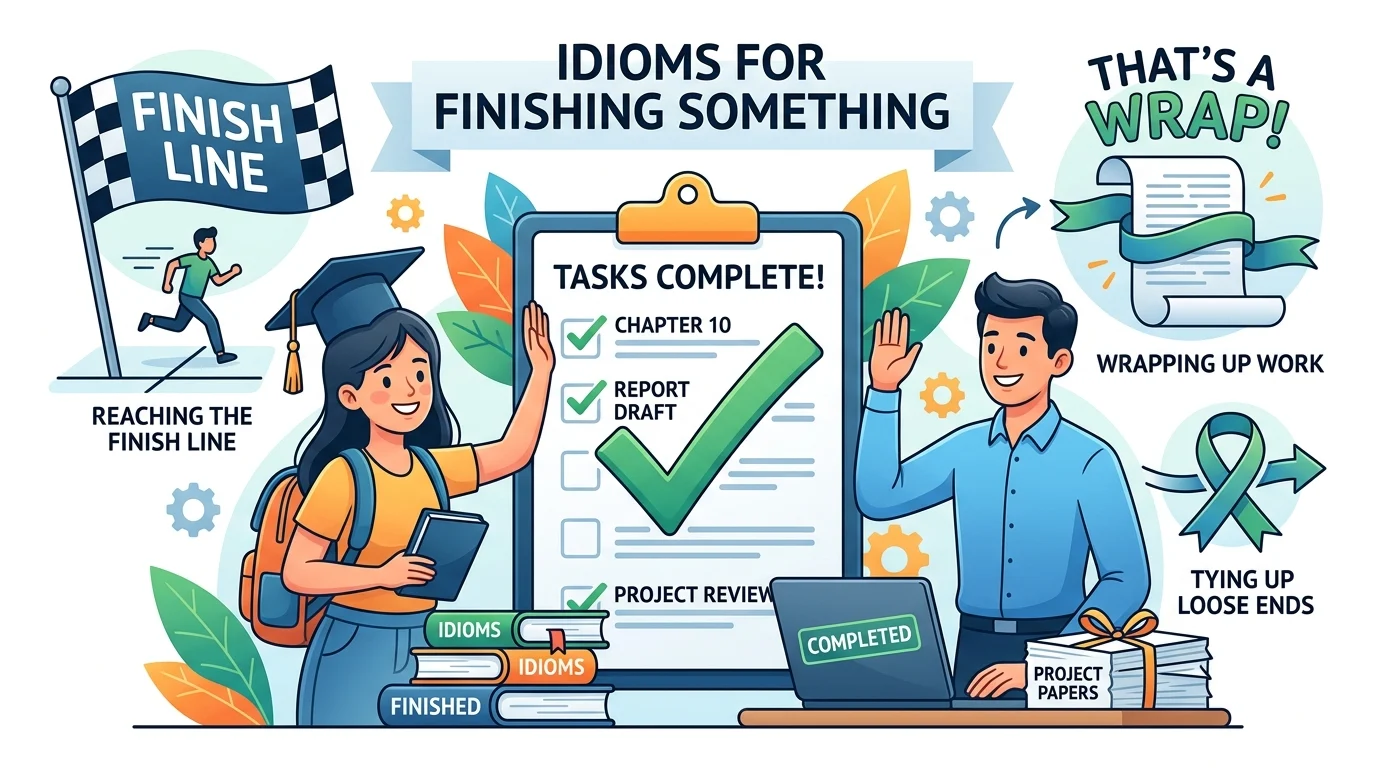
Finishing a task, project, meeting, or difficult job can be described in many ways beyond simply saying “I finished it.” These idioms for finishing something make everyday English more natural, expressive, and interesting.
For example, when your work is almost complete, you can say “I’m wrapping things up.” When everything is finally finished, you might say “Job done!” Learning these expressions helps you speak English with greater confidence and variety.
What Are Idioms for Finishing Something?
Idioms for finishing something are expressions used to talk about completing a task, reaching the end of an activity, ending a situation, or completing the final stage of a project.
Some are true idioms, while others are common English expressions frequently used to describe completion.
Here are a few quick examples:
- Wrap things up — finish something that is nearly complete
- Get the job done — successfully complete a task
- Call it a day — stop working for the day
- See something through — continue until it is completely finished
- Tie up loose ends — deal with the remaining details
- Come to an end — reach the final point
The right expression depends on what you are finishing and whether you want your English to sound casual, formal, humorous, or motivational.
Wrap Things Up
Meaning: To finish the remaining work and bring something to an end.
Example sentences:

- We only have two points left, so let’s wrap things up.
- I’m wrapping things up before I leave the office.
Common error: Do not confuse the figurative meaning with literally wrapping an object.
Usage note: This is one of the most natural expressions for finishing a meeting, project, conversation, or work session.
Get the Job Done
Meaning: Successfully complete a task or responsibility.
Example sentences:
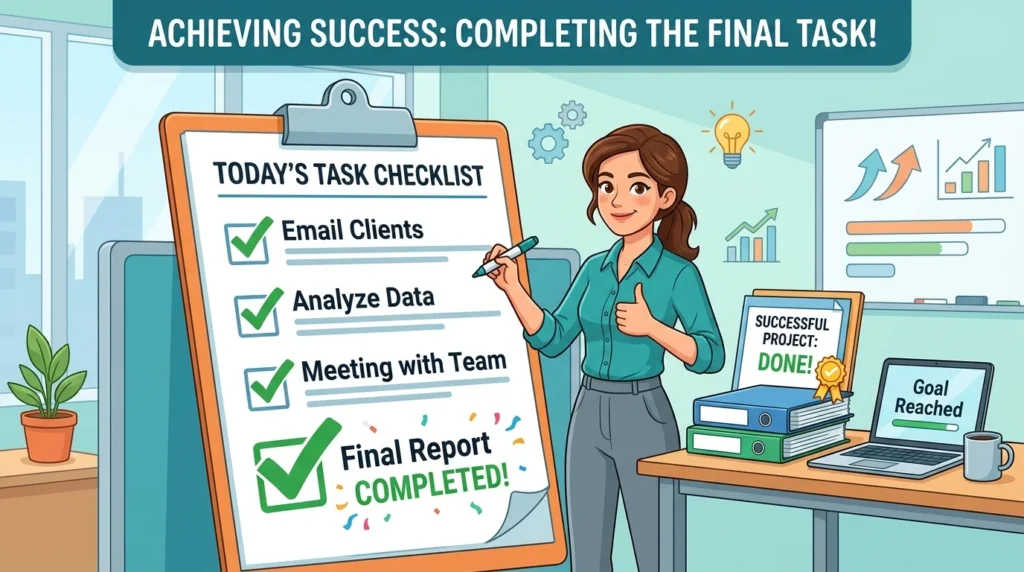
- We had a tight deadline, but we got the job done.
- She stayed focused and got the job done on time.
Common error: Say “get the job done,” not “get job done.”
Usage note: Use this phrase when the important point is successful completion.
Call It a Day
Meaning: Stop working on something for the day.
Example sentences:

- We’ve finished the important work, so let’s call it a day.
- I’m tired after studying for hours. I’m going to call it a day.
Common error: It does not necessarily mean the entire project is finished.
Usage note: This is a casual expression commonly used at work or after a period of study.
Bring Something to a Close
Meaning: Finish or formally end something.
Example sentences:
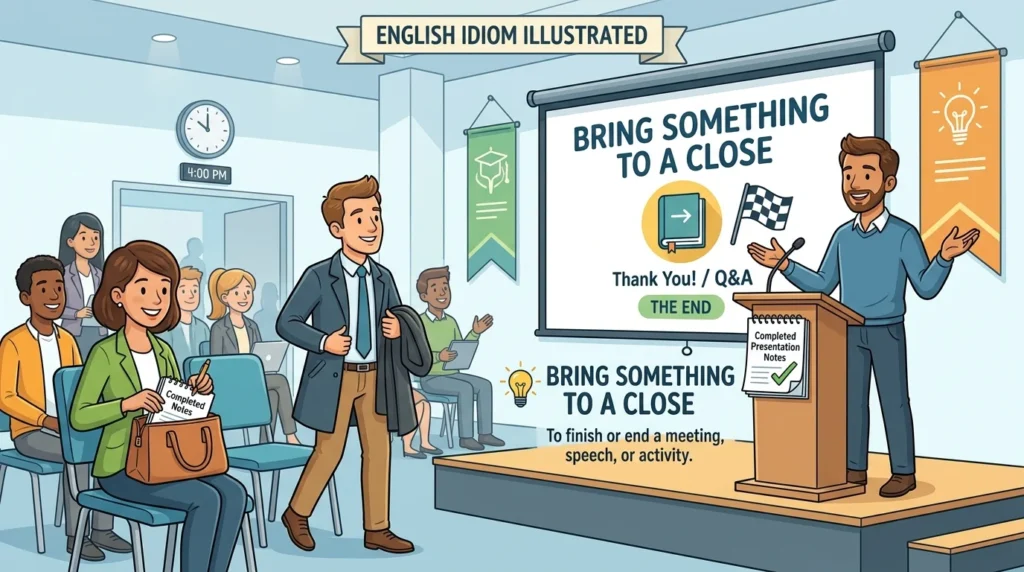
- The host brought the meeting to a close.
- We need to bring this discussion to a close.
Common error: Do not use “bring something at a close.”
Usage note: This phrase is slightly more formal and works well in professional or academic English.
Come to an End
Meaning: Reach the final point or finish naturally.
Example sentences:
- The school year is coming to an end.
- The long meeting finally came to an end.
Common error: The correct expression is “come to an end,” not “come at an end.”
Usage note: Use it for events, periods, experiences, stories, and situations.
Finish Off
Meaning: Complete the final part of something.
Example sentences:
- I need to finish off my presentation tonight.
- She finished off the last section of the assignment.
Common error: Do not use “finish off” when you mean that something is only beginning.
Usage note: It is particularly useful when most of the work has already been completed.
See Something Through
Meaning: Continue doing something until it is completely finished.
Example sentences:
- You started the course, so try to see it through.
- She promised to see the project through to the end.
Common error: Do not confuse “see it through” with simply “see something.”
Usage note: This expression emphasizes determination and persistence.
Reach the Finish Line
Meaning: Reach the final stage or successfully complete something.
Example sentences:
- We’re almost at the finish line with this project.
- After months of work, they finally reached the finish line.
Common error: It can be literal in a race, but in everyday conversation it is often figurative.
Usage note: This is a motivational expression for projects, goals, studies, and difficult tasks.
Put the Finishing Touches on Something
Meaning: Make the final improvements or additions before completion.
Example sentences:
- I’m putting the finishing touches on my essay.
- She put the finishing touches on the presentation.
Common error: Use it when something is nearly finished, not when the main work has barely started.
Usage note: This phrase is excellent for creative work, presentations, writing, designs, and projects.
Tie Up Loose Ends
Meaning: Complete the small remaining details.
Example sentences:
- I just need to tie up a few loose ends before leaving.
- The team spent Friday tying up loose ends.
Common error: It usually refers to small unfinished matters rather than the entire project.
Usage note: This is especially common in business, planning, stories, and professional conversations.
Finish the Job
Meaning: Complete the remaining work successfully.
Example sentences:
- We’re nearly finished, so let’s finish the job.
- The team worked together to finish the job.
Common error: Do not assume it always refers to employment; context determines the meaning.
Usage note: It sounds direct and determined and is useful when encouraging someone to complete a task.
Get It Over With
Meaning: Finish something unpleasant, boring, or difficult so you no longer have to deal with it.
Example sentences:
- I don’t enjoy paperwork, so I’ll get it over with now.
- Let’s finish the difficult part and get it over with.
Common error: This expression usually suggests relief rather than excitement.
Usage note: Use it when you want an uncomfortable or tedious activity to end.
Close the Book on Something
Meaning: Officially end a matter and stop dealing with it.
Example sentences:
- The company decided to close the book on the old project.
- They finally closed the book on the disagreement.
Common error: This is not normally used for ordinary small tasks.
Usage note: It works best for matters, situations, projects, or chapters that are considered completely finished.
Draw to a Close
Meaning: Gradually approach the end.
Example sentences:
- The conference is drawing to a close.
- As the evening drew to a close, everyone went home.
Common error: The correct form is “draw to a close.”
Usage note: This expression sounds more polished and is especially useful in formal writing.
Round Things Off
Meaning: Finish something in a suitable or satisfying way.
Example sentences:
- We had dessert to round off the meal.
- She summarized the main points to round off the presentation.
Common error: Do not assume it always means physically making something round.
Usage note: Use it when describing a final action that completes an experience.
Finish Up
Meaning: Complete what remains of an activity or task.
Example sentences:
- I’ll finish up my homework and come downstairs.
- Let’s finish up before the guests arrive.
Common error: “Finish up” usually refers to remaining work rather than an entire long-term project.
Usage note: It is casual, simple, and extremely common in everyday English.
Be Done With Something
Meaning: Have finished something or no longer need to deal with it.
Example sentences:
- I’m finally done with my assignment.
- Once we’re done with the project, we’ll take a break.
Common error: “I’m done with it” can sometimes mean you no longer want to deal with something, so context matters.
Usage note: This is a very natural everyday alternative to “I have finished it.”
Bring Something to Completion
Meaning: Successfully finish a task, process, or project.
Example sentences:
- Careful planning helped the team bring the project to completion.
- They worked together to bring the renovation to completion.
Common error: Do not say “bring something to complete.”
Usage note: This is more formal than “finish” and works well in professional and academic writing.
Call It Quits
Meaning: Decide to stop doing something or end an activity.
Example sentences:
- After several hours of work, we decided to call it quits.
- The two teams called it quits after the discussion became unproductive.
Common error: It does not always mean successfully completing a task.
Usage note: It can also describe ending a relationship or abandoning an activity, so use it according to context.
Put the Final Nail in the Coffin
Meaning: Take the final action that makes an ending or failure certain.
Example sentences:
- The final mistake put the nail in the coffin for the old plan.
- That decision was the final nail in the coffin for the proposal.
Common error: This is a dramatic expression and should not be used for ordinary tasks such as homework.
Usage note: It is best for serious or figurative situations involving the final event that ends something.
Idioms for Finishing Something Funny
Sometimes you want idioms for finishing something funny rather than formal expressions. In casual conversations, these phrases can add personality:
- That’s a wrap! — A playful way to say something is finished.
- Job done! — Short and confident.
- Mission accomplished! — A humorous way to celebrate success.
- And that’s that! — Shows that something is settled or finished.
- All done! — Simple, friendly, and casual.
For example, after finally cleaning your desk, you could smile and say, “Mission accomplished!”
Phrases for the End of Something
There are many useful phrases for the end of something besides traditional idioms.
| Phrase | Meaning |
|---|---|
| Come to an end | Reach the final point |
| Draw to a close | Gradually approach the end |
| Reach the finish line | Complete a difficult process |
| In the final stages | Almost finished |
| Near completion | Very close to being finished |
| Wrap things up | Finish remaining work |
| Bring it to a close | End something formally |
| At the end | Reach the final point |
| Finish up | Complete what remains |
| Put the finishing touches on | Add final details |
These phrases can help you avoid repeating “finish” throughout your writing and conversations.
Idioms for Ending a Relationship
Some idioms for ending a relationship overlap with general expressions for stopping something, but they have a more personal meaning.
Call It Quits
This means deciding to stop a relationship or activity.
Example: After many conversations, they decided to call it quits.
Break Things Off
This means ending a romantic relationship.
Example: They decided to break things off because the relationship was no longer working.
Go Separate Ways
This means two people stop being together and continue independently.
Example: After graduation, the friends went their separate ways.
Move On
This means leaving a past relationship or situation behind and focusing on the future.
Example: After the relationship ended, she decided to move on.
These expressions should be used thoughtfully because relationship-related language can carry emotional meaning.
To Complete Something: Synonyms
If you’re searching for a to complete something synonym, several words can work depending on the context.
| Synonym | Best used when |
|---|---|
| Finish | Everyday tasks |
| Complete | General or formal situations |
| Accomplish | Achieving a goal |
| Fulfill | Meeting a duty or requirement |
| Conclude | Formally ending something |
| Finalize | Making something officially complete |
| Wrap up | Informal completion |
| Execute | Carrying out a planned task |
| Achieve | Successfully reaching a goal |
For ordinary conversation, finish, complete, wrap up, and get the job done are among the most useful choices.
What Is the Idiom for Completing a Task?
There is no single idiom that works in every situation. Get the job done is one of the strongest choices when you want to say that a task was successfully completed.
Other useful expressions include finish up, wrap things up, finish the job, and see it through.
For example:
I finally got the job done.
This emphasizes successful completion, while:
I’m wrapping things up.
suggests that only the final part remains.
What Are Common Phrases Using Finish?
Common phrases using finish include:
- Finish up
- Finish off
- Finish the job
- Finish strong
- Finish on time
- Finish what you started
- Finish the final stage
- Finish the last part
- Finish completely
One particularly useful expression is “finish what you started,” which encourages someone to continue until a task is complete.
How Do You Say Done in a Cool Way?
If you want to say done in a casual, confident, or playful way, try:
- That’s a wrap!
- Job done!
- Mission accomplished!
- All set!
- We’re good to go!
- And that’s that!
- Finished and done!
The best choice depends on the situation. “That’s a wrap!” sounds playful, while “All set!” is relaxed and practical.
What Are the Top 10 Idioms?
If you want to start with the most useful expressions from this article, learn these ten first:
- Wrap things up
- Get the job done
- Call it a day
- Bring something to a close
- Come to an end
- Finish off
- See something through
- Reach the finish line
- Tie up loose ends
- Finish up
These expressions cover many everyday situations, including work, school, projects, meetings, events, and personal goals.
Frequently Asked Questions
What is a good idiom for completing a task?
Get the job done is one of the best everyday expressions for successfully completing a task. Finish up, wrap things up, and finish the job are also useful.
What is a funny way to say something is finished?
You can say “That’s a wrap!”, “Mission accomplished!”, or “Job done!” These expressions are casual and can make your English sound more playful.
What is an idiom for reaching the end?
Come to an end, draw to a close, and reach the finish line are common expressions for reaching or approaching the final stage.
What is an idiom for completing something completely?
See something through emphasizes continuing until completion, while close the book on something suggests officially ending a matter.
Is “finish up” the same as “finish off”?
They are similar, but finish up usually means completing what remains, while finish off often emphasizes completing the final part of something.
Conclusion
Learning idioms for finishing something gives you more natural ways to talk about completing tasks, projects, meetings, activities, and goals. Instead of repeating “finish” or “complete,” you can use expressions such as wrap things up, get the job done, see it through, and tie up loose ends.
Remember that not every expression has exactly the same meaning. Call it a day means stopping work for now, while get the job done emphasizes successful completion. Tie up loose ends focuses on small remaining details, and reach the finish line highlights reaching the final stage.
The best way to remember these expressions is to use them in real sentences. The next time you complete homework, finish a project, end a meeting, or reach a personal goal, try using one of these phrases instead of simply saying “I’m finished.” With regular practice, these expressions will become a natural part of your English vocabulary.

“Wilkie Collins brings classic idioms to life on LearnIdom.com, making language learning engaging, memorable, and full of literary charm.”