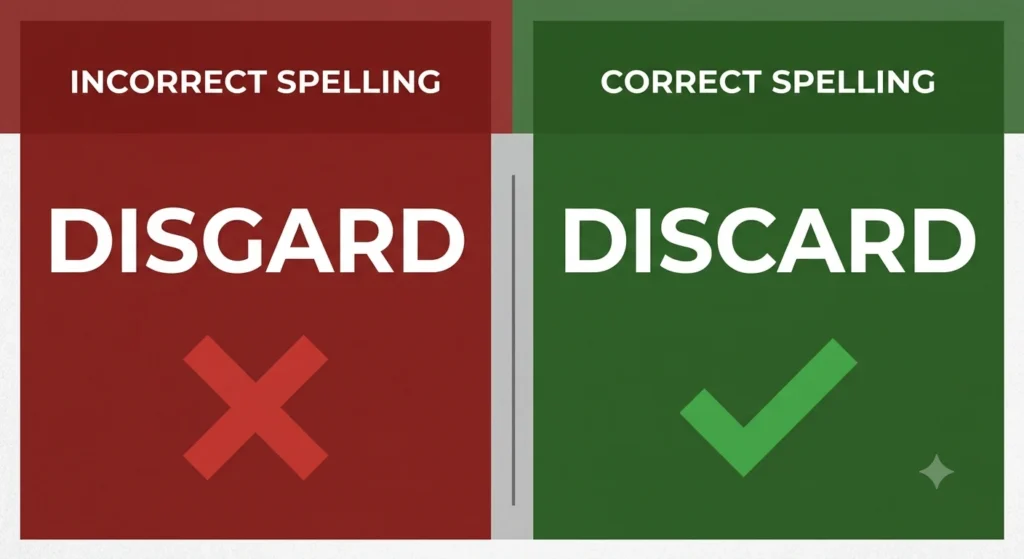
Disgard vs discard is a common spelling question that confuses many English learners and writers. The correct spelling is discard, while disgard is a misspelling and is not recognized in standard English dictionaries.
The word discard means to throw away, get rid of, reject, or remove something that is no longer needed or useful. If you’re unsure whether to use disgard or discard, understanding the correct spelling, meaning, pronunciation, and usage can help you avoid common writing mistakes.
This guide explains the difference between Disgard vs Discard, why one spelling is incorrect, and how to use discard correctly in everyday English.
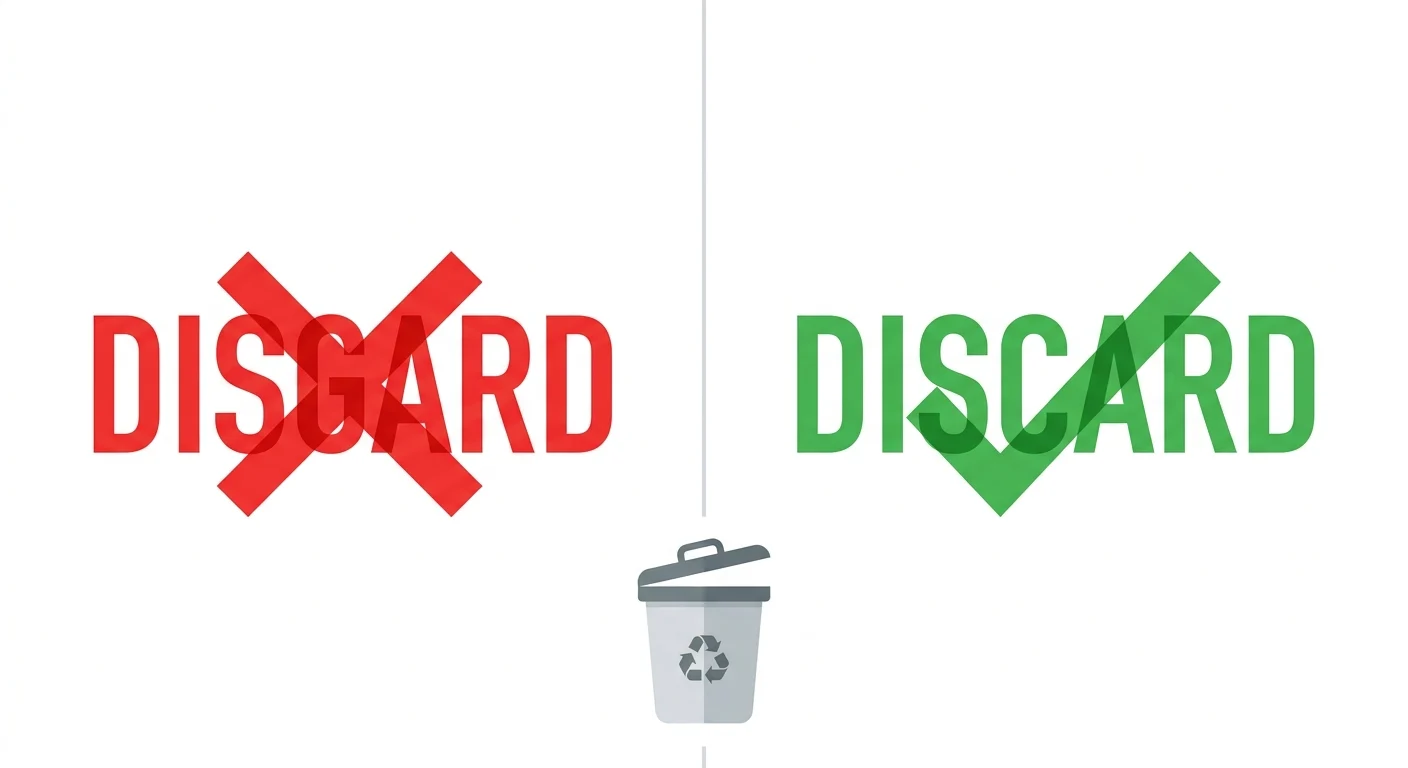
Discard is Correct ✅
The correct spelling is discard. “Disgard” is wrong and should never be used.
What Does Discard Mean?
Discard means to throw away, get rid of, or reject something that is no longer useful.
Simple Examples:
- Please discard the empty boxes.
- The chef told us to discard spoiled food.
- You should discard old computer files.
- The judge decided to discard weak evidence.
Memory Trick:
Think of playing CARDS. You dis-CARD unwanted cards from your hand. The “C” in discard comes from “card.” This simple trick will help you remember forever! 🃏
Why Do People Misspell It as “Disgard”? 🤔
The misspelling “disgard” happens for several reasons. Let us explore them.
Pronunciation Confusion
When we say “discard” quickly, the “c” and “g” sounds blend together. In some accents, the “c” sounds like a hard “g.” People write what they hear. This leads to the “disgard” error.
Influence of Other Words
English has many words with similar sounds. For example:
- Regard (has a “g” sound)
- Guard (has a “g” sound)
- Vanguard (has a “g” sound)
People see these words and apply the same spelling pattern to “discard.” This is a classic mistake. 😅
Autocorrect and Typing Errors
Sometimes fingers slip while typing. The “c” and “g” keys are close together on a keyboard. A simple typo becomes “disgard.” Autocorrect may not always catch it if the word is close enough.
Lack of Awareness
Many people simply do not know the correct spelling. They have never been taught properly. They see “disgard” online and assume it is correct.
The Solution
Now you know why the mistake happens. You can avoid it. Always remember the “C” stands for “card.” This simple memory trick will save you. ✅
Discard Meaning and Origin 📜
Understanding the origin of a word helps you remember its spelling.
Original Meaning (1500s)
The word discard comes from card games. In the 1500s, players would “discard” unwanted cards from their hands. They threw these cards away to get better ones.
Word Breakdown
- Dis- = a prefix meaning “away” or “apart”
- Card = playing card
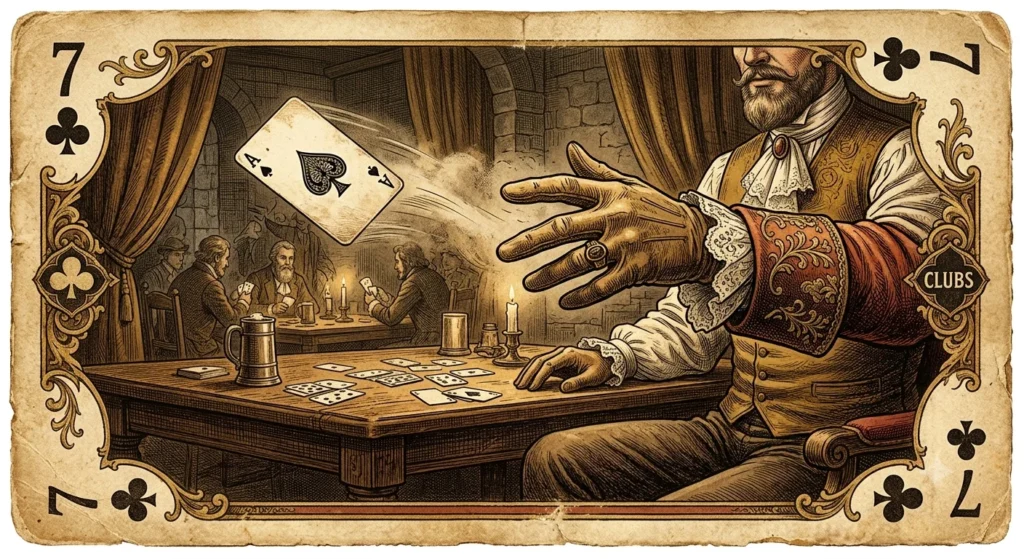
So discard literally means “to put a card away.” Over time, the meaning grew. Today, we use discard for anything we throw away.
Modern Usage
Now discard means:
- Throwing away physical objects (trash, food, items)
- Rejecting ideas or plans
- Removing digital files
- Letting go of thoughts or emotions
Example in Different Contexts:
- Physical: “Discard the broken glass carefully.”
- Digital: “The app will discard unsaved changes.”
- Mental: “Discard negative thoughts and focus on positivity.”
- Professional: “The committee decided to discard the proposal.”
Understanding this history makes the spelling logical. You are literally throwing away a “card.” The “C” is essential. 🃏
Discard vs Disregard: What is the Difference? 🔍
Many people confuse these two words. They sound similar but have different meanings.
| Word | Meaning | Example |
|---|---|---|
| Discard | To throw away | “Please discard the expired milk.” |
| Disregard | To ignore | “Please disregard my previous email.” |
Key Difference:
- Discard = physical or mental removal (throw away)
- Disregard = ignoring or paying no attention
More Examples:
- “Discard the broken toys.” (throw them away)
- “Disregard the noise outside.” (ignore it)
Memory Trick:
- Discard has a “C” like “card” (throw away cards)
- Disregard has a “G” like “give” (give no attention)
Once you know the difference, you will never confuse them again! ✅
How to Use Discard Correctly (With Examples) 📝
Let us see discard in action. These examples will help you use the word naturally.
In Professional Emails 📧
- “Please discard the old price list and use the new one.”
- “We will discard all incomplete applications.”
- “Kindly discard the outdated guidelines.”
In Academic Writing 📚
- “Researchers often discard data that does not fit their hypothesis.”
- “The study recommends discarding biased sources.”
- “It is essential to discard outdated theories.”
In Everyday Conversation 🗣️
- “I need to discard these old clothes.”
- “Don’t discard that box. I can reuse it.”
- “The app will discard unsaved changes.”
In Digital Contexts 💻
- “Click ‘discard’ to cancel the changes.”
- “Discard the draft and start over.”
- “The system will discard corrupted files.”
In News Headlines 📰
- “Company to discard defective products.”
- “Judge orders jury to discard weak evidence.”
- “Scientists discard outdated climate models.”
Social Media Posts 💬
- “Time to discard negative energy. ✨”
- “Decided to discard my old habits this year. 💪”
- “Can someone tell me how to discard this notification? 😩”
Common Spelling Mistakes and How to Avoid Them ❌
Here are the most frequent mistakes with discard. Learn them and avoid them.
Mistake #1: “Disgard”
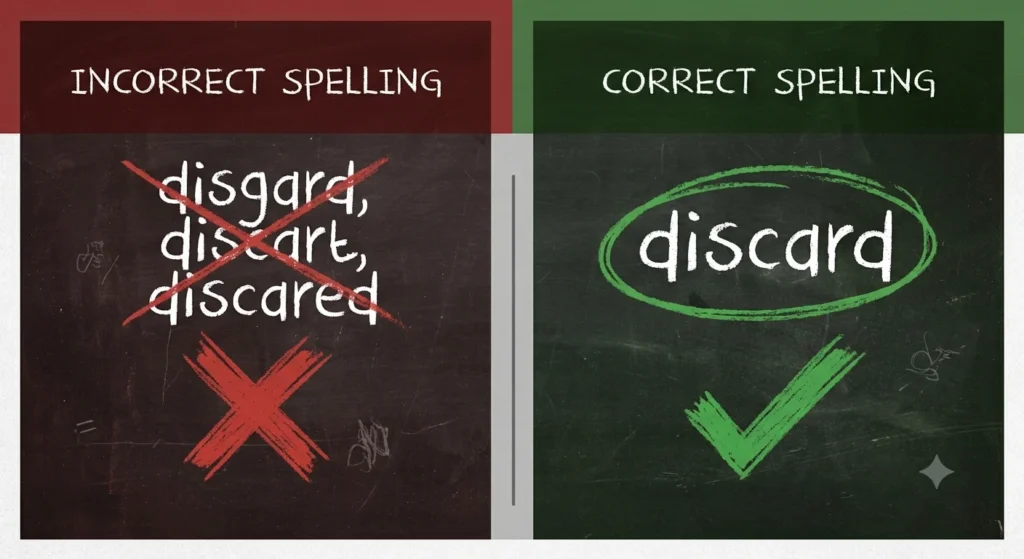
❌ Wrong: “Please disgard the broken plates.”
✅ Correct: “Please discard the broken plates.”
Why it happens: The “c” sounds like “g” in some accents.
Fix: Remember “C” stands for “card.” 🃏
Mistake #2: “Discart”
❌ Wrong: “I will discart these old magazines.”
✅ Correct: “I will discard these old magazines.”
Why it happens: Confusion between “card” and “cart.”
Fix: Think of playing cards, not shopping carts.
Mistake #3: “Discared”
❌ Wrong: “She discared the old letters.”
✅ Correct: “She discarded the old letters.”
Why it happens: Forgetting the past tense “ed” ending.
Fix: Always add “ed” for past tense.
Mistake #4: Using “discard” as an adjective
❌ Wrong: “The discard items are in the bin.”
✅ Correct: “The discarded items are in the bin.”
Why it happens: Confusing verb and adjective forms.
Fix: Use “discarded” as an adjective.
Correction Table
| Incorrect | Correct | Explanation |
|---|---|---|
| disgard | discard | Always use “c” not “g” |
| discart | discard | It is “card” not “cart” |
| discared | discarded | Add “ed” for past tense |
| discard items | discarded items | Use adjective form |
Discard Synonyms and Alternative Words 📖
Sometimes you need different words. Here are synonyms for discard.
Common Synonyms:
| Word | When to Use |
|---|---|
| Throw away | Casual context |
| Get rid of | Everyday speech |
| Dispose of | Formal context |
| Remove | General use |
| Eliminate | Stronger meaning |
| Dump | Informal |
| Scrap | Business context |
| Jettison | Formal/professional |
| Toss | Very casual |
| Abandon | Physical or mental |
Example Sentences with Synonyms:
- “Please throw away the empty bottles.”
- “We need to get rid of these old files.”
- “The hospital will dispose of medical waste properly.”
- “The team decided to scrap the old plan.”
- “It is time to jettison outdated policies.”
Choosing the Right Word:
- Discard is neutral and works everywhere.
- Throw away is casual and everyday.
- Dispose of is more formal.
- Jettison is business or technical.
- Dump is informal and sometimes negative.
Use discard when you want to be clear and professional. It fits all contexts perfectly. ✅
Frequently Asked Questions ❓
Q1: Is “disgard” a word?
No. “Disgard” is not a real word in English. It is a common misspelling of “discard.” Always use “discard.”
Q2: What does discard mean?
Discard means to throw away, get rid of, or reject something. It can be physical objects, ideas, files, or even emotions.
Q3: Is it discard or disgard?
It is always discard (with a “c”). “Disgard” is incorrect and should never be used.
Q4: What is the difference between discard and disregard?
- Discard = to throw away
- Disregard = to ignore
Example: “Discard the broken items” vs “Disregard the noise.”
Q5: Can discard be used as a noun?
Yes, but rarely. In card games, the “discard pile” is a noun. Example: “Throw it on the discard pile.”
Q6: What is the adjective form of discard?
The adjective form is discarded. Example: “Discarded items belong in the trash.”
Q7: How do you pronounce discard?
Pronounced: dis-KARD (rhymes with “card”). The stress is on the second syllable.
Q8: What is a simple memory trick for discard?
Think of playing cards. You dis-CARD unwanted cards. The “C” stands for “card.” Simple! 🃏
Q9: Is discard formal or informal?
Discard is neutral. It works in formal, professional, academic, and casual writing. It is more formal than “throw away.”
Q10: Can I use discard for ideas and emotions?
Yes. You can discard thoughts, ideas, plans, and even negative emotions. Example: “Discard your fears and focus on success.”
Google Trends and Usage Data 📊
The word “discard” is widely used across the globe. Let us look at the data.
Popularity by Country:
- United States: High usage in business and environmental contexts
- United Kingdom: Common in formal writing and food safety
- Australia: Frequent in recycling campaigns
- India: Growing usage in professional writing
- Canada: Similar to US patterns
Most Common Search Queries:
- “Discard meaning”
- “Discard in a sentence”
- “Discard synonym”
- “Discard vs throw away”
- “Discard or disgard”
- “Define discard”
- “Discard pronunciation”
Peak Times for Searches:
- January: New Year decluttering
- Spring: Spring cleaning season
- December: Year-end document cleanup
Trending Contexts:
- Environmental: “Discard waste responsibly”
- Technology: “Discard files” or “Discard changes”
- Food: “Discard expired products”
- Professional: “Discard outdated policies”
The data shows that discard is an essential English word. Using it correctly is important in many contexts. 🌍
Conclusion 🎯
Now you know the complete truth about disgard or discard. Let’s review everything:
✅ Discard is the only correct spelling.
✅ Disgard is always wrong – it is not a word.
✅ What does a discard mean? To throw away or get rid of something.
✅ Discard verb forms: discard, discards, discarded, discarding.
✅ Discard past tense = discarded.
✅ Discard adjective form = discarded.
✅ Discard synonym = throw away, dump, scrap, remove.
✅ Discard in a sentence always uses a “c,” never a “g.”
Whether you are writing an email, a school paper, a business report, or a social media post, use discard with confidence. No more red underlines. No more guessing. No more embarrassing typos.
And if someone asks you “Is disgard a word?” you can now say NO – and explain exactly why.
Final reminder: Every time you write disgard, stop. Change the “g” to a “c.” Write discard. You will never make this mistake again. ✅

“Rose Macaulay shares the charm of idioms on LearnIdom.com, making language learning delightful, insightful, and full of wit for every reader.”