Have you ever heard someone say “It’s a piece of cake” even when there was no cake around? English idioms can be confusing at first, but once you understand them, they make your English sound natural and fluent. This comprehensive Test Idioms with Answers guide will help you learn the most common idioms used in everyday conversations, exams, classrooms, and professional communication.
As an English tutor, I’ve noticed that many students struggle with idioms because they try to understand them word by word. The good news is that with regular practice and examples, idioms become easy to remember and use confidently. Whether you’re preparing for school exams, competitive tests, IELTS, TOEFL, or simply improving your English, this guide is designed for you.
What Are Idioms?
Idioms are phrases whose meanings cannot be understood from the individual words alone. Instead, they have a special figurative meaning that native speakers commonly use.
Example
Piece of Cake
Literal Meaning: A slice of cake.
Idiomatic Meaning: Something very easy.
When someone says, “The test was a piece of cake,” they mean the test was easy—not that it involved cake.
Why Are Idioms Important in English?
Learning idioms offers several benefits:
- Improves speaking fluency
- Makes conversations sound natural
- Enhances writing skills
- Helps understand movies and books
- Improves exam performance
- Expands vocabulary naturally
Many English exams include test idioms and phrases questions because idioms are essential for advanced language skills.
Reference Table: Common English Idioms
| Idiom | Meaning | Difficulty |
|---|---|---|
| Break the Ice | Start a conversation | Easy |
| Piece of Cake | Very easy | Easy |
| Spill the Beans | Reveal a secret | Easy |
| Under the Weather | Feeling sick | Easy |
| On Cloud Nine | Very happy | Easy |
| Bite the Bullet | Face difficulty bravely | Medium |
| Cost an Arm and a Leg | Very expensive | Medium |
| Hit the Nail on the Head | Exactly correct | Medium |
| Burn the Midnight Oil | Study or work late | Medium |
| Beat Around the Bush | Avoid the point | Medium |
Break the Ice
Word-by-Word Meaning
Break frozen ice.
Idiomatic Meaning
Start a conversation or reduce tension.
Example Sentences
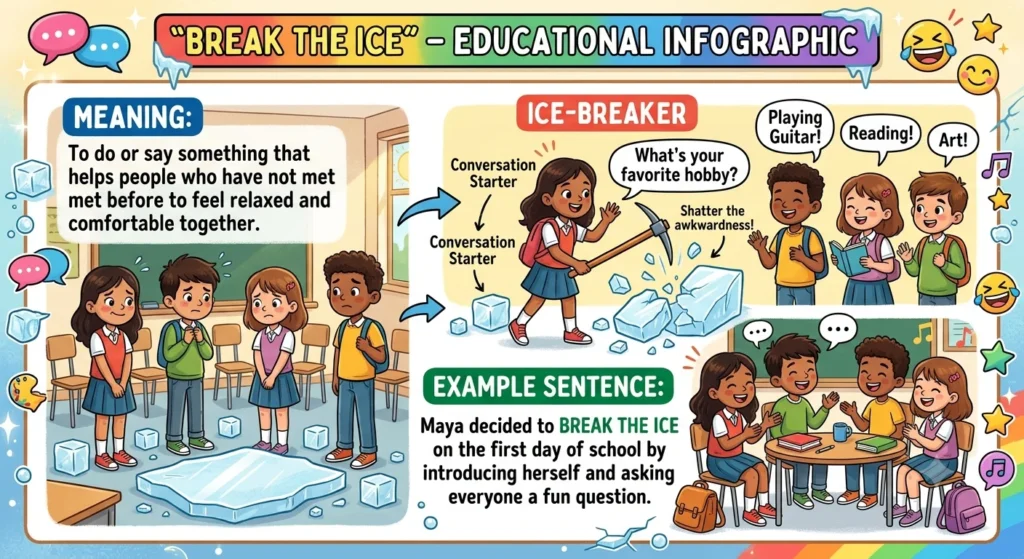
- The teacher told a joke to break the ice.
- Games helped break the ice at the workshop.
Common Error
❌ Break an ice
✅ Break the ice
Usage Note
Used in meetings, classrooms, and social gatherings.
Piece of Cake
Word-by-Word Meaning
A slice of cake.
Idiomatic Meaning
Very easy.
Example Sentences
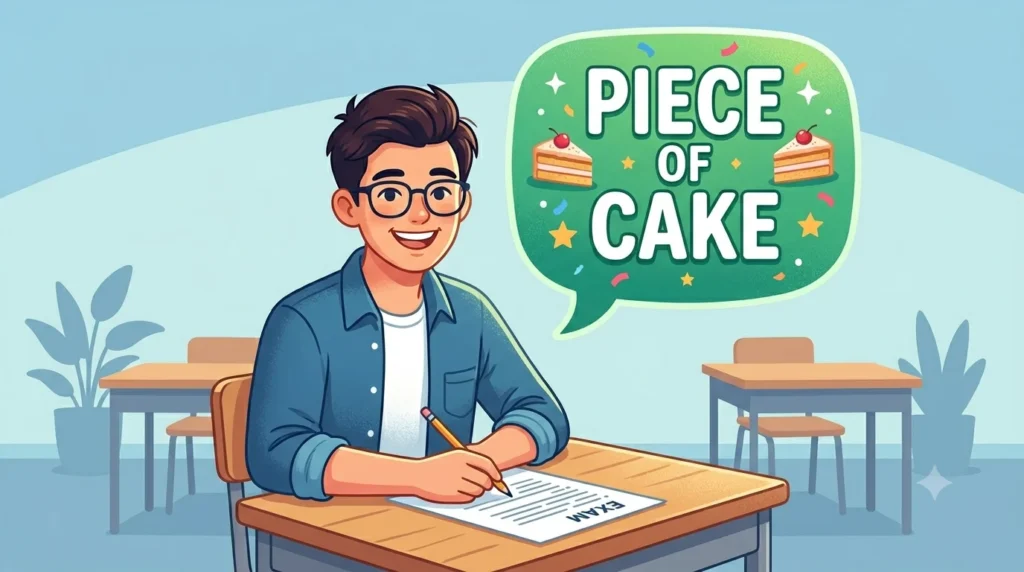
- The math quiz was a piece of cake.
- Learning this lesson was a piece of cake.
Common Error
❌ Piece from cake
✅ Piece of cake
Spill the Beans
Word-by-Word Meaning
Drop beans accidentally.
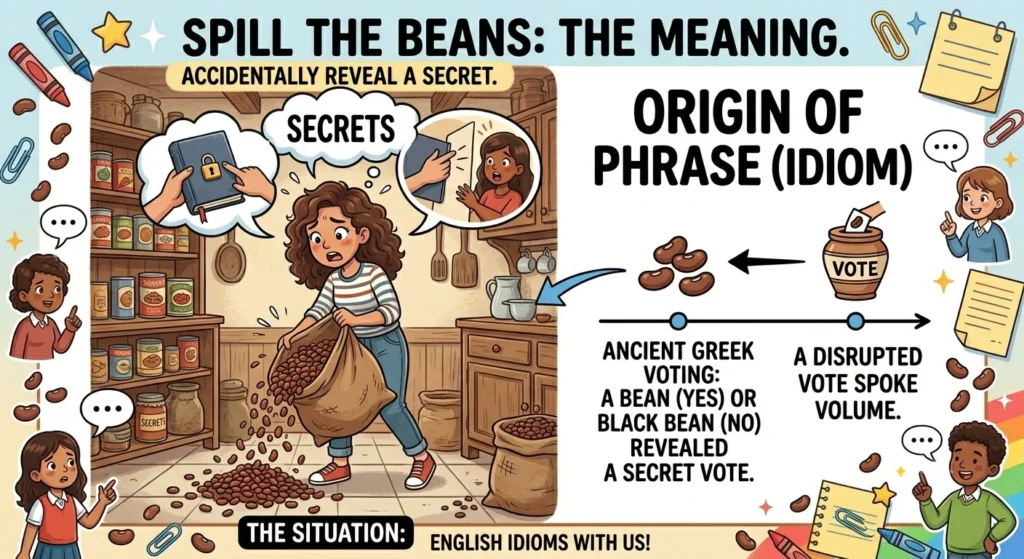
Idiomatic Meaning
Reveal a secret.
Example Sentences
- Don’t spill the beans about the surprise.
- Someone spilled the beans before the party.
Under the Weather
Idiomatic Meaning

Feeling sick or unwell.
Example Sentences
- I’m feeling under the weather today.
- She stayed home because she felt under the weather.
On Cloud Nine
Idiomatic Meaning
Extremely happy.
Example Sentences

- She was on cloud nine after winning.
- He felt on cloud nine after passing the exam.
Hit the Nail on the Head
Idiomatic Meaning
Say exactly the right thing.
Example Sentences
- Your answer hit the nail on the head.
- She hit the nail on the head during the discussion.
Bite the Bullet
Idiomatic Meaning
Face a difficult situation courageously.
Example Sentences
- I finally bit the bullet and visited the dentist.
- He bit the bullet and apologized.
Cost an Arm and a Leg
Idiomatic Meaning
Very expensive.
Example Sentences
- That laptop costs an arm and a leg.
- Their vacation cost an arm and a leg.
Burn the Midnight Oil
Idiomatic Meaning
Study or work late into the night.
Example Sentences
- Students burn the midnight oil before exams.
- She burned the midnight oil to finish the project.
Beat Around the Bush
Idiomatic Meaning
Avoid discussing the main issue.
Example Sentences
- Stop beating around the bush.
- He beat around the bush instead of answering.
Let the Cat Out of the Bag
Idiomatic Meaning
Reveal a secret accidentally.
Example Sentences
- Sarah let the cat out of the bag.
- He let the cat out of the bag about the gift.
Once in a Blue Moon
Idiomatic Meaning
Very rarely.
Example Sentences
- We meet once in a blue moon.
- She travels abroad once in a blue moon.
Pull Someone’s Leg
Idiomatic Meaning
Joke with someone.
Example Sentences
- I’m just pulling your leg.
- They were pulling his leg.
Back to Square One
Idiomatic Meaning
Start over again.
Example Sentences
- The plan failed, so we’re back to square one.
- The project sent us back to square one.
Add Fuel to the Fire
Idiomatic Meaning
Make a problem worse.
Example Sentences
- His comments added fuel to the fire.
- Don’t add fuel to the fire.
Every Cloud Has a Silver Lining
Idiomatic Meaning
Every problem has something positive.
Example Sentences
- Don’t worry; every cloud has a silver lining.
A Blessing in Disguise
Idiomatic Meaning
Something bad that becomes beneficial.
Example Sentences
- Losing that job was a blessing in disguise.
Actions Speak Louder Than Words
Idiomatic Meaning
What people do matters more than what they say.
Example Sentences
- He helped immediately; actions speak louder than words.
The Ball Is in Your Court
Idiomatic Meaning
It is your turn to act.
Example Sentences
- I’ve done my part; the ball is in your court.
Kill Two Birds with One Stone
Idiomatic Meaning
Achieve two goals with one action.
Example Sentences
- Walking to work kills two birds with one stone.
Barking Up the Wrong Tree
Idiomatic Meaning
Looking in the wrong place.
Example Sentences
- You’re barking up the wrong tree.
Cross That Bridge When You Come to It
Idiomatic Meaning
Deal with a problem when it happens.
Example Sentences
- We’ll cross that bridge when we come to it.
Don’t Judge a Book by Its Cover
Idiomatic Meaning
Don’t judge by appearance.
Example Sentences
- Don’t judge a book by its cover.
Miss the Boat
Idiomatic Meaning
Miss an opportunity.
Example Sentences
- He missed the boat on that investment.
Hit the Sack
Idiomatic Meaning
Go to sleep.
Example Sentences
- I’m tired; it’s time to hit the sack.
Through Thick and Thin
Idiomatic Meaning
In good and bad times.
Example Sentences
- Friends stay together through thick and thin.
Jump on the Bandwagon
Idiomatic Meaning
Follow a popular trend.
Example Sentences
- Many companies jumped on the bandwagon.
Keep an Eye On
Idiomatic Meaning
Watch carefully.
Example Sentences
- Please keep an eye on my bag.
The Early Bird Catches the Worm
Idiomatic Meaning
People who act early often succeed.
Example Sentences
- Apply now; the early bird catches the worm.
No Pain, No Gain
Idiomatic Meaning
Success requires effort.
Example Sentences
- She practiced daily because no pain, no gain.
Test Idioms and Phrases Quiz
1. Which idiom means “very easy”?
A) Under the Weather
B) Piece of Cake
C) Miss the Boat
Answer: Piece of Cake
2. Which idiom means “very expensive”?
A) Cost an Arm and a Leg
B) Break the Ice
C) Hit the Sack
Answer: Cost an Arm and a Leg
3. Which idiom means “go to sleep”?
A) Hit the Sack
B) Spill the Beans
C) On Cloud Nine
Answer: Hit the Sack
4. Which idiom means “reveal a secret”?
A) Spill the Beans
B) Bite the Bullet
C) Beat Around the Bush
Answer: Spill the Beans
5. Which idiom means “miss an opportunity”?
A) On Cloud Nine
B) Miss the Boat
C) Burn the Midnight Oil
Answer: Miss the Boat
Difficult Idioms Quiz
Can you explain these without looking above?
- Barking Up the Wrong Tree
- Blessing in Disguise
- Through Thick and Thin
- Jump on the Bandwagon
- Cross That Bridge When You Come to It
These are commonly included in a Difficult Idioms Quiz for intermediate and advanced learners.
Idioms Quiz for Grade 6
These idioms are ideal for beginners and school students:
- Piece of Cake
- Break the Ice
- On Cloud Nine
- Under the Weather
- Pull Someone’s Leg
Teachers often use these in an Idioms Quiz for Grade 6 because they are simple and memorable.
Finish the Idiom Quiz
Complete the following:
- Break the _____
- Spill the _____
- On Cloud _____
- Hit the _____
- Miss the _____
Answers
- Ice
- Beans
- Nine
- Sack
- Boat
Idioms Quiz with Pictures Activities
Visual learning helps students remember idioms faster.
Examples include:
- Cake image → Piece of Cake
- Cloud image → On Cloud Nine
- Moon image → Once in a Blue Moon
- Beans image → Spill the Beans
- Ice image → Break the Ice
This format is popular in classroom-based Idioms Quiz with Pictures exercises.
How to Practice Idioms Effectively
Use Idioms in Daily Conversations
Try using one new idiom every day.
Create Flashcards
Write the idiom on one side and the meaning on the other.
Take Weekly Quizzes
Regular quizzes improve long-term memory.
Read English Content
Books, blogs, movies, and podcasts expose you to natural idiom usage.
Frequently Asked Questions
What is the difference between idioms and phrases?
A phrase is a group of words, while an idiom has a figurative meaning different from its literal meaning.
Are idioms important for IELTS and TOEFL?
Yes. Understanding idioms improves listening, reading, and speaking performance.
How many idioms should beginners learn?
Start with 20–30 common idioms and gradually expand your knowledge.
Can I create an Idioms Test with Answers PDF from this article?
Yes. This guide can easily be converted into an Idioms Test with Answers PDF for study and classroom use.
Where can I find a 100 Idioms Quiz with Answers?
Many educational resources offer larger collections, but mastering these 30 common idioms first builds a strong foundation.
Conclusion
Mastering idioms is one of the fastest ways to improve your English fluency and confidence. The 30 idioms covered in this guide represent some of the most commonly used expressions in conversations, classrooms, and exams. Practice them regularly, complete the quizzes, and challenge yourself to use at least one new idiom every day.
Remember: fluency isn’t about learning difficult words—it’s about understanding how real people actually speak. Start practicing these idioms today and watch your English become more natural and expressive.

“L.P. Hartley brings classic idioms to life on LearnIdom.com, helping readers explore language with wit, clarity, and timeless insight.”