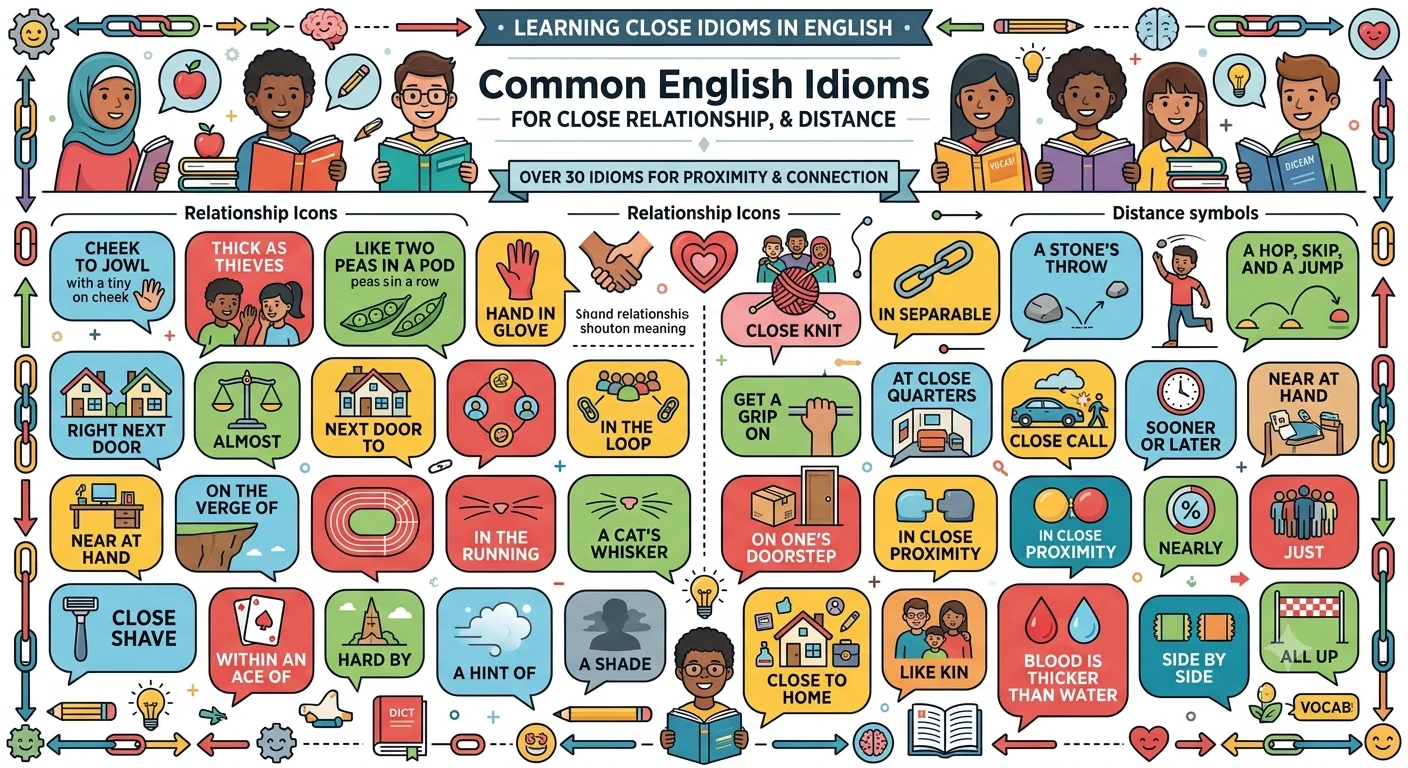
Have you ever heard someone say, “We’re as close as two peas in a pod” or “The deal was close at hand”? Native English speakers use close idioms every day to describe relationships, distance, opportunities, and situations. Learning these expressions can make your English sound more natural and fluent.
In this guide, you’ll discover the most common close idioms in English, their meanings, examples, and practical usage tips. Whether you’re an English learner, student, or language enthusiast, these idioms will help you communicate like a native speaker.
Understanding the Word “Close” in English
Before learning idioms, let’s understand the word close itself.
| Form | Meaning |
|---|---|
| Close (Verb) | To shut something |
| Close (Adjective) | Near in distance, relationship, or time |
| Close (Noun) | An ending or conclusion |
| Closed Meaning | Not open or unavailable |
What Are Two Meanings of Close?
The word close commonly has two meanings:
- Near or not far away.
- To shut or finish something.
Example:
- The school is close to my house.
- Please close the door.
Many idioms for close distance and relationships come from these meanings.
Close at Hand
Word-by-Word Meaning
Something physically nearby.
Idiomatic Meaning
Available soon or within easy reach.
Example Sentences
- Help is close at hand.
- The solution was close at hand all along.
Common Error
Don’t use it only for physical distance.
Usage Note
Often used for opportunities, help, or solutions.
Two Peas in a Pod
Word-by-Word Meaning
Two peas inside one pod.
Idiomatic Meaning
Two people who are extremely close.
Example Sentences
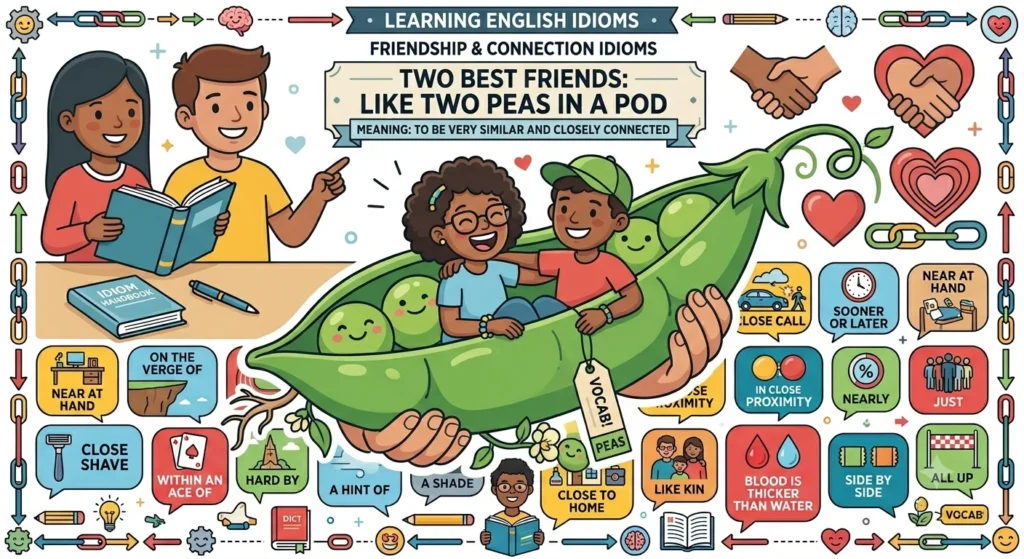
- Sarah and Emma are two peas in a pod.
- The brothers are like two peas in a pod.
Common Error
Not used for enemies.
Usage Note
Perfect for close friendships.
Keep Someone Close
Word-by-Word Meaning
Remain near someone.
Idiomatic Meaning
Maintain a strong relationship or monitor someone carefully.
Example Sentences
- Keep your friends close.
- She keeps her family close.
Usage Note
Can refer to emotional closeness.
Close to Home
Word-by-Word Meaning
Near one’s house.
Idiomatic Meaning
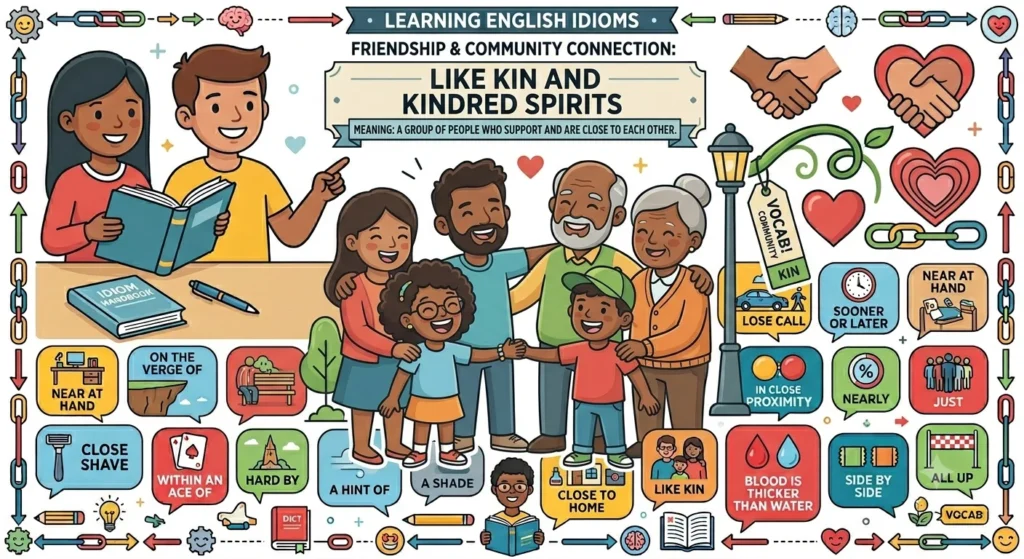
Personally relevant or emotionally sensitive.
Example Sentences
- His comments hit close to home.
- The movie felt close to home.
Common Error
Not always about physical location.
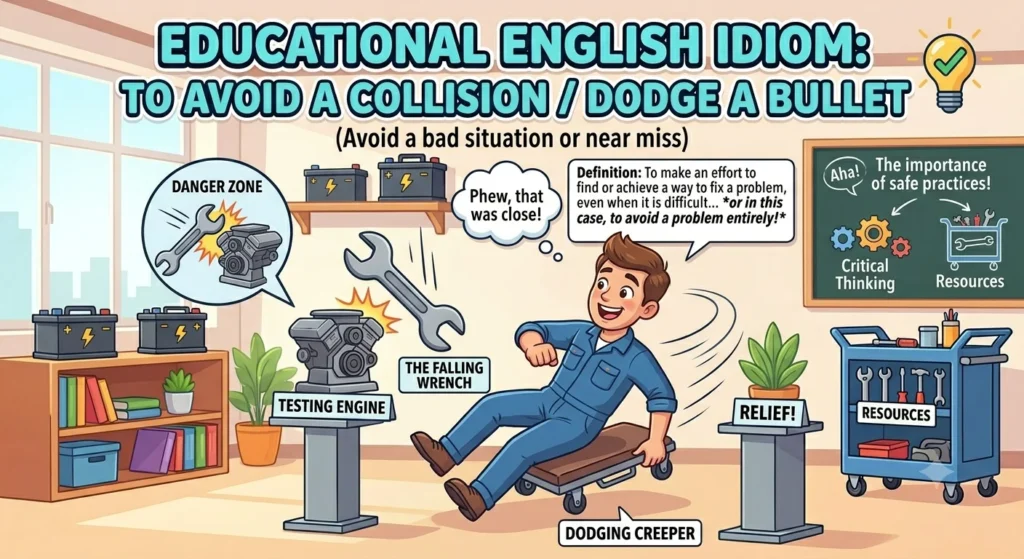
A Close Call
Word-by-Word Meaning
A near event.
Idiomatic Meaning
A situation where danger was narrowly avoided.
Example Sentences
- Missing the accident was a close call.
- That exam was a close call.
Usage Note
Very common in everyday English.
Close Ranks
Word-by-Word Meaning
Stand together closely.
Idiomatic Meaning
Unite during difficult times.
Example Sentences
- The team closed ranks after criticism.
- Employees closed ranks to support their manager.
Draw Close
Word-by-Word Meaning
Move nearer.
Idiomatic Meaning
Approach in time or distance.
Example Sentences
- Winter is drawing close.
- As the deadline drew close, everyone worked harder.
Close the Gap
Word-by-Word Meaning
Reduce a space.
Idiomatic Meaning
Reduce differences between groups or situations.
Example Sentences
- Education can close the gap.
- The company is closing the gap with competitors.
Keep a Close Eye On
Word-by-Word Meaning
Watch carefully.
Idiomatic Meaning
Monitor something closely.
Example Sentences
- Keep a close eye on the baby.
- Investors keep a close eye on markets.
Close Shave
Word-by-Word Meaning
A very near shave.
Idiomatic Meaning
A narrow escape from danger.
Example Sentences
- That was a close shave.
- We had a close shave during the storm.
Close-Knit
Word-by-Word Meaning
Tightly connected.
Idiomatic Meaning
A group with strong relationships.
Example Sentences
- They belong to a close-knit community.
- Our family is close-knit.
Come Full Circle
Word-by-Word Meaning
Return to the starting point.
Idiomatic Meaning
Return to an earlier situation.
Example Sentences
- My career has come full circle.
- The story came full circle.
Within Arm’s Reach
Word-by-Word Meaning
Close enough to touch.
Idiomatic Meaning
Very near.
Example Sentences
- Keep water within arm’s reach.
- Success is within arm’s reach.
Right Around the Corner
Word-by-Word Meaning
Just nearby.
Idiomatic Meaning
Coming very soon.
Example Sentences
- Summer is right around the corner.
- Exams are right around the corner.
Shoulder to Shoulder
Word-by-Word Meaning
Standing side by side.
Idiomatic Meaning
Supporting each other closely.
Example Sentences
- We stood shoulder to shoulder.
- The workers stood shoulder to shoulder.
Hand in Hand
Word-by-Word Meaning
Holding hands.
Idiomatic Meaning
Closely connected.
Example Sentences
- Success and hard work go hand in hand.
- Health and happiness go hand in hand.
Hit Close to Home
Word-by-Word Meaning
Near one’s home.
Idiomatic Meaning
Emotionally personal.
Example Sentences
- The article hit close to home.
- Her story hit close to home.
Near and Dear
Word-by-Word Meaning
Close and loved.
Idiomatic Meaning
Important and cherished.
Example Sentences
- Family members are near and dear to her.
- The cause is near and dear to my heart.
In the Same Boat
Word-by-Word Meaning
Sharing one boat.
Idiomatic Meaning
Facing the same situation together.
Example Sentences
- We are all in the same boat.
- Students were in the same boat before exams.
At Your Fingertips
Word-by-Word Meaning
Right at your fingers.
Idiomatic Meaning
Easily accessible.
Example Sentences
- Information is at your fingertips.
- Learning resources are at your fingertips.
Summary Table of Close Idioms
| Idiom | Meaning |
| Close at Hand | Nearby or available |
| Two Peas in a Pod | Very close friends |
| Keep Someone Close | Maintain closeness |
| Close to Home | Personally relevant |
| A Close Call | Narrow escape |
| Close Ranks | Unite together |
| Draw Close | Approach |
| Close the Gap | Reduce differences |
| Keep a Close Eye On | Watch carefully |
| Close Shave | Narrow escape |
| Close-Knit | Strongly connected |
| Come Full Circle | Return to start |
| Within Arm’s Reach | Very near |
| Right Around the Corner | Coming soon |
| Shoulder to Shoulder | Support each other |
| Hand in Hand | Closely linked |
| Hit Close to Home | Personally affecting |
| Near and Dear | Cherished |
| In the Same Boat | Shared situation |
| At Your Fingertips | Easily accessible |
Why Learning Close Idioms in English Matters
Learning close idioms in English helps you:
- Sound more natural in conversations.
- Understand movies, books, and podcasts better.
- Improve IELTS, TOEFL, and spoken English scores.
- Express relationships and distance more effectively.
- Build confidence in everyday communication.
Frequently Asked Questions (FAQs)
What are close idioms?
Close idioms are expressions that use the idea of closeness, nearness, relationships, or narrow situations to convey a figurative meaning.
What are some common close idioms in English?
Popular examples include:
- Two peas in a pod
- Close at hand
- A close call
- Hit close to home
- Keep a close eye on
What are idioms for close distance?
Some common idioms for close distance are:
- Within arm’s reach
- Close at hand
- Right around the corner
- At your fingertips
What is the difference between close as a verb and close as an adjective?
Close verb: to shut something.
Example: Close the window.
Close adjective: near in distance, time, or relationship.
Example: We are close friends.
How can I learn English idioms faster?
Practice using idioms in daily conversations, write example sentences, and read English articles, books, and dialogues regularly.
Conclusion
Mastering these close idioms with meaning can dramatically improve your English fluency. From describing close friendships to talking about nearby opportunities and narrow escapes, these expressions are used every day by native speakers.
Start by learning five idioms today, use them in your conversations, and gradually add more to your vocabulary. The more you practice, the more natural your English will become.

“L.P. Hartley brings classic idioms to life on LearnIdom.com, helping readers explore language with wit, clarity, and timeless insight.”