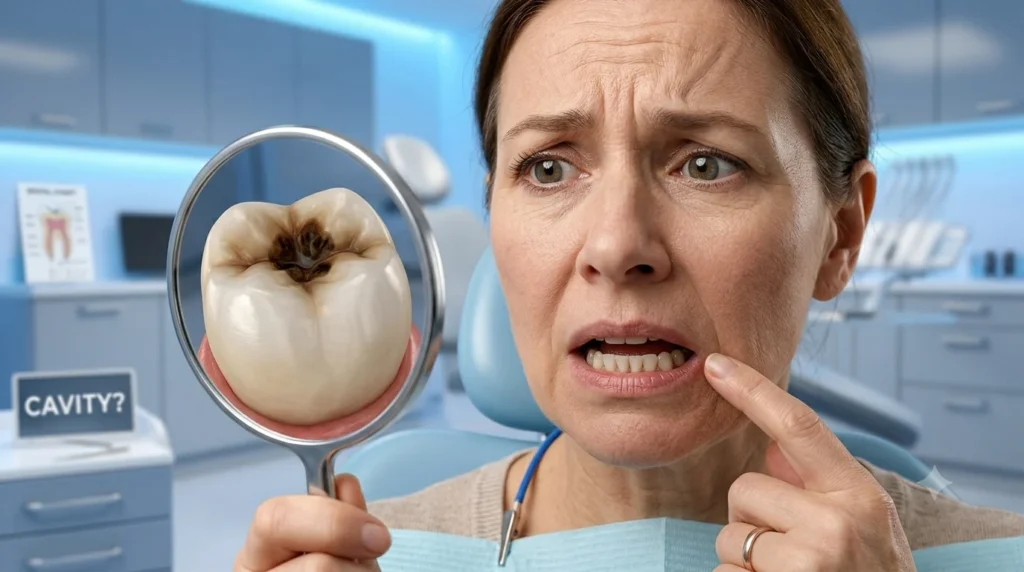
You look in the mirror and freeze. There it is – a dark spot on your tooth. Your heart sinks. Is it a cavity? Just a stain? This is one of the most common worries people have about their teeth, and it’s completely understandable.
Every day, thousands of people search online asking “stain or cavity?” because the two can look so similar. A brown spot on your tooth could be harmless discoloration from your morning coffee, or it could be the start of tooth decay that needs treatment.
The confusion is real, and it matters because the treatment for a cavity vs stain is completely different. One is a cosmetic issue you can often fix at home; the other is a dental problem that only a professional can treat.
This guide will give you the quick answer you need, explain the differences in detail, and help you decide your next step with confidence. Let’s solve this mystery together. 😊
Stain or Cavity? ⚡
Here is the fastest way to figure out what you’re dealing with.
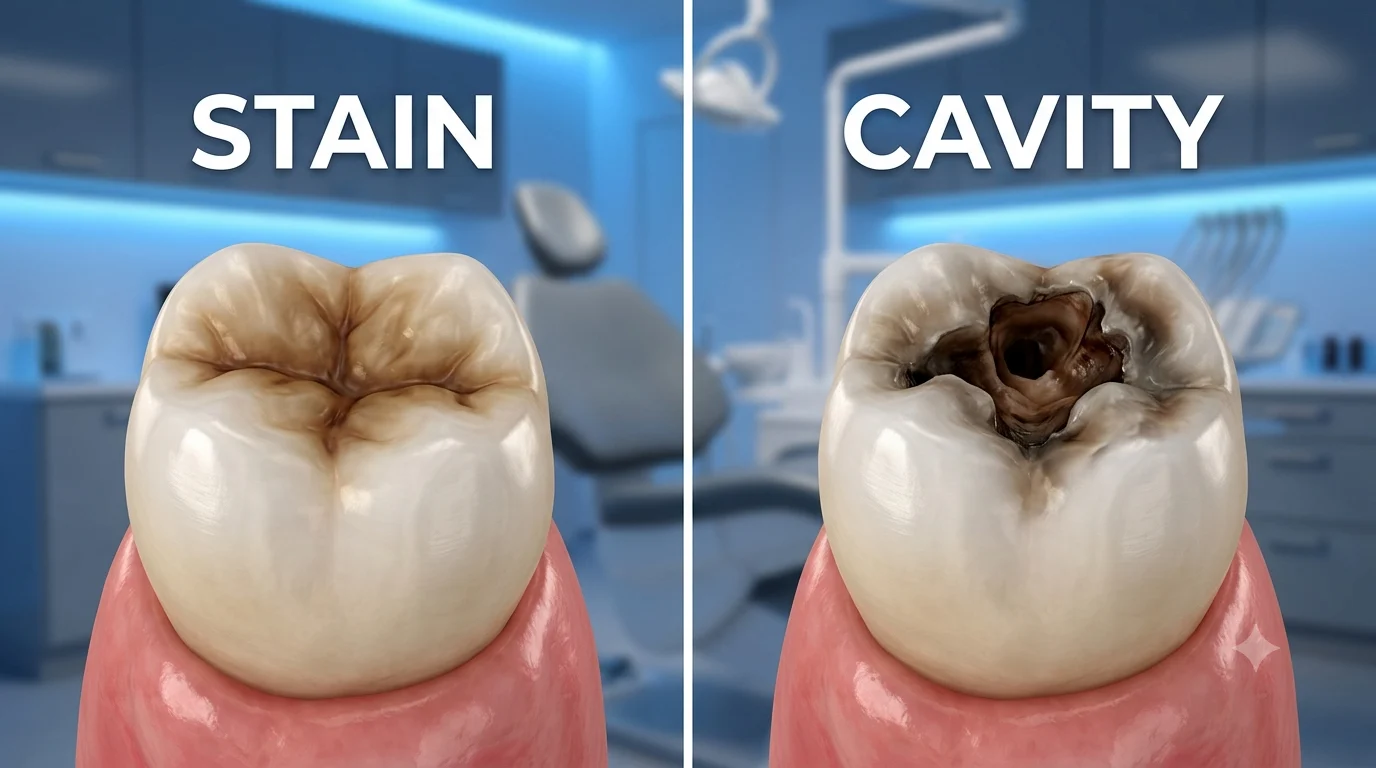
Stain: A surface discoloration on your tooth. It feels smooth, causes no pain, and is a cosmetic issue only. Think of it like a coffee ring on a cup.
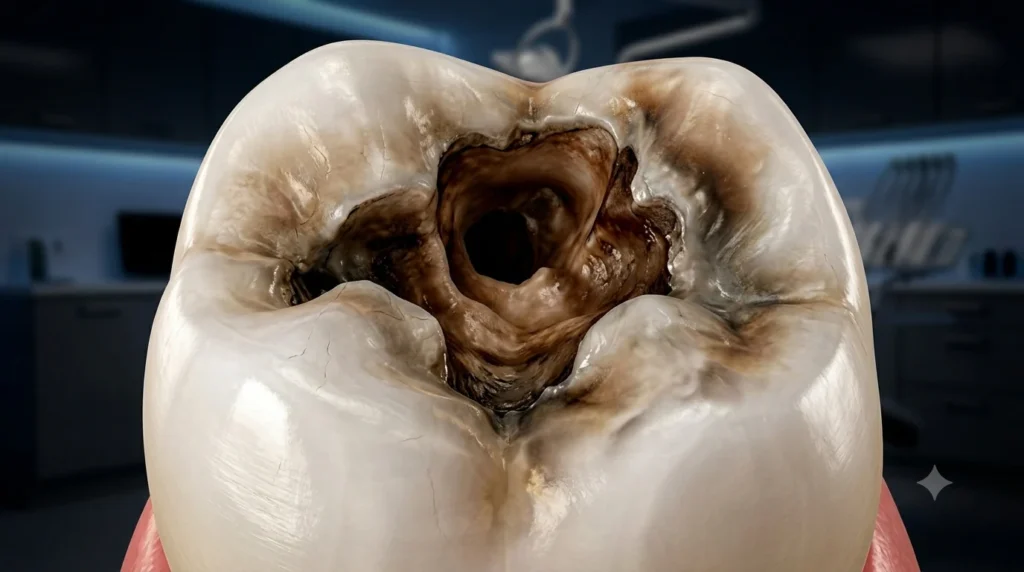
Cavity: A permanently damaged area of tooth enamel that has become a tiny hole. It may feel rough or sticky and can cause pain or sensitivity. It is a form of tooth decay that will grow without treatment.
Example: If you see a brown spot on tooth and it feels smooth when you rub your tongue over it, it is likely a stain. If it feels rough, catches a toothpick, or hurts when you eat something sweet or cold, it could be a cavity.
Cavity vs Stain – The Real Differences 🔍
To truly understand the difference, we need to look at more than just color. Here is a simple breakdown.
Feature
Tooth Stain 🟡
Cavity 🕳️
What is it?
A surface discoloration on the enamel.
Tooth decay that creates a hole in the tooth.
Appearance
Yellow, brown, or gray. Often affects a whole tooth or multiple teeth.
White (early), brown, black, or gray. Usually a single spot.
Texture
Smooth when you touch it with your tongue or fingernail.
Rough, sticky, or feels like a pit or hole.
Pain or Sensitivity
No pain or sensitivity at all.
Can cause sensitivity to hot, cold, or sweet things. May cause pain over time.
Does it get worse?
May stay the same or can sometimes fade.
Yes, it steadily grows bigger and deeper without treatment.
Can you fix it at home?
Yes, surface stains can often be reduced with whitening toothpaste or by avoiding stain-causing foods.
No, you cannot fix a cavity at home. It requires a dentist’s treatment.
Is it harmful?
No. It is only a cosmetic issue.
Yes. It is a disease that damages the tooth structure and can lead to infection.
Brown Spot on Tooth – Stain or Cavity? 🟤
This is the million-dollar question. A brown spot on tooth can be alarming, but it doesn’t always mean decay. Here is how to think about it:
If it’s a stain: The brown spot is likely flat and smooth. It might be from coffee, tea, wine, or tobacco. It doesn’t hurt, and it doesn’t catch your fingernail when you gently rub it.
If it’s a cavity: The brown spot might look like a small crater or have a dark center. It might feel sticky or rough. You might feel a twinge when you eat something sweet or drink something cold.
The key difference is texture and sensation. A stain is purely cosmetic on the surface. A cavity is structural damage to the tooth.
Cavity vs Stain on Molar – What to Look For 🦷
Molars are the most common place for both stains and cavities. They have deep grooves called fissures that trap food and bacteria.
When looking at a cavity vs stain on molar, focus on these details:
Location in the groove: Both stains and cavities love these deep grooves.
Texture check: A stain will feel hard and smooth. A cavity will feel soft, sticky, or like a tiny pit. Try gently running your fingernail across it – if it catches, it’s likely a cavity.
Color depth: Stains are usually uniform in color. Cavities often have a darker center with lighter edges.
Cavity vs Stain Chart – Visual Reference 📊
Characteristic
Stain ✅
Cavity ❌
Smooth to touch
Yes
No
Rough or sticky
No
Yes
Causes pain
Never
Sometimes
Sensitive to sweets
No
Often
Can be whitened
Yes
No
Needs dentist
No
Yes
Gets bigger
Sometimes
Always
Has a hole
No
Yes
Keep this cavity vs stain chart handy when you’re checking your teeth. It’s a simple guide to help you understand what you might be dealing with.
Fissure Staining vs Cavity – A Common Confusion 🔬
This is one of the trickiest questions in dentistry. The deep grooves on your molars are called fissures, and they are prone to both staining and decay.
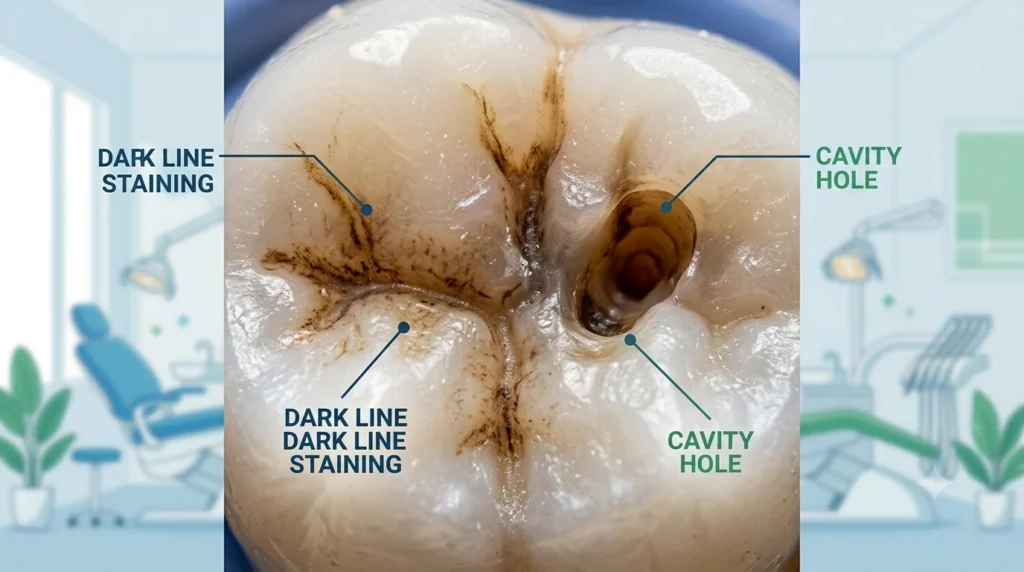
Fissure Staining:
Dark lines or spots along the grooves of your molars
Feels hard and smooth
No pain or sensitivity
Caused by food, drinks, and bacteria settling in the grooves
Does not need treatment beyond cleaning
Fissure Cavity:
Dark spot that feels soft or sticky
May catch a dental tool or fingernail
Can cause sensitivity
Caused by bacteria eating through the enamel
Requires a filling to fix
The only way to be 100% sure about fissure staining vs cavity is through a dentist’s examination and X-rays.
How to Tell If It’s Staining or a Cavity – Step by Step 🔎
Follow these simple steps to assess your tooth:
Step 1: The Tongue Test Run your tongue over the spot.
Smooth = likely stain
Rough or sticky = likely cavity
Step 2: The Sensitivity Test Eat or drink something cold, hot, or sweet.
No reaction = likely stain
Sharp twinge or ache = likely cavity
Step 3: The Visual Test Look at the spot in good lighting.
Flat and even color = likely stain
Dark center with lighter edges or pit = likely cavity
Step 4: The Time Test Think about how long it’s been there.
Same for months = likely stain
Getting bigger or darker = likely cavity
Stain or Cavity Reddit – What Online Communities Say 💬
Many people turn to Reddit when they’re worried about their teeth. Searches like “stain or cavity reddit” and “cavity vs stain on molar reddit” are very common.
The general consensus from these communities is helpful but limited:
People share photos and ask for opinions
Community members share their own experiences
Dental professionals sometimes offer guidance
However, the overwhelming advice from Reddit is always the same: See a dentist. No one can diagnose from a picture. Online communities are great for support and shared experiences, but they are not a substitute for professional care.
Cavity vs Stain Pictures – What Do They Look Like? 🖼️
While I can’t show you actual pictures here, here is what to look for:
Stain Pictures:
Yellow or brown discoloration
Often covers a large area
Smooth and flat
No visible hole or pit
Cavity Pictures:
Dark brown, black, or white spot
Often small and concentrated
May show a visible hole or crater
Sometimes has a dark center
Remember, looking at cavity vs stain pictures online can give you an idea, but it’s not a diagnosis. Many cavities look like stains in their early stages.
Why Cavities and Stains Get Confused 🤷
There are several reasons why people confuse cavities and stains:
Similar Appearance: Both can appear as dark spots on your teeth. A small cavity can look exactly like a stain.
Lack of Symptoms: Early cavities don’t hurt. If there’s no pain, people assume it’s just a stain.
Misinformation: Many people believe that all dark spots are cavities or all brown spots are stains. Both are wrong.
Hard to See: It’s difficult to see your own teeth clearly. What looks like a stain might actually be a cavity, and vice versa.
Dental Anxiety: Many people avoid the dentist, so they hope the spot is just a stain and ignore it.
Can Stains Be Mistaken for Cavities? 🤔
Yes, this happens all the time. Stains and cavities can look identical to the untrained eye.
Why it happens:
Both can be brown or black
Both can appear on the same parts of teeth
Both can develop slowly over time
The danger: Mistaking a cavity for a stain can lead to delayed treatment. The cavity grows, becomes more painful, and requires more complex treatment.
The solution: Always get a professional opinion. A dentist can tell the difference with a simple examination and X-rays.
Is Staining the Same as Cavity? ❌
No, absolutely not. This is a critical distinction.
Staining:
Surface level only
Cosmetic issue
No damage to tooth structure
Can be improved with whitening
Not harmful to health
Cavity:
Structural damage
Disease that destroys enamel
Gets worse without treatment
Requires dental filling
Can lead to infection and tooth loss
Understanding that staining is not the same as cavity can save you from unnecessary worry and help you seek the right treatment.
Can You Remove Cavity Stains? 🧐
This is a common question with a simple answer: No.
You cannot remove the “stain” of a cavity because the dark color is not a stain. It’s the color of decayed tooth structure. The cavity is a hole in your tooth, and the dark color is the damaged tissue inside that hole.
What you can do:
Visit a dentist to remove the decay
Get a filling to restore the tooth
Practice good oral hygiene to prevent future cavities
Trying to remove a cavity stain with whitening toothpaste or home remedies will not work. The only way to “remove” a cavity stain is to treat the cavity itself.
Here is how you might see or use these terms in real life:
In an Email to Your Dentist:
“Subject: Tooth Concern. Dear Dr. Smith, I’ve noticed a dark spot on my lower molar. I’m not sure if it’s a cavity or a stain. It doesn’t hurt, but I’m worried. Could you please take a look at my next appointment?”
On Social Media:
“Just found a brown spot on my tooth! 😰 Is it a stain or cavity? Trying not to panic until I see my dentist next week. Has anyone else dealt with this?”
In a News Article:
“Many adults cannot distinguish between a tooth stain and a cavity, leading to delayed dental care. Experts recommend regular check-ups to catch decay early.”
In a Blog Post:
“Worried about a dark spot on your tooth? Learn the difference between a stain and a cavity so you know when to see a dentist.”
In a Formal Dental Report:
“The patient presented with a discolored lesion on the occlusal surface of tooth #19. Differential diagnosis includes stain or cavity. Radiographic evaluation is recommended.”
Google Trends & Usage Data for “Stain or Cavity” 📈
Popularity by Country:
United States: Highest search volume
United Kingdom: Second highest
Canada: Third highest
Australia: Fourth highest
India: Growing interest
Seasonal Trends:
January: Spike as people make New Year’s health resolutions
September: Increase as children return to school and have dental check-ups
Summer: Slight decrease as people are on vacation
Search Context:
“Is it a cavity or a stain” – Worried individuals checking specific teeth
“Teeth stains and cavities” – People looking for prevention tips
“Can stains become cavities” – Confused users seeking education
“Stain or cavity reddit” – People seeking community opinions
Demographics:
Most searches come from adults aged 25-44
Slightly more women than men search for this topic
Parents often search for information about their children’s teeth
British English vs American English – Spelling Differences 🇬🇧🇺🇸
While “stain” and “cavity” are spelled the same in both versions of English, there are some related differences:
Term
American English 🇺🇸
British English 🇬🇧
Cavity
Cavity
Cavity
Tooth decay
Tooth decay
Tooth decay
Medical term
Caries
Caries
Color
Color
Colour
Fissure
Fissure
Fissure
Enamel
Enamel
Enamel
Dentist
Dentist
Dentist
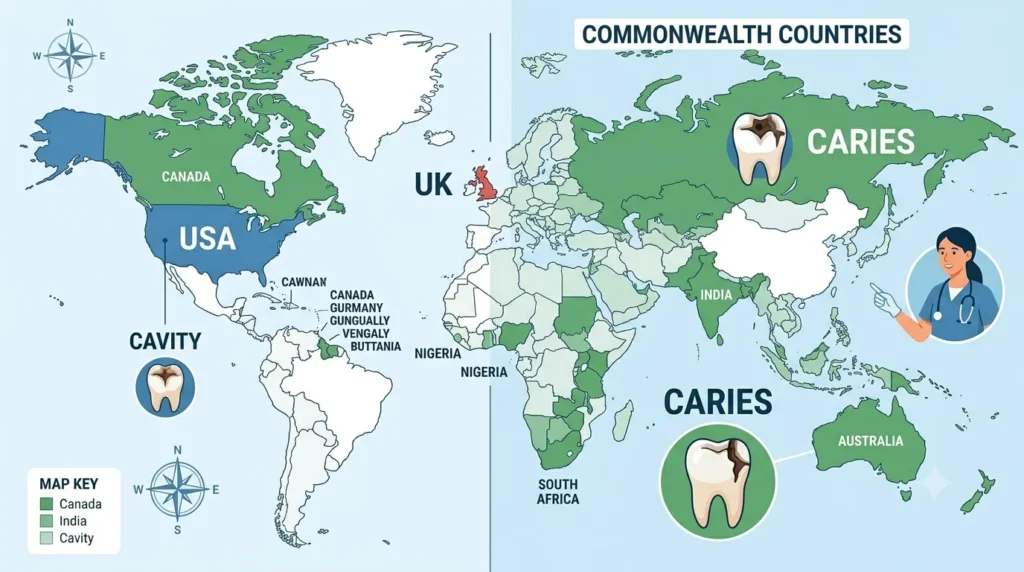
The medical term “caries” is used by dentists globally. Both “cavity” and “tooth decay” are understood everywhere. The spelling differences for “color” might appear in articles, but the dental terms remain the same.
Here is a simple guide to which term fits different audiences:
For American Readers 🇺🇸:
Use “cavity” and “stain”
Avoid “caries” unless speaking to a dentist
Use “color” for American spelling
For British/Commonwealth Readers 🇬🇧🇦🇺🇨🇦:
Use “cavity” and “stain”
“Tooth decay” is also very common
Use “colour” for British spelling
For International/Global Readers 🌏:
Use “cavity” and “stain”
These terms are understood everywhere
“Tooth decay” is a good alternative
Avoid regional slang
For Dental Professionals:
Use “caries” as the medical term
Use “cavity” when speaking to patients
Use “stain” for surface discoloration
Common Mistakes People Make with “Stain or Cavity” ❌
Here are the most frequent errors and how to correct them:
Mistake ❌
Correction ✅
Ignoring the spot because it doesn’t hurt
Cavities don’t hurt early on. Pain means it’s advanced.
Trying to scrape the spot off
This damages enamel and worsens cavities.
Self-diagnosing from online pictures
Only a dentist can accurately diagnose.
Waiting to see if it gets worse
Cavities never heal on their own. Early treatment is best.
Using whitening toothpaste on a cavity
Whitening toothpaste doesn’t treat decay.
Assuming all brown spots are stains
Many cavities look like brown spots initially.
Thinking cavities always have holes
Early cavities can look like white or brown spots.
Brushing harder to remove the spot
Hard brushing damages gums and enamel.
Prevention – How to Avoid Stains and Cavities 🛡️
The best way to avoid the “stain or cavity” worry is to prevent both.
How to Prevent Stains:
Brush after drinking coffee, tea, or red wine
Use a straw for dark drinks
Rinse your mouth with water after eating
Don’t smoke or use tobacco
Visit your dentist for professional cleanings
How to Prevent Cavities:
Brush twice daily with fluoride toothpaste
Floss daily to remove plaque between teeth
Limit sugary snacks and drinks
Drink water instead of soda or juice
Visit your dentist regularly for check-ups
Consider dental sealants for molars
Quick Prevention Tip: Rinse your mouth with water after eating anything sweet or sticky. This helps wash away sugar that bacteria feed on.
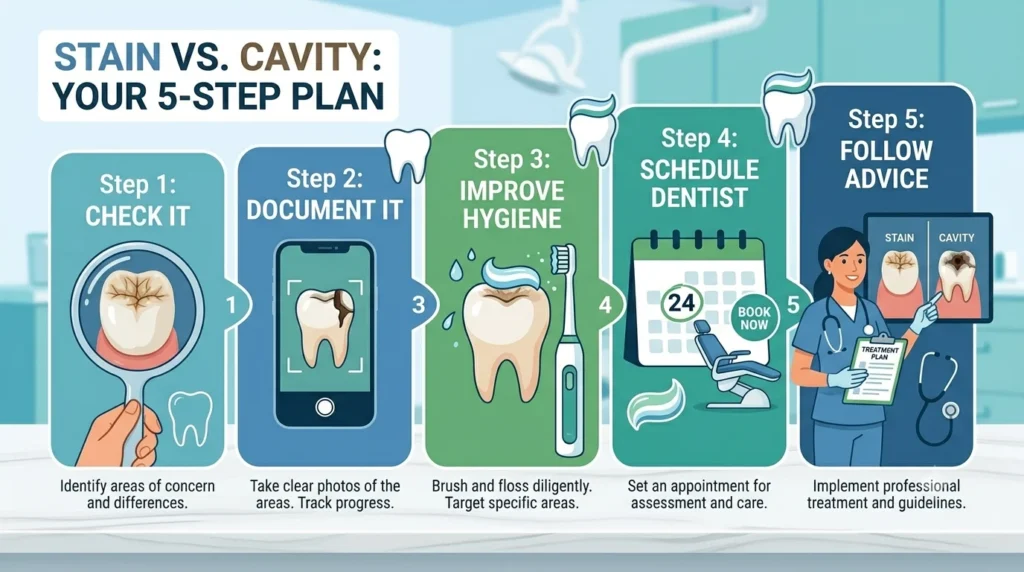
What to Do If You Find a Dark Spot – Action Plan 🏃
Found a spot? Don’t panic. Follow this simple action plan:
Step 1: Check It
Run your tongue over it
Test for sensitivity
Look at it in good light
Step 2: Document It
Take a photo with your phone
Note when you first noticed it
Track if it changes
Step 3: Improve Hygiene
Brush and floss carefully around the spot
Avoid sugary foods and drinks
Use fluoride mouthwash
Step 4: Schedule a Dentist Visit
Book an appointment for a check-up
Share your concerns and observations
Get X-rays if recommended
Step 5: Follow Professional Advice
If it’s a stain, ask about whitening options
If it’s a cavity, schedule the filling
Ask about prevention tips for the future
Frequently Asked Questions ❓
1. What is the easiest way to tell a cavity from a stain?
The easiest clue is pain and texture. Cavities often cause sensitivity to cold, hot, or sweet things. Stains never hurt. A cavity feels rough or like a hole, while a stain feels smooth.
2. Can a dark spot on my tooth just disappear?
A stain might fade if you change your habits, like cutting back on coffee or using whitening toothpaste. A true cavity will never disappear on its own. It will only get bigger and worse over time without treatment.
3. Do dentists always need to treat stains?
No. Stains are a cosmetic issue. If they bother you, your dentist can recommend whitening treatments. Cavities, however, always require treatment from a dentist to stop the decay from spreading.
4. Is it possible to have a cavity without any pain?
Yes, absolutely. Early-stage cavities often have no symptoms at all. This is why regular dental visits are so important. A dentist can catch a cavity before it becomes painful.
5. Can a stain turn into a cavity?
No. A stain is just on the surface and cannot turn into decay. However, a cavity can look like a stain initially, which is why you need a dentist to tell the difference between the two.
6. Can you remove cavity stains yourself?
No. You cannot remove the “stain” of a cavity because it’s not really a stain – it’s damaged tooth structure. The dark color is the sign of decay. Only a dentist can remove the decay and fill the cavity.
7. Should I try to scrape off a dark spot on my tooth?
Never. Do not try to scrape or poke a dark spot on your tooth with any sharp object. This can damage your enamel or turn a tiny cavity into a big problem. Let a dentist examine your teeth properly.
8. How long can I wait before seeing a dentist?
You should see a dentist as soon as possible. If it’s a cavity, early treatment means a smaller filling. Waiting can lead to pain, infection, and more complex treatments like root canals.
9. Can whitening toothpaste fix a cavity?
No. Whitening toothpaste only removes surface stains. It cannot treat decay. If you have a cavity, whitening toothpaste will not help and might even cause sensitivity.
10. Are cavities always dark?
No. Early cavities can be white spots on your teeth. As they progress, they turn brown, then black. A white spot on your tooth could be an early cavity, so don’t ignore it.
11. Can children get stains or cavities?
Yes. Children can get both stains and cavities. Stains in children are often from food or poor brushing. Cavities in children are very common and need prompt treatment.
12. Is every brown spot on a tooth a cavity?
No. Many brown spots are simply stains from food and drinks. However, you can’t be sure without a dental examination. Don’t assume it’s harmless.
13. Can you prevent cavities if you already have a stain?
Yes. A stain doesn’t mean you’ll get a cavity. But if the stain is in a hard-to-clean area, it could trap plaque and lead to decay. Good oral hygiene is your best defense.
14. Do cavities always need fillings?
Yes. Once a cavity forms, the decayed part must be removed and filled. There is no natural way for the tooth to heal itself. Early detection means smaller fillings.
15. Why do my teeth stain so easily?
Some people have thinner enamel that stains more easily. Genetics, diet, and habits all play a role. Using a straw for dark drinks and brushing regularly can help reduce staining.
Summary – Key Takeaways 📌
Here is everything you need to remember about stain or cavity:
Question
Answer
Is it a stain?
Smooth, painless, cosmetic only
Is it a cavity?
Rough, may hurt, structural damage
Can you tell by looking?
Not reliably
What should you do?
See a dentist
Can stains become cavities?
No
Can cavities be fixed at home?
No
Is a cavity dangerous?
Yes, without treatment
Is a stain dangerous?
No, only cosmetic
Conclusion 🎯
So, is it a stain or a cavity? Here is your final answer:
If your tooth feels smooth and doesn’t hurt, it’s likely a stain.
If your tooth feels rough, sticky, or causes pain, it could be a cavity.
The most important thing to remember is this: only a dentist can tell you for sure. Dark spots on your teeth can be tricky. Even experienced dentists sometimes need X-rays to confirm what’s happening beneath the surface.
Don’t risk your smile by guessing. A stain is just an aesthetic issue, but an untreated cavity can lead to pain, infection, and even tooth loss. If you’re worried about a spot on your tooth, the best thing you can do is make an appointment with your dentist.
They have the tools and expertise to give you a clear answer. And if you do have a cavity, catching it early means a simple filling instead of a root canal. That’s peace of mind worth having.
Take care of your teeth, and don’t hesitate to ask for professional help. Your smile is worth it! 😁🦷