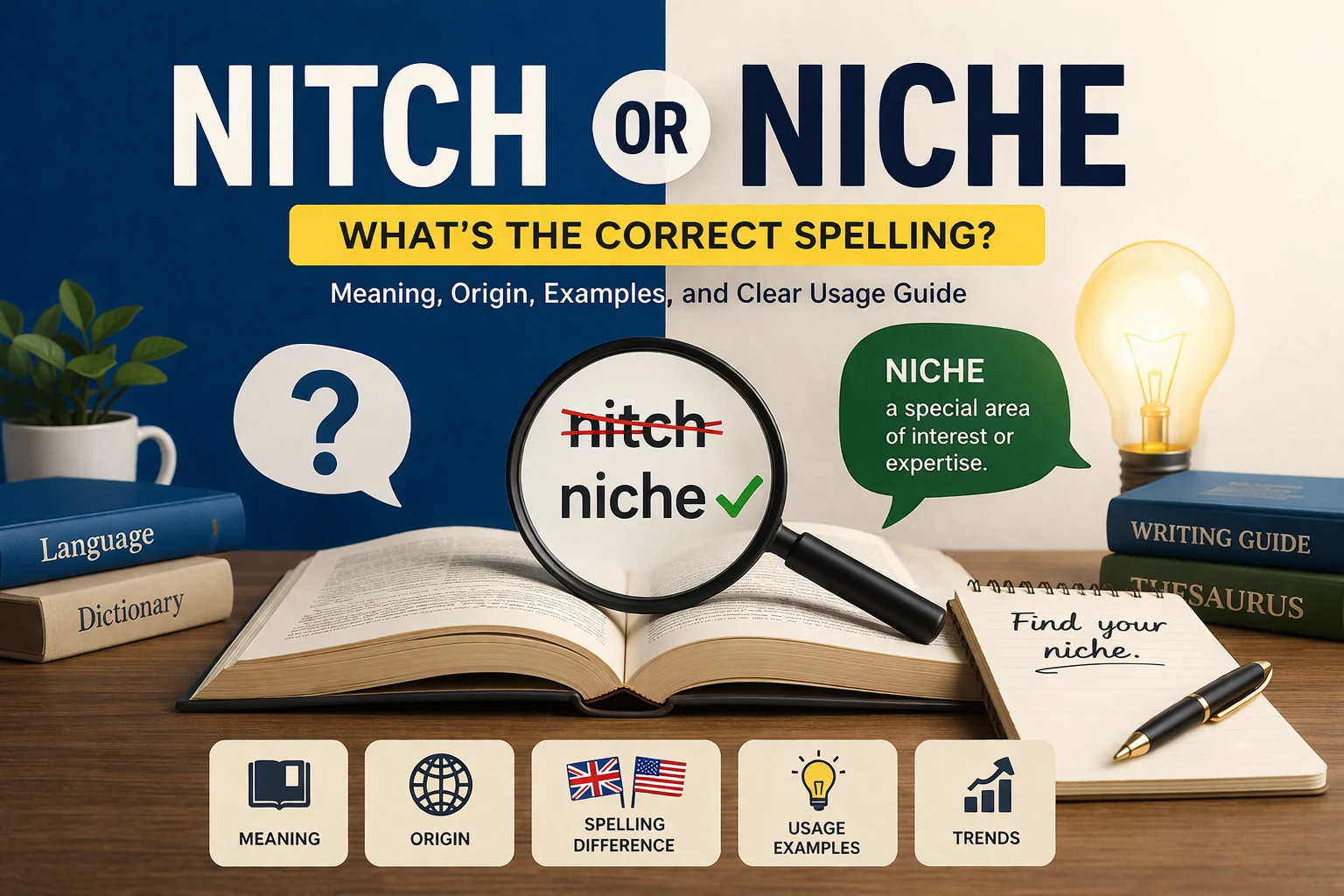
Many people often ask: is it “nitch” or “niche”? 🤔 This question arises because both spellings appear online, yet only one is widely accepted in formal, professional, and academic writing. People frequently search for nitch or niche meaning, nitch or niche synonym, and nitch or niche in English to clarify spelling, pronunciation, and correct usage.
This confusion goes beyond letters. It affects everyday communication, professional writing, social media, and even scientific or academic texts. For instance, in biology, asking “what is niche in biology?” without using the correct spelling could mislead readers. In business, knowing how to use niche correctly allows one to describe specialized markets or unique professional roles accurately.
The word also carries cultural and linguistic differences. Pronunciation may differ between the UK and the US, and casual online forums sometimes use “nitch,” adding to the confusion. This guide aims to:
- Explain the correct spelling and pronunciation
- Give the origin and historical context
- Compare British vs American usage
- Offer real-life examples in emails, news, and social media
- Share common mistakes and tips to avoid them
- Provide data from Google Trends and global usage patterns
By the end, you will confidently use niche in writing, speaking, and professional communication.
📚 Table of Contents – Nitch or Niche
- ⚡ Nitch or Niche
- 📜 The Origin of Nitch or Niche
- 🇬🇧🇺🇸 British English vs American English Spelling
- 🎯 Which Spelling Should You Use?
- ❌ Common Mistakes with Nitch or Niche
- 🖊️ Nitch or Niche in Everyday Examples
- 📊 Nitch or Niche – Google Trends & Usage Data
- 🔄 Keyword Variations Comparison Table
- ❓ Frequently Asked Questions (FAQs)
- ✅ Conclusion
- 📝 Meta Description
⚡ Nitch or Niche
Correct spelling: ✅ niche
Usage examples:
- “She finally found her niche in sustainable fashion.”
- “Our startup targets a niche market for eco-friendly products.”
Synonyms: specialty, corner, role, area, position
Common mistakes:
- Writing “nitch” instead of “niche”
- Mispronouncing it universally as /nɪtʃ/ when context requires /niːʃ/
Pronunciation tips:
- UK: /niːʃ/ (“neesh”)
- US: /nɪtʃ/ or /niːʃ/
- Use context and audience to select pronunciation
Even in forums like Reddit, “nitch” appears, but style guides and dictionaries consistently recommend niche in all professional, academic, and formal writing.
📜 The Origin of Nitch or Niche
The word niche has a rich history. It comes from French “nicher”, meaning to nest, derived from Latin “nidus” for “nest.” Originally, it referred to a recess in a wall for a statue. Over time, the meaning expanded to include specialized roles, positions, or areas in society, business, and ecology.
Historical timeline:
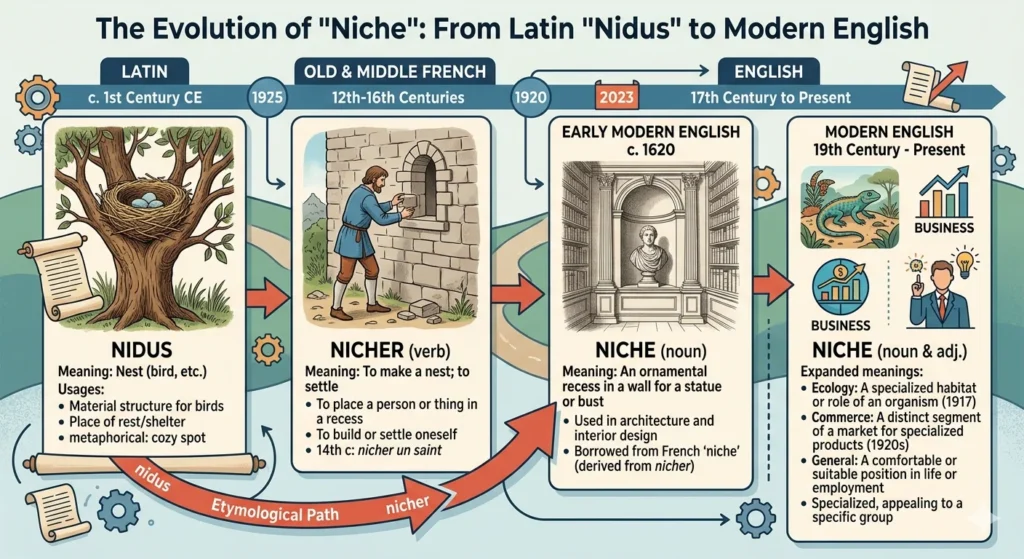
- 17th century: Architectural usage – “The statue rested in a small niche.”
- 18th century: Early metaphorical use – “He found his niche in society.”
- 19th century: Applied to professional roles and business – “Carving a niche in the market.”
- Modern usage: “She discovered her niche in digital marketing.”
Why “nitch” exists:
- Phonetic spelling by English speakers
- Listed as a variant in older dictionaries
- Now mostly informal and not recommended for professional writing
Understanding the origin helps writers and speakers appreciate the subtle nuances and avoid common mistakes.
🇬🇧🇺🇸 British English vs American English Spelling
The spelling niche is standard in both British and American English, but pronunciation differs.
| Feature | British English | American English |
|---|---|---|
| Spelling | niche | niche |
| Pronunciation | /niːʃ/ | /nɪtʃ/ or /niːʃ/ |
| Example | “He found his niche in photography.” | “She found her niche in digital marketing.” |
| Common Context | Academic papers, business communication | Informal conversation, professional writing |
Key takeaway: Spelling is universal; pronunciation changes depending on region. When in doubt, use “niche” for all professional writing.
🎯 Which Spelling Should You Use?
- US audiences: use niche, pronunciation /nɪtʃ/ or /niːʃ/
- UK & Commonwealth: use niche, pronunciation /niːʃ/
- Global audiences: always use niche, avoid “nitch”
Professional tip: For international publications, academic essays, or business reports, niche is the safest choice. Informal forums may allow “nitch,” but avoid it in professional contexts.
❌ Common Mistakes with Nitch or Niche
- Writing “nitch” in formal writing – informal only
- Mispronouncing the word in professional contexts
- Confusing it with unrelated words like “kitsch”
- Using it inaccurately in scientific or business contexts
- Overusing the term, diluting its meaning
Pro tip: Use the word to describe something truly unique or specialized. Avoid casual substitutions in official writing.
🖊️ Nitch or Niche in Everyday Examples
Emails
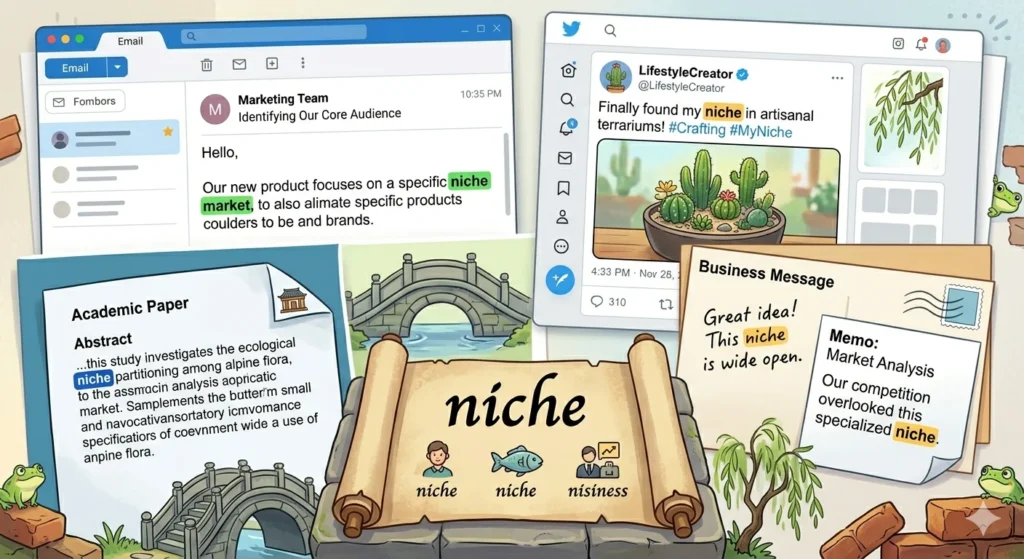
- Correct: “I’m trying to find my niche in the marketing team.”
- Incorrect: “I’m trying to find my nitch in the marketing team.”
News Headlines
- Correct: “Local artists carve out a niche in the city’s gallery scene.”
Social Media
- Correct: “Found my niche: teaching eco-friendly crafts.”
Academic/Scientific Writing
- Correct: “This species occupies a unique ecological niche in the rainforest.”
Business/Marketing
- Correct: “Our startup has found a niche in sustainable fashion products.”
Extended examples:
- Job applications: “I hope to develop a niche in data visualization within the company.”
- Blogs: “This blog focuses on a niche topic: vintage camera restoration.”
- Education: “Students are encouraged to find their niche before choosing a career path.”
📊 Nitch or Niche – Google Trends & Usage Data
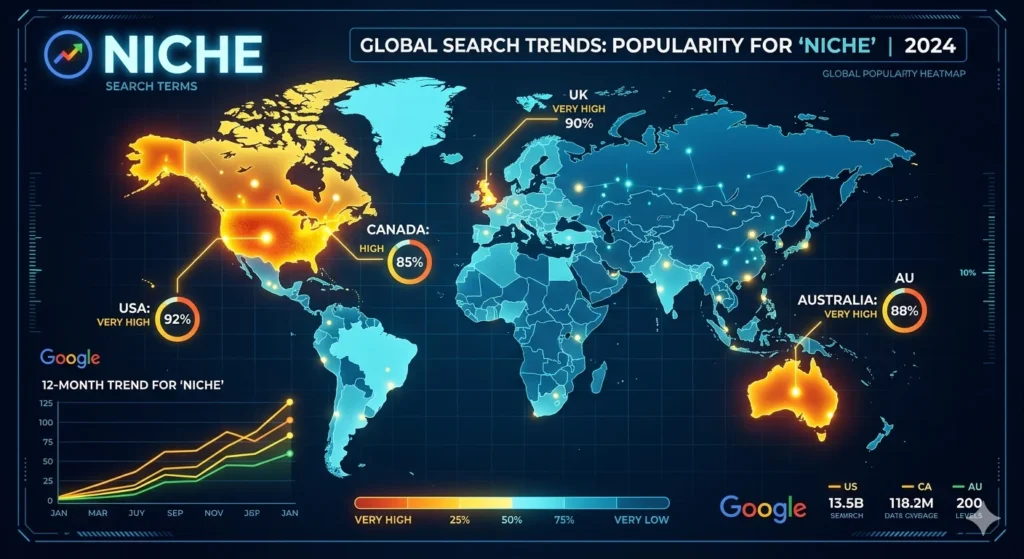
- Most searched in: US, UK, Canada, Australia
- Common queries:
- “Nitch or niche meaning”
- “Niche pronunciation and meaning”
- “What is niche in biology”
- Trends: Peaks during academic semesters, marketing seasons, and startup conferences
- Usage contexts: Education, business, ecology, personal development
Observation: Niche-related searches have grown steadily over the past decade, especially in online learning, career guidance, and content marketing.
🔄 Keyword Variations Comparison Table
| Variation | Correct Usage | Context |
|---|---|---|
| Nitch or niche definition | niche ✅ | Dictionaries, formal writing |
| Nitch or niche meaning | niche ✅ | Clarifying word sense |
| Nitch or niche in English | niche ✅ | Language and usage queries |
| Is nitch a word | nitch ❌ | Informal forum usage |
| Niche pronunciation | niche ✅ | UK /niːʃ/, US /nɪtʃ/ |
| What is niche in biology | niche ✅ | Scientific, ecological context |
| Nitch or niche Reddit | niche ✅ | Online discussions, forums |
❓ Frequently Asked Questions (FAQs)
- Is “nitch” a word? – Informally yes, but niche is preferred.
- How do you pronounce niche? – UK: /niːʃ/, US: /nɪtʃ/ or /niːʃ/.
- What does niche mean in biology? – A species’ role or position in its ecosystem.
- What is a synonym for niche? – Specialty, position, role, corner, area.
- Can I use “nitch” in professional writing? – No, avoid it in formal contexts.
- Why do people spell it nitch? – Phonetic spelling or casual usage.
- Is niche used in marketing? – Yes, it describes specialized markets or target audiences.
- Can niche refer to a skill? – Yes, e.g., “She has a niche in coding tutorials.”
- Does niche have multiple meanings? – Yes, in ecology, business, and personal skills.
- Is niche plural? – Yes, the plural is niches.
- How do I find my niche? – Identify your strengths, interests, and target audience.
- Is niche important for businesses? – Absolutely; it helps differentiate in competitive markets.
✅ Conclusion
- Niche is the correct and widely accepted spelling. “Nitch” is informal and should be avoided in professional contexts.
- Pronunciation differs slightly between the UK (/niːʃ/) and US (/nɪtʃ/ or /niːʃ/), but spelling remains consistent worldwide.
- Understanding the origin, meaning, synonyms, and usage of niche ensures clarity in emails, social media posts, academic papers, and business strategies.
- Always check audience, context, and region when choosing pronunciation, but never compromise on spelling.
Using niche correctly will make your communication clear, confident, and universally understood.

“Rose Macaulay shares the charm of idioms on LearnIdom.com, making language learning delightful, insightful, and full of wit for every reader.”