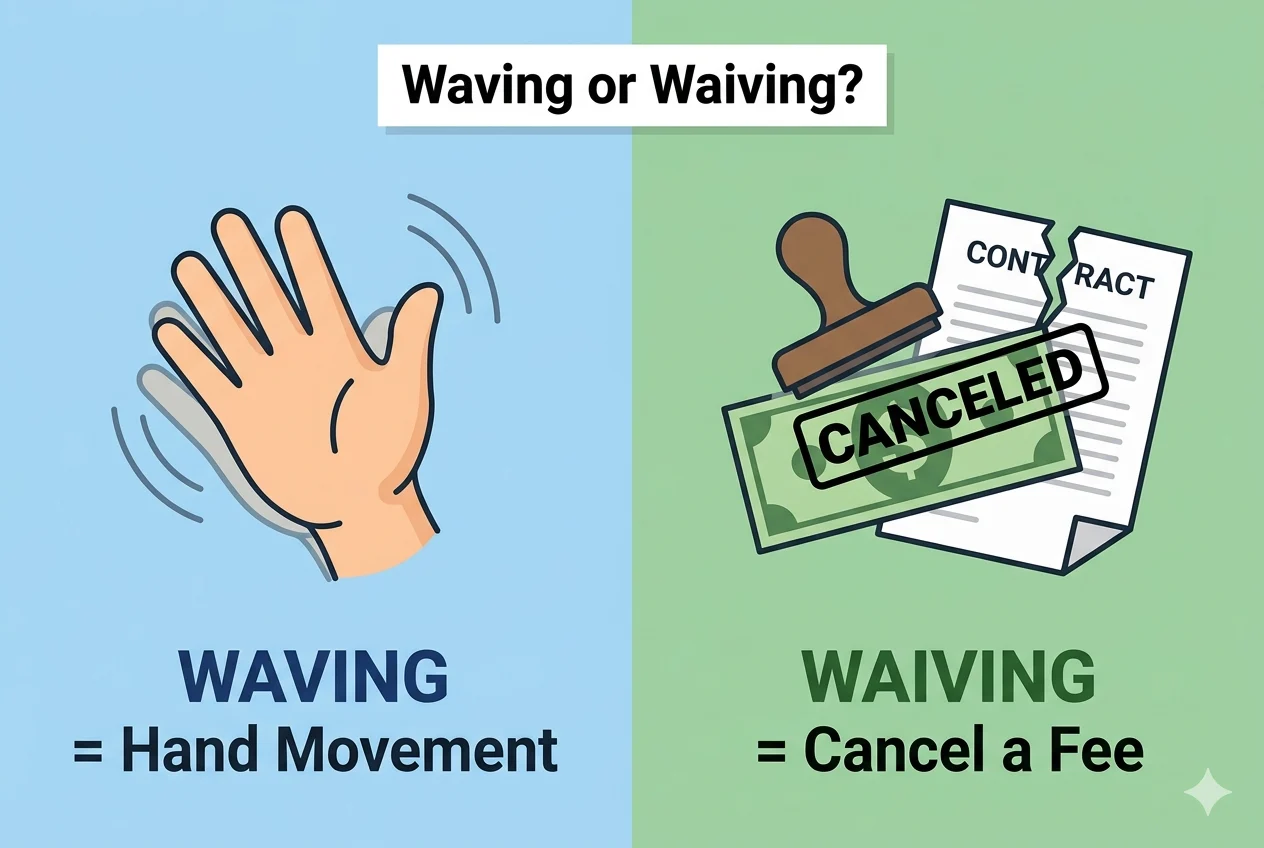
Do you struggle with the words waving and waiving? You are not alone. These two words sound exactly the same. But their meanings are completely different.
One small mistake can ruin a business email. Imagine writing “please wave my fee” to a client. They will think you are moving your hand at the money. Or writing “she was waiving hello” to a friend. They will be very confused.
People search for “waving or waiving” because this confusion is everywhere. Students mix them up in essays. Professionals use the wrong word in contracts. Even native English speakers make this error.
This guide gives you one simple rule. Read it once. You will never make this mistake again. Let us start.
Answer: Waving vs Waiving
Waving means moving your hand or an object back and forth.
Example: She was waving goodbye from the train station.
Waiving means giving up a right, a rule, or a fee.
Example: The bank is waiving the late fee this month.
One memory trick: Wave has an ‘e’ for hand movement. Waive has an ‘i’ for “I give up.”
Another trick: If you can replace the word with “moving hand,” use waving. If you can replace it with “canceling,” use waiving.
The Origin of These Words
The word wave comes from Old English wafian. This word meant “to flicker or move back and forth.” People have used it for over 1,000 years. They used it for hand gestures, ocean waves, and flags in the wind.
The word waive comes from Old French waivier. This word meant “to abandon or give up.” Lawyers in the 1500s used it first. They used it when someone gave up a legal right in court.
Why do the spellings differ? Because they came from two different language families. Wave is Germanic. Waive is French. They only sound the same by accident. English has many such homophones. Think of “there,” “their,” and “they’re.” Same sound, different meanings.
British English vs American English Spelling
Here is good news. Both words are spelled the same in British and American English. There is no spelling difference at all.
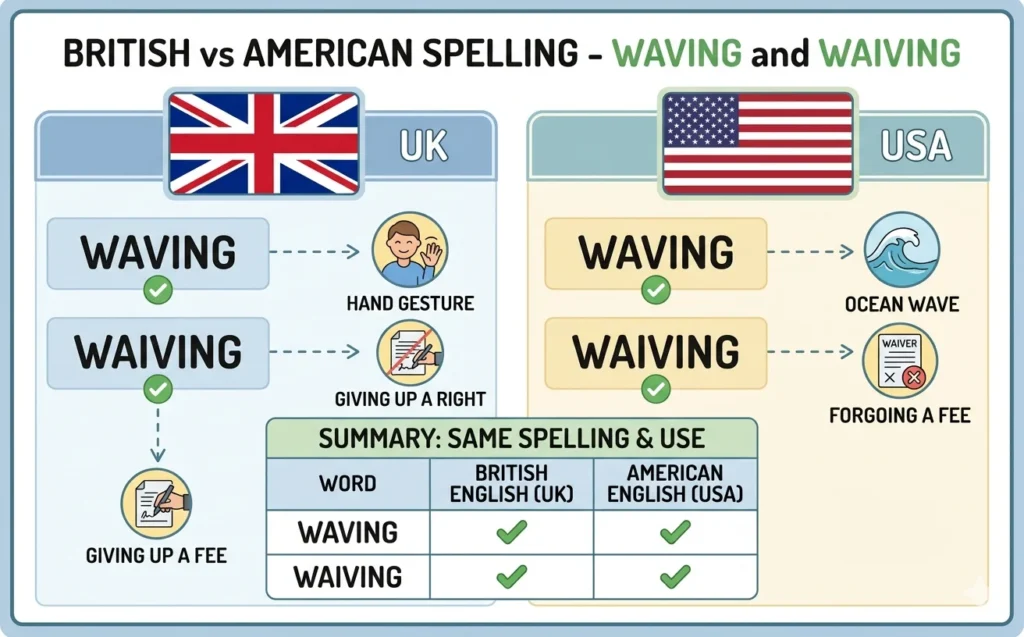
However, usage frequency changes by country. Americans use “waiving” more in business contexts. British writers use “waiver” as a noun more often.
| Word | British Spelling | American Spelling | Meaning |
|---|---|---|---|
| Waving | waving | waving | Moving hand or object |
| Waiving | waiving | waiving | Giving up a right or fee |
| Wave | wave | wave | Ocean water or hand motion |
| Waiver | waiver | waiver | Legal document |
The table above shows the truth. No difference. You only need to choose the correct meaning for your sentence.
Which Spelling Should You Use?
Your audience decides which word you need.
Use waving when you write for:
- Friends and family in text messages
- Social media posts
- Casual emails
- Describing hand gestures (He was waving from the car)
- Describing moving objects (The flag was waving in the wind)
Use waiving when you write for:
- Business clients and bosses
- Legal documents and contracts
- Banks and financial institutions
- Canceling a fee (The gym is waiving the joining fee)
- Giving up a legal right (By signing, you are waiving your right to sue)
For a global audience: Both spellings are correct everywhere. Just ask yourself one question. Am I moving my hand or am I canceling a rule? The answer tells you which word to use.
Seat vs Sit ⚡ Usage Differences Explained
Common Mistakes with Waving or Waiving
Here are the most frequent errors people make. Learn them. Avoid them.
Mistake 1: Using waving instead of waiving for fees
Wrong: The manager is waving the fee.
Why it is wrong: A manager cannot move a fee back and forth like a hand.
Correct: The manager is waiving the fee.
Mistake 2: Using waiving instead of waving for greetings
Wrong: She was waiving hello to her friend.
Why it is wrong: You cannot give up a hello. That makes no sense.
Correct: She was waving hello to her friend.
Mistake 3: Using wave instead of waive for legal rights
Wrong: I need to wave my right to appeal the decision.
Why it is wrong: You do not flicker a legal right away.
Correct: I need to waive my right to appeal the decision.
Mistake 4: Confusing wave off with waive off
Wave off means to signal someone to go away using your hand.
Waive off is not standard English. Avoid it. Use waive alone.
Waving or Waiving in Everyday Examples
Seeing these words in real situations helps you remember.
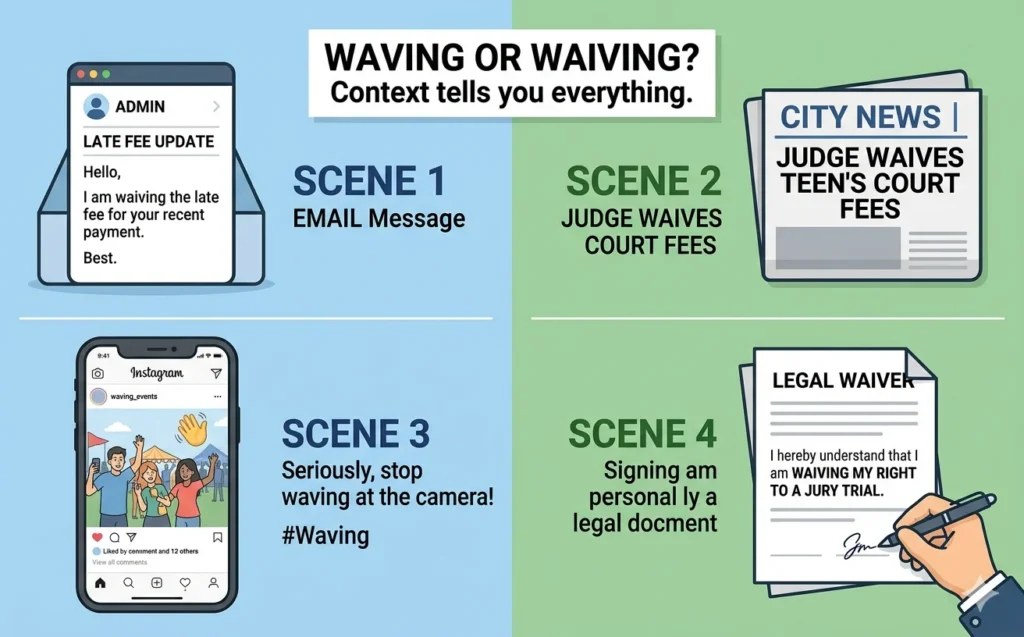
In professional emails:
- “Dear customer, we are waiving the late fee as a one-time courtesy.”
- “I saw you waving in the background of the video meeting.”
In news headlines:
- “Judge Waives Teen’s Court Fees After Community Service”
- “Fans Waving Flags Greet Olympic Team at Airport”
On social media posts:
- “Stop waving at the camera and just post the recipe already.”
- “My landlord is waiving this month’s late rent. Finally some good news.”
In formal legal writing:
- “By signing this document below, you are waiving your right to a jury trial.”
- “The defendant is waiving his right to remain silent.”
One sentence using both words together:
- “He kept waving his hands wildly, hoping the police officer would waive the speeding ticket.”
Google Trends and Usage Data
According to Google Trends data from the past five years:
Waving searches peak during summer months. People search for beach waves, waving goodbye photos, and waving flags at parades.
Waiving searches peak in January. People search for gym membership fee waivers, contract cancellations, and bank fee waivers.
By country search volume:
- United States: Highest searches for “waive a fee” and “waiver form”
- United Kingdom: More searches for “waiving” in legal forums
- Canada and Australia: Equal searches for both words
Peak confusion season: August to September each year. Parents search both terms. They ask “is the school waiving the supply fee?” and “why is no one waving at the school bus?” at the same time.
Complete Comparison Table
| Term | Part of Speech | Meaning | Example Sentence |
|---|---|---|---|
| Waving | Verb (present participle) | Moving hand or object back and forth | The toddler was waving a stick in the air. |
| Waiving | Verb (present participle) | Giving up a fee, right, or rule | The gym is waiving the enrollment fee this week. |
| Wave | Verb or noun | Hand motion or ocean water | A big wave crashed on the shore. |
| Waiver | Noun | A legal document | Please sign this liability waiver before you enter. |
| Wave off | Phrasal verb | Dismiss with hand signal | He tried to wave off the waiter’s help. |
This table gives you everything you need at a glance. Bookmark it for future reference.
Frequently Asked Questions
1. Is it waiving a fee or waving a fee?
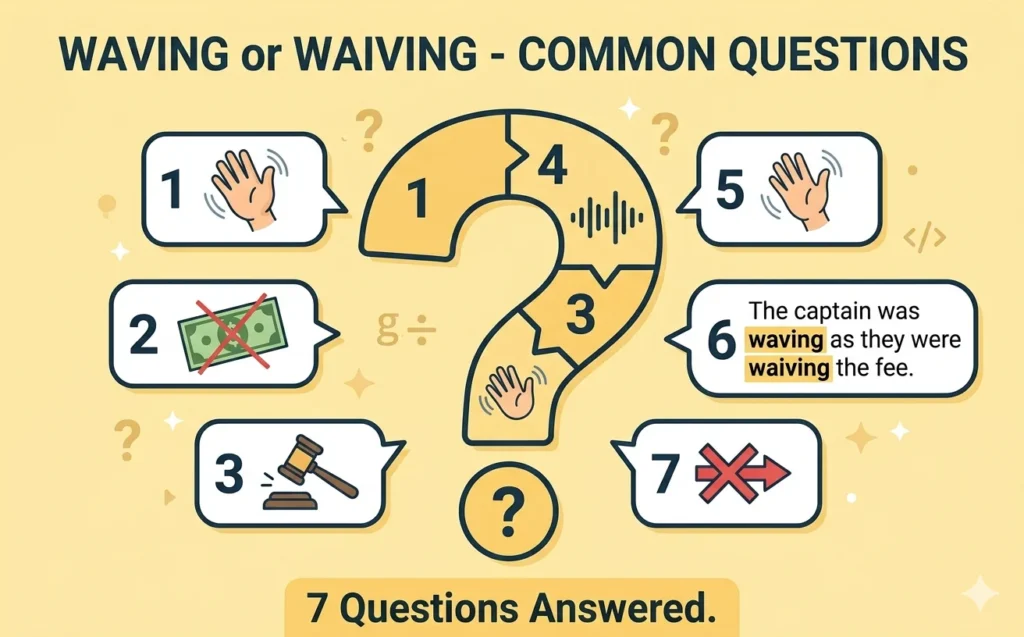
It is waiving a fee. You give up or cancel the fee. You do not move it like a hand. Example: The hotel is waiving the resort fee for our stay.
2. What does waiving someone mean?
It means letting someone off the hook from a rule or punishment. Example: The coach is waiving the player’s suspension after he apologized.
3. What do you mean by waving?
Waving means moving your hand side to side. People do this to say hello, goodbye, or get attention. Example: She was waving from the window as the train left.
4. What is the waiving or waving sound?
They sound exactly the same. Both are pronounced wey-ving. You cannot hear the difference with your ears. You must see the spelling to know the meaning.
5. When should I use waive or wave for my hand?
Always use wave your hand. You cannot “waive your hand” unless you are legally giving up ownership of your hand. That is very strange and never used.
6. Can you give a sentence with both wave and waive together?
Yes. Here is one: “I saw my neighbor waving from his porch, hoping the post office would waive the signature rule for his package.”
7. What is the difference between wave off and waive off?
Wave off is correct. It means to dismiss someone with your hand. Waive off is not standard English. Most experts say avoid it. Use waive alone for canceling things.
Conclusion
You now know the difference between waving and waiving. Waving is for hands, flags, and saying hello. Waiving is for fees, rights, and legal rules.
Remember the simple trick. Wave has an ‘e’ for hand movement. Waive has an ‘i’ for “I give up.” This one rule will save you from ever making this mistake again.
When you write, ask yourself one question. Am I moving something or canceling something? If moving, write waving. If canceling, write waiving.
For business emails and legal documents, the wrong word changes your meaning. A waived fee saves you money. A waved fee means nothing. For casual texts, friends will still understand. But professional writing needs accuracy.
Keep this guide nearby. Share it with someone who mixes these words up. You now write with confidence and clarity.

“Iris Murdoch explores the beauty of language and idioms on LearnIdom.com, making learning phrases engaging, memorable, and fun for everyone.”