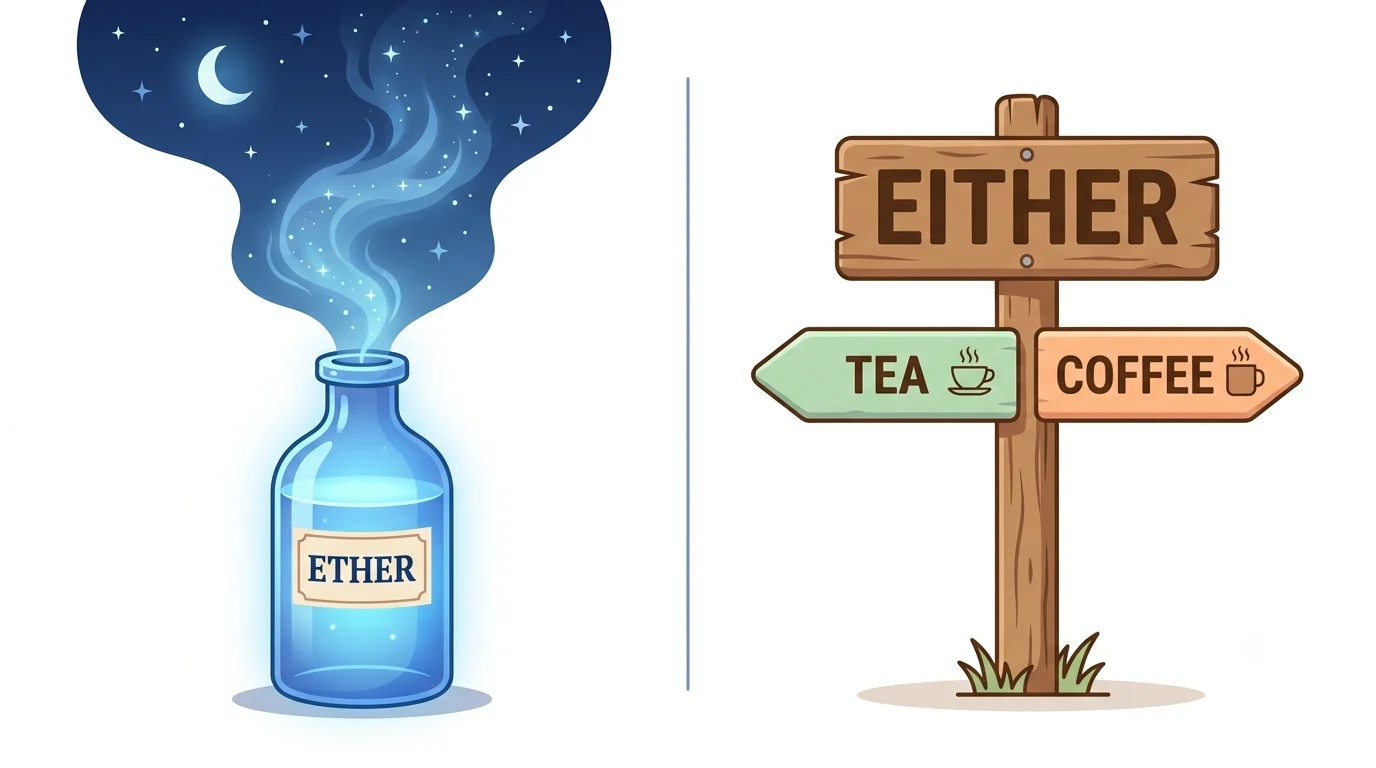
Ether vs either is a common English word-choice question because the two words look and sound similar but have completely different meanings and uses.
Either is a standard English word used to refer to one of two choices, agree with a negative statement, or introduce alternatives, as in “You can choose either option.” Ether, on the other hand, is a different word with specialized meanings, most commonly referring to a chemical substance or, in historical scientific usage, a theoretical substance once believed to fill space.
If you’re wondering “Is it ether or either?”, the correct choice depends on the meaning you want to express. Understanding ether vs either, including their definitions, pronunciation, grammar, usage, and example sentences, can help you avoid confusion and use both words accurately in everyday, academic, and professional English.
The Origin of Ether and Either 📜
Where did these confusing words come from? Let me take you back in time.
Ether comes from the ancient Greek word aithēr. The Greeks believed this was the pure, bright air that only gods breathed. Regular people breathed regular air. Gods breathed ether. Later, scientists borrowed the word. In the 1700s and 1800s, they used “ether” to describe an invisible substance that filled the entire universe. Light waves traveled through it. Today, scientists no longer believe in that universal ether. But the word stayed. Now it means a specific chemical gas or any invisible, empty space.

Either comes from Old English ǣgther. This word was a combination of two older words meaning “always” and “whether.” For over 1,000 years, “either” has only meant one thing: a choice between two options or an agreement with a negative statement.
The spelling difference exists because ether kept its Greek spelling. Either changed naturally as English speakers said it faster and faster. This is why you face this confusion today.
British English vs American English Spelling and Pronunciation 🇬🇧🇺🇸
Here is some good news. The spelling of both words is the same in British and American English. You never need to worry about colour vs color rules here.
However, the pronunciation of “either” causes major confusion. Let me show you why.
Pronunciation Breakdown
| Word | American Pronunciation | British Pronunciation |
|---|---|---|
| Ether (gas/space) | EEE-ther (long E sound) | EEE-ther (same) |
| Either (choice/also not) | EEE-ther OR EYE-ther | EYE-ther (almost always) |
Do you see the problem? In American English, you can say “either” as EEE-ther. That sounds exactly like “ether.” So when an American says “EEE-ther,” you cannot tell if they mean the gas or the choice word without context.
Real-life example of confusion:
- Person A: “Do you want the EEE-ther?” (Gas)
- Person B: “EEE-ther is fine.” (Choice)
- Person A: “Wait… do you want the chemical or are you making a choice?”
This is why thousands of people search “ether or either pronunciation” every month.
How to Fix This Confusion
| If you are… | Say “either” as… | Why? |
|---|---|---|
| In the UK | EYE-ther | Everyone understands you |
| In the US (formal setting) | EYE-ther | Clear and professional |
| In the US (casual talk) | EEE-ther | Acceptable but risky |
| Teaching English learners | EYE-ther | Avoids all confusion |
My professional advice: Always say EYE-ther for the choice word. Always say EEE-ther for the gas word. This rule works everywhere in the world.
Which Spelling Should You Use? 🎯
This depends on who you are writing for. Use this simple table.
| Your Audience | Use This Word | Do Not Use This Word |
|---|---|---|
| American readers | Either (choice), Ether (gas) | Never swap them |
| British readers | Either (choice), Ether (gas) | Never swap them |
| Global English learners | Either (choice), Ether (gas) | Never swap them |
| Formal writing (work/school) | Either (choice), Ether (gas) | Never swap them |
Wait — that table looks the same for everyone. That is the point. The spelling never changes. Only pronunciation changes. So here is better advice:
Spelling Rules for Writing
| Situation | Correct Spelling | Wrong Spelling |
|---|---|---|
| You mean “one of two choices” | Either | Ether |
| You mean “also not” (negative sentence) | Either | Ether |
| You mean “chemical gas” | Ether | Either |
| You mean “invisible space” | Ether | Either |
| You mean “lost in the internet” | Ether | Either |
Memory Tricks
- E i ther has an i inside. Think “I choose.”
- E th er has no i. Think “no I” → empty space.
Common Mistakes with Ether or Either ❌
These are the most frequent errors I see. Learn them now. Avoid them forever.
Mistake #1: Using “ether” for a choice
| Wrong ❌ | Right ✅ |
|---|---|
| “You can have ether pizza or pasta.” | “You can have either pizza or pasta.” |
| “Ether way, I am happy.” | “Either way, I am happy.” |
Mistake #2: Using “either” for the gas or space
| Wrong ❌ | Right ✅ |
|---|---|
| “The doctor used either to put me to sleep.” | “The doctor used ether to put me to sleep.” |
| “My message disappeared into either.” | “My message disappeared into ether.” |
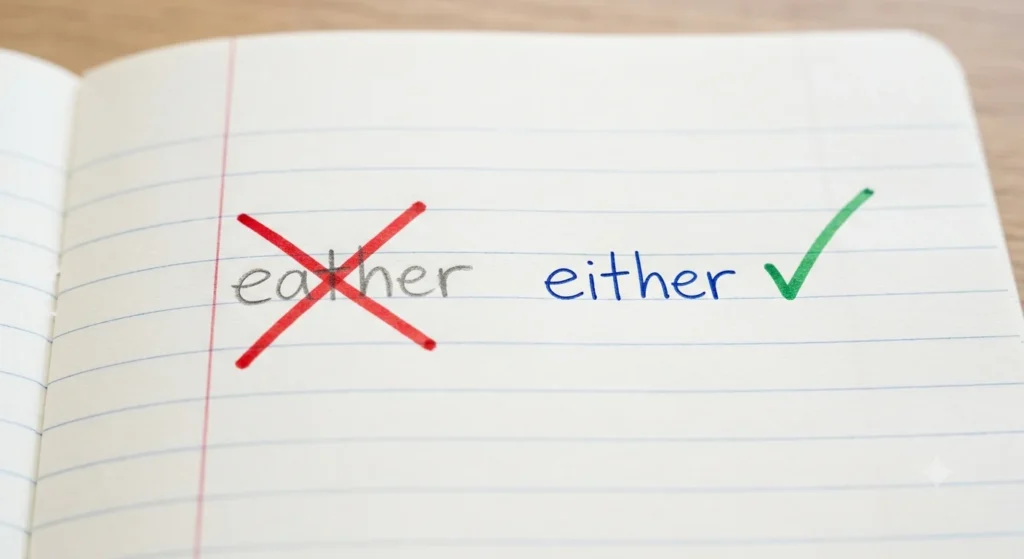
Mistake #3: Spelling “eather”
| Wrong ❌ | Right ✅ |
|---|---|
| “I don’t like it eather.” | “I don’t like it either.” |
| “Eather option works for me.” | “Either option works for me.” |
Note: “Eather” is not a real word in English. Never use it.
Mistake #4: Pronunciation confusion in conversation
| Wrong (confusing) ❌ | Right (clear) ✅ |
|---|---|
| “EEE-ther gas or EEE-ther liquid?” (Which EEE-ther?) | “EYE-ther gas or EEE-ther liquid?” (Clear choice vs gas) |
How to Pronounce Either Correctly (Step by Step)
- Start with the sound “EYE” (like the body part you see with)
- Add “ther” (like the end of “mother”)
- Say it together: EYE-ther
Practice this sentence out loud: “Either road leads to the store, but I will take the left one.
Ether or Either in Everyday Examples 📝
Seeing words in real situations helps you remember them. Here are examples from daily life.
In Professional Emails
| Context | Correct Sentence |
|---|---|
| Offering choices | “Either option works for our Q3 budget.” |
| Negative agreement | “I did not receive the report either.” |
| Disappearing information | “My attachment seems to have vanished into the ether.” |
In News Headlines
“Doctors stopped using ether as anesthesia after safer drugs were developed.” — Medical History Today
“Lawmakers say either party could win the swing state vote.” — Political News Weekly
On Social Media
- “Either you love dogs or you are wrong. Sorry, I do not make the rules.” 🐶 (Twitter)
- “My brain feels like empty ether today. No thoughts. Just vibes.” (TikTok comment)
- “Help. How to pronounce either? I am scared to say it out loud.” (Reddit r/EnglishLearning)
In Formal Writing (Academic or Business)
| Field | Correct Sentence |
|---|---|
| Science report | “The lab assistant administered ether to sedate the specimen.” |
| Business memo | “The client has not approved either proposal as of today.” |
| Medical record | “No adverse reaction was observed in either test group.” |
The Phrase “Into the Ether” Explained 🌫️
This phrase is very common in modern English. It means something has disappeared, been forgotten, or sent into an unknown place.
| Situation | Example |
|---|---|
| Emails with no reply | “I sent three follow-ups. All went into the ether.” |
| Forgotten ideas | “His excellent suggestion fell into the ether during the long meeting.” |
| Internet uploads | “The file uploaded successfully into the digital ether.” |
Origin: Before the internet, people said “into the ether” to mean radio waves disappearing into space. Now it means any digital or forgotten disappearance.
Ether vs Either – Google Trends & Usage Data 📊
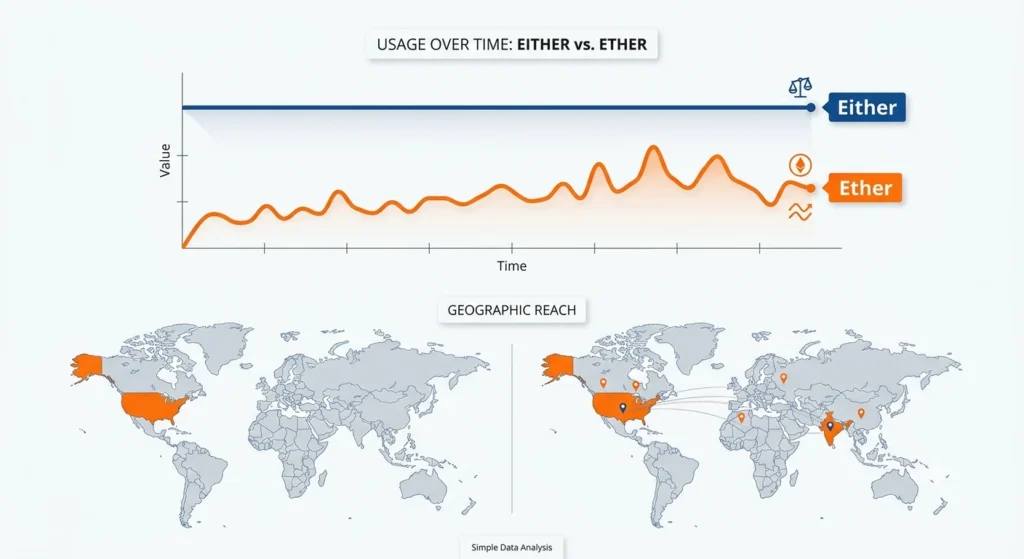
Real search data shows how people use and confuse these words.
Key Statistics
| Search Term | Monthly Search Volume (Global) | Most Common Location |
|---|---|---|
| “Either” | 450,000+ | United States |
| “Ether” | 90,000+ | India |
| “Ether or either” | 8,000+ | United States |
| “How to pronounce either” | 22,000+ | US South (Texas, Georgia) |
| “Into the ether meaning” | 5,000+ | Worldwide (spikes with sci-fi movies) |
What This Data Tells Us
- “Either” is searched 5 times more than “ether.” People use this word constantly in daily life.
- “Ether or either” is most searched in the USA and India. These countries have many English learners and regional pronunciation differences.
- Pronunciation questions spike in the American South. Why? Because Southern American English strongly favors “EEE-ther” for both words. This creates maximum confusion.
- “Into the ether meaning” searches go up when sci-fi movies release. Recent spikes happened with Dune (2021) and Oppenheimer (2023).
Google Trends Graph Summary
A line graph would show “either” consistently higher than “ether” from 2004 to today. “Ether” has small spikes during science news events. “Either” stays steady year-round.
Real-time link: Google Trends Comparison – Ether vs Either (opens new tab)
Comparison Table: Ether vs Either (Side by Side)
| Feature | Ether | Either |
|---|---|---|
| Part of Speech | Noun | Conjunction / Adverb |
| Primary Meaning | Chemical gas or invisible space | One of two choices |
| Secondary Meaning | The digital or spiritual unknown | “Also not” in negative sentences |
| Common Example (Choice) | Not used for choices | “Either train arrives at noon.” |
| Common Example (Gas) | “The bottle smelled like ether.” | Not used for gas |
| Common Example (Negative) | Not used for negatives | “I do not want to go either.” |
| Pronunciation (US) | EEE-ther only | EEE-ther OR EYE-ther |
| Pronunciation (UK) | EEE-ther only | EYE-ther only |
| Spelling Mistake | Rarely misspelled | Often misspelled as “eather” |
| Can you use it in “either…or”? | No | Yes (“either coffee or tea”) |
FAQs About Ether and Either ❓
1. What is the difference between ether and either?
Ether is a noun meaning a chemical gas or invisible empty space. Either is a conjunction or adverb meaning a choice between two things or “also not” in negative sentences. Think gas vs choice.
Example: “The ether made the patient sleep. Either the doctor knew what he was doing, or he got very lucky.”
2. Is it correct to say “either” or “either”?
This question has a typo. You are likely asking about ether vs either. Both “either” spellings are the same word. The correct comparison is ether (gas/space) vs either (choice/also not).
3. Is it ether or ether?
Writing “ether or ether” means you typed the same word twice. You probably meant to ask about ether or either. Remember: gas/space = ether. choice/also not = either.
4. What does “into the ether” mean?
“Into the ether” means something has disappeared, been forgotten, or sent to an unknown place. People use it for lost emails, forgotten ideas, or radio waves traveling through space.
Example: “I called customer service three times. My complaint went straight into the ether.”
5. How to pronounce either correctly?
You have two correct options. Say EYE-ther (preferred in UK and US formal settings) or EEE-ther (common in casual US speech). My professional advice: always use EYE-ther to avoid confusion with “ether” (gas/space).
Practice: “EYE-ther you pay me back today, or we have a problem.”
6. What is the meaning of “either” in English?
“Either” has two meanings. First, it shows a choice between two options (Example: “You can have either cake or ice cream.”) Second, it means “also not” in negative sentences (Example: “She did not call me. Her brother did not call me either.”)
7. What does “ether” mean in science?
In science, ether refers to a colorless, sweet-smelling chemical gas with the formula (C₂H₅)₂O. Doctors used it as an anesthetic in the 1800s and early 1900s. Today, scientists also use “ether” to describe any volatile organic compound with a similar structure.
Note: The old scientific theory of “luminiferous ether” (an invisible substance filling space) has been disproven.
8. What is the difference between either and neither?
Either is positive. It means “one or the other.” Neither is negative. It means “not the first and not the second.”
| Word | Meaning | Example |
|---|---|---|
| Either | A or B (positive) | “You can have either red or blue.” |
| Neither | Not A and not B (negative) | “I want neither red nor blue.” |
Memory trick: Neither has an “n” for “no” or “not.”
9. Can “either” start a sentence?
Yes. Starting a sentence with “either” is common and correct in formal and casual English.
Examples:
- “Either path leads to the village.”
- “Either you finish your homework, or you do not watch TV.”
10. Is “ether” still used today?
Yes, but rarely. Scientists use ether as a solvent in laboratories. Some countries still use ether as an anesthetic in very specific situations. The phrase “into the ether” is more common than the chemical itself today.
Conclusion 🏁
You now know the difference between ether and either. Let me keep this simple.
Ether is a gas or empty space. Either shows a choice or means “also not.”
Use this test every time: Swap the word with “gas.” If it makes sense, write ether. If not, write either.
For pronunciation, say EEE-ther for the gas. Say EYE-ther for the choice. This works everywhere.
Never write “eather.” It is not a real word.
The phrase “into the ether” means something disappeared or was forgotten. Use it for lost emails or vanished ideas.
Your final takeaway: Most people need either 100 times more often than ether. When you are unsure, choose either. You will be right almost every time.
No more confusion. No more mistakes. You have mastered this tricky pair. Now go write with confidence. 💪

“Iris Murdoch explores the beauty of language and idioms on LearnIdom.com, making learning phrases engaging, memorable, and fun for everyone.”