You are typing fast. You want to stop a subscription. You write: “Please cancell my order.” Something looks wrong. Is it cancel or cancell? You delete the second L. But now you are not sure. Should there be two Ls? What about cancelled? Or canceled? Your brain starts to hurt.
This happens to millions of people every day. They search for cancell or cancel because English spelling is tricky. One small letter can change everything. The good news? The answer is very simple. And after reading this, you will never make a mistake again.
This article solves one big confusion: When do you use one L, and when do you use two Ls? You will learn the rule in 30 seconds. You will also learn the history, the difference between American and British English, and how to write perfect emails, news headlines, and social media posts. No more doubt. No more typos. Let us begin.
Cancel or Cancel – The One Second Answer
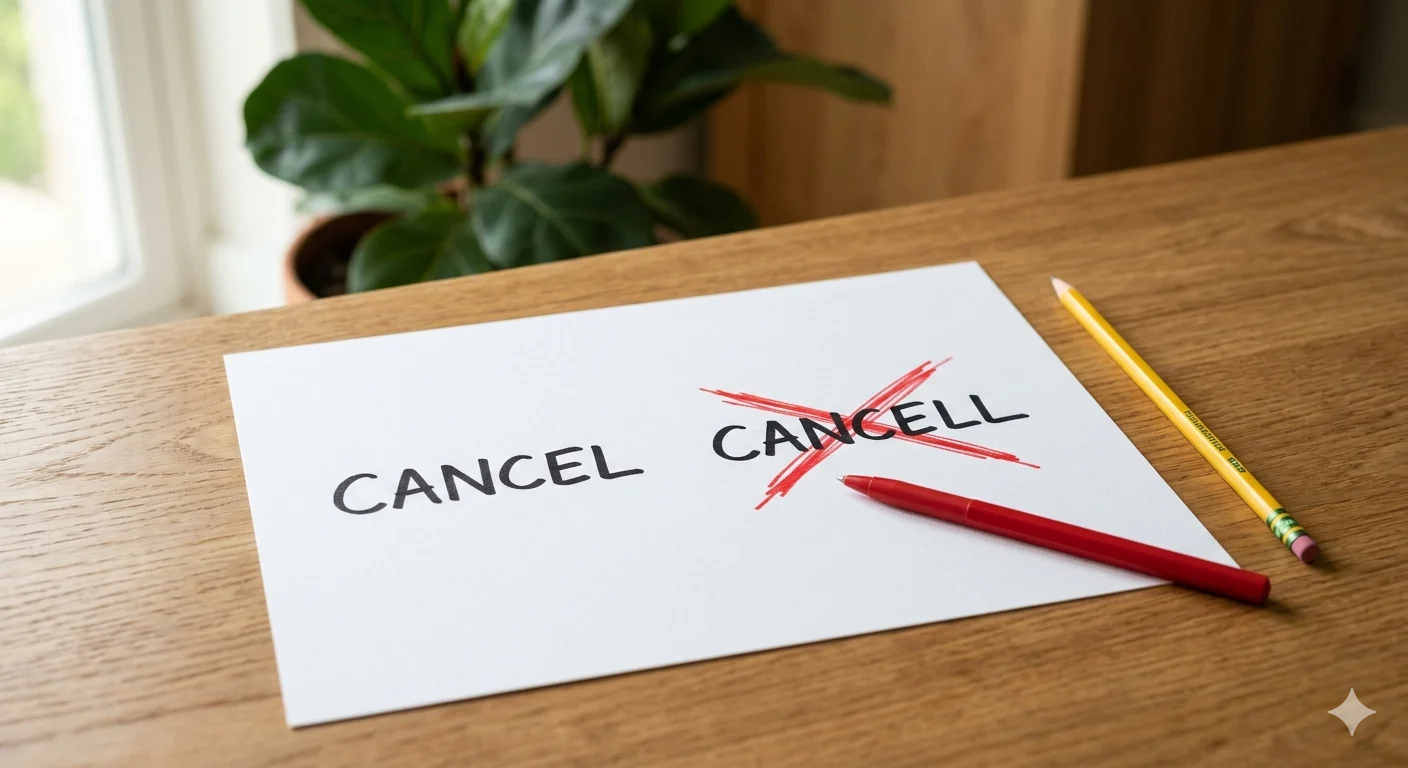
Cancel is correct. Cancell is wrong.
That is it. The base word always has one L. Think of it like this:
- Cancel = correct ✅
- Cancell = mistake ❌
Examples:
- “Please cancel my flight.” (correct)
- “Please cancell my flight.” (wrong)
Cancell or cancel meaning is the same idea. The meaning does not change. Only the spelling matters. And the correct spelling is cancel.
If you see someone write “cancell,” they made a typo. It happens. But now you know better.
Where Did This Confusion Come From?
The word cancel comes from Latin. The original word was cancellare. It meant “to cross out” or “to make a lattice pattern.” Think of a gate with crossing lines. That is a lattice. When you cancel something, you cross it out.

Old French changed it to canceller. English borrowed it in the 1300s. For hundreds of years, people spelled it many ways. But by the 1800s, cancel became the standard.
So why do people still search cancell or cancel? Because English has many words that double their last letter. Look at these examples:
| Base word | US past tense | UK past tense |
|---|---|---|
| travel | traveled | travelled |
| label | labeled | labelled |
| cancel | canceled | cancelled |
People see “travelled” with two Ls. They think “cancelled” must also have two Ls in the base form. But that is wrong. The base form cancel never changes. Only the past tense changes.
Is it cancel or cancell? It is cancel. Always.
American English vs British English – The Big Split
Here is where most people get confused. The base word cancel is the same everywhere. But the past tense is different.
American English (United States, Philippines, Latin America)
- Past tense: canceled (one L)
- Present participle: canceling (one L)
- Noun: cancellation (two Ls – yes, this is the trap!)
British English (UK, Australia, New Zealand, South Africa)
- Past tense: cancelled (two Ls)
- Present participle: cancelling (two Ls)
- Noun: cancellation (two Ls – same as US)
Look at this table carefully:
| Word form | American | British |
|---|---|---|
| I need to cancel | ✅ cancel | ✅ cancel |
| Yesterday I canceled | ✅ canceled | ❌ canceled |
| Yesterday I cancelled | ❌ cancelled | ✅ cancelled |
| I am canceling | ✅ canceling | ❌ canceling |
| I am cancelling | ❌ cancelling | ✅ cancelling |
| The cancellation | ✅ cancellation | ✅ cancellation |
Canceled or cancelled AP style – AP (Associated Press) is the American news standard. They say canceled with one L. All US newspapers follow this.
Is cancelled UK spelling? Yes. If you see cancelled with two Ls, that is British English.
Does the double L matter in cancellation? Yes. This word always has two Ls. Even Americans write cancellation with two Ls. Many people forget this and write “cancelation” (wrong). Do not make that mistake.
Which One Should You Actually Use?
This depends on who is reading your writing.
If you write for Americans:
- Use cancel (base)
- Use canceled (past)
- Use canceling (-ing form)
- Example: “The show was canceled due to rain.”
If you write for British, Australian, or New Zealand readers:
- Use cancel (base)
- Use cancelled (past)
- Use cancelling (-ing form)
- Example: “The show was cancelled due to rain.”
If you write for a global audience (everyone in the world):
Pick one spelling and stick with it. American spelling is more common online. But British spelling is also accepted everywhere. The key is consistency. Do not write “canceled” in one sentence and “cancelling” in the next.
If you write for school or work:
Ask your teacher or boss. American companies use American spelling. British companies use British spelling. International organizations often accept both.
Cancell or cancel synonym – No matter which spelling you choose, the synonyms are the same: call off, scrap, drop, abort, revoke, annul, nullify.
Common Mistakes People Make Every Day
Here are the top 7 mistakes with cancell or cancel. Avoid these and you will look like a professional writer.
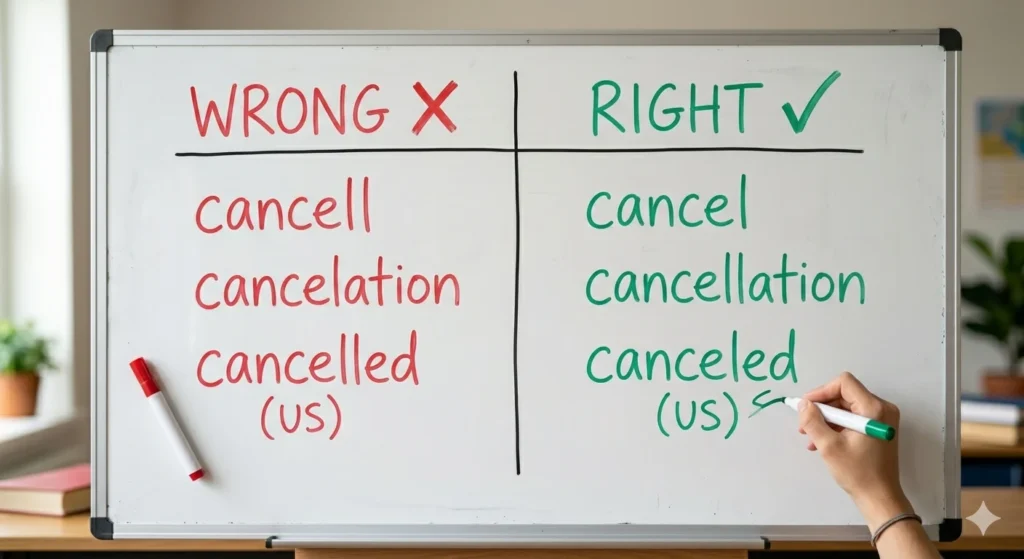
Mistake #1: Writing “cancell”
Wrong: “I want to cancell my appointment.”
Right: “I want to cancel my appointment.”
Can cancel be spelled with two L’s? No. Never in the base form.
Mistake #2: Mixing US and UK forms
Wrong: “The flight was canceled, so they are cancelling all bookings.”
Right (US): “The flight was canceled, so they are canceling all bookings.”
Right (UK): “The flight was cancelled, so they are cancelling all bookings.”
Mistake #3: Forgetting the double L in cancellation
Wrong: “We sent a cancelation notice.”
Right: “We sent a cancellation notice.”
Mistake #4: Using “cancelled” in US news writing
Wrong (for AP style): “The game was cancelled.”
Right (for AP style): “The game was canceled.”
Mistake #5: Typing “cancel” when you mean “cancellation”
Wrong: “There was a last minute cancel.”
Right: “There was a last minute cancellation.”
Mistake #6: Spelling the past tense of “cancel” as “canceled” in British English
Wrong (for UK): “The event was canceled.”
Right (for UK): “The event was cancelled.”
Mistake #7: Searching “cancell or cancel” and still being confused
You found this article. You are no longer confused. Good job.
Cancel past tense – Just remember: US = canceled (one L), UK = cancelled (two Ls).
Real Life Examples – Emails, News, Social Media, Formal Writing
Let us see cancell or cancel in action. These are real situations where you will use this word.
In Emails (Cancell or cancel email)
Example 1 – Subscription cancellation:
Subject: Please cancel my account
Dear Support Team,
I want to cancel my monthly subscription. My account email is john@example.com. Please confirm the cancellation.
Thank you.
Example 2 – Appointment cancellation (US):
Hi Dr. Smith,
I need to cancel my appointment for Tuesday. I canceled the wrong appointment earlier. Sorry for the confusion.
Example 3 – Appointment cancellation (UK):
Dear Dr. Smith,
I need to cancel my appointment for Tuesday. I cancelled the wrong appointment earlier. Sorry for the confusion.
In News Headlines
American news (AP style):
“NFL cancels Sunday games due to storm”
“Flight canceled after mechanical issue”
British news (BBC style):
“Train services cancelled across London”
“Festival cancels final day after flooding”
On Social Media
Twitter (X):
“They canceled my favorite show. I am so angry. 😤 #SaveTheShow”
Reddit (r/grammar):
User asks: “Cancelled or canceled reddit – which is right?”
Top reply: “Both are right. US uses canceled. UK uses cancelled. Pick one and be consistent.”
Instagram caption:
“Weather canceled our beach day. New plan: movies and pizza. 🍕”
In Formal Writing
Business contract:
“Either party may cancel this agreement with 30 days written notice. Cancellation must be sent by certified mail.”
Academic paper (US university):
“The researcher canceled the experiment due to equipment failure.”
Legal document (UK):
“The tenant cancelled the lease agreement before the move-in date.”
Cancell or cancel email – Always write “cancel” in the base form. Never write “cancell.”
Cancell or cancel synonym in formal writing: rescind, terminate, void, annul.
Google Trends – What the Data Shows
When you search cancell or cancel on Google, here is what the data says:
- “Cancel” is searched more than 10,000 times every month.
- “Cancell” is a typo. It has very low search volume.
- “Canceled vs cancelled” is searched most in the United States, Canada, and Australia.
- “Cancelled” (two Ls) is more popular in the UK, Ireland, New Zealand, and South Africa.
- “Canceled” (one L) dominates in the US, Philippines, and Latin America.
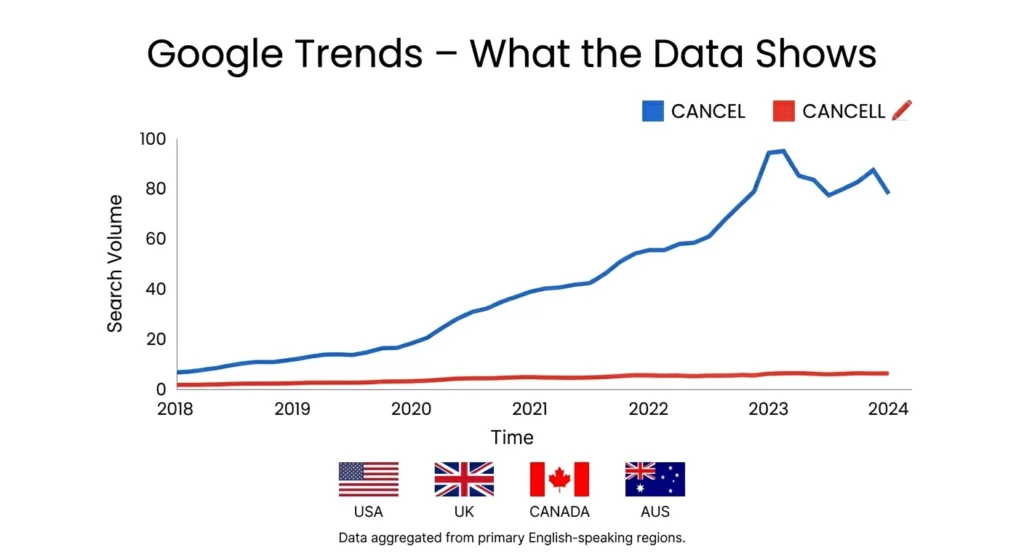
The search cancell or cancel meaning spikes when people are writing important emails. They want to be sure before they hit send.
Canceled or cancelled AP style – This search is done mostly by American journalists and students. AP style is clear: use canceled.
Cancelled or canceled reddit – This is a very common search. Reddit users love to debate small grammar rules. The most upvoted answers always say: “Both are correct. Know your audience.”
Cancell or cancel synonym – People search this when they are tired of using the same word again and again. Synonyms like “call off” and “scrap” are popular alternatives.
Cancell or Cancel Meaning – Deep Dive
Let us fully understand cancell or cancel meaning. The word has several meanings depending on the situation.
Meaning 1: To stop something from happening
“The school canceled the field trip.”
“They cancelled the wedding.”
Meaning 2: To mark something as void or unused
“Please cancel this stamp before reusing it.”
“The check was canceled after payment.”
Meaning 3: To end a contract or subscription
“I want to cancel my gym membership.”
“Netflix cancelled my account after non-payment.”
Meaning 4: To cross out written words
“Cancel the last sentence and rewrite it.”
“The editor canceled the entire paragraph.”
Meaning 5: In mathematics – to remove equal terms
“You can cancel the X on both sides of the equation.”
Meaning 6: In social media – to stop supporting someone
“Fans tried to cancel the singer after his comments.”
“The hashtag #CancelThat trended for days.”
So cancell or cancel meaning is wide. But the spelling rule never changes. Always cancel for the base form.
Cancell or cancel synonym for each meaning:
- Stop = call off, abort
- Mark void = nullify, annul
- End subscription = terminate, drop
- Cross out = delete, strike
- Math = remove, eliminate
- Social = boycott, shun
The Noun Trap – Cancellation Every Time
One more thing. Many people write cancelation with one L. That is wrong in both American and British English.
The noun form is always cancellation with two Ls.
Examples:
- “We regret the cancellation of the event.” ✅
- “We regret the cancelation of the event.” ❌
Does the double L matter in cancellation? Yes. Very much. Spelling it with one L is a clear mistake. Even the strictest AP style guide says cancellation with two Ls.
So remember:
- Base verb = cancel (one L)
- Past tense US = canceled (one L)
- Past tense UK = cancelled (two Ls)
- Noun (all dialects) = cancellation (two Ls)
Quick Reference – Cancel Past Tense and More
Here is your cheat sheet for cancel past tense and all other forms:
| Tense / Form | American | British |
|---|---|---|
| Present | I cancel | I cancel |
| Past | I canceled | I cancelled |
| Past participle | I have canceled | I have cancelled |
| Present participle | I am canceling | I am cancelling |
| Noun | cancellation | cancellation |
| 3rd person singular | He cancels | He cancels |
Is it cancel or cancell? → Cancel.
Can cancel be spelled with two l’s? → No, not the base form.
Is cancelled UK spelling? → Yes.
Canceled or cancelled AP style → Canceled.
Cancelled or canceled reddit → Both, but pick one and stay consistent.
Cancell or cancel meaning → To stop, void, or end something.
Cancell or cancel synonym → Call off, scrap, drop, abort, revoke, annul.
Cancell or cancel email → “Please cancel my subscription.”
Conclusion
You started with one question: cancell or cancel? Now you know the answer. Cancel is always correct. Cancell is always wrong. That is rule number one.
Rule number two is about the past tense. American English uses canceled with one L. British English uses cancelled with two Ls. Both are right. Just know your audience.
Rule number three is about the noun. Cancellation always has two Ls. Never write “cancelation.”
Cancel past tense is simple now. One L for US. Two Ls for UK. Cancell or cancel meaning is clear: to stop or void something. Cancelled or canceled reddit debates will continue, but you have the final answer.
Next time you write an email, use cancel. Your spelling will be perfect. Your grammar will be strong. And you will never doubt yourself again.

“Rose Macaulay shares the charm of idioms on LearnIdom.com, making language learning delightful, insightful, and full of wit for every reader.”