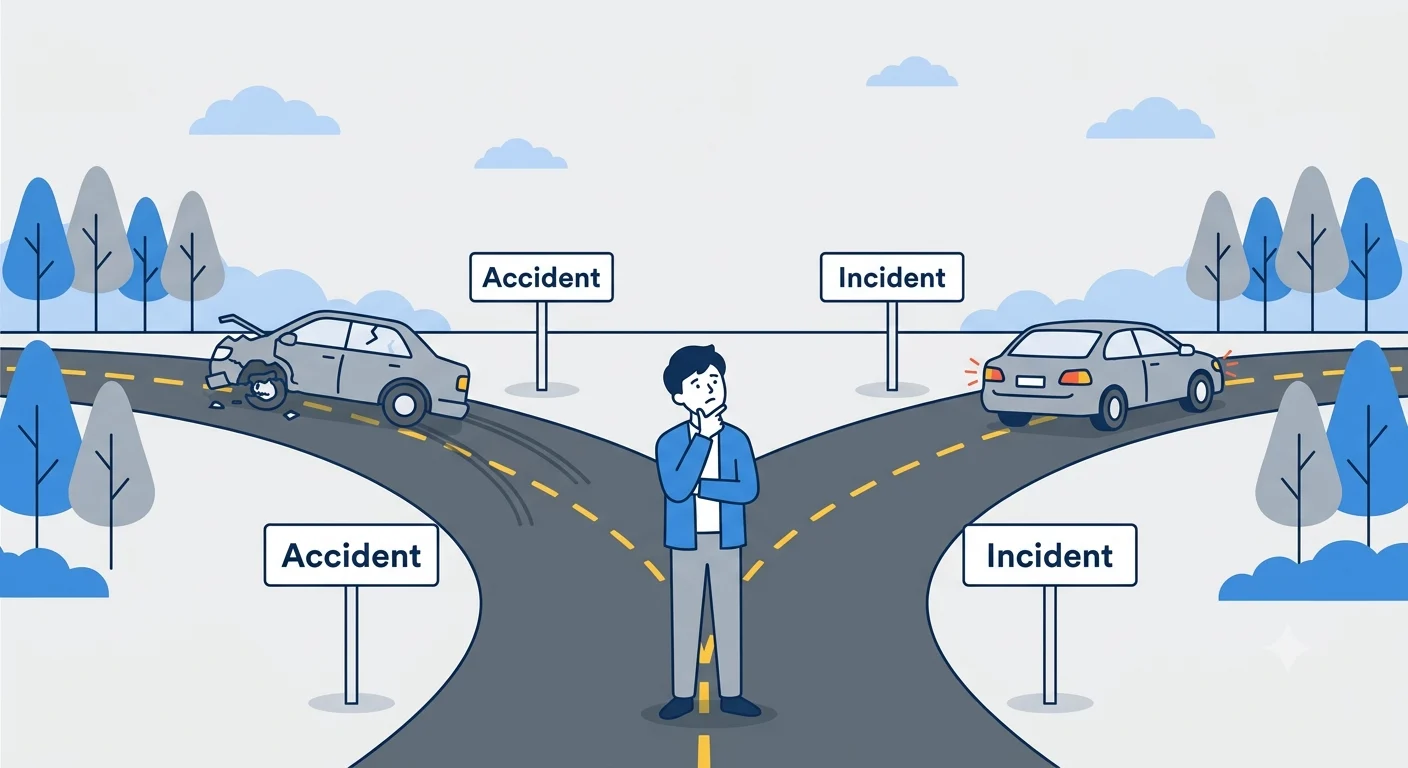
Incident vs accident is a common English word-choice question because both words can describe something that happens, but their meanings are different. An incident is an event or occurrence, especially one that is unusual, noteworthy, or potentially problematic, while an accident is an unexpected event that happens unintentionally and may cause damage or injury.
For example, “The school reported a minor incident” describes an event, while “He was involved in a car accident” describes an unintended event that caused harm or damage. Understanding incident vs accident, including their definitions, differences, usage, pronunciation, and example sentences, can help English learners choose the right word in everyday conversations, news reports, workplace communication, and formal writing.
This guide explains the key differences between incident and accident in simple English, with clear examples to make the distinction easy to remember.
What is the Difference Between an Incident and an Accident? ⚡
This is the most asked question. So here is the fastest answer possible.
| Situation | Is it an Incident? | Is it an Accident? |
|---|---|---|
| A car crashes into a tree. Someone is hurt. | ✅ Yes (it is an event) | ✅ Yes (harm happened) |
| A car skids but stops safely. No one is hurt. | ✅ Yes (it is an event) | ❌ No (no harm) |
| A worker falls from a ladder. Broken leg. | ✅ Yes | ✅ Yes |
| A worker slips but catches the railing. No fall. | ✅ Yes | ❌ No |
| A small fire in a trash can. Put out in 2 seconds. | ✅ Yes | ❌ No |
| A house burns down completely. | ✅ Yes | ✅ Yes |
The golden rule: Every accident is an incident. But NOT every incident is an accident.
👉 What is the difference between an incident and an accident form? An accident form asks for injury and damage details. An incident form asks for any event — even if nothing broke and no one got hurt.
Where Do the Words Incident and Accident Come From? 📜
Ever wonder why we have two different words for almost the same thing? History explains it.
Accident comes from the Latin word accidere. It means “to fall upon” or “to happen to.” Imagine something falling on you from the sky — that is the feeling. Unlucky. Unexpected. By the 1500s, English speakers used “accident” only for bad events with damage or injury.
Incident comes from the Latin word incidere. It means “to fall into” or “to happen.” This word is wider and more neutral. A funny conversation is an incident. A fight is an incident. A butterfly landing on your hand is also an incident.

Why do we have both? Because English took both words from French after the Norman Conquest of 1066. French kept both words alive. Over 500 years, “accident” became the “bad luck” word, and “incident” stayed the “any event” word.
📌 Fun fact: In the 1900s, factories started using “incident” on purpose. They believed calling everything an “accident” made workers feel helpless (like fate). They wanted workers to report “incidents” (small problems) so they could fix them before they became “accidents” (injuries).
Do Americans and British Spell Incident or Accident Differently? 🇺🇸🇬🇧
Good news! Spelling is exactly the same in both countries.
- Accident → A-C-C-I-D-E-N-T (everywhere)
- Incident → I-N-C-I-D-E-N-T (everywhere)
However, how people USE the words is different.
American English Usage 🇺🇸
Americans say “accident” for almost everything — car crashes, sports injuries, kitchen cuts. They use “incident” more for police or work reports.
Examples:
- “He had a car accident on the highway.” 🚗
- “There was an incident at the school today.” 🏫
British English Usage 🇬🇧
British people use “incident” much more often in formal settings — police, military, trains, government. “Accident” is reserved for clear harm.
Examples:
- “A serious incident occurred on the railway.” 🚂
- “Three people died in a road accident.” 😔
Comparison Table: UK vs US Usage
| Word | British Use | American Use | UK Example | US Example |
|---|---|---|---|---|
| Accident | Only for harm/damage | Wide use, any unplanned harm | “A workplace accident” | “A car accident” |
| Incident | Police, military, formal | Neutral event | “A security incident” | “An incident at the mall” |
| Near miss | Very common in safety | Common in safety reports | “Report any near miss” | “Log the near miss” |
👉 The bottom line: Spelling is easy. But if you write for Americans, use “accident” more. If you write for British readers, use “incident” more in formal writing.
Which Word Should You Use – Incident or Accident? (Audience Guide) 👥
This depends on who you are talking to. Here is your simple guide.
1. You are writing for Americans 🇺🇸
Use accident for anything with harm. Use incident for neutral or police events.
✅ “A bad car accident on I-95.”
✅ “The incident with the loud music was resolved.”
2. You are writing for British or Commonwealth (UK, Australia, Canada) 🇬🇧🇦🇺🇨🇦
Use incident more in professional reports. Use accident only for clear injury or damage.
✅ “A major incident shut down the train station.”
✅ “He died in a climbing accident.”
3. You are writing for global audience (non-native English speakers) 🌍
Keep it simple. Accident = harm. Incident = any event.
✅ “This is the difference between accident and incident that everyone should know.”
4. You are writing for safety professionals (OSHA, NEBOSH, ISO 45001) 🦺
Use the technical definitions exactly.
- Accident = Unplanned event that results in injury, illness, or damage.
- Incident = Unplanned event that COULD have resulted in injury/damage (near miss) OR did result in minor harm.
- Near miss = Incident with zero harm or damage.
👉 Is death an incident or accident? Death can be both. If a crash kills someone → accident. If a planned fight kills someone → criminal incident. In safety reports, a death is always called an accident (unplanned).
What Are Common Mistakes With Incident and Accident? ❌
People make these errors daily. Do NOT make them.
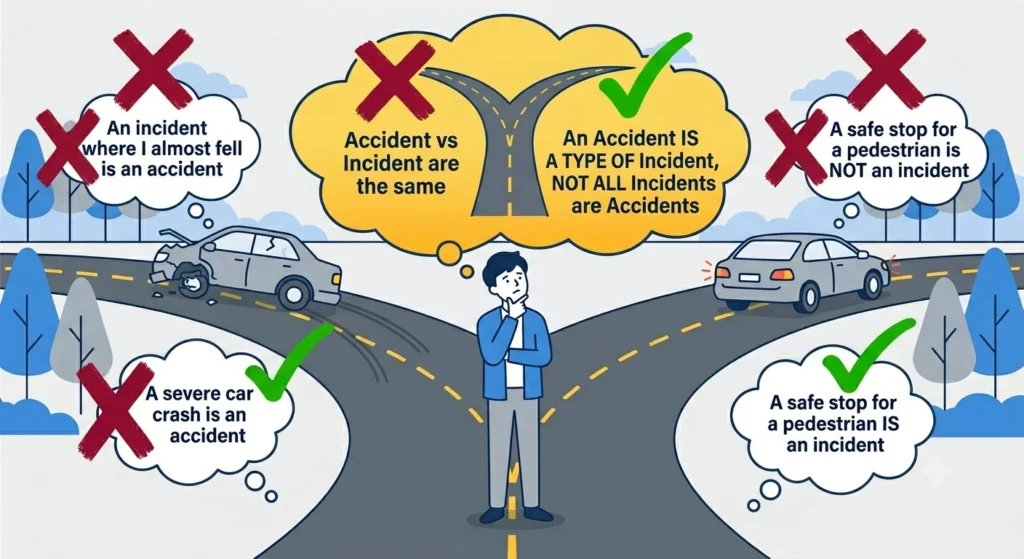
Mistake 1: Calling everything an “accident”
❌ Wrong: “I had an accident when I dropped my pencil.”
✅ Correct: “I had an incident when I dropped my pencil.” (No harm = incident)
Mistake 2: Calling a near miss an “accident”
❌ Wrong: “The almost-crash was an accident.”
✅ Correct: “The almost-crash was an incident (a near miss).”
Mistake 3: Confusing accident and incident forms
❌ Wrong: “I will write an incident report for the broken arm.”
✅ Correct: “I will write an accident report for the broken arm.” (Harm = accident form)
👉 What is the difference between an incident and an accident form?
- Accident form = for injuries and damage. Asks “what broke?” and “who got hurt?”
- Incident form = for any event. Asks “what happened?” even if no one was hurt.
Mistake 4: Not knowing if fire is incident or accident
❌ Wrong: “Every fire is an accident.”
✅ Correct: Fire is incident or accident? Depends on the result.
- Small fire, no damage → incident
- Big fire, house burns → accident
- Fire started on purpose → crime (neither)
Mistake 5: Confusing “waiving” and “waving”
Many people ask: is it waiving a fee or waving a fee? Here is the answer.
- Waiving a fee = removing or cancelling a fee. (Example: The bank is waiving the late fee.)
- Waving a fee = moving your hand to say hello to a fee. (This makes no sense! ❌)
✅ Correct: “The company is waiving the application fee.”
Incident or Accident in Urdu – آسان اردو میں فرق 🇵🇰
اگر آپ incident or accident in Urdu جاننا چاہتے ہیں تو یہ رہا آسان جواب۔
- Accident (ایکسیڈنٹ) = حادثہ۔ جب کوئی برا واقعہ ہو جس میں چوٹ لگے، نقصان ہو، یا موت واقع ہو۔
- Incident (انسڈنٹ) = واقعہ۔ کوئی بھی کام جو ہو جائے — اچھا، برا، یا معمولی۔ ضروری نہیں کہ نقصان ہو۔
مثال (Example):
- گاڑی کا درخت سے ٹکرا کر ٹوٹ جانا = Accident (حادثہ)
- گاڑی کا بچنا لیکن درخت نہ ٹکرانا = Incident (واقعہ)
Incident or accident meaning in Urdu: حادثہ کا مطلب ہے نقصان۔ واقعہ کا مطلب ہے کوئی بھی عمل۔
👉 Difference between incident and accident in safety (سیفٹی میں فرق): سیفٹی آفیسرز صرف حادثات (accidents) کی نہیں بلکہ واقعات (incidents) کی بھی رپورٹ کرتے ہیں تاکہ بڑا حادثہ ہونے سے پہلے روکا جا سکے۔
Incident or Accident in Everyday Life – Real Examples 📱
See how real people use these words every day.
In Emails (Workplace)
Subject: Safety Report – June 15
“There was a near miss incident today in the warehouse. A box fell from the top shelf. Nobody was hurt. Please review the difference between accident and incident before our next safety meeting.”
In News Headlines 📰
“Four injured in serious road accident on Highway 101.” 🚗
“Police investigate incident at downtown bank; no injuries reported.” 👮
In Social Media 📱
“Omg just saw a terrible car accident outside my window. Hope everyone is ok.” 😢
“Strange incident at the coffee shop. Someone’s laptop just exploded but no one was hurt.”
In Formal Safety Reports 📋
“Accident, incident, near miss definition according to OSHA Standard 1904:
- Accident = injury or damage reported
- Incident = any unplanned event logged
- Near miss = incident with zero harm”
Difference Between Accident and Incident Example (Clear Table)
| Scenario | Type | Why? |
|---|---|---|
| Worker cuts hand on machine, bleeds | Accident | Injury happened |
| Machine jams, worker stops it in time | Incident (near miss) | No injury |
| Car hits pedestrian | Accident | Harm happened |
| Car brakes suddenly, pedestrian jumps back | Incident | No harm |
| House fire, family escapes safely but house damaged | Accident | Damage happened |
| Candle starts small fire on table, person puts it out fast | Incident | No damage |
Is Fire Incident or Accident? 🔥 Complete Answer
This is a very common question. Let me give you the complete answer.
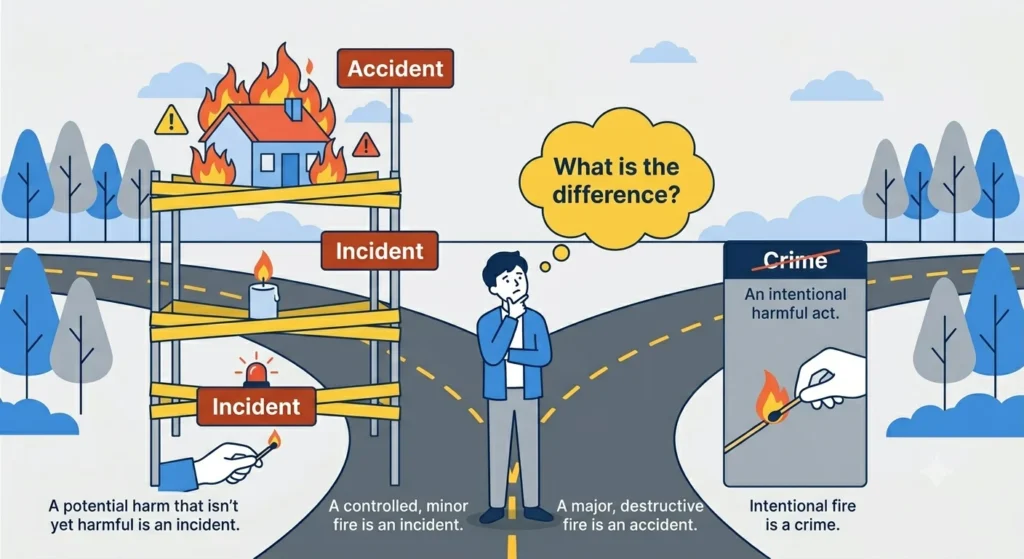
Fire is incident or accident? It depends on the result.
| Type of Fire | Call it Incident? | Call it Accident? | Why? |
|---|---|---|---|
| Match burns a napkin, you put it out | ✅ Yes | ❌ No | No damage or injury |
| Toaster catches fire, smoke only | ✅ Yes | ❌ No | No damage |
| Small trash can fire, put out quickly | ✅ Yes | ❌ No | Contained fast |
| Kitchen fire damages cabinets | ✅ Yes | ✅ Yes | Damage happened |
| House fire, family inside gets hurt | ✅ Yes | ✅ Yes | Injury + damage |
| Forest fire, trees burn | ✅ Yes | ✅ Yes | Major damage |
| Arson (someone starts fire on purpose) | ✅ Yes | ❌ No (it’s a crime) | Intentional |
Quick rule for fire:
- No damage = Incident
- Damage or injury = Accident
- On purpose = Crime (not accident or incident)
👉 Incident or accident example for fire: A candle falls. The carpet burns a little hole. That is an accident (damage). A candle falls. You catch it before anything burns. That is an incident (no damage).
Accident, Incident, Near Miss Definition – Complete Table 📊
Safety professionals use these three terms every day. Here is the exact definition of each.
| Term | Simple Definition | Does Harm Happen? | Example |
|---|---|---|---|
| Accident | Unplanned event with injury, death, or damage | ✅ Yes | Fall from ladder → broken bone |
| Incident | Any unplanned event (harmful or not) | ❌ No / Maybe | Slip but catch railing |
| Near Miss | Incident with POTENTIAL for harm but NO actual harm | ❌ No | Box almost hits head |
Car accident vs incident example:
- Car accident: Two cars collide. Airbags open. People go to hospital.
- Car incident: Two cars almost collide. Both brake in time. No one is hurt.
👉 What is the difference between an incident and an accident form? An accident form has a section for “injury description” and “damage cost.” An incident form has a section for “what almost happened” and “prevention steps.”
Incident or Accident – Google Trends & Usage Data 📊
What does real data say about how people use these words?
By Country (Last 12 months)
| Country | Most Searched Term | Popularity Ratio |
|---|---|---|
| United States | “Car accident” | 10:1 vs “car incident” |
| United Kingdom | “Traffic accident” + “Traffic incident” | 60:40 |
| India | “Incident or accident in Urdu” | Very high |
| Australia | “Workplace incident” | Now > “workplace accident” |
| Canada | “Car accident” | 8:1 |
By Context
| Context | Preferred Word | Why? |
|---|---|---|
| Legal documents | Incident report | More neutral, avoids blame |
| News media | Accident | More dramatic, gets clicks |
| Safety training | Incident + Near miss | Focuses on prevention |
| Police reports | Incident | Formal and neutral |
| Everyday conversation | Accident | Common and simple |
Google Trends Insight 🔍

- Searches for “difference between accident and incident” peak every September (safety training season)
- Searches for “incident or accident meaning” highest in manufacturing states (Ohio, Michigan, Texas)
- “Incident or accident in Urdu” searches have grown 300% in 2 years
👉 What this means for you: If you work in safety, use “incident” and “near miss” more. If you are a normal person, “accident” is fine for harm.
Frequently Asked Questions (FAQs) ❓
1. What is the difference between an incident and an accident?
An accident always causes harm (injury, death, or damage). An incident is any event — it might cause harm or not. All accidents are incidents, but not all incidents are accidents.
2. Is death an incident or accident?
It depends. If death is caused by an unplanned event (crash, fall, fire), it is an accident. If death is caused by a planned action (fight, crime, war), it is a criminal incident.
3. What is the difference between an incident and an accident form?
An accident form asks for injury details, damage cost, and medical treatment. An incident form asks for what happened, even if no one was hurt — including near misses and strange events.
4. What are incident examples?
- Dropping a glass (no break, no cut)
- A machine stopping for 2 seconds
- A loud noise with no injury
- A customer yelling (no physical harm)
- A near miss on stairs (slip but no fall)
- A fire that goes out by itself
5. Fire is incident or accident?
- Small fire, no damage = incident
- Big fire with damage or injury = accident
- Fire started on purpose = crime (neither)
6. Can the same event be both an incident and an accident?
Yes. A car crash is an accident (harm happened). It is also an incident (an event occurred). The word “incident” is the bigger category. Think of it like this: all squares are rectangles, but not all rectangles are squares.
7. What is the difference between accident and incident in safety?
In safety: An accident requires a full investigation (someone got hurt or something broke). An incident requires a simple log entry (no one got hurt, but something happened). Incidents are treated as warnings to prevent future accidents.
8. What is a near miss?
A near miss is a type of incident where harm almost happened but did not. Example: A tool falls from a ladder and lands right next to a worker’s head. No injury. That is a near miss. Report it to prevent a future accident.
9. Is it waiving a fee or waving a fee?
Waiving a fee is correct. It means to cancel or remove a fee. Waving a fee is incorrect — that would mean moving your hand at a fee, which makes no sense. ✅ Correct: “The bank is waiving the late fee this month.”
10. Where can I find incident or accident in Urdu translation?
Incident in Urdu = واقعہ (Waqia). Accident in Urdu = حادثہ (Haadsa). Waqia is any event. Haadsa is a bad event with harm.
Conclusion🎯
You made it! Now you understand the real difference between incident and accident.
Let me summarize everything in three simple lines:
- Accident = unplanned event + harm (injury, death, or damage)
- Incident = any unplanned event (harm or no harm)
- Near miss = incident with potential for harm but no actual harm
Remember this incident or accident example: A car crash that hurts someone is an accident. A car that almost crashes but stops safely is an incident (near miss).
What is the difference between an incident and an accident form? Accident forms ask “what broke and who got hurt?” Incident forms ask “what happened — even if nothing broke?”
Is fire incident or accident? No damage = incident. Damage = accident. On purpose = crime.
Incident or accident meaning in Urdu: حادثہ (Haadsa) = harm. واقعہ (Waqia) = any event.
Difference between accident and incident in safety: Safety experts track incidents (near misses) to stop accidents (injuries) before they happen.
Car accident vs incident example: Crash = accident. Almost crash = incident.
Accident, incident, near miss definition: Accident = harm. Incident = any event. Near miss = almost harm.
And if you ever forget: Just ask one question — “Was anyone hurt or was anything broken?” If yes → ACCIDENT. If no → INCIDENT.
Now go use these words with confidence! 🚀

“Rose Macaulay shares the charm of idioms on LearnIdom.com, making language learning delightful, insightful, and full of wit for every reader.”