Life is full of moments when things feel completely impossible—a deadline that’s too tight, a problem with no slution, or a task that just can’t be done. In English, we often describe these moments using idioms for impossible situations, and native speakers use them all the time without even thinking about it.
Imagine trying to explain to your friend that fixing an old phone is pointless, or that convincing someone is a waste of time. Instead of long explanations, idioms help you say it quickly and naturally.
That’s why learning idioms for impossible situations is such a powerful step toward sounding fluent. In this guide, you’ll learn 20 of the most famous idioms, broken down in a simple, learner-friendly way—with meanings, examples, and common mistakes—so you can confidently use them in real conversations.
Like Finding a Needle in a Haystack

Word-by-word meaning: A needle hidden in dry grass
Idiomatic meaning: Something extremely hard or almost impossible to find
Example sentence: Finding that old email is like finding a needle in a haystack.
Common error: Using it for easy searches
Usage note: Often used for searches, people, or objects
When Pigs Fly

Word-by-word meaning: Pigs flying in the air
Idiomatic meaning: Something that will never happen
Example sentence: He’ll apologize when pigs fly.
Common error: Using it for unlikely but possible events
Usage note: Very informal and humorous
A Snowball’s Chance in Hell

Word-by-word meaning: A snowball surviving in extreme heat
Idiomatic meaning: No chance at all
Example sentence: We have a snowball’s chance in hell of winning.
Common error: Using in formal writing
Usage note: Casual and strong in tone
Mission Impossible

Word-by-word meaning: An impossible mission
Idiomatic meaning: A task that cannot be done
Example sentence: Finishing this in one day feels like Mission Impossible.
Common error: Forgetting capitalization when referencing the idiom
Usage note: Inspired by pop culture
Beat a Dead Horse
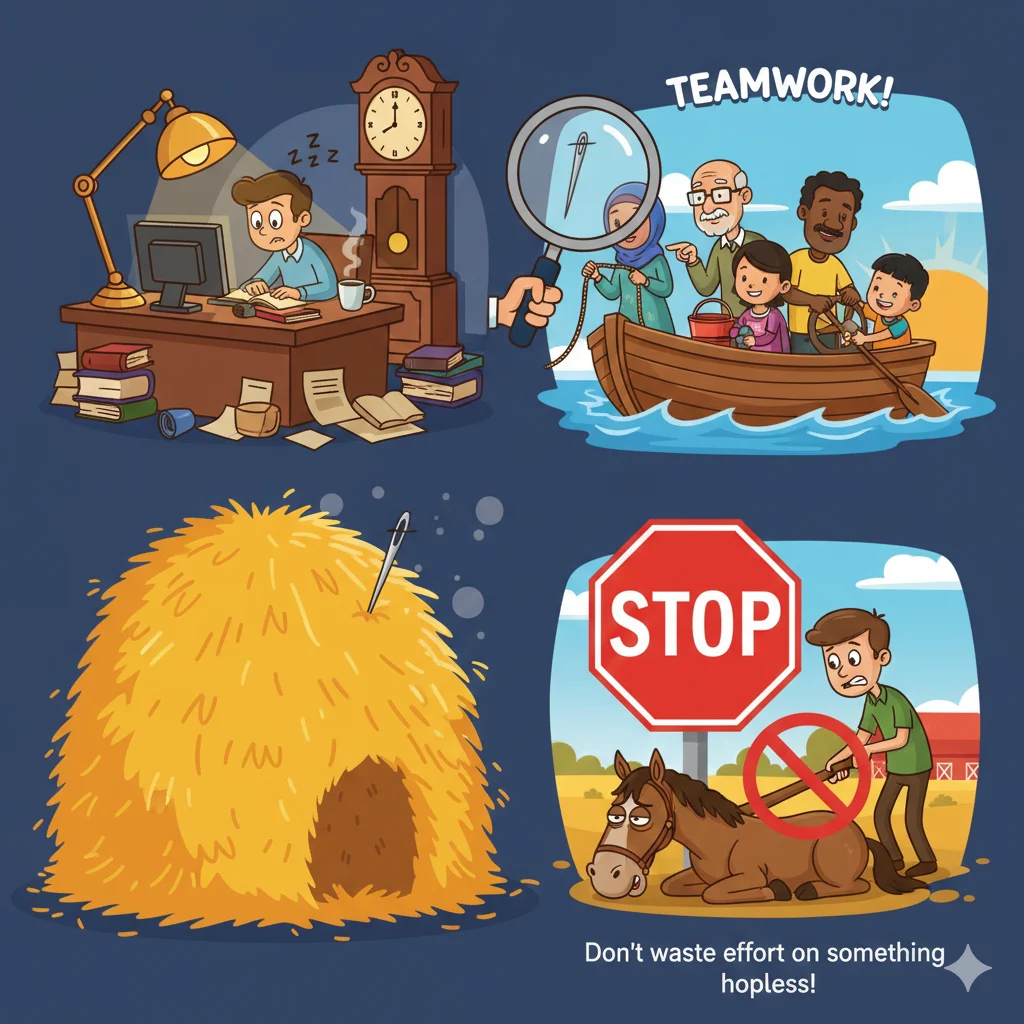
Word-by-word meaning: Hitting an already dead horse
Idiomatic meaning: Wasting time on something pointless
Example sentence: Arguing more is just beating a dead horse.
Common error: Using it for new discussions
Usage note: Common in debates
Draw Water from a Stone
Word-by-word meaning: Getting water from stone
Idiomatic meaning: Trying to get something impossible
Example sentence: Asking him for help is like drawing water from a stone.
Common error: Mixing with “blood from a stone”
Usage note: British and American English
Ask for the Moon
Word-by-word meaning: Requesting the moon
Idiomatic meaning: Asking for something unrealistic
Example sentence: She’s asking for the moon with those demands.
Common error: Confusing with ambition
Usage note: Used for unreasonable requests
Square the Circle
Word-by-word meaning: Turning a circle into a square
Idiomatic meaning: Trying to do the impossible
Example sentence: Balancing both sides is like squaring the circle.
Common error: Using it literally
Usage note: Often used intellectually
Catch the Wind
Word-by-word meaning: Grabbing air
Idiomatic meaning: Trying to do something impossible
Example sentence: Convincing her now is like trying to catch the wind.
Common error: Confusing with “catch a break”
Usage note: Poetic tone
A Lost Cause
Word-by-word meaning: Something already lost
Idiomatic meaning: No hope of success
Example sentence: Fixing that car is a lost cause.
Common error: Using before all options are tried
Usage note: Neutral and common
Climb a Glass Mountain
Word-by-word meaning: Climbing smooth glass
Idiomatic meaning: Facing an impossible challenge
Example sentence: Starting again felt like climbing a glass mountain.
Common error: Rarely used incorrectly
Usage note: Less common but vivid
Like Nailing Jelly to a Wall
Word-by-word meaning: Nailing soft jelly
Idiomatic meaning: Doing something impossible or chaotic
Example sentence: Organizing them is like nailing jelly to a wall.
Common error: Overusing in formal speech
Usage note: British English
No Win Situation
Word-by-word meaning: No possible victory
Idiomatic meaning: Every option leads to failure
Example sentence: It’s a no-win situation.
Common error: Adding “-ing”
Usage note: Very common in speech
Beyond Reach
Word-by-word meaning: Too far to touch
Idiomatic meaning: Impossible to achieve
Example sentence: That goal is beyond reach right now.
Common error: Using for temporary delays
Usage note: Neutral tone
Tilt at Windmills
Word-by-word meaning: Attacking windmills
Idiomatic meaning: Fighting imaginary or impossible enemies
Example sentence: He’s tilting at windmills with that plan.
Common error: Not understanding literary origin
Usage note: Literary but still used
Chase a Wild Goose
Word-by-word meaning: Running after a wild bird
Idiomatic meaning: Wasting time on an impossible task
Example sentence: This lead is a wild goose chase.
Common error: Forgetting “wild”
Usage note: Very common
Pipe Dream
Word-by-word meaning: Dream from smoke
Idiomatic meaning: Unrealistic hope
Example sentence: That plan is just a pipe dream.
Common error: Using positively
Usage note: Casual tone
Get Blood from a Stone
Word-by-word meaning: Forcing stone to bleed
Idiomatic meaning: Asking the impossible
Example sentence: Getting money from him is like blood from a stone.
Common error: Mixing with similar idioms
Usage note: Very common in UK English
Not a Chance
Word-by-word meaning: Zero possibility
Idiomatic meaning: Completely impossible
Example sentence: Not a chance this will work.
Common error: Overusing for minor doubts
Usage note: Informal emphasis
Up Against a Brick Wall
Word-by-word meaning: Facing a solid wall
Idiomatic meaning: No way forward
Example sentence: We’re up against a brick wall.
Common error: Confusing with “hit a wall”
Usage note: Widely used in work contexts
Frequently Asked Questions About Idioms for Impossible Situations
1. Why should I learn idioms for impossible situations?
They help you sound natural and express complex ideas quickly.
2. Are these idioms formal or informal?
Most are informal, but some work in neutral or professional contexts.
3. Can I use idioms in writing exams?
Yes, but choose neutral ones and don’t overuse them.
4. How can I remember idioms easily?
Link them to real-life situations or funny images.
5. Do native speakers use these idioms daily?
Absolutely—especially in conversations and storytelling.
Conclusion
Idioms may describe impossible situations, but learning them doesn’t have to feel impossible at all. Start by choosing just three idioms for impossible situations from this list and use them in your own sentences today. Try them in conversations, journaling, or even short stories. The more you practice, the more natural they’ll feel—and soon, expressing “that can’t be done” in English will be effortless.

“Rose Macaulay shares the charm of idioms on LearnIdom.com, making language learning delightful, insightful, and full of wit for every reader.”