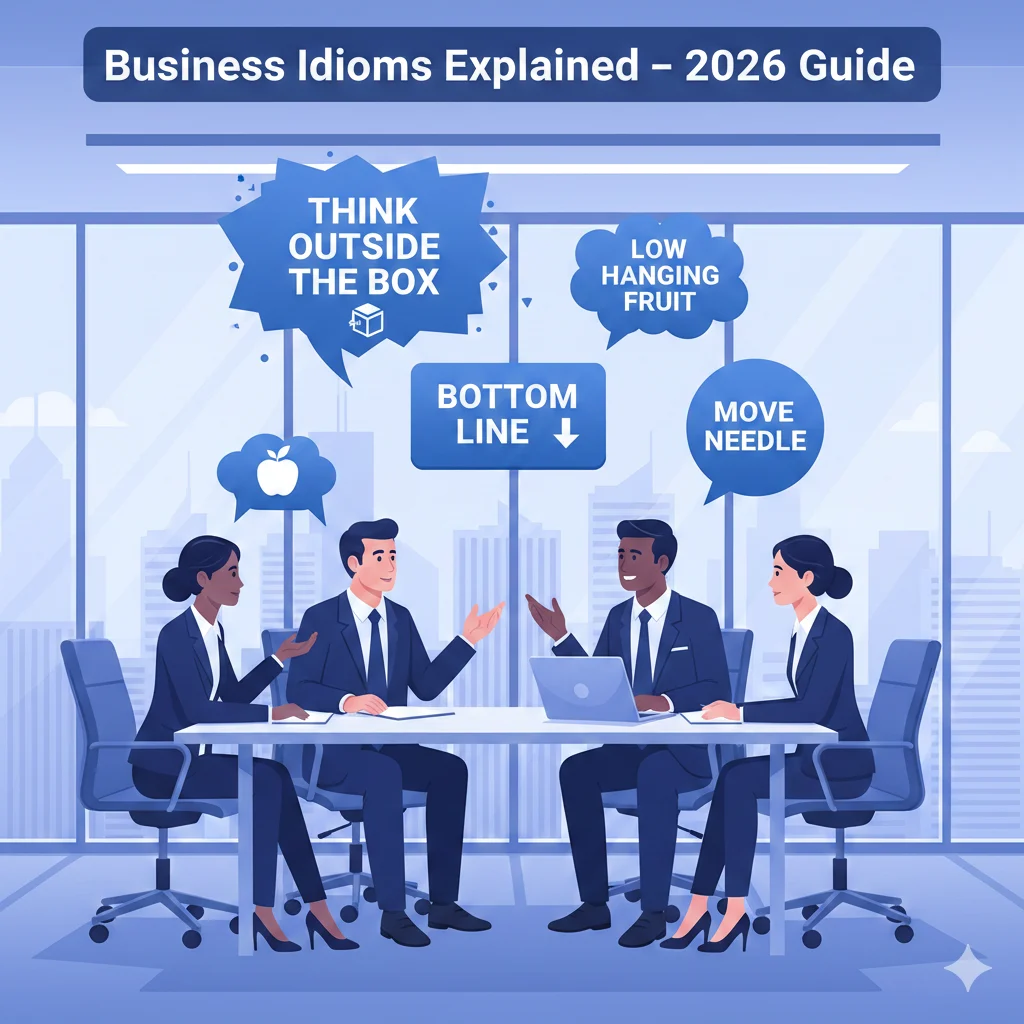
Looking for the most useful business idioms to improve your workplace communication?
Business idioms are commonly used expressions in professional settings that describe deals, teamwork, success, and challenges in a clear and natural way.
Popular examples include:
- “think outside the box” (be creative)
- “get down to business” (start working seriously)
- “cut corners” (do something cheaply or quickly)
- “on the same page” (agree with others)
- “close the deal” (finalize an agreement)
These idioms are widely used in meetings, emails, presentations, and office conversations, making them essential for professional fluency.
Using business idioms helps you sound more confident, natural, and effective in both spoken and written communication.
This guide provides powerful, real-life business idioms with meanings and examples to help you communicate clearly and succeed in the workplace.
Do you ever find yourself nodding along in meetings while secretly wondering what your colleagues actually mean? Understanding business idioms is the secret weapon that separates confident professionals from those who feel lost in corporate conversations. Whether you’re preparing for an important presentation, negotiating a deal, or simply trying to fit into a new team, mastering these business idioms in English will transform your communication skills overnight.
The corporate world runs on figurative language, and knowing the most common idioms business professionals use daily can accelerate your career growth. From boardrooms to break rooms, these expressions appear everywhere. Let’s dive into the 20 most famous business idioms that every ambitious professional must know.
Get the Ball Rolling – Starting Projects with Confidence
Word-by-word meaning: To physically set a ball in motion.
Idiomatic/figurative meaning: To initiate a project, process, or discussion.
Example sentences:
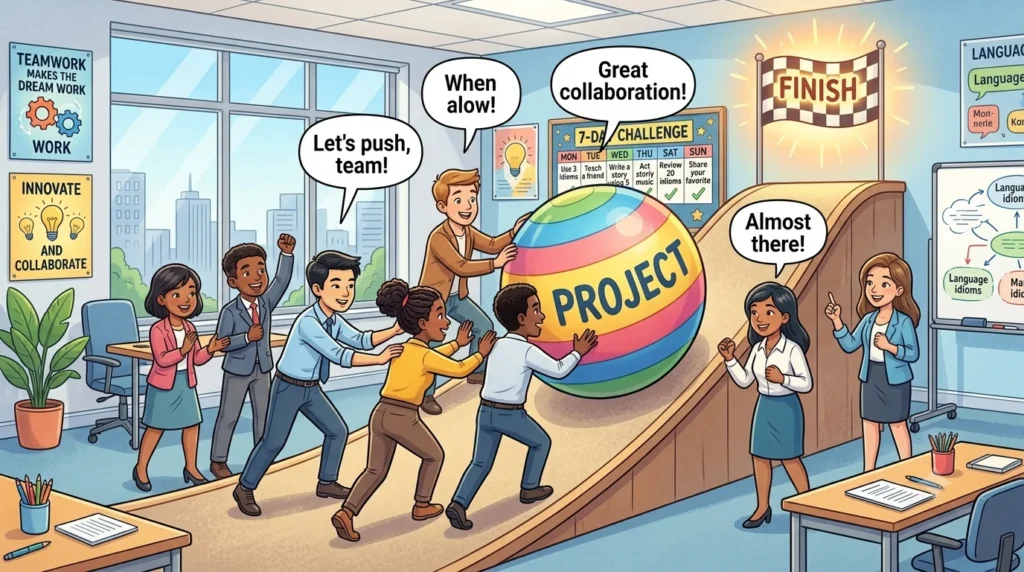
- “Let’s schedule a kickoff meeting to get the ball rolling on our Q4 marketing strategy.”
- “I’ve prepared the initial budget estimates to get the ball rolling for the board presentation.”
Common error: Using this when a project is already halfway complete. It strictly refers to beginning something new.
Usage note: This is one of the most frequently used business idioms examples in project management. Perfect for team meetings when you need to initiate action.
On the Same Page – Achieving Mutual Understanding
Word-by-word meaning: Reading from the identical page of a book.
Idiomatic/figurative meaning: To share a common understanding, agreement, or alignment on a topic.
Example sentences:

- “Before we proceed with the client proposal, I want to ensure everyone is on the same page regarding deliverables.”
- “Our cross-functional teams need to get on the same page about the product roadmap.”
Common error: Using this phrase when referring to physical documents. It’s always about mental alignment.
Usage note: A staple in collaborative environments. This business idioms in English phrase promotes unity and clarity among team members.
Touch Base – Effective Check-Ins and Follow-Ups
Word-by-word meaning: To make physical contact with a base in baseball.
Idiomatic/figurative meaning: To briefly connect or check in with someone.
Example sentences:
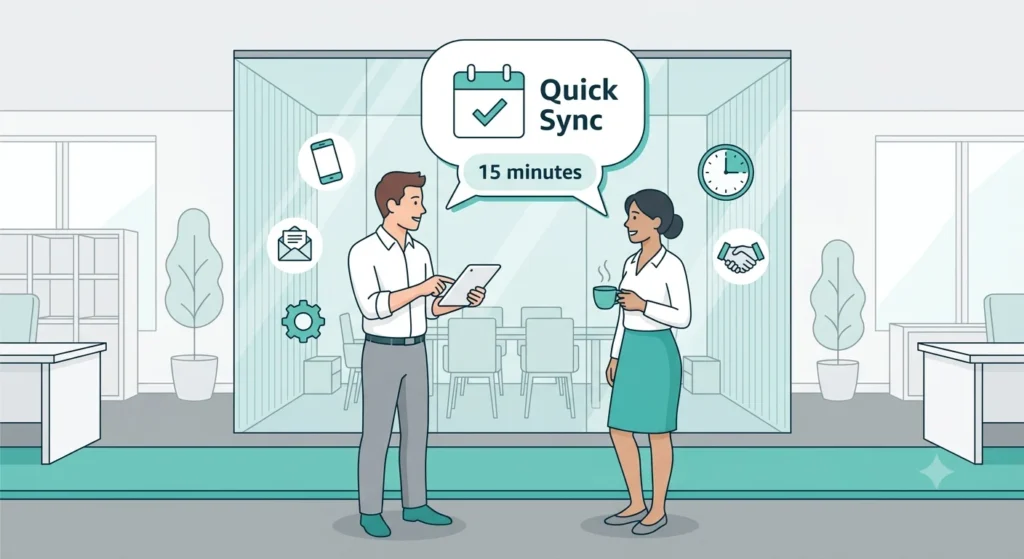
- “I’ll touch base with the finance team next week to review the quarterly projections.”
- “Let’s touch base after the client meeting to debrief and align our next steps.”
Common error: Using this for long, detailed discussions. It implies a quick, focused conversation.
Usage note: Ideal for maintaining communication flow. You’ll find this in almost every list of business idioms and phrases PDF because of its universal applicability.
Think Outside the Box – Fostering Innovation and Creativity
Word-by-word meaning: To think beyond a physical container.
Idiomatic/figurative meaning: To approach problems creatively and unconventionally.
Example sentences:

- “Our competitors are all doing the same thing. We need to think outside the box to stand out.”
- “The most successful marketing campaigns come from teams who think outside the box.”
Common error: Using this cliché without backing it up with actual creative action.
Usage note: Essential for brainstorming sessions. This is consistently ranked among the top 100 business idioms in innovation-driven companies.
Raise the Bar – Setting Higher Standards for Excellence
Word-by-word meaning: To lift a horizontal bar to a greater height.
Idiomatic/figurative meaning: To establish higher expectations, standards, or performance goals.
Example sentences:
- “Our new product line will raise the bar for quality and sustainability in our industry.”
- “The CEO’s vision challenges us to raise the bar on customer experience.”
Common error: Using this when standards are actually being lowered or maintained.
Usage note: Frequently used in performance reviews and strategic planning. A common entry in any business idioms PDF focused on growth.
The Bottom Line – Understanding What Truly Matters
Word-by-word meaning: The final line of a financial statement.
Idiomatic/figurative meaning: The most important factor, ultimate result, or core issue.
Example sentences:
- “The bottom line is that we need to increase revenue by 15% this quarter.”
- “While design matters, the bottom line is always about profitability and sustainability.”
Common error: Using this only for financial discussions. It applies to any critical point.
Usage note: Dominates decision-making conversations. Essential for business idioms exercises focusing on prioritisation.
Hit the Ground Running – Making an Immediate Impact
Word-by-word meaning: To start running immediately upon landing.
Idiomatic/figurative meaning: To begin a new role or project with great energy and instant productivity.
Example sentences:
- “Our newest team member hit the ground running and delivered exceptional results within her first week.”
- “We need a consultant who can hit the ground running during this peak season.”
Common error: Using this for roles or projects that require extensive ramp-up time.
Usage note: Perfect for onboarding discussions. Frequently appears in business idioms in English resources for HR professionals.
Learn the Ropes – Mastering Organisational Culture
Word-by-word meaning: To learn how to handle ropes on a ship.
Idiomatic/figurative meaning: To understand how a specific job, system, or organisation operates.
Example sentences:
- “It took me about three months to learn the ropes in the new department.”
- “She’s still learning the ropes, so please be patient and supportive.”
Common error: Using this after someone has been in a role for several years.
Usage note: Excellent for describing onboarding. This is standard corporate slang in any list of business idioms and phrases PDF.
Keep Your Eye on the Ball – Maintaining Focus
Word-by-word meaning: To keep watching a ball during gameplay.
Idiomatic/figurative meaning: To stay focused on the primary goal or task at hand.
Example sentences:
- “With so many distractions, it’s crucial to keep your eye on the ball.”
- “She kept her eye on the ball and delivered the complex project on time despite challenges.”
Common error: Using this when the task doesn’t require sustained concentration.
Usage note: Great for productivity and time management discussions. Featured in many business idioms examples for workplace efficiency.
Ballpark Figure – Making Informed Estimates
Word-by-word meaning: A number associated with a baseball stadium.
Idiomatic/figurative meaning: An approximate estimate rather than an exact calculation.
Example sentences:
- “Could you provide a ballpark figure for the total implementation costs?”
- “I need a ballpark figure of the budget before we can move forward with planning.”
Common error: Treating this as a final, exact number.
Usage note: Perfect for initial planning and feasibility discussions. A common entry in any top 100 business idioms compilation.
Bite the Bullet – Facing Difficult Decisions with Courage
Word-by-word meaning: To bite down on a lead bullet historically used to endure pain.
Idiomatic/figurative meaning: To confront a difficult or unpleasant situation with determination and bravery.
Example sentences:
- “We had to bite the bullet and announce the restructuring despite the emotional toll.”
- “It’s time to bite the bullet and address the performance issues head-on.”
Common error: Using this for trivial, easy decisions that don’t require courage.
Usage note: Essential for crisis management conversations. A classic among business idioms for leadership and tough choices.
Back to the Drawing Board – Embracing Fresh Starts
Word-by-word meaning: Returning to a board used for drawing architectural or design plans.
Idiomatic/figurative meaning: To restart a project or approach from scratch because a previous attempt failed.
Example sentences:
- “The client rejected our initial proposal, so it’s back to the drawing board for the creative team.”
- “The prototype failed quality testing, so we’re going back to the drawing board.”
Common error: Using this after minor setbacks that don’t require a complete overhaul.
Usage note: Indicates resilience and commitment to excellence. Appears frequently in business idioms examples about project management.
Play Hardball – Navigating Tough Negotiations
Word-by-word meaning: To play baseball aggressively and competitively.
Idiomatic/figurative meaning: To act firmly, aggressively, and uncompromisingly in negotiations or competition.
Example sentences:
- “We may need to play hardball with this supplier to secure the most favourable terms.”
- “The CEO is known for playing hardball with competitors during merger discussions.”
Common error: Using this in collaborative, low-stakes situations where a softer approach is appropriate.
Usage note: Describes assertive negotiation tactics. Important for business idioms exercises on deal-making strategies.
Low-Hanging Fruit – Prioritising Quick Wins
Word-by-word meaning: Fruit that grows low on a tree and is easy to pick.
Idiomatic/figurative meaning: The easiest tasks, goals, or opportunities to achieve with minimal effort and quick rewards.
Example sentences:
- “Let’s focus on the low-hanging fruit first to show quick progress and build momentum.”
- “We’ve already picked all the low-hanging fruit and now need to tackle more complex challenges.”
Common error: Assuming low-hanging fruit is always the most valuable or profitable.
Usage note: Popular in strategy, project planning, and sales. Featured in top 100 business idioms for prioritisation and efficiency.
Up in the Air – Managing Uncertainty
Word-by-word meaning: Suspended or floating in the sky.
Idiomatic/figurative meaning: Undecided, uncertain, or not yet finalised.
Example sentences:
- “The product launch date is still up in the air until we resolve the supply chain issues.”
- “His promotion remains up in the air pending the final performance review.”
Common error: Using this when decisions have been clearly made but simply not communicated.
Usage note: Perfect for status updates and managing expectations. Common in business idioms in English for project tracking.
Go the Extra Mile – Demonstrating Exceptional Dedication
Word-by-word meaning: To travel additional distance beyond what is required.
Idiomatic/figurative meaning: To make a special effort that goes above and beyond normal expectations.
Example sentences:
- “Our customer support team consistently goes the extra mile to resolve client issues.”
- “If you want that promotion, you need to go the extra mile on every project.”
Common error: Using this for minimal or standard effort that doesn’t exceed expectations.
Usage note: Highlights commitment and excellence. A standard entry in 100 business idioms lists for performance recognition.
In a Nutshell – Delivering Concise Summaries
Word-by-word meaning: Inside the shell of a nut (a very small space).
Idiomatic/figurative meaning: In summary; expressed briefly and concisely.
Example sentences:
- “In a nutshell, our strategy is to expand into emerging markets while optimising costs.”
- “Here’s the quarterly report in a nutshell: we exceeded revenue targets but missed on efficiency.”
Common error: Using this for lengthy, detailed explanations that contradict the word “nutshell.”
Usage note: Essential for executive summaries and presentations. A staple in any business idioms PDF for effective communication.
See Someone’s Point – Building Empathy in Conversations
Word-by-word meaning: To visually perceive a location someone is indicating.
Idiomatic/figurative meaning: To understand and acknowledge someone else’s perspective or reasoning.
Example sentences:
- “I completely see your point about the budget constraints. Let’s explore alternatives together.”
- “She finally sees my point and has agreed to the revised implementation timeline.”
Common error: Saying “I see your point” but not genuinely acknowledging or valuing the other person’s perspective.
Usage note: Vital for effective negotiation, conflict resolution, and building rapport. Appears in many business idioms examples for interpersonal skills.
Corner the Market – Achieving Market Dominance
Word-by-word meaning: To dominate a physical marketplace corner.
Idiomatic/figurative meaning: To gain significant control or dominance over a particular market segment or industry.
Example sentences:
- “The tech giant has successfully cornered the market on cloud computing infrastructure.”
- “They’re aggressively trying to corner the market with their revolutionary product line.”
Common error: Using this when you have a moderate or small market share.
Usage note: Describes competitive advantage and strategic dominance. Important for business idioms exercises on competition and market strategy.
Win-Win Situation – Creating Mutual Benefit
Word-by-word meaning: A situation where both participants win.
Idiomatic/figurative meaning: An arrangement, deal, or outcome where all parties involved benefit.
Example sentences:
- “The strategic partnership created a genuine win-win situation for both companies.”
- “We’re actively seeking a win-win situation in this merger that benefits all stakeholders.”
Common error: Promoting a proposal as “win-win” when it’s clearly one-sided or unbalanced.
Usage note: Ideal for negotiation, partnerships, and collaborative decision-making. Essential in business idioms in English for diplomacy and relationship management.
Practical Strategies to Master Business Idioms
Learning workplace expressions is just the beginning. To truly internalise these idioms business professionals use daily, you need a systematic approach. Start by selecting three idioms from this list and deliberately incorporating them into your emails or conversations each week. Pay careful attention to how senior leaders and native speakers use these expressions in different contexts.
For deeper learning, consider creating your own business idioms exercises. Try rewriting a standard work email using five idioms from this collection. Alternatively, find comprehensive business idioms and phrases PDF resources online for offline study. Many professionals also benefit from keeping a personal journal of idioms they encounter in meetings, along with the context in which they were used. The more you practice, the more natural these expressions will become. Remember, confidence comes from consistent, authentic application in real workplace situations.
Frequently Asked Questions About Business Idioms
1. What exactly are business idioms and why should I learn them?
Business idioms are figurative expressions commonly used in professional settings. They are essential because they enhance communication, help you understand native speakers better, and make you sound more confident and natural in meetings, presentations, and emails. Mastering business idioms in English can significantly boost your professional credibility.
2. What is the most effective way to learn and remember business idioms?
The most effective approach is contextual learning. Use the business idioms examples provided in this article, practise writing them in sentences, and actively try to use them in conversations. Many learners benefit from downloading a business idioms PDF or enrolling in workplace English courses that focus on practical application rather than rote memorisation.
3. What common mistakes should I avoid when using business idioms?
Two prevalent mistakes are using idioms incorrectly (such as saying “get the ball rolling” for a project that’s nearly finished) and overusing them to the point of sounding unnatural. Additionally, always consider your audience, as some idioms may be culturally specific. Be mindful that certain business idioms in English might confuse non-native speakers from different cultural backgrounds.
4. Where can I find a comprehensive list of business idioms and phrases?
You can find excellent resources including detailed list of business idioms and phrases PDF downloads available on educational websites, business English platforms, and professional development blogs. This article’s top 100 business idioms section serves as an excellent starting point for beginners and intermediate learners alike.
5. Which business idioms are most useful for negotiations?
For negotiations, essential idioms include “play hardball” (to negotiate firmly), “meet someone halfway” (to compromise), “drive a hard bargain” (to negotiate aggressively), “seal the deal” (to finalise an agreement), and “win-win situation” (to create mutual benefit). These expressions appear frequently in 100 business idioms resources focused on negotiation skills.
H2: Conclusion: Transform Your Professional Communication Today
Mastering business idioms is more than just learning vocabulary—it’s about unlocking a deeper understanding of corporate culture and professional dynamics. By integrating these 20 powerful expressions into your daily work life, you’ll communicate with greater clarity, confidence, and impact. Whether you’re writing a persuasive email, delivering a compelling presentation, or navigating a complex negotiation, the right idiom can be your secret advantage.
Your journey starts now. Select one idiom from this list and commit to using it in your very next work interaction. With consistent practice, these phrases will become an effortless part of your professional vocabulary. For continued learning, explore additional business idioms PDF resources or revisit this article whenever you need a refresher. The corporate world is waiting—go out there and make your mark with the language of business success.
Conclusion
Mastering these business idioms can transform the way you communicate at work. Instead of using simple, repetitive sentences, you’ll express ideas with confidence, clarity, and professionalism. In modern workplaces — especially in 2026’s fast-paced global environment — strong communication skills are a major advantage. Whether you’re attending meetings, writing emails, negotiating deals, or preparing for interviews, these idioms will help you sound more natural and competent.
The key is practice. Start by using one or two business idioms daily in conversations or emails. Over time, they will become part of your natural vocabulary. Remember, fluency is not about using difficult words — it’s about using the right expressions at the right time. Keep learning, keep practicing, and raise the bar in your professional English journey. 🚀

“Rose Macaulay shares the charm of idioms on LearnIdom.com, making language learning delightful, insightful, and full of wit for every reader.”