Dogs aren’t just our loyal companions—they’ve inspired countless phrases in English! From “barking up the wrong tree” to “dog days of summer,” idioms for dogs are everywhere in everyday conversations.
Understanding these expressions can make your English more colorful and help you sound like a native speaker. Imagine your friend saying, “Don’t bark up the wrong tree!” and you nodding, knowing exactly what they mean.
In this guide, we’ll explore 20 popular idioms for dogs, their meanings, examples, and tips for correct usage so you never mix them up. Whether you’re learning English or just love dogs, these phrases are both fun and practica
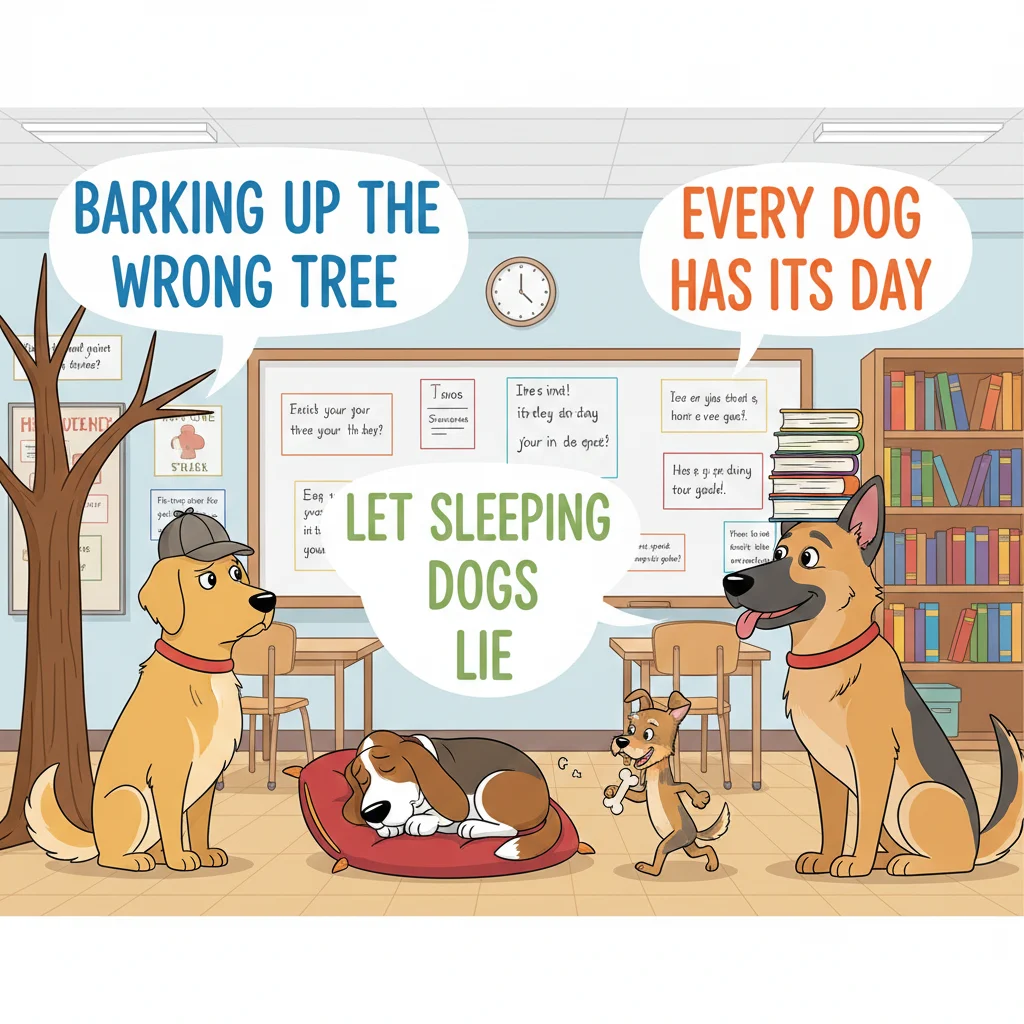
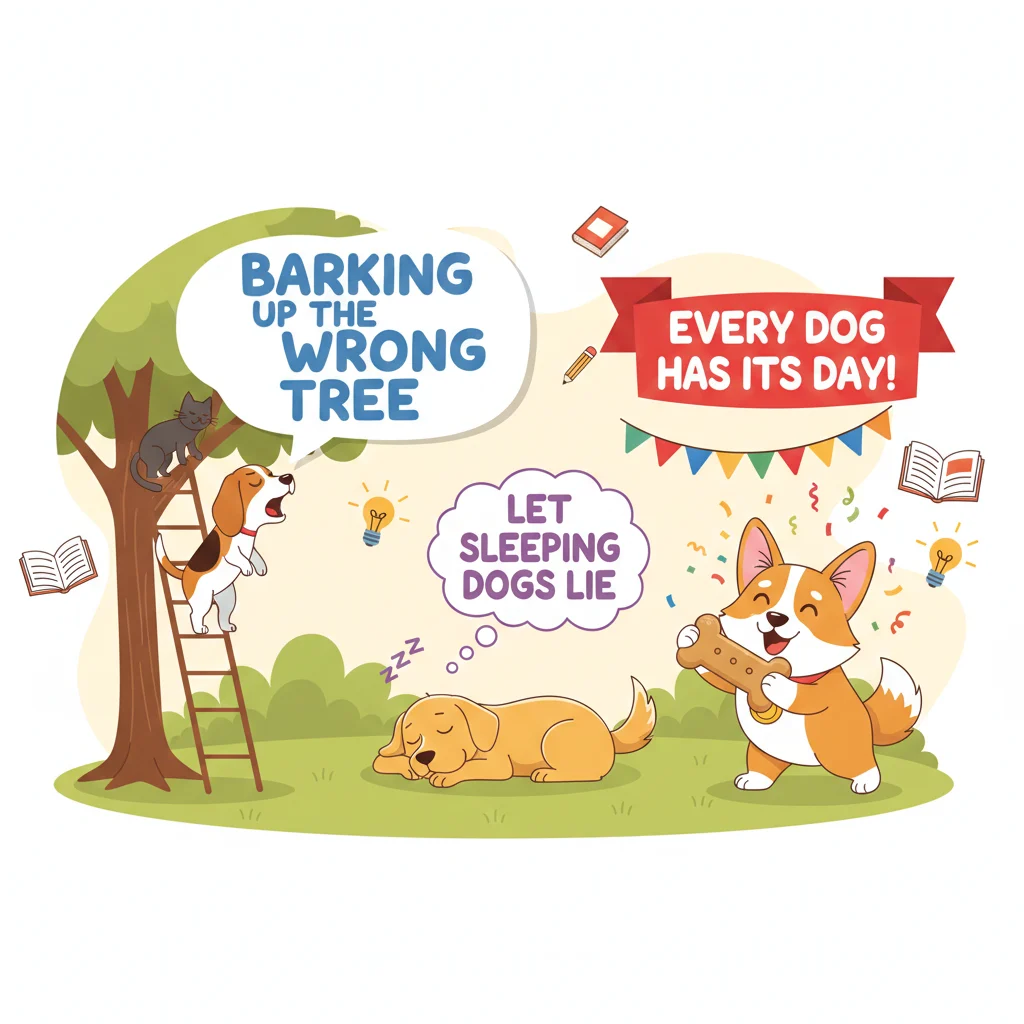
Barking Up the Wrong Tree
Word-by-word meaning
- Barking: Making a dog sound
- Up the wrong tree: Literally at the wrong location
Idiomatic meaning
To pursue a mistaken or misguided course of action.
Example sentences
- “If you think I took your book, you’re barking up the wrong tree.”
- “She’s barking up the wrong tree by blaming him for the mistake.”
Common error
Using it for actual dogs instead of figurative situations.
Usage note
Used when someone is incorrectly blaming or pursuing someone/something.
Let Sleeping Dogs Lie
Word-by-word meaning
- Let: Allow
- Sleeping dogs: Dogs that are asleep
- Lie: Stay or remain
Idiomatic meaning
Avoid interfering in a situation that could cause trouble.
Example sentences
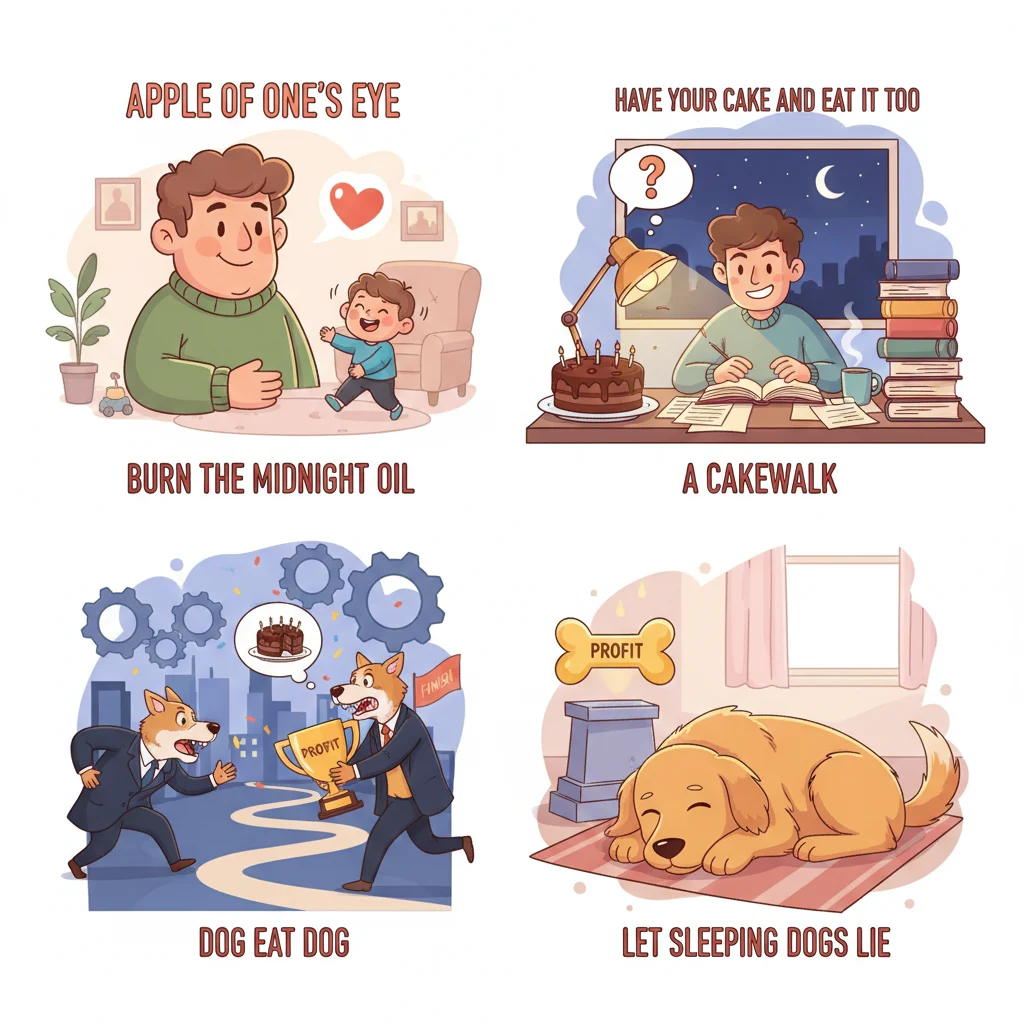
- “Don’t bring up old arguments—let sleeping dogs lie.”
- “It’s better to let sleeping dogs lie rather than restart the fight.”
Common error
Confusing it with ignoring problems; it’s about avoiding unnecessary conflict.
Usage note
Typically used in advice or warnings.
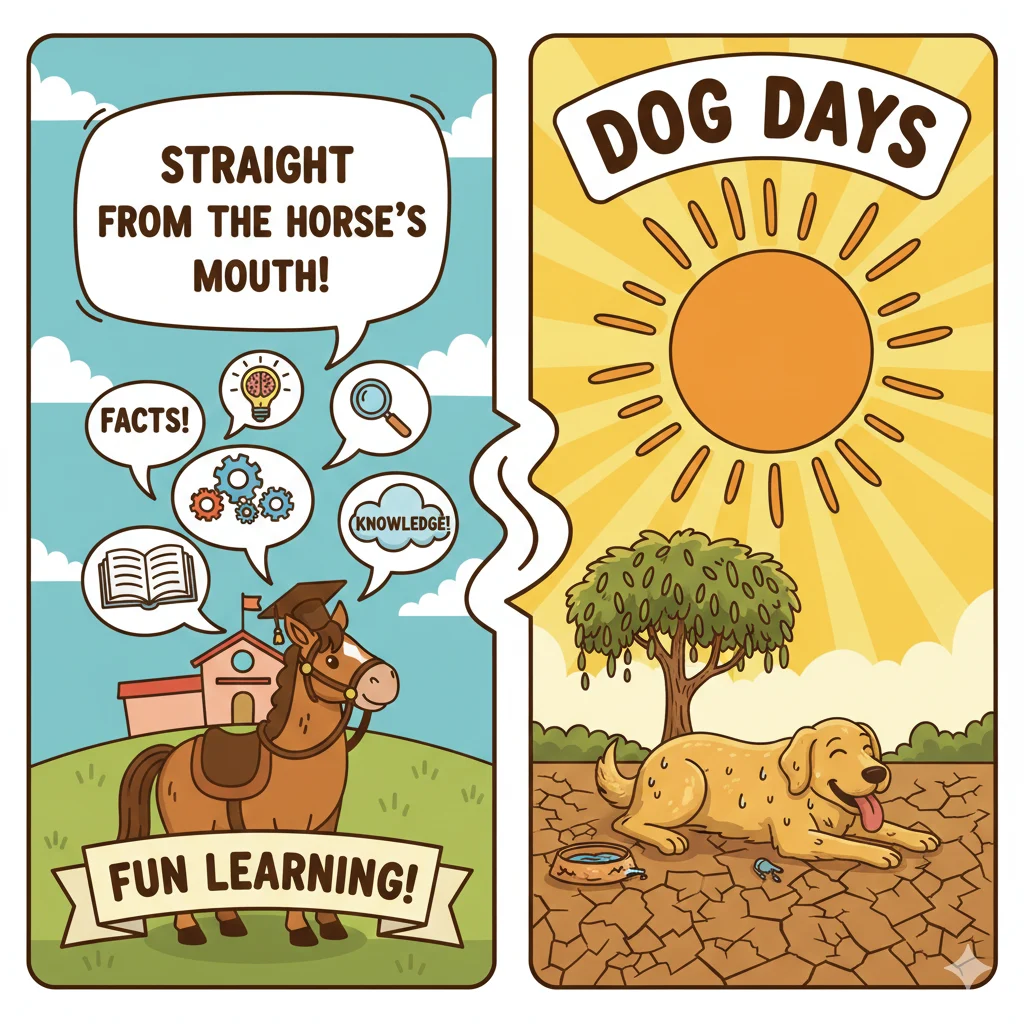
Dog Days
Word-by-word meaning
- Dog: Canine animal
- Days: Periods of time
Idiomatic meaning
The hottest, most uncomfortable days of summer.
Example sentences
- “I love swimming during the dog days of summer.”
- “The dog days made everyone lazy and sleepy.”
Common error
Using it to describe difficult workdays instead of hot summer days.
Usage note
Originates from the “Dog Star” Sirius, linked to summer heat.
Every Dog Has Its Day
Word-by-word meaning
- Every dog: All dogs
- Has its day: Experiences success or happiness
Idiomatic meaning
Everyone gets a chance for success or recognition eventually.
Example sentences
- “Don’t worry—you’ll get the promotion. Every dog has its day.”
- “He finally won the competition. Every dog has its day.”
Common error
Using it to mean “all dogs are lucky,” which isn’t correct.
Usage note
Encouraging phrase often used to give hope.
Work Like a Dog
Word-by-word meaning
- Work: To perform tasks
- Like a dog: Very hard, persistently
Idiomatic meaning
To work extremely hard.
Example sentences
- “He worked like a dog to finish the project on time.”
- “She’s been working like a dog all week.”
Common error
Misinterpreting it as working lazily or casually.
Usage note
Casual, conversational expression for emphasizing effort.
Dog-Eat-Dog World
Word-by-word meaning
- Dog-eat-dog: Dogs fighting each other
- World: Society or environment
Idiomatic meaning
A ruthless, competitive environment where people harm others to succeed.
Example sentences
- “The corporate world is a dog-eat-dog world; you must fight for your place.”
- “In politics, it’s a dog-eat-dog world.”
Common error
Using it to describe simple competition; it implies extreme ruthlessness.
Usage note
Often used for business, politics, or competitive industries.
Top Dog
Word-by-word meaning
- Top: Highest
- Dog: Canine
Idiomatic meaning
The most important or dominant person in a group.
Example sentences
- “He became the top dog in the company after years of hard work.”
- “In our team, she’s the top dog.”
Common error
Confusing it with “best dog” literally.
Usage note
Informal, often used in workplace or social hierarchy contexts.
Dog-Tired
Word-by-word meaning
- Dog: Canine
- Tired: Exhausted
Idiomatic meaning
Extremely exhausted or worn out.
Example sentences
- “After the marathon, I was dog-tired.”
- “She felt dog-tired after studying all night.”
Common error
Using it for slight tiredness; it emphasizes extreme fatigue.
Usage note
Casual expression for stress or physical exhaustion.
In the Doghouse
Word-by-word meaning
- Doghouse: A small shelter for a dog
Idiomatic meaning
Being in trouble or out of favor with someone.
Example sentences
- “He’s in the doghouse with his boss for missing the deadline.”
- “She forgot their anniversary and ended up in the doghouse.”
Common error
Thinking it’s literal; it refers to disapproval.
Usage note
Commonly used in personal relationships and workplaces.
Call Off the Dogs
Word-by-word meaning
- Call off: Cancel
- Dogs: Literally, the animals
Idiomatic meaning
Stop criticizing or attacking someone.
Example sentences
- “The manager called off the dogs after realizing it was a misunderstanding.”
- “He finally called off the dogs and let her explain.”
Common error
Using it for actual dogs; it’s figurative.
Usage note
Formal or informal; implies ending a verbal attack or criticism.
Dog and Pony Show
Word-by-word meaning
- Dog and pony: Literal animals in a show
- Show: Performance
Idiomatic meaning
An elaborate presentation designed to impress, often with little substance.
Example sentences
- “The product launch was just a dog and pony show.”
- “Don’t be fooled by the dog and pony show; check the facts.”
Common error
Taking it literally as an actual animal show.
Usage note
Mostly used in business or politics.
Dog in the Manger
Word-by-word meaning
- Dog: Canine
- Manger: Feeding trough
Idiomatic meaning
Someone who prevents others from enjoying something they themselves don’t need.
Example sentences
- “She’s being a dog in the manger, refusing to share the resources.”
- “Don’t be a dog in the manger; let others benefit too.”
Common error
Confusing it with selfishness without understanding the nuance of denying others.
Usage note
Classic idiom from Aesop’s fables, still widely used.
Sick as a Dog
Word-by-word meaning
- Sick: Ill
- Dog: Canine
Idiomatic meaning
Extremely ill or unwell.
Example sentences
- “I was sick as a dog after eating that food.”
- “He felt sick as a dog all night.”
Common error
Using it for mild discomfort; it implies severe illness.
Usage note
Informal, very common in spoken English.
Dog’s Breakfast
Word-by-word meaning
- Dog’s: Possessive of dog
- Breakfast: Morning meal
Idiomatic meaning
A mess, something done poorly.
Example sentences
- “The report was a dog’s breakfast, full of mistakes.”
- “His bedroom looked like a dog’s breakfast.”
Common error
Thinking it’s about food; it’s figurative for disorder.
Usage note
Informal British English; highlights poor quality or disorder.
Hair of the Dog
Word-by-word meaning
- Hair of the dog: Literally a dog’s hair
Idiomatic meaning
Drinking alcohol to relieve a hangover.
Example sentences
- “He had a little hair of the dog this morning.”
- “Hair of the dog can sometimes ease the headache.”
Common error
Misunderstanding as literally involving dogs; it’s about alcohol.
Usage note
Informal, mostly humorous.
Dog-Eared
Word-by-word meaning
- Dog: Canine
- Eared: Having ears
Idiomatic meaning
Refers to a book’s page that is folded down at the corner.
Example sentences
- “I’ve dog-eared all my favorite pages in this book.”
- “The textbook was dog-eared from constant use.”
Common error
Thinking it’s about actual dogs’ ears; it’s about books.
Usage note
Common in reading and library contexts.
Hot Dog
Word-by-word meaning
- Hot dog: Sausage in a bun
Idiomatic meaning
Used to describe someone showing off or being flashy.
Example sentences
- “He’s quite a hot dog on the skateboard.”
- “She’s a hot dog with her guitar skills.”
Common error
Confusing it with the food item; context matters.
Usage note
Informal, often playful.
Dog’s Life
Word-by-word meaning
- Dog: Canine
- Life: Existence
Idiomatic meaning
A hard, unhappy life.
Example sentences
- “He’s been living a dog’s life after losing his job.”
- “Some people think being a delivery driver is a dog’s life.”
Common error
Using it positively; it’s usually negative.
Usage note
Common in literature and casual speech.
Tail Wagging the Dog
Word-by-word meaning
- Tail: Dog’s tail
- Wagging: Moving back and forth
Idiomatic meaning
A small part controlling the whole situation.
Example sentences
- “In the company, the marketing team was tail wagging the dog.”
- “Don’t let minor issues wag the dog.”
Common error
Taking it literally; it’s metaphorical.
Usage note
Used in business, politics, and management contexts.
Dogged Determination
Word-by-word meaning
- Dogged: Persistent
- Determination: Strong resolve
Idiomatic meaning
Extreme persistence and determination.
Example sentences
- “She showed dogged determination to finish the marathon.”
- “His dogged determination impressed everyone.”
Common error
Confusing “dogged” with laziness; it means stubborn persistence.
Usage note
Positive idiom praising effort and persistence.
Frequently Asked Questions (FAQs)
Q1: Can dog idioms be used in formal writing?
- Mostly informal, but some like “every dog has its day” can appear in essays or speeches.
Q2: Are all dog idioms negative?
- No, some are neutral or positive, e.g., “every dog has its day.”
Q3: Do other languages have dog idioms?
- Yes! Many languages use dog metaphors, though meanings may differ.
Q4: How can I remember dog idioms easily?
- Create stories or personal examples linking the idiom to a real-life dog situation.
Q5: Can idioms for dogs improve my English?
- Absolutely! They make conversations lively and help you sound like a native speaker.
Conclusion
Dog idioms are more than just fun expressions—they make your English engaging, relatable, and memorable. Start by using one or two idioms in daily conversations, then gradually add more. The more you practice, the more natural these expressions will feel. Remember: learning idioms is like training a dog—it takes patience, repetition, and a little fun along the way. So, bark up the right tree and start practicing today!

“Rose Macaulay shares the charm of idioms on LearnIdom.com, making language learning delightful, insightful, and full of wit for every reader.”