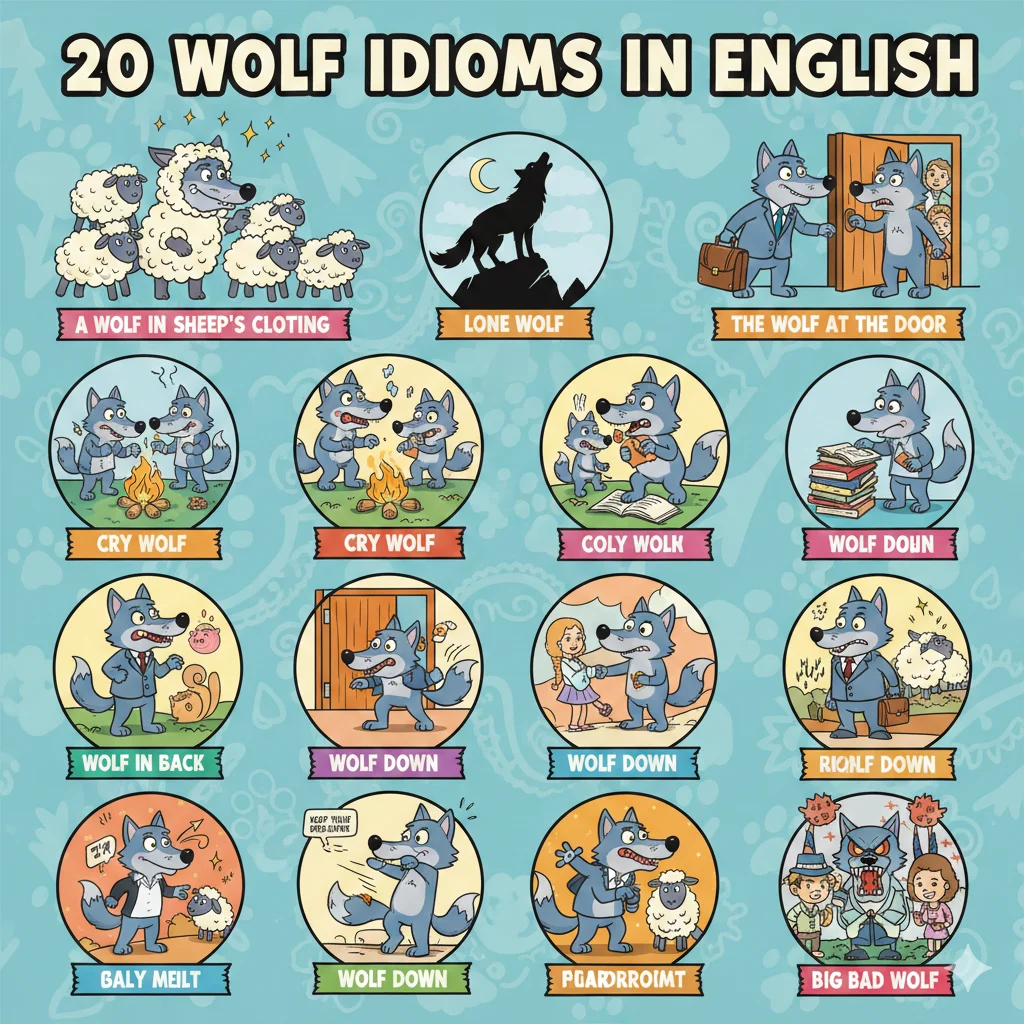
Wolf idioms are powerful English expressions that use the word “wolf” to represent danger, deception, greed, or survival in symbolic ways. Common phrases like “cry wolf,” “a wolf in sheep’s clothing,” and “keep the wolf from the door” appear frequently in conversations, news reports, movies, and professional discussions. If you’ve ever felt confused hearing these expressions, you’re not alone — their meanings are not literal, which makes them tricky for English learners.
Understanding wolf idioms helps you recognize hidden meanings, avoid misunderstandings, and speak more naturally. These phrases allow you to describe risky situations, dishonest behavior, or financial struggles with stronger impact instead of using basic vocabulary.
Whether you are preparing for exams, improving spoken English, or creating engaging content, mastering wolf idioms can instantly elevate your communication skills. Once you learn their meanings and usage, you’ll start spotting them everywhere in real-life English conversations.
🐺 Cry Wolf
Word-by-Word Meaning
Cry = shout
Wolf = wild animal
Idiomatic Meaning
To raise a false alarm repeatedly so that people stop believing you.
Example Sentences
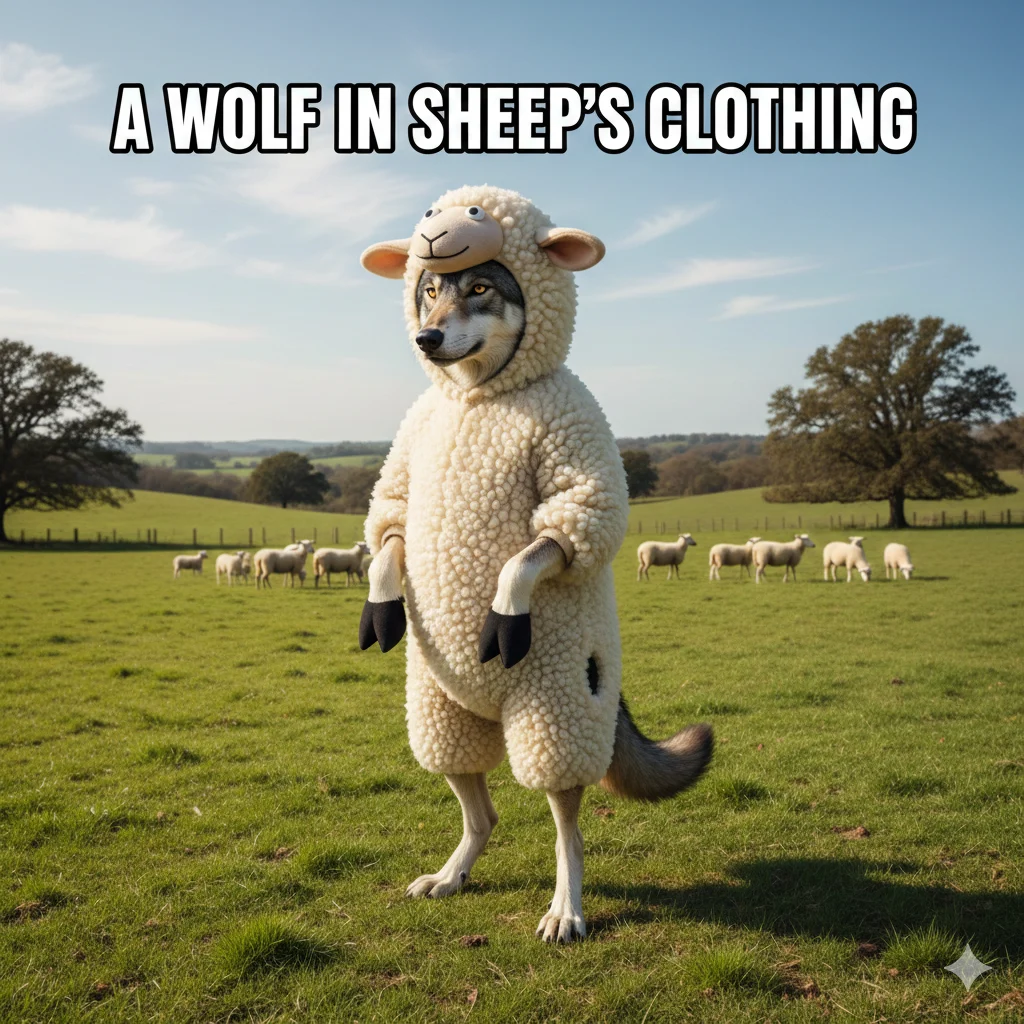
- He always cries wolf, so no one believed him this time.
- Don’t cry wolf unless it’s a real emergency.
- If you keep crying wolf, people will ignore you.
Common Error
❌ Using it for real danger.
(It means false alarm, not real warning.)
Usage Note
Comes from the old fable “The Boy Who Cried Wolf.”
🐺 Wolf in Sheep’s Clothing
Word-by-Word Meaning
Wolf = dangerous animal
Sheep’s clothing = disguise
Idiomatic Meaning
A dangerous or evil person pretending to be kind or harmless.
Example Sentences
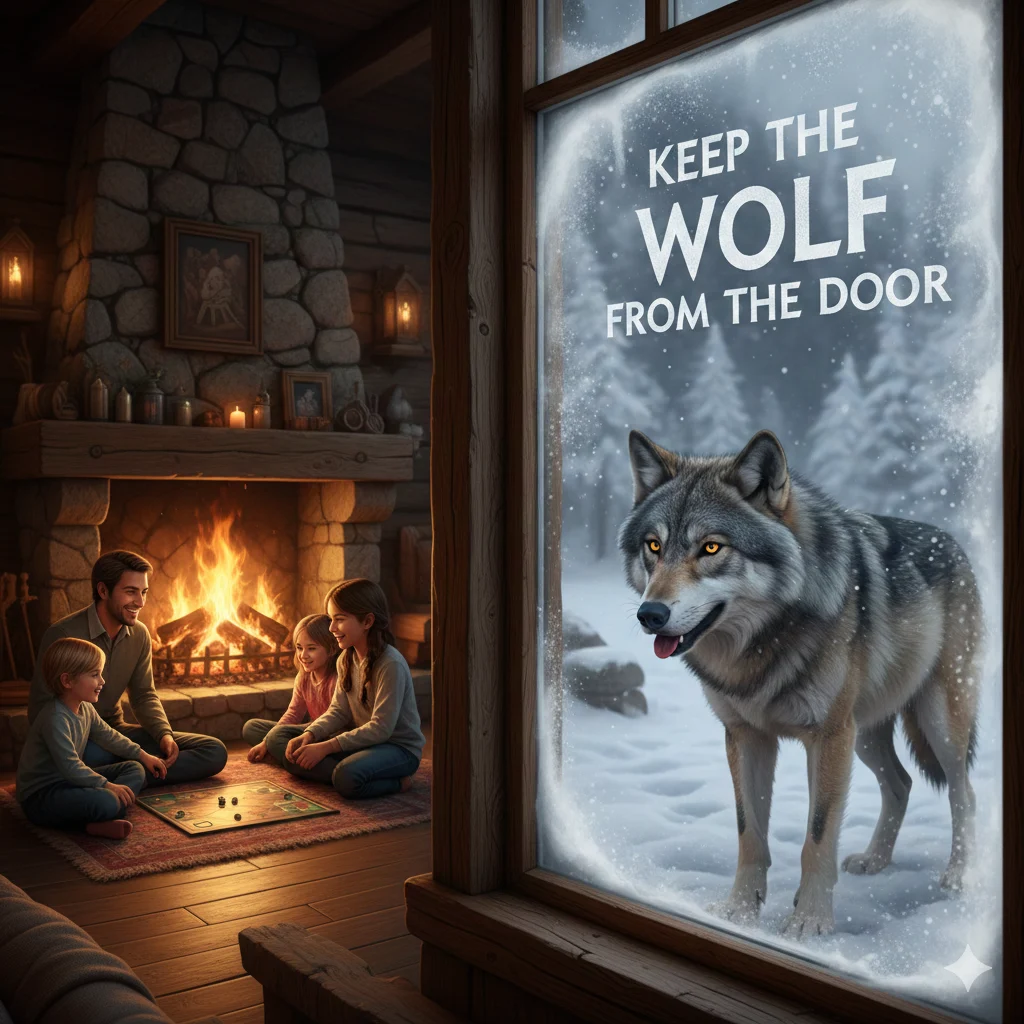
- He looks innocent, but he’s a wolf in sheep’s clothing.
- Be careful of wolves in sheep’s clothing.
- The fraudster was a wolf in sheep’s clothing.
Usage Note
Used when warning about fake or dishonest people.
🐺 Keep the Wolf from the Door
Word-by-Word Meaning
Wolf = danger/hunger
Door = home entrance
Idiomatic Meaning

To earn enough money to survive and avoid poverty.
Example Sentences
- She works two jobs to keep the wolf from the door.
- The small salary helps keep the wolf from the door.
- They struggled to keep the wolf from the door.
Usage Note
Common in financial discussions.
🐺 Lone Wolf
Word-by-Word Meaning
Lone = alone
Wolf = animal
Idiomatic Meaning
A person who prefers to act alone rather than in groups.
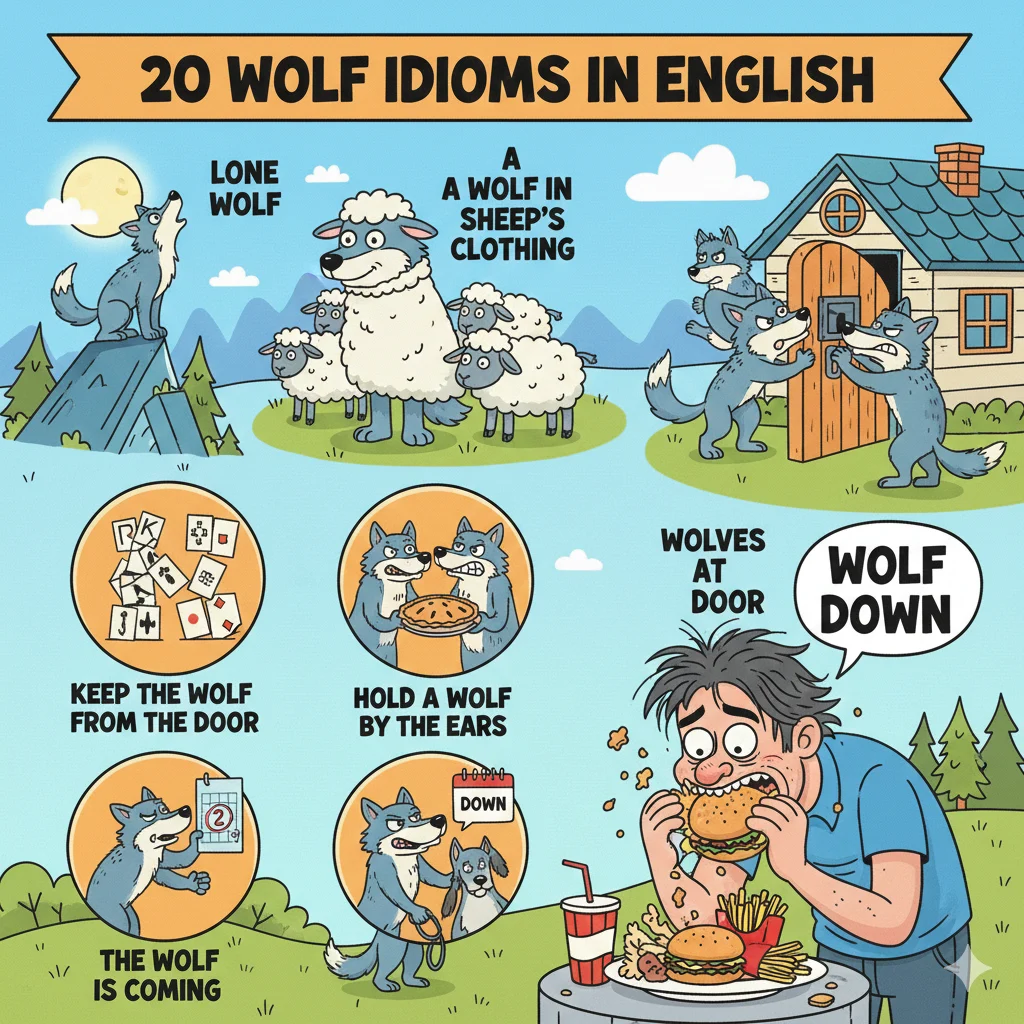
Example Sentences
- He is a lone wolf at work.
- She prefers studying alone like a lone wolf.
- The detective was a lone wolf.
Usage Note
Can be positive (independent) or negative (unsociable).
🐺 Throw to the Wolves
Word-by-Word Meaning
Throw = push
Wolves = dangerous animals
Idiomatic Meaning
To expose someone to danger or criticism without protection.
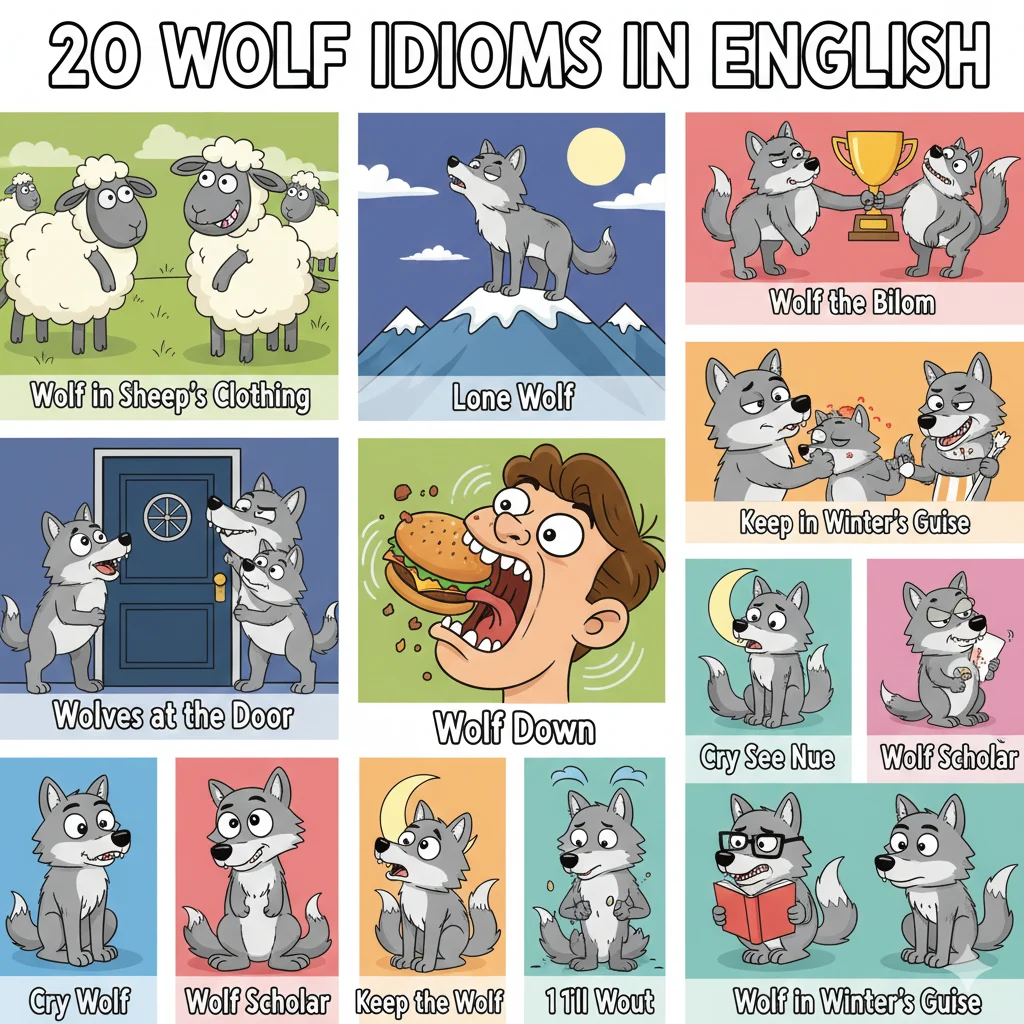
Example Sentences
- The manager threw him to the wolves.
- I felt thrown to the wolves in the meeting.
- Don’t throw new employees to the wolves.
Usage Note
Used in workplace or social pressure situations.
🐺 🐺 A Wolf at the Door
Word-by-Word Meaning
Wolf = danger or hunger
Door = entrance of the house
Idiomatic / Figurative Meaning
Serious financial trouble or the threat of poverty approaching.
Example Sentences
- After losing his job, he had a wolf at the door.
- Without savings, the wolf is always at the door.
- Rising prices brought a wolf to their door.
Common Error
❌ Thinking it means physical danger.
(It usually refers to financial hardship.)
Usage Note
Often used in economic or personal finance discussions.
🐺 Run with the Wolves
Word-by-Word Meaning
Run = move with
Wolves = wild animals
Idiomatic Meaning
To associate with aggressive, rebellious, or risky people.
Example Sentences
- He started running with the wolves in college.
- She refused to run with the wolves.
- Teenagers sometimes run with the wolves to fit in.
Usage Note
Can suggest negative peer influence.
🐺 Big Bad Wolf
Word-by-Word Meaning
Big = large
Bad = evil
Wolf = predator
Idiomatic Meaning
A person who is threatening, harsh, or intimidating.
Example Sentences
- The boss acted like the big bad wolf.
- Don’t make me the big bad wolf here.
- The media portrayed him as the big bad wolf.
Usage Note
Comes from fairy tales like “Little Red Riding Hood.”
🐺 Man Is a Wolf to Man
Word-by-Word Meaning
Man = human
Wolf = cruel predator
Idiomatic Meaning
Humans can be cruel or selfish toward one another.
Example Sentences
- In tough competition, man is a wolf to man.
- History proves man is a wolf to man.
- During war, man becomes a wolf to man.
Usage Note
Often used in philosophical or serious discussions.
🐺 Wolf Pack
Word-by-Word Meaning
Wolf = animal
Pack = group
Idiomatic Meaning
A group acting together, often aggressively or competitively.
Example Sentences
- The reporters attacked like a wolf pack.
- They moved through the market like a wolf pack.
- The team played like a wolf pack.
Usage Note
Used for strong group unity, sometimes negative.
🐺 Hungry Like a Wolf
Word-by-Word Meaning
Hungry = needing food
Wolf = animal known for appetite
Idiomatic Meaning
Extremely hungry or very eager for something.
Example Sentences
- I’m hungry like a wolf after practice.
- She is hungry like a wolf for success.
- The kids came home hungry like wolves.
Usage Note
Can refer to ambition, not just food.
🐺 Set the Wolf to Guard the Sheep
Word-by-Word Meaning
Wolf = predator
Guard = protect
Sheep = vulnerable animals
Idiomatic Meaning
To give responsibility to someone who cannot be trusted.
Example Sentences
- Making him cashier is setting the wolf to guard the sheep.
- That decision is like setting the wolf to guard the sheep.
Usage Note
Used when criticizing poor judgment.
🐺 Wolf Whistle
Word-by-Word Meaning
Wolf = symbol of boldness
Whistle = sharp sound
Idiomatic Meaning
A loud whistle to show admiration, often inappropriate.
Example Sentences
- Someone gave a wolf whistle at the model.
- Wolf whistling is considered disrespectful.
Common Error
❌ Thinking it is always positive.
(It can be rude or offensive.)
🐺 Crying Wolf Syndrome
Word-by-Word Meaning
Crying wolf = false alarm
Syndrome = repeated pattern
Idiomatic Meaning
When people stop believing warnings because of repeated false alarms.
Example Sentences
- His repeated excuses created crying wolf syndrome.
- The boy suffered from crying wolf syndrome.
Usage Note
Used in social or psychological discussions.
🐺 Wolfish Appetite
Word-by-Word Meaning
Wolfish = like a wolf
Appetite = hunger
Idiomatic Meaning
A very strong or greedy hunger.
Example Sentences
- After the game, he had a wolfish appetite.
- Teenagers often have a wolfish appetite.
🐺 Feed the Wolves
Word-by-Word Meaning
Feed = give food
Wolves = predators
Idiomatic Meaning
To satisfy critics temporarily by giving them what they demand.
Example Sentences
- The company fed the wolves with a public apology.
- Politicians feed the wolves to calm the media.
🐺 Among Wolves
Word-by-Word Meaning
Among = surrounded by
Wolves = predators
Idiomatic Meaning
In a dangerous, competitive, or hostile environment.
Example Sentences
- Entering politics feels like living among wolves.
- He survived among wolves in the corporate world.
🐺 Wolf Territory
Word-by-Word Meaning
Wolf = predator
Territory = area
Idiomatic Meaning
A risky or competitive area where one must be careful.
Example Sentences
- Negotiating with them is entering wolf territory.
- That market is pure wolf territory.
🐺 Smell Like a Wolf
Word-by-Word Meaning
Smell = sense
Wolf = animal with sharp instinct
Idiomatic Meaning
To sense danger or opportunity instinctively.
Example Sentences
He smelled danger like a wolf.Wolf Down
She can smell opportunity like a wolf.
Word-by-Word Meaning
Wolf = animal
Down = completely
Idiomatic Meaning
To eat food very quickly.
Example Sentences
- He wolfed down his lunch.
- She wolfed down the pizza in minutes.
- The kids wolfed down their snacks.
Common Error
❌ Writing “wolf it down” incorrectly.
Correct: “wolf down” or “wolfed down.”
❓ FAQs About Wolf Idioms
1. What are wolf idioms?
Wolf idioms are expressions that use “wolf” symbolically to describe danger, hunger, or personality traits.
2. Why are wolf idioms common in English?
Wolves symbolize power, danger, and independence in many cultures.
3. Are wolf idioms used in exams?
Yes, especially in speaking and creative writing.
4. How can I remember wolf idioms easily?
Connect each idiom with a strong mental image.
🚀 Conclusion
Wolf idioms add power, emotion, and vivid imagery to your English. They help you describe danger, independence, hunger, and hidden intentions more effectively. Instead of simple sentences, these idioms make your speech dramatic and expressive. Practice using a few wolf idioms daily in conversations or writing. Over time, they will become natural in your vocabulary. Keep learning, stay consistent, and soon your English will be as confident and strong as a wolf.

“Elizabeth Bowen shares timeless idioms and language wisdom on LearnIdom.com, making learning phrases fun, easy, and unforgettable.”