Learning Spanish to English idioms can feel confusing at first—but it’s also one of the most exciting parts of mastering a new language. Imagine hearing someone say “tirar la casa por la ventana” (throw the house out the window). At first it sounds strange, but native speakers immediately understand it means celebrating in a big way.
Idioms are expressions whose meanings are different from their literal translation. They are everywhere in Spanish conversations—movies, music, social media, and daily chats. If you want to speak Spanish more naturally, learning idioms is essential.
For example, when a Spanish friend says “estoy en las nubes”, they don’t mean they’re floating in the sky. They mean they’re distracted or daydreaming.
In this guide, you’ll discover of the most famous Spanish to English idioms, including their literal translations, real meanings, common mistakes, and practical examples so you can confidently use them in real conversations.
Overview of Common Spanish Idioms
| Spanish Idiom | Literal Meaning | English Equivalent |
|---|---|---|
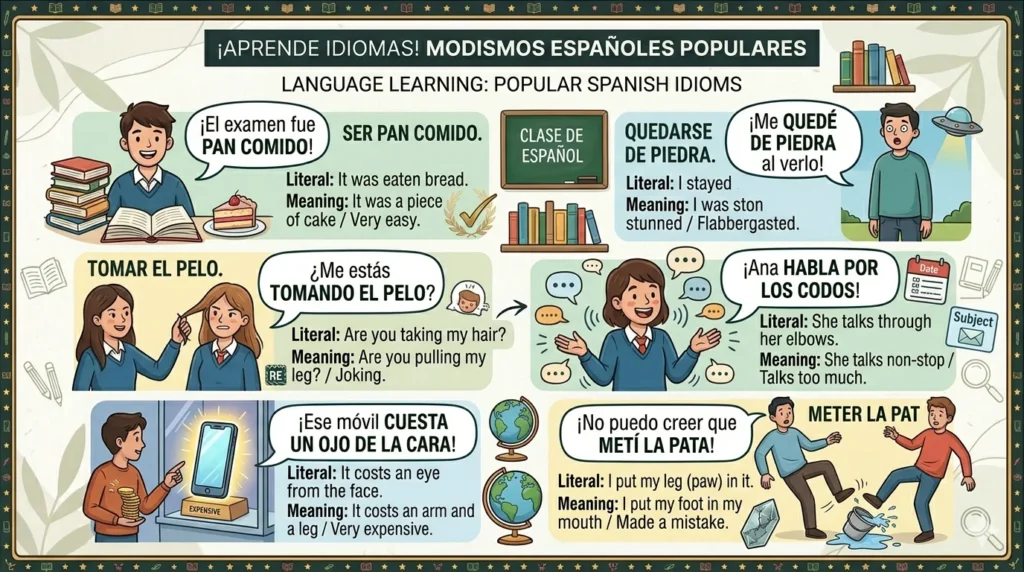
| Estar en las nubes | To be in the clouds | Daydreaming |
| Costar un ojo de la cara | Cost an eye | Cost an arm and a leg |
| Tirar la casa por la ventana | Throw the house out the window | Celebrate big |
| Meter la pata | Put the paw in | Make a mistake |
| Ser pan comido | Eaten bread | Piece of cake |
Estar en las nubes
Word-by-word meaning
- Estar = to be
- En = in
- Las nubes = the clouds
Idiomatic meaning
This idiom means to be distracted, absent-minded, or daydreaming. It describes someone who is not paying attention to what is happening around them.
Example sentences
- Juan estaba en las nubes durante la clase y no escuchó al profesor.
- I was in the clouds during the meeting and missed the important details.
- Siempre estás en las nubes cuando hablamos de trabajo.
Common error
Many learners think it refers to weather or imagination literally. In reality, it simply describes a lack of attention.
Usage note
It is very common in everyday conversation, especially when talking about students, employees, or friends who seem distracted.
Costar un ojo de la cara
Word-by-word meaning
- Costar = to cost
- Un ojo = an eye
- De la cara = from the face
Idiomatic meaning
It means something is extremely expensive, similar to the English idiom “cost an arm and a leg.”
Example sentences
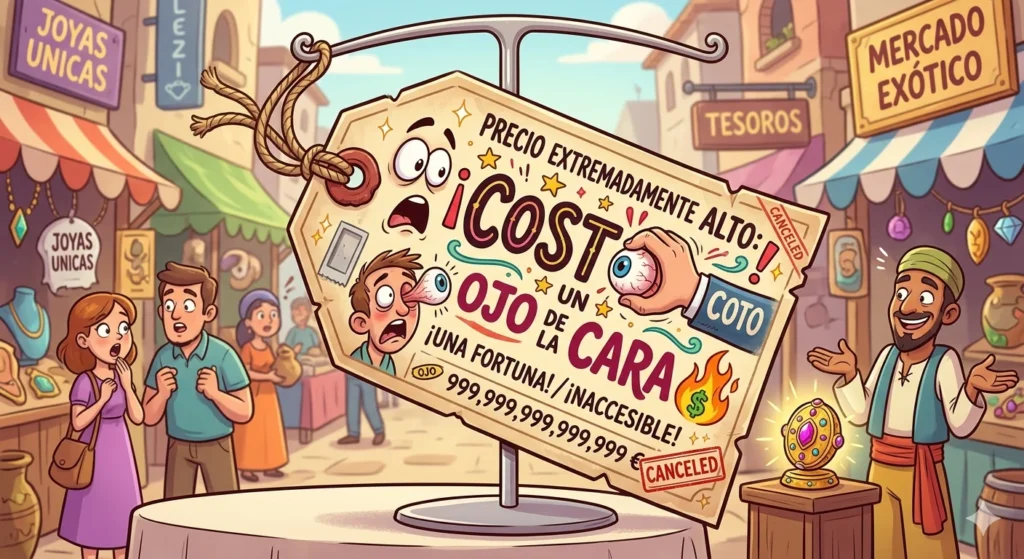
- Ese teléfono nuevo cuesta un ojo de la cara.
- The concert tickets cost an arm and a leg.
- Comprar una casa en esa ciudad cuesta un ojo de la cara.
Common error
Some learners think it sounds offensive or dramatic. However, it’s just a common exaggeration.
Usage note
Often used when discussing technology, luxury items, houses, or travel costs.
Tirar la casa por la ventana
Word-by-word meaning
- Tirar = to throw
- La casa = the house
- Por la ventana = through the window
Idiomatic meaning
This idiom means to celebrate extravagantly or spend a lot of money for a special occasion.
Example sentences
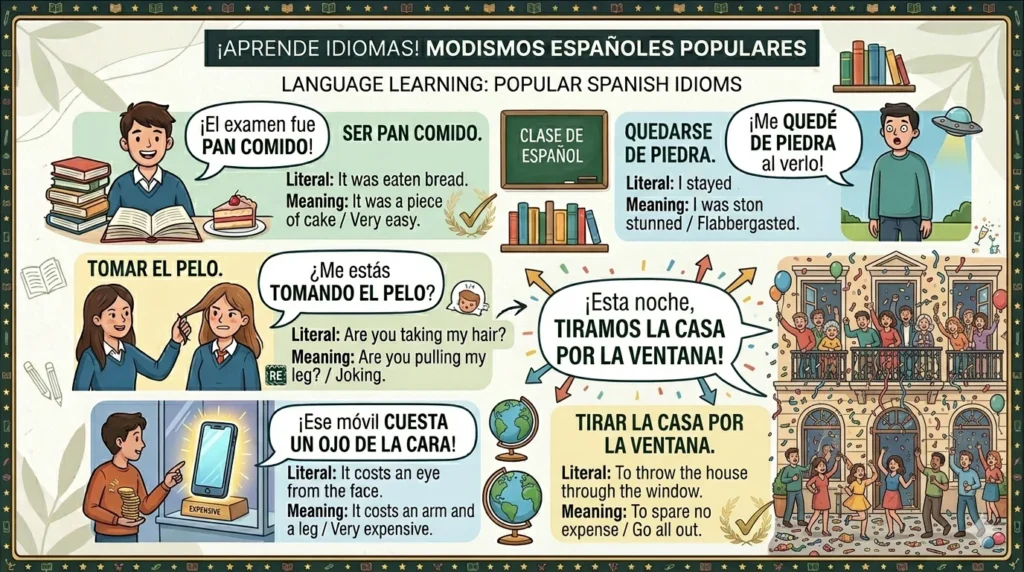
- Para su boda decidieron tirar la casa por la ventana.
- We’re going to celebrate big for our anniversary.
- Ganó la lotería y decidió tirar la casa por la ventana.
Common error
Learners sometimes assume it means destroying something.
Usage note
Usually used for big celebrations, weddings, graduations, or lottery wins.
Estar entre la espada y la pared
Word-by-word meaning
- Espada = sword
- Pared = wall
Idiomatic meaning
To be stuck between two difficult options where neither choice is good.
Example sentences
- Me siento entre la espada y la pared con esta decisión.
- He was between a rock and a hard place in that negotiation.
- El gerente está entre la espada y la pared con los empleados.
Common error
Thinking it refers to physical danger rather than a difficult decision.
Usage note
Common in business, personal conflicts, and decision-making situations.
Dar en el clavo
Word-by-word meaning
- Dar = to hit
- Clavo = nail
Idiomatic meaning
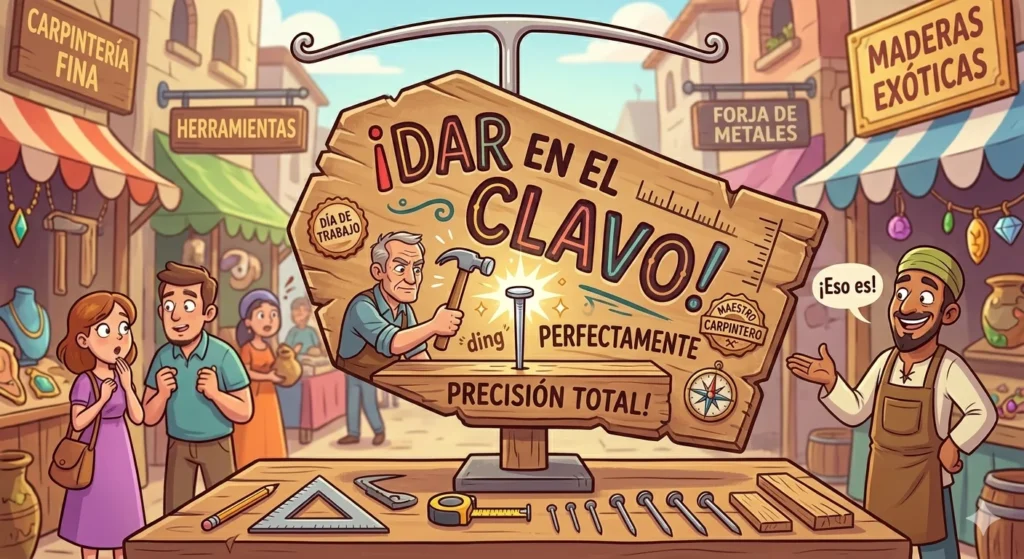
To be exactly right about something or give the correct answer.
Example sentences

- Tu explicación dio en el clavo.
- You hit the nail on the head with your analysis.
- El profesor dio en el clavo con su comentario.
Common error
Thinking it means physically hammering something.
Usage note
Often used when someone correctly identifies a problem or solution.
Meter la pata
Word-by-word meaning
- Meter = to put
- Pata = paw or foot
Idiomatic meaning
To make a mistake or embarrass yourself socially.
Example sentences
- Creo que metí la pata en la reunión.
- I really messed up during the interview.
- No quería ofenderte; metí la pata.
Common error
Learners sometimes confuse it with physical movement.
Usage note
Used frequently in social or professional situations.
Tomar el pelo
Word-by-word meaning
- Tomar = to take
- Pelo = hair
Idiomatic meaning
To tease or joke with someone, similar to “pulling someone’s leg.”
Example sentences
- ¿Me estás tomando el pelo?
- Are you pulling my leg?
- Siempre me toma el pelo cuando hablamos.
Common error
Literal translation makes it sound strange in English.
Usage note
Usually friendly and playful.
Ser pan comido
Word-by-word meaning
- Pan = bread
- Comido = eaten
Idiomatic meaning
Something very easy to do.
Example sentences
- El examen fue pan comido.
- That assignment was a piece of cake.
- Para él, aprender idiomas es pan comido.
Usage note
Often used by students after exams.
Estar como una cabra
Word-by-word meaning
- Cabra = goat
Idiomatic meaning
To be crazy, eccentric, or acting strangely.
Example sentences
- Ese artista está como una cabra.
- My friend acts crazy sometimes.
Usage note
Usually humorous rather than insulting.
No tener pelos en la lengua
Word-by-word meaning
- Pelos = hair
- Lengua = tongue
Idiomatic meaning
To speak very directly without hiding opinions.
Example sentences
- Ella no tiene pelos en la lengua.
- He always says exactly what he thinks.
Usage note
Often used for honest or outspoken people.
Hacer la vista gorda
Word-by-word meaning
- Vista = sight
- Gorda = fat
Idiomatic meaning
To ignore something intentionally.
Example sentences
- El jefe hizo la vista gorda con el retraso.
Usage note
Often used when authorities ignore small mistakes.
Estar sin blanca
Word-by-word meaning
- Blanca = coin
Idiomatic meaning
To have no money at all.
Example sentences
- Después del viaje estoy sin blanca.
Ponerse las pilas
Word-by-word meaning
- Pilas = batteries
Idiomatic meaning
To get motivated or start working harder.
Example sentences
- Tienes que ponerte las pilas si quieres aprobar.
Dormir como un tronco
Word-by-word meaning
- Tronco = log
Idiomatic meaning
To sleep very deeply.
Example sentences
- Después del trabajo dormí como un tronco.
Ser uña y carne
Word-by-word meaning
- Uña = nail
- Carne = flesh
Idiomatic meaning
To be very close friends.
Example sentences
- Ellos son uña y carne desde niños.
Ir al grano
Word-by-word meaning
- Grano = grain
Idiomatic meaning
To get straight to the point.
Example sentences
- Vamos a ir al grano en esta reunión.
Estar en la luna
Word-by-word meaning
- Luna = moon
Idiomatic meaning
To be distracted or absent-minded.
Example sentences
- Siempre estás en la luna en clase.
Buscarle tres pies al gato
Word-by-word meaning
- Tres pies = three feet
- Gato = cat
Idiomatic meaning
To complicate something unnecessarily.
Example sentences
- No le busques tres pies al gato.
Dar la lata
Word-by-word meaning
- Lata = can
Idiomatic meaning
To annoy or bother someone repeatedly.
Example sentences
- Mi hermano siempre me da la lata.
Más vale tarde que nunca
Word-by-word meaning
- Tarde = late
- Nunca = never
Idiomatic meaning
It is better to do something late than not at all.
Example sentences
- Llegaste tarde, pero más vale tarde que nunca.
FAQ About Spanish to English Idioms
1. What are Spanish to English idioms?
Spanish idioms are expressions whose meanings differ from their literal translation. They are commonly used in everyday conversations.
2. Why should language learners study idioms?
Idioms help you sound more natural and understand native speakers better.
3. Are Spanish idioms used in all Spanish-speaking countries?
Many idioms are universal, but some expressions vary by region.
4. How can I memorize Spanish idioms faster?
Practice using them in sentences, watch Spanish movies, and repeat them in conversations.
5. Are Spanish idioms used in formal situations?
Most idioms are informal, but some appear in literature and professional speech.
Conclusion
Mastering Spanish to English idioms is one of the fastest ways to sound more fluent and natural in Spanish. These expressions reflect culture, humor, and everyday communication.
Instead of translating word-by-word, focus on understanding the real meaning behind each idiom. Start practicing a few phrases every day and try using them when chatting with Spanish speakers or watching Spanish media.
If you practice consistently, these idioms will soon become a natural part of your vocabulary.
Start today by choosing three idioms from this list and using them in your next Spanish conversation.

“L.P. Hartley brings classic idioms to life on LearnIdom.com, helping readers explore language with wit, clarity, and timeless insight.”