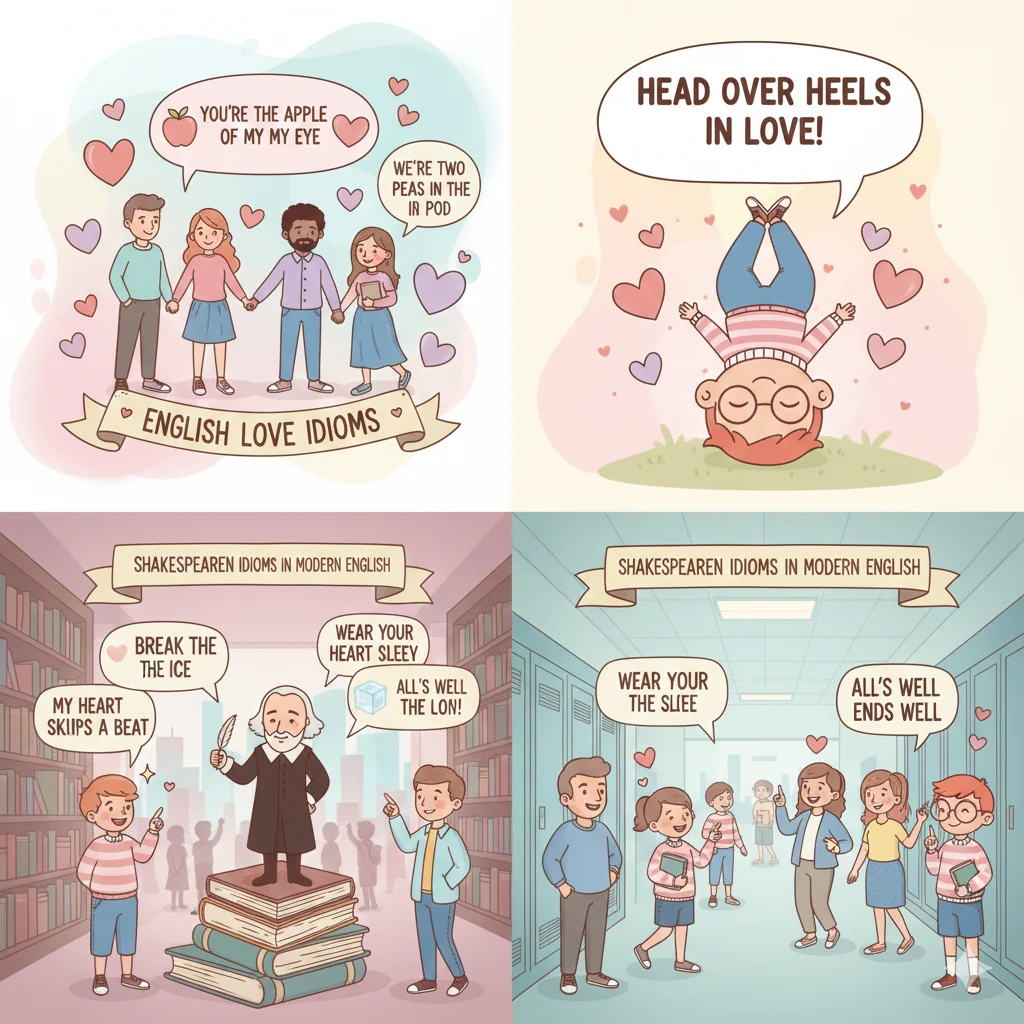
The English you speak today carries echoes from over 400 years ago—and much of it comes from Shakespeare. Many phrases we use daily, like “break the ice” or “wild-goose chase,” were first written by him. These Shakespeare idioms used today may sound modern, but their roots lie in classic plays and poems.
When I first learned this, I was surprised to realize I’d been quoting Shakespeare without knowing it! Whether you’re a student, English learner, or language lover, understanding these idioms helps you sound smarter, more natural, and culturally aware.
In this article, you’ll explore 20 of the most famous Shakespeare idioms, explained simply with meanings, examples, common mistakes, and usage notes—so you can confidently use them in real life.
🎭 Break the Ice
Word-by-Word Meaning
Break frozen water
Idiomatic Meaning
To start a conversation or reduce tension
Example Sentences

- He told a joke to break the ice at the meeting.
Common Error
❌ Using it for physical ice only
Usage Note
Used in social or professional situations
🎭 Wild-Goose Chase
Word-by-Word Meaning
Chasing a wild goose
Idiomatic Meaning
A pointless or hopeless search
Example Sentences

- Looking for that file was a wild-goose chase.
Common Error
❌ Using it for successful efforts
Usage Note
From Romeo and Juliet
🎭 Green-Eyed Monster
Word-by-Word Meaning
A monster with green eyes
Idiomatic Meaning
Jealousy
Example Sentences

- Jealousy is a green-eyed monster.
Common Error
❌ Taking it literally
Usage Note
From Othello
🎭 Wear Your Heart on Your Sleeve
Word-by-Word Meaning
Show your heart openly
Idiomatic Meaning
Show emotions openly
Example Sentences
- She wears her heart on her sleeve.

Common Error
❌ Using for secrecy
Usage Note
Emotional or personal contexts
🎭 All That Glitters Is Not Gold
Word-by-Word Meaning
Shiny things aren’t always gold
Idiomatic Meaning
Appearances can be deceptive
Example Sentences

- Be careful—all that glitters is not gold.
Common Error
❌ Using it for literal gold
Usage Note
From The Merchant of Venice
🎭 A Foregone Conclusion
Word-by-Word Meaning
Decided in advance
Idiomatic Meaning
An obvious result
Example Sentences
- His victory was a foregone conclusion.
Common Error
❌ Using for uncertain outcomes
Usage Note
Formal and informal use
🎭 The World Is Your Oyster
Word-by-Word Meaning
The world belongs to you
Idiomatic Meaning
You have many opportunities
Example Sentences
- With this degree, the world is your oyster.
Common Error
❌ Mixing with food context
Usage Note
Motivational phrase
🎭 Laughing Stock
Word-by-Word Meaning
Something everyone laughs at
Idiomatic Meaning
A person who is mocked
Example Sentences
- His mistake made him a laughing stock.
Common Error
❌ Using positively
Usage Note
Slightly negative tone
🎭 Dead as a Doornail
Word-by-Word Meaning
Completely dead
Idiomatic Meaning
Totally finished or lifeless
Example Sentences
- My phone battery is dead as a doornail.
Common Error
❌ Using in sensitive contexts
Usage Note
Very informal
🎭 Fair Play
Word-by-Word Meaning
Just behavior
Idiomatic Meaning
Honest and respectful treatment
Example Sentences
- He won the match—fair play to him.
Common Error
❌ Using sarcastically incorrectly
Usage Note
From The Tempest
🎭 It’s Greek to Me
Word-by-Word Meaning
Something written in Greek
Idiomatic Meaning
Impossible to understand
Example Sentences
- This math problem is Greek to me.
Common Error
❌ Using for foreign languages only
Usage Note
Very common idiom
🎭 In a Pickle
Word-by-Word Meaning
Inside a pickle jar
Idiomatic Meaning
In trouble or difficulty
Example Sentences
- I’m in a pickle—I lost my keys.
Common Error
❌ Using it jokingly in serious matters
Usage Note
Light-hearted tone
🎭 Cold Comfort
Word-by-Word Meaning
Comfort that feels cold
Idiomatic Meaning
Unhelpful reassurance
Example Sentences
- His words were cold comfort.
Common Error
❌ Using it positively
Usage Note
Emotional situations
🎭Full Circle
Word-by-Word Meaning
Return to the start
Idiomatic Meaning
End up where you began
Example Sentences
- Life has come full circle.
Common Error
❌ Using for partial progress
Usage Note
Reflective contexts
🎭 Too Much of a Good Thing
Word-by-Word Meaning
Excess of something good
Idiomatic Meaning
Even good things can be harmful in excess
Example Sentences
- Work is good, but too much of a good thing is bad.
Common Error
❌ Using for negative things
Usage Note
Advice-based idiom
🎭 Seen Better Days
Word-by-Word Meaning
Better times have passed
Idiomatic Meaning
Worn-out or declining
Example Sentences
- This house has seen better days.
Common Error
❌ Using for people emotionally only
Usage Note
Neutral-to-negative tone
🎭 The Game Is Up
Word-by-Word Meaning
The game has ended
Idiomatic Meaning
A secret is discovered
Example Sentences
- The police arrived—the game is up.
Common Error
❌ Using for sports only
Usage Note
Dramatic contexts
🎭 Love Is Blind
Word-by-Word Meaning
Love cannot see
Idiomatic Meaning
Love ignores faults
Example Sentences
- He ignored all warnings—love is blind.
Common Error
❌ Using sarcastically in serious advice
Usage Note
Romantic contexts
🎭 One Fell Swoop
Word-by-Word Meaning
One sudden action
Idiomatic Meaning
All at once
Example Sentences
- He lost everything in one fell swoop.
Common Error
❌ Spelling “fell” as “fail”
Usage Note
Formal and dramatic tone
🎭 Star-Crossed Lovers
Word-by-Word Meaning
Stars working against lovers
Idiomatic Meaning
Lovers doomed by fate
Example Sentences
- Romeo and Juliet were star-crossed lovers.
Common Error
❌ Using for casual relationships
Usage Note
Literary and romantic use
❓ FAQs About Shakespeare Idioms Used Today
Q1. Why are Shakespeare idioms still used today?
Because they express ideas clearly and memorably.
Q2. Are Shakespeare idioms formal?
Many are informal and used daily.
Q3. Do exams include Shakespeare idioms?
Yes, especially in reading and vocabulary tests.
Q4. Can beginners use these idioms?
Yes—start with common ones like break the ice.
Q5. Did Shakespeare invent all these phrases?
Many were first recorded or popularized by him.
🎯 Conclusion
Learning Shakespeare idioms used today connects you to the heart of English itself. These phrases make your speech richer, smarter, and more expressive. Don’t just read them—use them in conversations, writing, and practice daily. When you do, you’re not just learning English—you’re carrying a literary legacy forward.

“L.P. Hartley brings classic idioms to life on LearnIdom.com, helping readers explore language with wit, clarity, and timeless insight.”