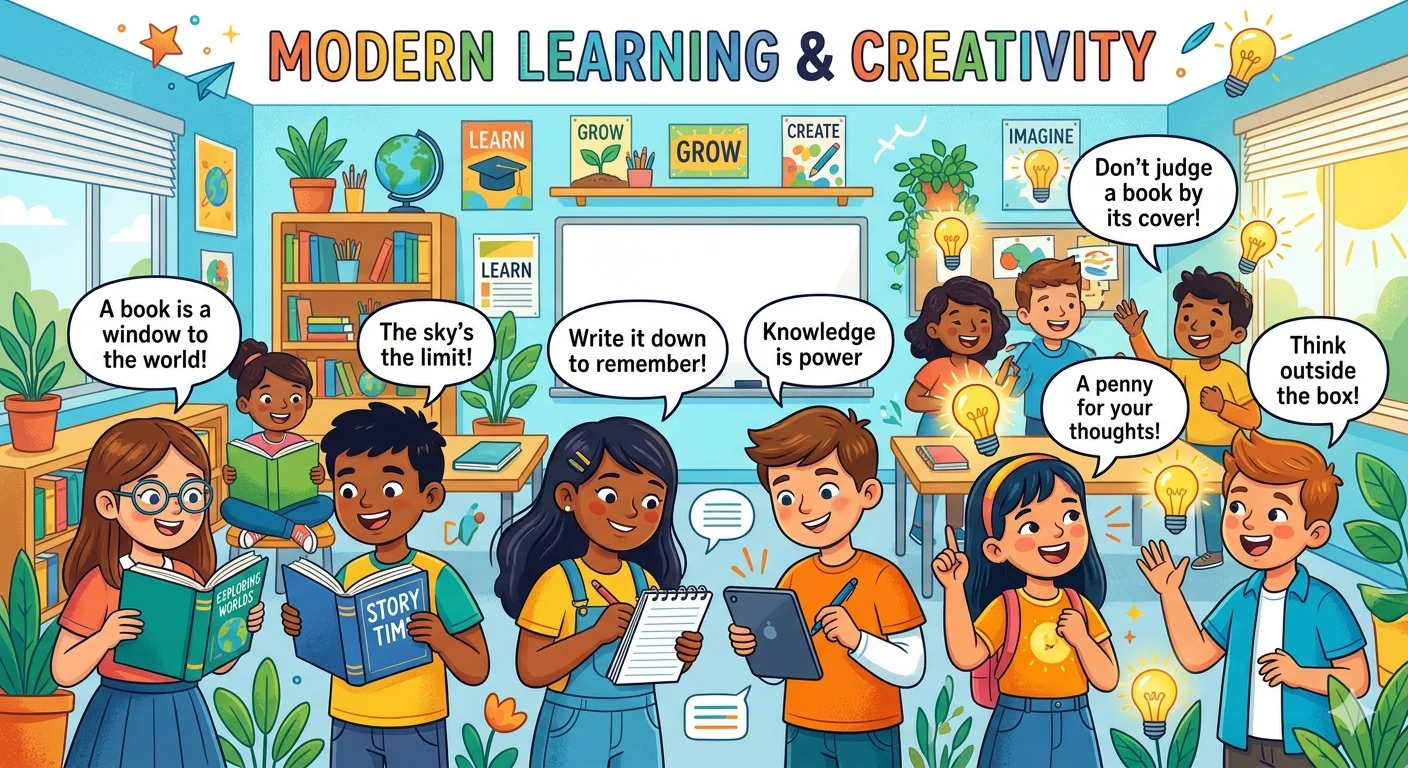
Have you ever heard phrases like “read between the lines,” “think outside the box,” or “hit the books” and wondered what they really mean? These expressions are examples of read, write, and think idioms, which are commonly used in English conversations, education, and everyday communication.
Idioms are phrases whose meanings are different from the literal meanings of the words. For example, when someone says “hit the books,” they are not telling you to hit books physically—they simply mean you should study hard.
Learning idioms about reading, writing, and thinking helps English learners communicate more naturally and understand native speakers better. These idioms often appear in classrooms, workplaces, books, and daily conversations.
In this complete guide, you will discover common read, write, and think idioms, along with their meanings, example sentences, common mistakes, and usage tips that will help you improve your English fluency and confidence.
Table of Contents
- Introduction
- What Are Read, Write, and Think Idioms?
- Quick Overview of Popular Idioms
- 20 Idioms Related to Reading, Writing, and Thinking
- Why Learning Idioms Is Important
- Tips to Learn Idioms Faster
- FAQs
- Conclusion
Overview of Popular Idioms
| Idiom | Meaning |
|---|---|
| Read between the lines | Understand hidden meaning |
| Think outside the box | Think creatively |
| Hit the books | Study hard |
| A closed book | Something difficult to understand |
| Food for thought | An idea worth thinking about |
| By the book | Follow rules exactly |
| Read the room | Understand people’s emotions |
| Think on your feet | Think quickly |
| Write something off | Consider something unimportant |
| Know by heart | Memorize completely |
Read Between the Lines
Word-by-Word Meaning
- Read = look at written words
- Between = in the middle
- Lines = sentences or written text
Idiomatic Meaning
To understand the hidden or implied meaning behind something that is not directly stated.
Example Sentences

- I could read between the lines and tell that she was upset.
- If you read between the lines of his email, he seems unhappy with the decision.
Common Error
Some learners use this idiom when the meaning is obvious. The idiom should only be used when there is a hidden message.
Usage Note
This idiom is commonly used when people communicate indirectly or politely.
Think Outside the Box
Word-by-Word Meaning
Thinking beyond the limits of a box or traditional thinking.
Idiomatic Meaning
To think creatively and develop unique solutions.
Example Sentences

- Successful entrepreneurs learn to think outside the box.
- The teacher encouraged students to think outside the box while solving the problem.
Common Error
Using this idiom in situations where strict rules must be followed.
Usage Note
This idiom is very popular in business, innovation, and creative discussions.
Hit the Books
Word-by-Word Meaning
- Hit = strike
- Books = textbooks
Idiomatic Meaning
To study seriously, especially before exams.
Example Sentences

- I have an exam tomorrow, so I need to hit the books tonight.
- She spent the entire weekend hitting the books.
Common Error
Using this idiom for casual reading.
Usage Note
Very common among students and teachers.
A Closed Book
Word-by-Word Meaning
A book that is closed and cannot be read.
Idiomatic Meaning
Something that is difficult to understand or mysterious.
Example Sentences

- Advanced physics is a closed book to me.
- His personality is a closed book.
Usage Note
Often used when something seems confusing or difficult to understand.
Food for Thought
Word-by-Word Meaning
Food that feeds the mind.
Idiomatic Meaning
An idea or information that makes you think deeply.
Example Sentences

- The documentary gave us food for thought.
- Her speech provided food for thought about education.
Usage Note
Common in intellectual discussions and debates.
In Black and White
Word-by-Word Meaning
Printed words in black ink on white paper.
Idiomatic Meaning
Something clearly written or officially documented.
Example Sentences
- The rules are written in black and white.
- I want the agreement in black and white.
Usage Note
Often used in legal or formal communication.
By the Book
Idiomatic Meaning
To follow rules exactly without deviation.
Example Sentences
- The officer handled the case by the book.
- She prefers doing everything by the book.
Usage Note
Common in professional environments.
Read the Room
Idiomatic Meaning
To understand people’s emotions or reactions in a situation.
Example Sentences
- A good leader knows how to read the room.
- He should have read the room before making that joke.
Usage Note
Common in social interactions and leadership.
Think on Your Feet
Idiomatic Meaning
To respond quickly and intelligently in unexpected situations.
Example Sentences
- Teachers often have to think on their feet.
- She impressed everyone by thinking on her feet during the interview.
Write Something Off
Word-by-Word Meaning
- Write = likhna ya record karna
- Something = koi cheez ya idea
- Off = hata dena ya cancel kar dena
Idiomatic Meaning
Kisi idea, plan ya cheez ko important na samajhna ya usay reject kar dena.
Example Sentences
- Don’t write off his idea before listening to it carefully.
- Many critics wrote the movie off, but it later became very popular.
- Teachers should never write off a student just because they struggle at first.
Common Error
Kuch learners ise sirf financial accounting term samajh lete hain. Lekin everyday English me iska matlab dismiss kar dena hota hai.
Usage Note
Ye idiom aksar opinions, ideas, projects aur people ke context me use hota hai.
Back to the Drawing Board
Word-by-Word Meaning
- Back = wapas
- Drawing board = wo board jahan designers ya planners ideas banate hain
Idiomatic Meaning
Jab koi plan fail ho jaye aur phir se shuru se planning karni pade.
Example Sentences
- The project failed, so it’s back to the drawing board.
- Our marketing plan didn’t work, so we went back to the drawing board.
- Engineers went back to the drawing board to redesign the product.
Common Error
Is idiom ko normal planning ke liye use karna galat hai. Ye tab use hota hai jab previous plan fail ho jaye.
Usage Note
Commonly used in business, engineering, design, and creative work.
Get the Message
Word-by-Word Meaning
- Get = samajhna
- Message = signal ya baat
Idiomatic Meaning
Kisi hint ya indirect baat ko samajh lena.
Example Sentences
- After several warnings, he finally got the message.
- She kept reminding me about the deadline until I got the message.
- I got the message that they wanted to leave early.
Common Error
Is idiom ko literal message receive karne ke liye use karna incorrect hai.
Usage Note
Often used when someone finally understands a hint or indirect instruction.
Take Note
Word-by-Word Meaning
- Take = lena
- Note = note ya observation
Idiomatic Meaning
Kisi important cheez par dhyan dena ya usay yaad rakhna.
Example Sentences
- Students should take note of this grammar rule.
- Please take note of the meeting time change.
- Scientists took note of the unusual results.
Common Error
Learners kabhi kabhi ise sirf notes likhne ke sense me use karte hain, jabke iska matlab attention dena bhi hota hai.
Usage Note
Academic aur professional environments me common hai.
A Quick Read
Word-by-Word Meaning
- Quick = fast
- Read = reading material
Idiomatic Meaning
Koi article ya book jo jaldi aur easily read ki ja sakti ho.
Example Sentences
- This blog post is a quick read.
- The magazine article was short and a quick read.
- I prefer quick reads during my commute.
Common Error
Is idiom ko long novels ke liye use karna incorrect hai.
Usage Note
Often used for articles, blogs, and short books.
Brainstorm
Word-by-Word Meaning
- Brain = mind
- Storm = strong burst of activity
Idiomatic Meaning
Ideas generate karne ke liye creative discussion karna.
Example Sentences
- Let’s brainstorm some marketing ideas.
- The team brainstormed solutions to the problem.
- Students brainstormed ideas for their project.
Common Error
Some learners think brainstorming means criticizing ideas, but actually it means generating ideas freely.
Usage Note
Very common in team meetings, business, and education.
Put It in Writing
Word-by-Word Meaning
- Put = place
- Writing = written form
Idiomatic Meaning
Kisi agreement ya decision ko officially likh lena.
Example Sentences
- Please put the agreement in writing.
- The manager asked them to put the terms in writing.
- It’s always safer to put contracts in writing.
Common Error
Kuch learners ise casual note ke liye use karte hain, jabke ye mostly formal documentation ke liye hota hai.
Usage Note
Often used in legal, business, and professional contexts.
Know by Heart
Word-by-Word Meaning
- Know = knowledge hona
- Heart = memory ya feelings
Idiomatic Meaning
Kisi cheez ko perfectly memorize kar lena.
Example Sentences
- She knows the poem by heart.
- Actors must know their lines by heart.
- Students often learn multiplication tables by heart.
Common Error
Is idiom ko partial memory ke liye use karna incorrect hai.
Usage Note
Common in education, music, and performances.
Turn Over a New Leaf
Word-by-Word Meaning
- Turn over = palatna
- Leaf = page
Idiomatic Meaning
Apni life ya behavior me positive change shuru karna.
Example Sentences
- After failing the exam, he decided to turn over a new leaf.
- She promised to turn over a new leaf and study harder.
- The company turned over a new leaf after hiring new management.
Common Error
Is idiom ko simple change ke liye use karna wrong hai. Ye major positive change ke liye hota hai.
Usage Note
Often used for personal improvement and fresh starts.
Read Someone Like a Book
Word-by-Word Meaning
- Read = understand
- Book = clear information source
Idiomatic Meaning
Kisi person ke feelings ya thoughts easily samajh lena.
Example Sentences
- I can read him like a book.
- Parents often read their children like a book.
- The detective read the suspect like a book.
Common Error
Is idiom ko literal reading ke sense me use karna incorrect hai.
Usage Note
Often used in psychology, relationships, and social situations.
Think Twice
Word-by-Word Meaning
- Think = sochna
- Twice = do dafa
Idiomatic Meaning
Kisi decision se pehle carefully sochna.
Example Sentences
- You should think twice before quitting your job.
- Students must think twice before cheating in exams.
- He didn’t think twice before helping his friend.
Common Error
Is idiom ko normal thinking ke liye use karna incorrect hai.
Usage Note
Often used in decision-making situations.
Why Learning Idioms Is Important
Learning English idioms provides several benefits:
- Improves natural communication
- Helps understand native speakers
- Makes conversations more engaging
- Improves writing and storytelling
Idioms also help learners express complex ideas in simple ways.
Tips to Learn Idioms Faster
Here are some effective strategies:
1 Learn in Context
Learn idioms within sentences instead of memorizing them individually.
2 Use Real Conversations
Practice idioms while speaking with friends or classmates.
3 Watch English Media
Movies, podcasts, and TV shows are great sources of idioms.
4 Maintain an Idiom Notebook
Write new idioms along with examples.
5 Practice Regularly
Use idioms in writing and daily conversation.
FAQs
What are read, write, and think idioms?
They are idiomatic expressions related to learning, studying, thinking, and communication.
Why should English learners study idioms?
Idioms help learners understand natural speech and improve communication skills.
Are idioms used in formal English?
Some idioms are used in professional contexts, but many are more common in informal communication.
How many idioms should beginners learn?
Start with 5–10 idioms and practice them regularly.
What is the best way to remember idioms?
Using idioms in real conversations and connecting them with examples helps remember them easily.
Conclusion
Mastering read, write, and think idioms is an excellent way to improve your English fluency and confidence. These expressions appear frequently in classrooms, conversations, books, and professional communication.
Instead of memorizing hundreds of vocabulary words, learning idioms allows you to express ideas naturally and creatively. By practicing the idioms in this guide, you will be able to understand conversations better and communicate more effectively.
Start using a few idioms every day, and gradually they will become a natural part of your English communication.

“Rose Macaulay shares the charm of idioms on LearnIdom.com, making language learning delightful, insightful, and full of wit for every reader.”