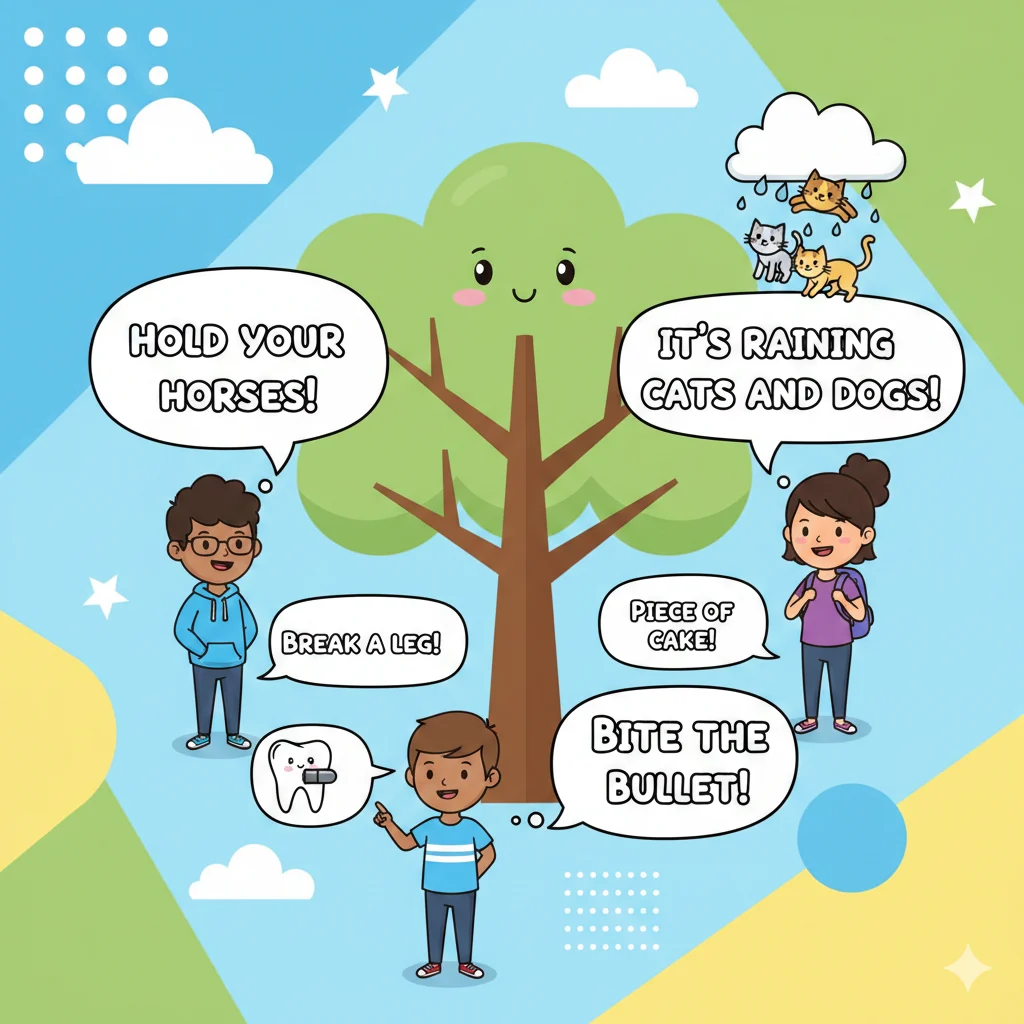
Learning English idioms is one of the smartest and fastest ways to improve your fluency and sound like a natural speaker. Idioms are special phrases whose meanings are different from the literal words, such as “piece of cake” meaning something very easy, or “break the ice” meaning to start a conversation comfortably. Many learners understand grammar and vocabulary but still struggle to follow real conversations because idioms are used everywhere — in movies, social media, books, and daily speech.
By mastering common idioms, you not only expand your vocabulary but also gain confidence in speaking and writing. Idioms make your sentences more expressive, engaging, and memorable. Whether you are a student, job seeker, or content creator, learning idioms helps you communicate ideas more clearly and connect better with native speakers. In short, idioms turn basic English into powerful, real-life English that truly stands out.
Quick Overview Table – Common English Idioms
| Idiom | Short Meaning | Best Use |
|---|---|---|
| Break the Ice | Start conversation | Social |
| Piece of Cake | Very easy | Exams |
| Hit the Nail on the Head | Exactly right | Opinions |
| Once in a Blue Moon | Rarely | Frequency |
| Under the Weather | Feeling sick | Health |
| Spill the Beans | Reveal secret | Gossip |
| Cost an Arm and a Leg | Very expensive | Shopping |
| Bite the Bullet | Face difficulty | Decisions |
| Let the Cat Out of the Bag | Reveal secret | Mistakes |
| Burn the Midnight Oil | Study late | Exams |
| Kill Two Birds with One Stone | Two goals at once | Productivity |
| A Blessing in Disguise | Hidden benefit | Life events |
| Beat Around the Bush | Avoid main topic | Discussions |
| Hit the Sack | Go to sleep | Daily life |
| On Cloud Nine | Extremely happy | Emotions |
| Pull Someone’s Leg | Joke/tease | Friends |
| The Ball Is in Your Court | Your decision | Responsibility |
| Cut Corners | Do cheaply/quickly | Work |
| See Eye to Eye | Agree | Relationships |
| Add Fuel to the Fire | Worsen situation | Arguments |
Break the Ice
Word-by-Word Meaning
Break = todna, Ice = baraf
Idiomatic Meaning
To start a conversation and remove awkward silence.
Example Sentences

- He told a joke to break the ice.
- I smiled to break the ice at the meeting.
- Games help students break the ice.
Common Error
Thinking it means real ice.
Usage Note
Used in social or formal gatherings.
Piece of Cake
Word Meaning
Cake ka tukra
Idiomatic Meaning
Something very easy.
Examples

- The test was a piece of cake.
- Cooking pasta is a piece of cake.
- For her, math is a piece of cake.
Common Error
Taking it literally.
Usage Note
Informal situations.
Hit the Nail on the Head
Idiomatic Meaning
To say exactly the right thing.
Examples

- You hit the nail on the head.
- Her comment hit the nail on the head.
- The teacher hit the nail on the head.
Common Error
Physical action samajhna.
Usage Note
Opinions or analysis.
Once in a Blue Moon
Idiomatic Meaning
Very rarely.
Examples

- I eat junk food once in a blue moon.
- He travels once in a blue moon.
- We meet once in a blue moon.
Usage Note
Frequency expression.
Under the Weather
Idiomatic Meaning
Feeling slightly sick.
Examples

- I’m under the weather today.
- She felt under the weather yesterday.
- He stayed home under the weather.
Break the Ice
Word-by-Word Meaning
Break = to smash
Ice = frozen water
Idiomatic Meaning
To start a conversation in a social situation and make people feel comfortable.
Example Sentences
- He told a joke to break the ice at the meeting.
- Teachers often play games to break the ice on the first day.
- She smiled and said hello to break the ice.
Common Error
Thinking it means breaking real ice.
Usage Note
Used in meetings, parties, or first introductions.
Piece of Cake
Word-by-Word Meaning
Piece = a part
Cake = a sweet dessert
Idiomatic Meaning
Something very easy to do.
Example Sentences
- The test was a piece of cake.
- Cooking this recipe is a piece of cake.
- For him, math is a piece of cake.
Common Error
Believing it is about food.
Usage Note
Informal expression for easy tasks.
Once in a Blue Moon
Word-by-Word Meaning
Once = one time
Blue Moon = a rare full moon event
Idiomatic Meaning
Something that happens very rarely.
Example Sentences
- I eat fast food once in a blue moon.
- She travels abroad once in a blue moon.
- We meet once in a blue moon now.
Common Error
Assuming the moon actually turns blue.
Usage Note
Used for rare activities or events.
Let the Cat Out of the Bag
Word-by-Word Meaning
Let = allow
Cat = animal
Bag = a sack
Idiomatic Meaning
To reveal a secret accidentally.
Example Sentences
- He let the cat out of the bag about the surprise party.
- She let the cat out of the bag during dinner.
- They let the cat out of the bag too early.
Common Error
Taking it literally.
Usage Note
Used when secrets are revealed unintentionally.
Under the Weather
Word-by-Word Meaning
Under = below
Weather = climate condition
Idiomatic Meaning
Feeling sick or unwell.
Example Sentences
- I’m feeling under the weather today.
- She stayed home because she was under the weather.
- He looked under the weather at work.
Common Error
Thinking it is about the weather forecast.
Usage Note
Polite way to say you are sick.
Kill Two Birds with One Stone
Word-by-Word Meaning
Kill = to end life
Two Birds = two animals
One Stone = a single rock
Idiomatic Meaning
To achieve two goals with one action.
Example Sentences
- I studied while traveling to kill two birds with one stone.
- Walking to work helps me exercise and save money—kill two birds with one stone.
- She listened to podcasts while cooking to kill two birds with one stone.
Common Error
Thinking it promotes violence.
Usage Note
Used for productivity and smart planning.
A Blessing in Disguise
Word-by-Word Meaning
Blessing = something good
Disguise = hidden form
Idiomatic Meaning
Something that seems bad at first but turns out good later.
Example Sentences
- Losing that job was a blessing in disguise.
- The delay was a blessing in disguise.
- Missing the train became a blessing in disguise.
Common Error
Assuming it is good from the beginning.
Usage Note
Used for life lessons and experiences.
Beat Around the Bush
Word-by-Word Meaning
Beat = hit
Bush = a plant
Idiomatic Meaning
To avoid the main topic and not speak directly.
Example Sentences
- Stop beating around the bush and answer clearly.
- He kept beating around the bush in the interview.
- Don’t beat around the bush—be honest.
Common Error
Taking it literally.
Usage Note
Common in serious discussions.
Hit the Sack
Word-by-Word Meaning
Hit = strike
Sack = bag
Idiomatic Meaning
To go to sleep.
Example Sentences
- I’m tired—I’ll hit the sack early.
- He hit the sack after dinner.
- They hit the sack at midnight.
Common Error
Thinking it means hitting a bag.
Usage Note
Informal night-time expression.
On Cloud Nine
Word-by-Word Meaning
Cloud = sky vapor
Nine = number 9
Idiomatic Meaning
Extremely happy or excited.
Example Sentences
- She was on cloud nine after her success.
- He felt on cloud nine on his birthday.
- They were on cloud nine after winning.
Common Error
Thinking it relates to weather.
Usage Note
Used for strong happiness.
Pull Someone’s Leg
Word-by-Word Meaning
Pull = drag
Leg = limb
Idiomatic Meaning
To joke or tease someone in a friendly way.
Example Sentences
- I was just pulling your leg.
- He enjoys pulling his friend’s leg.
- She smiled and said she was pulling my leg.
Common Error
Believing it is physical.
Usage Note
Friendly humor only.
The Ball Is in Your Court
Word-by-Word Meaning
Ball = sports ball
Court = playing area
Idiomatic Meaning
It is your responsibility or decision now.
Example Sentences
- I’ve done my part; the ball is in your court.
- She explained everything—the ball is in his court.
- We offered help; the ball is in their court.
Common Error
Thinking it is only sports-related.
Usage Note
Used in decisions and negotiations.
Cut Corners
Word-by-Word Meaning
Cut = slice
Corners = edges
Idiomatic Meaning
To do something cheaply or quickly by skipping quality steps.
Example Sentences
- Don’t cut corners on safety.
- The company cut corners to save money.
- Students shouldn’t cut corners in studies.
Common Error
Taking it literally.
Usage Note
Common in work and business talk.
See Eye to Eye
Word-by-Word Meaning
See = view
Eye = vision organ
Idiomatic Meaning
To completely agree with someone.
Example Sentences
- We see eye to eye on this issue.
- They rarely see eye to eye.
- Friends usually see eye to eye on plans.
Common Error
Assuming it means looking physically.
Usage Note
Used in relationships and teamwork.
Add Fuel to the Fire
Word-by-Word Meaning
Fuel = energy source
Fire = flames
Idiomatic Meaning
To make a bad situation worse.
Example Sentences
- Don’t add fuel to the fire during arguments.
- His words added fuel to the fire.
- Complaining only adds fuel to the fire.
Common Error
Thinking it is about real fire.
Usage Note
Used in conflicts and emotional situations.
FAQs – Learn English Idioms
1. What are English idioms?
English idioms are phrases whose meanings are different from the literal words. For example, “piece of cake” does not mean real cake — it means something very easy.
2. Why should I learn English idioms?
Learning idioms makes your English sound natural, fluent, and native-like. They are commonly used in movies, conversations, interviews, and daily communication.
3. How can I memorize idioms easily?
- Learn 2–3 idioms daily
- Use them in sentences and conversations
- Watch English dramas or YouTube videos
- Write a small diary using new idioms
4. Are idioms used in exams and interviews?
Yes. Idioms often appear in spoken English tests, IELTS, job interviews, and presentations because they show strong language command.
5. How long does it take to learn idioms?
If you practice daily, you can learn basic idioms in 1–2 months and become confident in 3–4 months.
Conclusion
Learning English idioms is one of the smartest ways to improve your fluency and confidence in speaking. Idioms add color, emotion, and natural rhythm to your language, making your conversations sound more like a native speaker rather than a textbook learner.
The key is not memorizing hundreds at once but practicing a few daily and using them in real-life situations such as chatting with friends, writing social media posts, or watching English shows. Consistency is more important than speed. Even learning one idiom a day can create big progress in a few months. Stay curious, keep practicing, and don’t be afraid to make mistakes. With regular use, idioms will become a natural and powerful part of your English communication skills.

“Elizabeth Bowen shares timeless idioms and language wisdom on LearnIdom.com, making learning phrases fun, easy, and unforgettable.”