
Good idioms are figurative expressions used to describe positive emotions, success, happiness, kindness, good luck, and favorable situations. These popular idioms about good things help speakers express positive ideas in a more natural, colorful, and engaging way.
Common positive idioms such as “as good as gold,” “on cloud nine,” “the best of both worlds,” “a blessing in disguise,” and “come up roses” are frequently used in everyday conversations, writing, literature, and professional communication. Learning good idioms with meanings and examples can improve your vocabulary, strengthen your communication skills, and help you understand native English speakers more easily.
Whether you’re a student, teacher, writer, or English learner, this guide explores the most common good idioms, their meanings, usage, and practical examples for daily conversation and effective communication.
A blessing in disguise
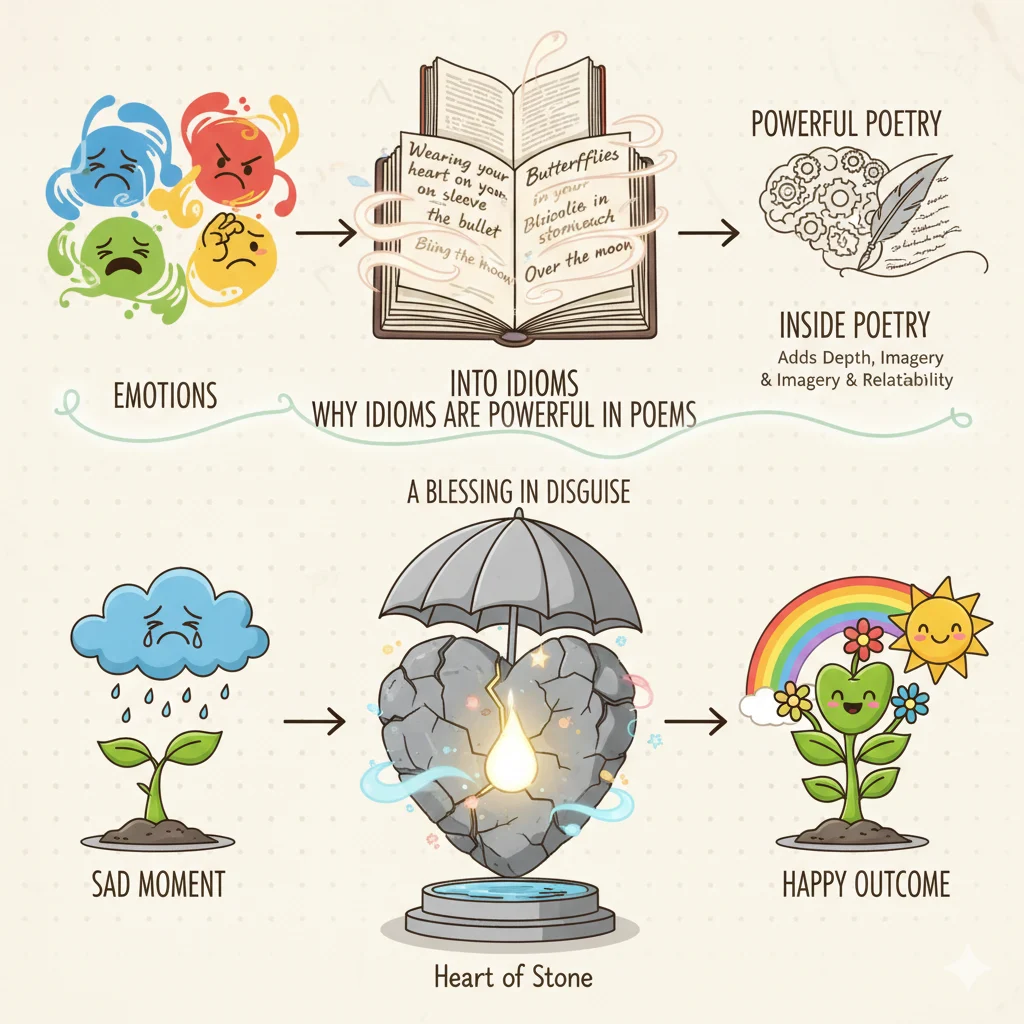
Word-by-word meaning: A hidden blessing
Idiomatic meaning: Something good that seemed bad at first
Example sentence:
Losing that job was a blessing in disguise because I found a better one.
Common error: Using it for clearly good events
Usage note: Often used when reflecting on the past
The best of both worlds

Word-by-word meaning: Two good worlds
Idiomatic meaning: Enjoying two advantages at the same time
Example sentence:
Working from home gives me the best of both worlds.
Common error: Using it for compromises
Usage note: Use when both sides are positive
On cloud nine

Word-by-word meaning: On the ninth cloud
Idiomatic meaning: Extremely happy
Example sentence:
She was on cloud nine after passing the exam.
Common error: Saying in cloud nine
Usage note: Always “on,” not “in”
A win-win situation

Word-by-word meaning: Everyone wins
Idiomatic meaning: A result that benefits everyone
Example sentence:
Flexible hours are a win-win situation for staff and managers.
Common error: Using it for one-sided benefits
Usage note: Common in business English
Hit the jackpot

Word-by-word meaning: Win money
Idiomatic meaning: Achieve great success or luck
Example sentence:
We hit the jackpot with that restaurant.
Common error: Using only for gambling
Usage note: Often used casually
In good hands
Word-by-word meaning: Safe hands
Idiomatic meaning: Being well cared for
Example sentence:
Don’t worry, your project is in good hands.
Common error: Forgetting “in”
Usage note: Reassuring phrase
A breath of fresh air
Word-by-word meaning: Clean air
Idiomatic meaning: Something new and positive
Example sentence:
Her attitude is a breath of fresh air.
Common error: Using for physical air only
Usage note: Common for people or ideas
Have a good head on your shoulders
Word-by-word meaning: A good head
Idiomatic meaning: Be sensible and smart
Example sentence:
He’s young but has a good head on his shoulders.
Common error: Shortening incorrectly
Usage note: Compliment
Make someone’s day
Word-by-word meaning: Create a day
Idiomatic meaning: Make someone very happy
Example sentence:
Your message really made my day.
Common error: Using for big life events
Usage note: Often informal
A stroke of luck
Word-by-word meaning: A sudden touch of luck
Idiomatic meaning: Unexpected good fortune
Example sentence:
Meeting her was a stroke of luck.
Common error: Confusing with skill
Usage note: Sudden events
Good as gold
Word-by-word meaning: Equal to gold
Idiomatic meaning: Very well-behaved or reliable
Example sentence:
The kids were good as gold today.
Common error: Using for objects only
Usage note: Common with children
Have the time of your life
Word-by-word meaning: Best time
Idiomatic meaning: Enjoy something very much
Example sentence:
We had the time of our life on vacation.
Common error: Wrong tense
Usage note: Past experiences
Plain sailing
Word-by-word meaning: Easy sailing
Idiomatic meaning: No problems
Example sentence:
After the exam, it was plain sailing.
Common error: Using for difficult situations
Usage note: British English
Bring home the bacon
Word-by-word meaning: Bring food home
Idiomatic meaning: Earn money or succeed
Example sentence:
She works hard to bring home the bacon.
Common error: Taking literally
Usage note: Informal
On the right track
Word-by-word meaning: Correct path
Idiomatic meaning: Doing something correctly
Example sentence:
Your plan is on the right track.
Common error: Mixing with “right way”
Usage note: Encouraging phrase
Come up roses
Word-by-word meaning: Flowers appear
Idiomatic meaning: Turn out very well
Example sentence:
Everything came up roses in the end.
Common error: Rare tense use
Usage note: American English
Have a ball
Word-by-word meaning: Play with a ball
Idiomatic meaning: Have fun
Example sentence:
We had a ball at the party.
Common error: Using for sports only
Usage note: Informal
A happy medium
Word-by-word meaning: Balanced middle
Idiomatic meaning: A good compromise
Example sentence:
Let’s find a happy medium.
Common error: Using for extremes
Usage note: Neutral tone
All’s well that ends well
Word-by-word meaning: Good ending matters
Idiomatic meaning: Problems don’t matter if outcome is good
Example sentence:
It was stressful, but all’s well that ends well.
Common error: Using mid-situation
Usage note: Conclusion phrase
In seventh heaven
Word-by-word meaning: Highest heaven
Idiomatic meaning: Extremely happy
Example sentence:
She’s in seventh heaven about her new job.
Common error: Mixing with cloud nine
Usage note: Similar to “on cloud nine”
Frequently Asked Questions About Good Idioms
1. What are good idioms?
Good idioms are expressions with positive or favorable meanings commonly used by native speakers.
2. Are idioms formal English?
Most idioms are informal, but some are acceptable in professional settings.
3. How can I remember idioms easily?
Use them in sentences, connect them to personal experiences, and review often.
4. Can idioms be translated word for word?
No. Idioms usually lose meaning when translated literally.
Conclusion
In conclusion, idioms about good are powerful expressions that help make English more natural, expressive, and engaging. Instead of using the word “good” in a simple way, these idioms allow speakers and writers to describe kindness, positivity, success, and favorable situations in a more creative manner.
Phrases like “good as gold,” “a good Samaritan,” “as good as it gets,” and “good things come to those who wait” are commonly used in daily life, literature, and conversations. Learning these idioms not only improves vocabulary but also helps learners sound more fluent and confident in English. They are especially useful in writing, speaking, storytelling, and social communication where natural expression matters. By practicing and using these idioms regularly, learners can enhance their communication skills and make their language more impactful. Overall, mastering idioms about good is a simple yet powerful way to strengthen English fluency and express positive ideas effectively.

“L.P. Hartley brings classic idioms to life on LearnIdom.com, helping readers explore language with wit, clarity, and timeless insight.”