Have you ever heard someone say, “It’s raining cats and dogs” or “He’s a dark horse” and wondered what animals have to do with it? That’s the magic of animal idioms in English. These expressions make the language colorful, emotional, and more natural—just like native speakers use it in daily life.
I still remember my first confusion when a teacher said, “Don’t be a chicken before exams.” I actually looked around for a bird! 😄 That moment taught me how important idioms are for real communication. Animal idioms don’t mean exactly what the words say; instead, they carry deeper, figurative meanings.
In this article, you’ll explore the 20 most famous animal idioms in English, explained simply with examples, common mistakes, and usage tips—so you can confidently use them in speaking and writing.
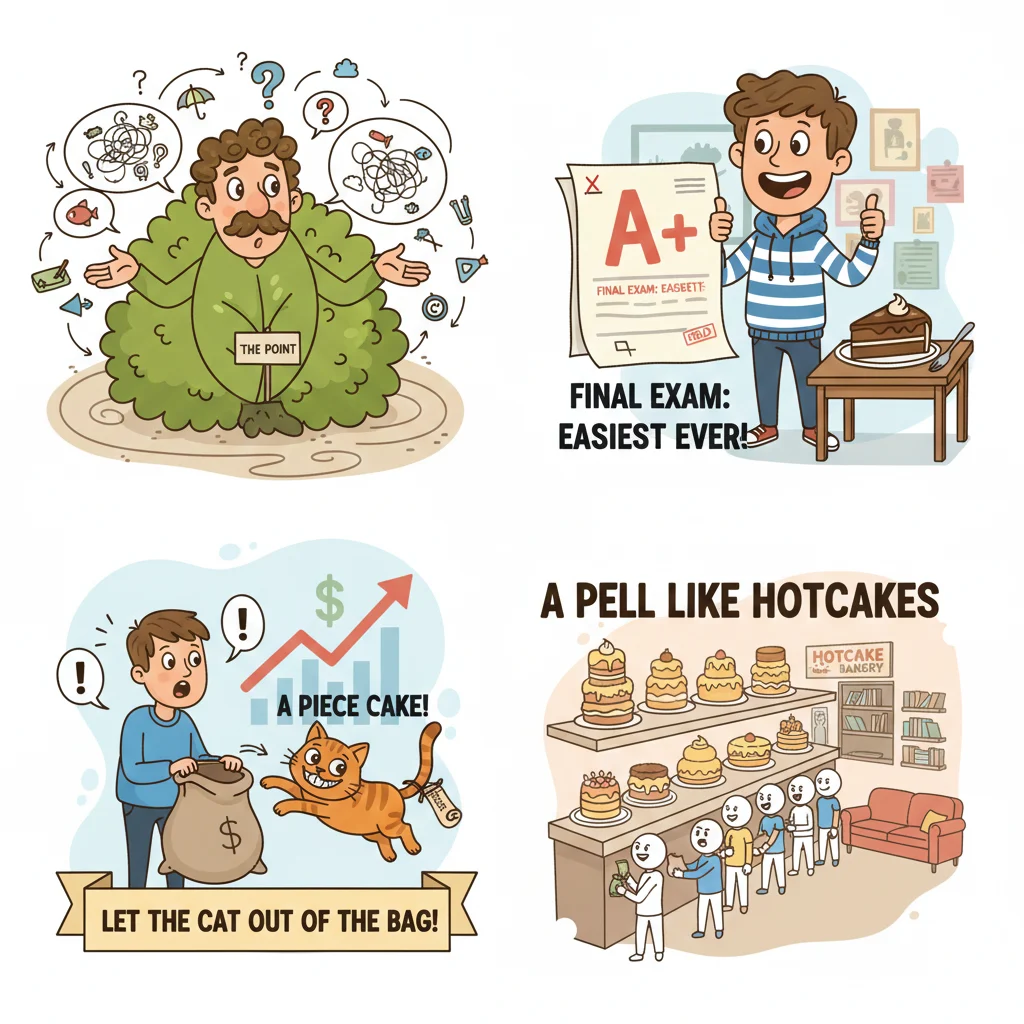
🐶 Let the Cat Out of the Bag
Word-by-word Meaning
To release a cat from a bag
Idiomatic Meaning
To reveal a secret accidentally
Example Sentences
- She let the cat out of the bag about the surprise party.
- I didn’t mean to let the cat out of the bag.
Common Error
❌ Saying it for intentional secrets
✔️ Use it for accidental disclosure
Usage Note
Often used in informal conversations.
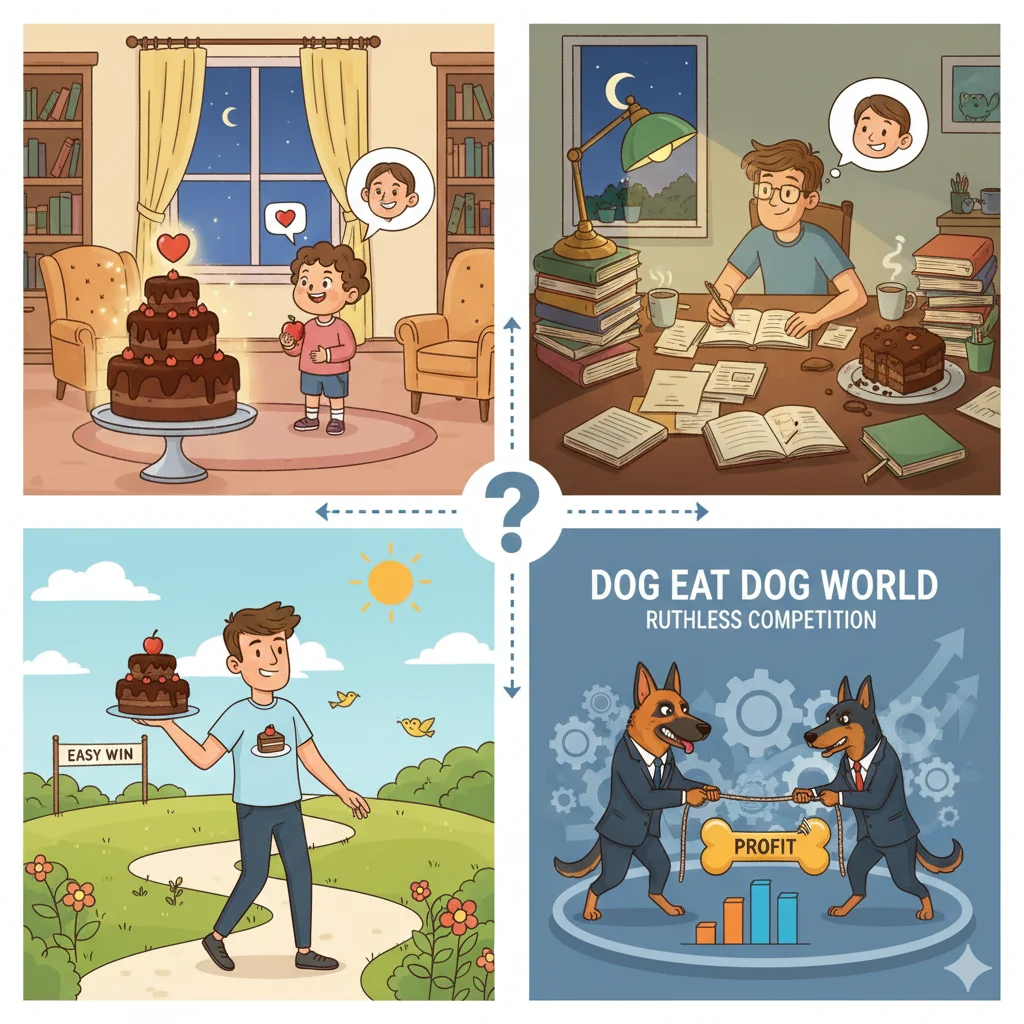
🐕 Dog Eat Dog
Word-by-word Meaning
Dogs eating other dogs
Idiomatic Meaning
A very competitive or cruel situation
Example Sentences
- The business world is dog eat dog.
- It’s a dog eat dog competition.
Common Error
❌ Using it for friendly competition
✔️ Use for harsh rivalry
Usage Note
Common in business or career contexts.
🐴 Straight from the Horse’s Mouth
Word-by-word Meaning
Information from a horse’s mouth
Idiomatic Meaning
Information from the original source
Example Sentences
- I heard it straight from the horse’s mouth.
- The news came from the horse’s mouth.

Common Error
❌ Using for rumors
✔️ Use only for reliable sources
Usage Note
Very common in spoken English.
🐱 Curiosity Killed the Cat
Word-by-word Meaning
Curiosity caused a cat’s death
Idiomatic Meaning
Too much curiosity can be dangerous
Example Sentences
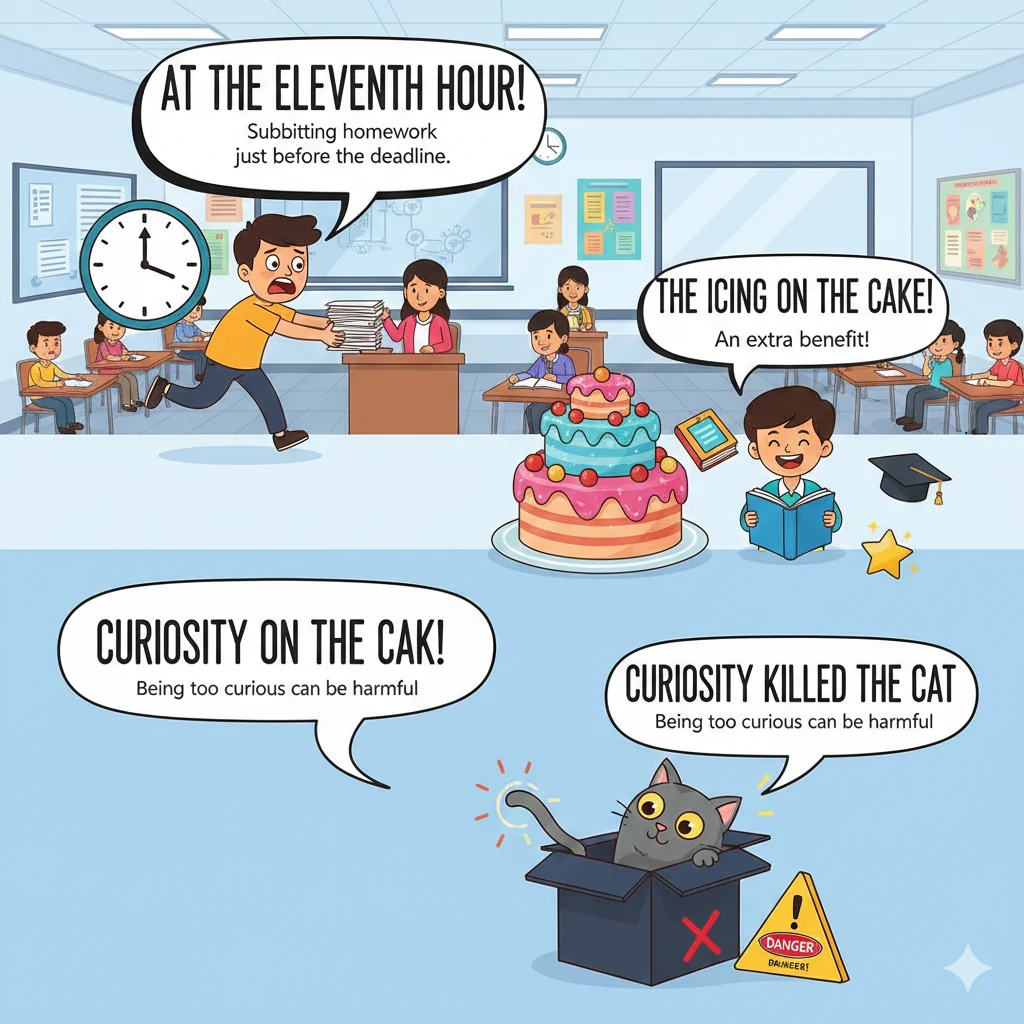
- Don’t ask too many questions—curiosity killed the cat.
Common Error
❌ Using it positively
✔️ Usually a warning
Usage Note
Often said humorously.
🐑 Black Sheep
Word-by-word Meaning
A sheep with black wool
Idiomatic Meaning
A person who is different or disgraced in a group
Example Sentences
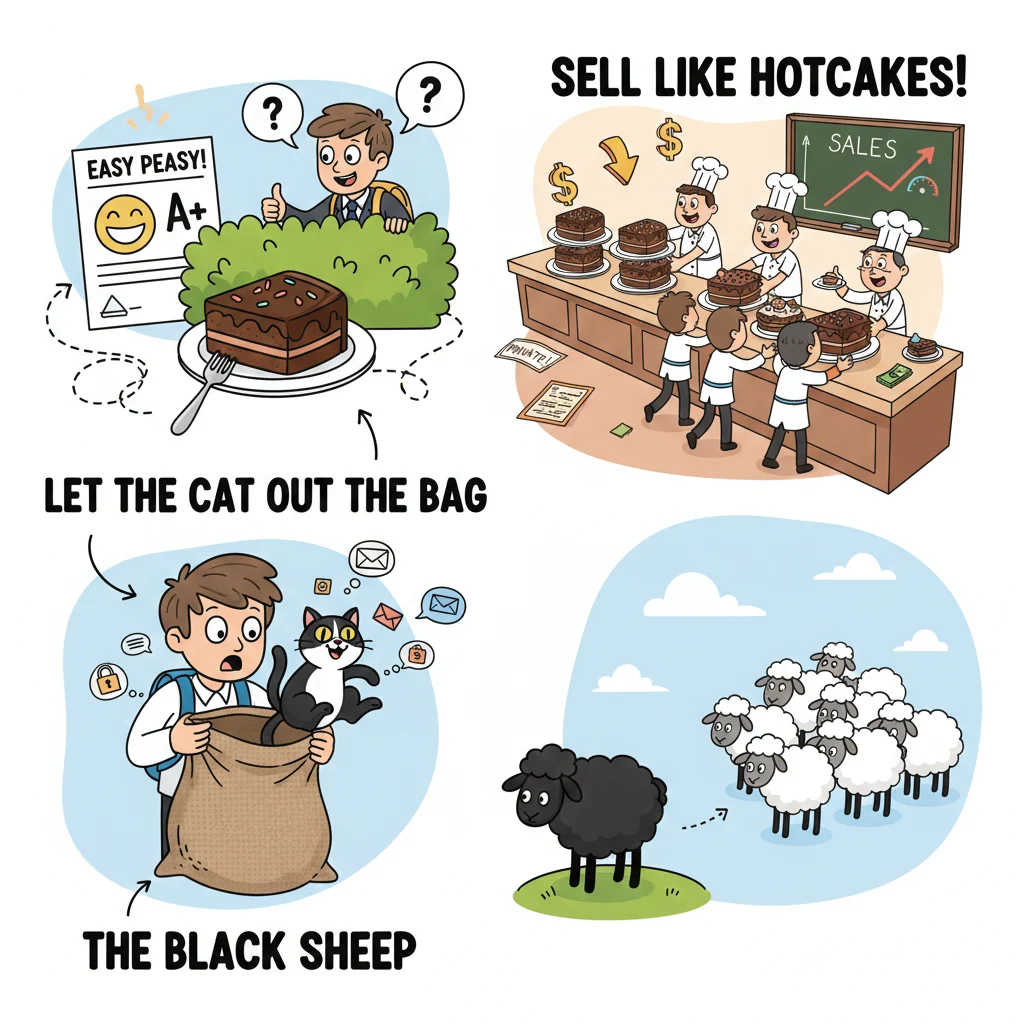
- He’s the black sheep of the family.
Common Error
❌ Using for positive uniqueness
✔️ Usually negative or neutral
Usage Note
Family and social contexts.
🐘 Elephant in the Room
Word-by-word Meaning
An elephant inside a room
Idiomatic Meaning
An obvious problem everyone avoids
Example Sentences
- Let’s talk about the elephant in the room.
Common Error
❌ Using for small issues
✔️ Use for major issues
Usage Note
Common in meetings and discussions.
🐓 Chicken Out
Word-by-word Meaning
To become a chicken
Idiomatic Meaning
To lose courage
Example Sentences
- He chickened out at the last minute.
Common Error
❌ Using for physical weakness
✔️ Use for fear or hesitation
Usage Note
Very informal.
🐝 Busy as a Bee
Word-by-word Meaning
A bee that is busy
Idiomatic Meaning
Very hardworking
Example Sentences
- She’s busy as a bee these days.
Common Error
❌ Using for stress only
✔️ It means active and productive
Usage Note
Positive expression.
🐍 Snake in the Grass
Word-by-word Meaning
A hidden snake
Idiomatic Meaning
A hidden enemy or traitor
Example Sentences
- Be careful—he’s a snake in the grass.
Common Error
❌ Using without suspicion context
✔️ Use for betrayal
Usage Note
Strong negative tone.
🐎 Hold Your Horses
Word-by-word Meaning
Stop the horses
Idiomatic Meaning
Wait or slow down
Example Sentences
- Hold your horses! We’re not ready yet.
Common Error
❌ Using for anger
✔️ Use for patience
Usage Note
Friendly and informal.
🐶 Every Dog Has Its Day
Word-by-word Meaning
Every dog will have its own day
Idiomatic / Figurative Meaning
Everyone gets a chance for success or happiness at some point in life
Example Sentences
- Don’t lose hope—every dog has its day.
- He struggled for years, but every dog has its day.
Common Error
❌ Using it only for animals
✔️ Use it for people and life situations
Usage Note
Motivational and encouraging; common in spoken English.
🐭 Quiet as a Mouse
Word-by-word Meaning
As silent as a mouse
Idiomatic / Figurative Meaning
Extremely quiet or silent
Example Sentences
- The kids were quiet as a mouse during the movie.
- He sat quiet as a mouse in the meeting.
Common Error
❌ Using for shyness only
✔️ Use specifically for silence
Usage Note
Positive or neutral tone.
🐔 Count Your Chickens Before They Hatch
Word-by-word Meaning
Counting baby chickens before they are born
Idiomatic / Figurative Meaning
Don’t assume success before it actually happens
Example Sentences
- Don’t count your chickens before they hatch—you haven’t passed yet.
- He booked a vacation too early and counted his chickens before they hatched.
Common Error
❌ Using after success
✔️ Use before results are confirmed
Usage Note
Often used as advice or warning.
🐺 A Wolf in Sheep’s Clothing
Word-by-word Meaning
A wolf dressed like a sheep
Idiomatic / Figurative Meaning
A dangerous or dishonest person pretending to be kind
Example Sentences
- He looks friendly, but he’s a wolf in sheep’s clothing.
- Be careful—wolves often hide in sheep’s clothing.
Common Error
❌ Using for harmless people
✔️ Use only for hidden danger
Usage Note
Strong negative meaning.
🐟 A Fish Out of Water
Word-by-word Meaning
A fish outside water
Idiomatic / Figurative Meaning
Feeling uncomfortable or out of place
Example Sentences
- I felt like a fish out of water at the party.
- She was a fish out of water in her new job.
Common Error
❌ Using for confidence
✔️ Use when someone feels awkward
Usage Note
Very common in daily conversation.
🐦 Birds of a Feather Flock Together
Word-by-word Meaning
Similar birds stay together
Idiomatic / Figurative Meaning
People with similar interests or personalities stick together
Example Sentences
- They’re best friends—birds of a feather flock together.
- Gamers usually hang out together; birds of a feather flock together.
Common Error
❌ Using for temporary groups
✔️ Use for long-term similarities
Usage Note
Neutral or slightly judgmental.
🐱 Cat Got Your Tongue?
Word-by-word Meaning
A cat took your tongue
Idiomatic / Figurative Meaning
Why are you suddenly silent?
Example Sentences
- What’s wrong? Cat got your tongue?
- You were talking so much—cat got your tongue now?
Common Error
❌ Using in formal writing
✔️ Use only in informal speech
Usage Note
Often playful or teasing.
🐮 Till the Cows Come Home
Word-by-word Meaning
Until cows return home
Idiomatic / Figurative Meaning
For a very long time
Example Sentences
- You can argue till the cows come home, but I won’t change my mind.
- He can play games till the cows come home.
Common Error
❌ Using for short time
✔️ Use for long or endless duration
Usage Note
Casual and humorous.
🐕 Barking Up the Wrong Tree
Word-by-word Meaning
A dog barking at the wrong tree
Idiomatic / Figurative Meaning
Blaming the wrong person or misunderstanding a situation
Example Sentences
- If you think I broke it, you’re barking up the wrong tree.
- The police were barking up the wrong tree.
Common Error
❌ Using without accusation context
✔️ Use when someone is mistaken
Usage Note
Common in spoken English.
🐒 Monkey See, Monkey Do
Word-by-word Meaning
Monkeys copy what they see
Idiomatic / Figurative Meaning
People copy others without thinking
Example Sentences
- Kids often learn by monkey see, monkey do.
- He doesn’t think for himself—monkey see, monkey do.
Common Error
❌ Using for learning skills
✔️ Use for blind imitation
Usage Note
Often used humorously or critically.
Frequently Asked Questions (FAQs)
❓ What are animal idioms in English?
Animal idioms are expressions that use animals symbolically to express ideas, emotions, or situations.
❓ Why should learners study animal idioms?
They help you sound natural, fluent, and confident in real conversations.
❓ Are animal idioms formal or informal?
Most are informal and best for speaking and casual writing.
❓ Can animal idioms be translated word-for-word?
No, they should be learned as fixed expressions.
❓ How can I practice animal idioms?
Use them in sentences, short stories, and daily conversations.
Conclusion
Learning animal idioms in English is like unlocking a secret door to fluent communication. Start with 2–3 idioms, use them in daily speech, and notice how natural your English sounds. Don’t be afraid to make mistakes—every learner has their day! Keep practicing, stay curious, and soon these idioms will feel as easy as talking about your favorite animal.

“Elizabeth Bowen shares timeless idioms and language wisdom on LearnIdom.com, making learning phrases fun, easy, and unforgettable.”