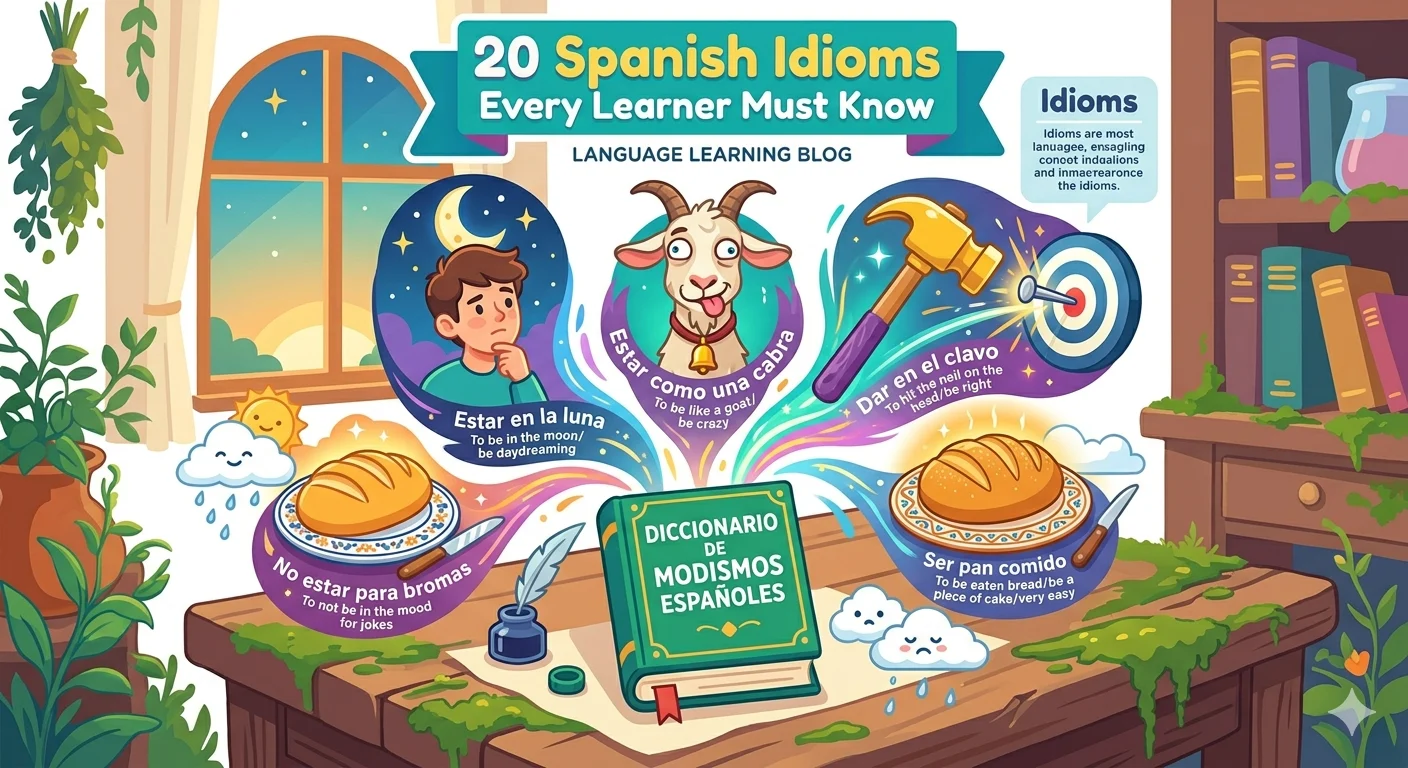
When I first started learning Spanish, grammar and vocabulary were manageable—but Spanish idioms completely confused me. Native speakers would say things that made no sense when translated word by word. For example, someone once told me “Estás en la luna.” Literally, that means “You are on the moon.” But the real meaning is that someone is distracted or daydreaming.
This is why learning Spanish idioms is so important. Idioms are colorful expressions that reflect culture, humor, and everyday communication. Native speakers use them constantly in conversations, movies, and social media.
By understanding common Spanish idiomatic expressions, you move beyond textbook Spanish and start sounding natural and confident. In this guide, you will learn 20 of the most famous Spanish idioms, including their literal translations, figurative meanings, example sentences, common mistakes learners make, and practical usage tips. Mastering these expressions will help you understand Spanish conversations faster and communicate more like a native speaker.
What Are Spanish Idioms?
Spanish idioms are phrases whose meanings cannot be understood from the literal translation of the individual words. Instead, they carry figurative meanings commonly used in everyday Spanish conversations.
For example:
| Idiom | Literal Meaning | Real Meaning |
|---|---|---|
| Estar en la luna | To be on the moon | To be distracted |
| Ser pan comido | Eaten bread | Something very easy |
Learning these expressions helps you understand real spoken Spanish instead of only textbook language.
Estar en la Luna
Word-by-word Meaning
- Estar = To be
- en = in/on
- la luna = the moon
Idiomatic Meaning
To be distracted, absent-minded, or daydreaming.
Example Sentences

- Marta was en la luna during the meeting and missed the instructions.
- Stop being en la luna and focus on your homework.
Common Error
Many learners think it refers to outer space instead of distraction.
Usage Note
This is one of the most common Spanish expressions used in schools or workplaces.
Ser Pan Comido
Word-by-word Meaning
- Ser = To be
- pan = bread
- comido = eaten
Idiomatic Meaning
Something very easy to do.
Example Sentences

- The math exam was pan comido for her.
- Cooking pasta is pan comido if you follow the recipe.
Common Error
Literal translation may confuse learners.
Usage Note
Equivalent to the English idiom “a piece of cake.”
Tirar la Casa por la Ventana
Word-by-word Meaning
- Tirar = To throw
- la casa = the house
- por la ventana = through the window
Idiomatic Meaning
To celebrate extravagantly or spend a lot of money.
Example Sentences
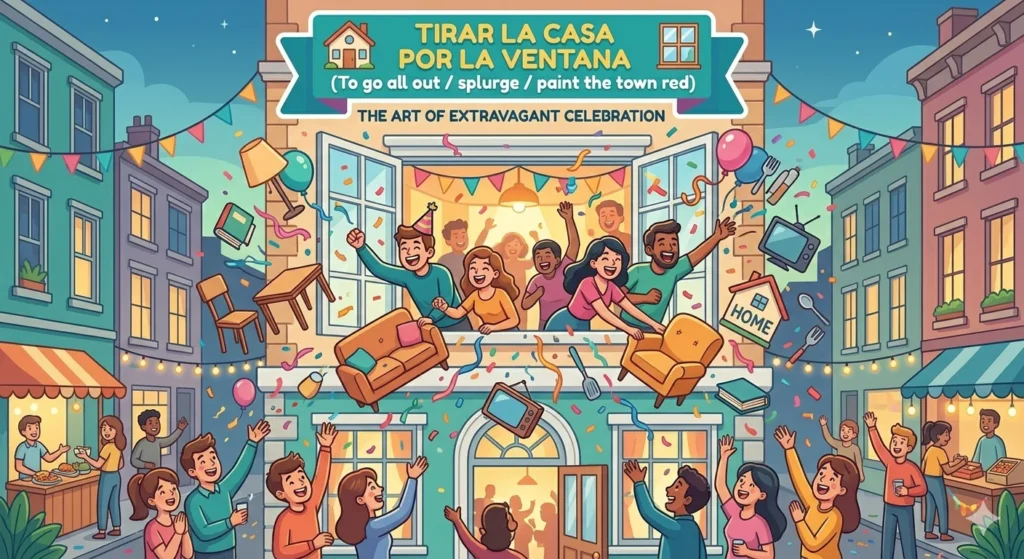
- They tiraron la casa por la ventana at their wedding.
- After winning the competition, he decided to tirar la casa por la ventana.
Usage Note
Often used for weddings, birthdays, or major celebrations.
Costar un Ojo de la Cara
Word-by-word Meaning
- Costar = to cost
- un ojo = an eye
- de la cara = from the face
Idiomatic Meaning
Something extremely expensive.
Example Sentences

- That luxury watch costó un ojo de la cara.
- Apartments in the city cuestan un ojo de la cara.
Usage Note
Similar to the English phrase “cost an arm and a leg.”
Estar Como una Cabra
Word-by-word Meaning
- Estar = to be
- como = like
- una cabra = a goat
Idiomatic Meaning
Someone behaving in a crazy or irrational way.
Example Sentences
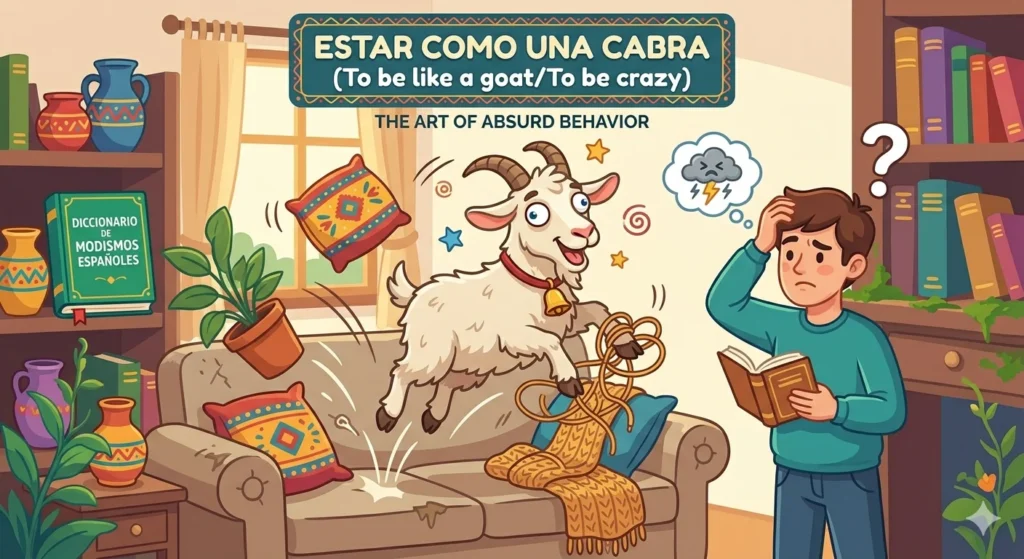
- If you jump into freezing water, you’re como una cabra.
- My cousin is como una cabra, but he’s very entertaining.
Usage Note
Often used humorously rather than as a serious insult.
Meter la Pata
Word-by-word Meaning
- Meter = to put
- la pata = the paw/foot
Idiomatic Meaning
To make an embarrassing mistake.
Example Sentences
- I metí la pata by mentioning her ex-boyfriend.
- Be careful not to meter la pata during the meeting.
Usage Note
Similar to the English expression “put your foot in your mouth.”
Dar en el Clavo
Word-by-word Meaning
- Dar = to hit
- el clavo = the nail
Idiomatic Meaning
To be exactly right.
Example Sentences
- You diste en el clavo with that answer.
- She dio en el clavo when identifying the problem.
Usage Note
Equivalent to “hit the nail on the head.”
Estar en las Nubes
Word-by-word Meaning
- Estar = to be
- en = in
- las nubes = the clouds
Idiomatic Meaning
To be lost in thought or distracted.
Example Sentences
- The student was en las nubes during the lecture.
- Stop being en las nubes and listen.
Usage Note
Very similar to estar en la luna, but slightly softer.
Ponerse las Pilas
Word-by-word Meaning
- Ponerse = to put on
- las pilas = the batteries
Idiomatic Meaning
To get motivated or start working seriously.
Example Sentences
- You need to ponerte las pilas before exams.
- The team se puso las pilas and finished the project.
Usage Note
Common in workplace or school contexts.
Buscarle Tres Pies al Gato
Word-by-word Meaning
- Buscar = to look for
- tres pies = three feet
- al gato = to the cat
Idiomatic Meaning
To complicate something unnecessarily.
Example Sentences
- Stop buscando tres pies al gato. The solution is obvious.
- He always busca tres pies al gato in simple situations.
No Tener Pelos en la Lengua
Word-by-word Meaning
“No hair on the tongue.”
Idiomatic Meaning
To speak very directly and honestly.
Example Sentences
- My aunt no tiene pelos en la lengua.
- She always says what she thinks sin pelos en la lengua.
No Tener Pelos en la Lengua
Word-by-word Meaning
- No tener = To not have
- pelos = hairs
- en la lengua = on the tongue
Literal translation: “To not have hairs on the tongue.”
Idiomatic Meaning
This Spanish idiom describes someone who speaks very directly and honestly without holding back their opinion.
It is often used for people who say exactly what they think, even if it might sound blunt.
Example Sentences
- Mi abuela no tiene pelos en la lengua cuando habla de política.
(My grandmother doesn’t hold back when talking about politics.) - She doesn’t have hairs on her tongue — she always tells the truth.
Common Error
Some learners think it refers to physical speech problems. In reality, it simply refers to being very direct in speech.
Usage Note
This idiom is commonly used when describing someone who is very honest or outspoken.
Estar Hecho Polvo
Word-by-word Meaning
- Estar = To be
- hecho = made
- polvo = dust
Literal translation: “To be made into dust.”
Idiomatic Meaning
It means to be extremely tired, exhausted, or emotionally drained.
Example Sentences
- After the 10-hour flight, I was hecho polvo.
- She felt hecha polvo after working all night.
Common Error
Learners sometimes think it means being dirty or dusty. In reality, it refers to physical or emotional exhaustion.
Usage Note
This idiom is commonly used after long workdays, travel, or intense activities.
Dormir Como un Tronco
Word-by-word Meaning
- Dormir = To sleep
- como = like
- un tronco = a log
Literal translation: “To sleep like a log.”
Idiomatic Meaning
It describes someone who sleeps very deeply without waking up easily.
Example Sentences
- I was so tired that I dormí como un tronco.
- The baby duerme como un tronco every night.
Common Error
Some learners assume it refers to sleeping outside or in nature. It actually means sleeping very deeply.
Usage Note
This idiom is similar to the English phrase “sleep like a log.”
Ser la Manzana de la Discordia
Word-by-word Meaning
- Ser = To be
- la manzana = the apple
- de la discordia = of discord/conflict
Literal translation: “To be the apple of discord.”
Idiomatic Meaning
Something that causes conflict, argument, or disagreement between people.
This idiom originates from Greek mythology, where a golden apple started a dispute among goddesses.
Example Sentences
- Money became la manzana de la discordia between the brothers.
- The new policy turned into la manzana de la discordia in the company.
Common Error
Learners sometimes confuse it with “apple of my eye.” The meanings are completely different.
Usage Note
Often used in discussions about family, business, or political disagreements.
Estar Entre la Espada y la Pared
Word-by-word Meaning
- Estar = To be
- entre = between
- la espada = the sword
- y la pared = and the wall
Literal translation: “To be between the sword and the wall.”
Idiomatic Meaning
To be in a difficult situation where both options are unpleasant.
Example Sentences
- He was entre la espada y la pared when choosing between two jobs.
- The manager felt entre la espada y la pared during negotiations.
Common Error
Some learners interpret it as a physical threat, but it usually refers to decision pressure.
Usage Note
This idiom is very similar to the English phrase “between a rock and a hard place.”
Dar la Cara
Word-by-word Meaning
- Dar = To give
- la cara = the face
Literal translation: “To give the face.”
Idiomatic Meaning
To take responsibility for something and face the consequences bravely.
Example Sentences
- Good leaders dan la cara when problems happen.
- He refused to dar la cara after making the mistake.
Common Error
Learners may interpret it literally as showing your face physically.
Usage Note
Often used in situations involving leadership, responsibility, or accountability.
Estar en Boca de Todos
Word-by-word Meaning
- Estar = To be
- en boca = in the mouth
- de todos = of everyone
Literal translation: “To be in everyone’s mouth.”
Idiomatic Meaning
Something that everyone is talking about.
Example Sentences
- The new movie is en boca de todos.
- The scandal is en boca de todos in the news.
Common Error
Literal translation may confuse learners, but the idiom simply refers to popular topics of conversation.
Usage Note
Often used for trending news, celebrities, or major events.
A Otro Perro con Ese Hueso
Word-by-word Meaning
- A otro perro = to another dog
- con ese hueso = with that bone
Literal translation: “Give that bone to another dog.”
Idiomatic Meaning
It means “Don’t try to fool me with that excuse.”
Example Sentences
- Nice story, but a otro perro con ese hueso.
- You forgot your homework again? A otro perro con ese hueso.
Common Error
Learners may assume it refers to animals or food.
Usage Note
This idiom is often used humorously when someone doesn’t believe an excuse.
Hacer la Vista Gorda
Word-by-word Meaning
- Hacer = To make
- la vista = the view
- gorda = fat
Literal translation: “To make the view fat.”
Idiomatic Meaning
To pretend not to notice something wrong or ignore a problem intentionally.
Example Sentences
- The teacher hizo la vista gorda when students were late.
- The manager hace la vista gorda to small mistakes.
Common Error
Learners often misunderstand the literal words.
Usage Note
Equivalent to “turn a blind eye.”
Más Vale Tarde que Nunca
Word-by-word Meaning
- Más vale = it is better
- tarde = late
- que nunca = than never
Literal translation: “Better late than never.”
Idiomatic Meaning
It is better to do something late than not do it at all.
Example Sentences
- He finally apologized — más vale tarde que nunca.
- You started learning Spanish at 40? Más vale tarde que nunca!
Common Error
Some learners assume it implies failure. In reality, it encourages action even if delayed.
Usage Note
This idiom is widely used in daily conversations and motivational contexts.
Tips to Remember Spanish Idioms Faster
Learning Spanish idioms and expressions becomes easier with practice.
Try these strategies:
• Learn idioms in context instead of memorizing lists
• Watch Spanish movies and note common expressions
• Practice using idioms in conversations
• Write your own example sentences
• Review idioms weekly
Even learning 3 idioms per week can significantly improve your fluency.
FAQs
What are Spanish idioms?
Spanish idioms are phrases whose meanings differ from their literal translations.
Why should I learn Spanish idioms?
They help you understand real conversations and sound more natural.
Are idioms used frequently in Spanish?
Yes, native speakers use idioms daily.
Are Spanish idioms difficult to learn?
Not if you learn them with examples and context.
How many idioms should beginners learn?
Starting with 20–30 common idioms is a great foundation.
Conclusion
Mastering Spanish idioms is one of the fastest ways to move from beginner Spanish to natural, confident communication. These expressions reveal the humor, creativity, and culture of the Spanish language.
Instead of memorizing isolated vocabulary words, start incorporating idioms into your conversations. The more you hear and use them, the easier they become to remember.
Choose a few idioms from this list, practice them this week, and soon you’ll find yourself understanding Spanish speakers and expressing yourself much more naturally.

“Rose Macaulay shares the charm of idioms on LearnIdom.com, making language learning delightful, insightful, and full of wit for every reader.”