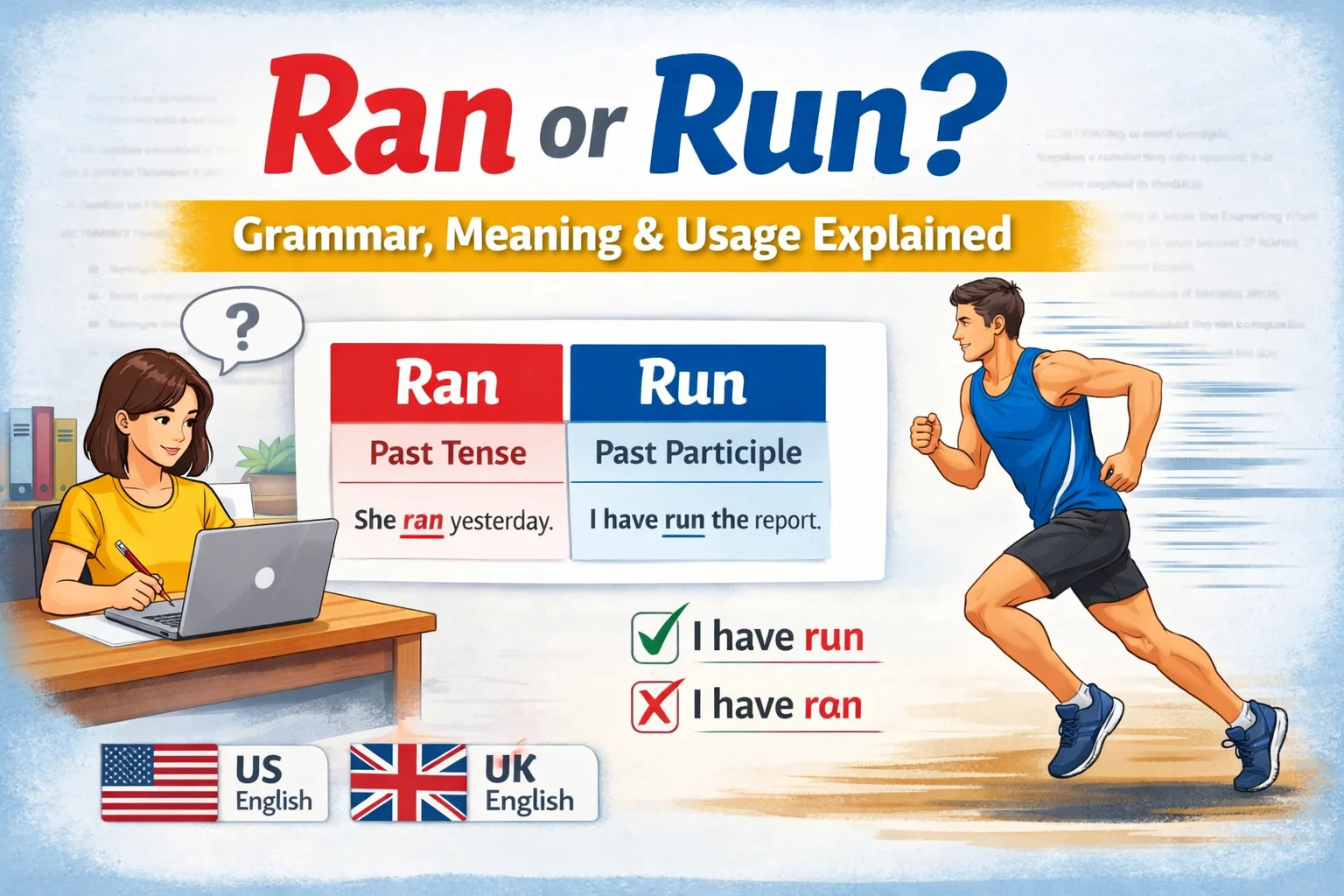
Many people search “ran or run” because English verb forms can be confusing. The words ran and run look similar, but they are used in different grammar situations. A small mistake with these words can make a sentence incorrect, especially in emails, reports, or professional writing.
Common questions people ask include:
- Ran vs run past tense — which one is correct?
- I have run or ran the report?
- I haven’t ran or run?
- Is it well run or well ran?
- What does “ran” mean?
These questions appear often because run is an irregular verb. That means it does not follow the normal -ed rule used by regular verbs.
Understanding the difference between ran or run meaning, grammar rules, and examples helps you write clearly and professionally. This guide explains the rules in simple language with examples, tables, and common mistakes.
By the end of this article, you will know:
- the difference between ran vs run past tense
- the correct ran or run past participle
- how to write proper ran or run sentences in everyday communication.
Ran or Run
The difference between ran or run depends on verb tense.
| Word | Grammar Role | Example |
|---|---|---|
| Run | Base form / past participle | I run every morning. |
| Ran | Past tense | She ran yesterday. |
Simple Rule
- Ran = simple past tense
- Run = base verb or past participle
Ran or Run Sentences
Correct examples:
- She ran five miles yesterday.
- I have run this test before.
- They run a small company.
Incorrect examples:
- ❌ I have ran the report
- ❌ I haven’t ran the program
Correct form:
- ✔ I have run the report
- ✔ I haven’t run the program
This explains the common grammar question:
I have run or ran the report? → “Run” is correct.
The Origin of Ran or Run
The verb run comes from Old English words “rinnan” and “irnan.” These words meant to move quickly using the legs.
Over time, English verbs developed different forms. Because run is an irregular verb, its past tense changes differently than regular verbs.
| Verb Form | Word |
|---|---|
| Base Verb | Run |
| Past Tense | Ran |
| Past Participle | Run |
| Present Participle | Running |
According to the Oxford English Dictionary, the verb run has been used in English for more than 1,000 years and developed the past tense ran through historical pronunciation changes.
Language authorities like Merriam-Webster and Cambridge Dictionary also confirm that ran is the past tense while run is the past participle.
This irregular structure is the main reason people confuse ran or run grammar rules.
British English vs American English Spelling
Many learners think ran or run is a spelling difference between British and American English. However, the grammar rule is the same in both versions of English.
Comparison Table
| Grammar Use | American English | British English |
|---|---|---|
| Present | They run every day | They run every day |
| Past Tense | She ran yesterday | She ran yesterday |
| Past Participle | I have run the test | I have run the test |
So the correct form does not change by country.
The difference is only about verb tense, not spelling.
Which Spelling Should You Use?
Choosing between ran or run depends on sentence structure.
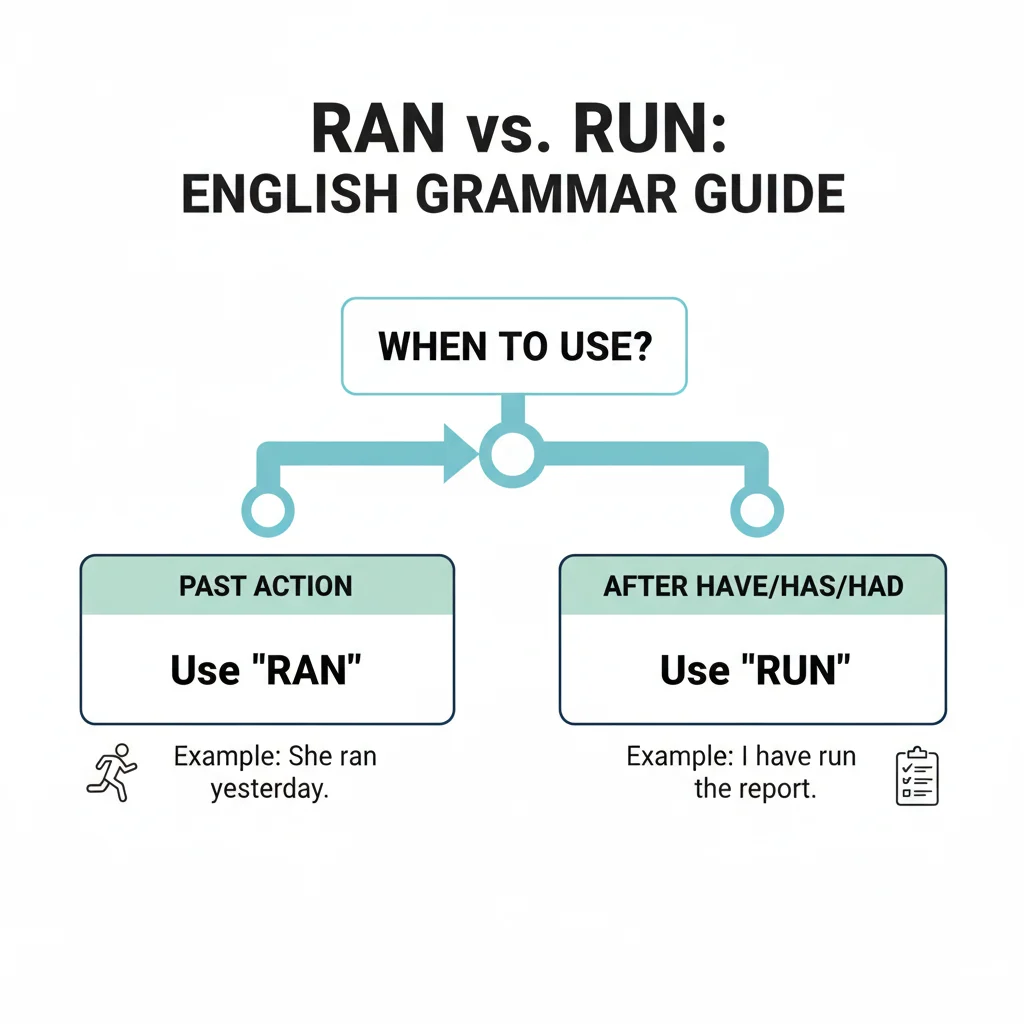
Use Ran
Use ran when talking about a finished action in the past.
Examples:
- She ran in the marathon yesterday.
- He ran to catch the train.
- They ran the event last year.
Use Run
Use run when the sentence includes have, has, or had.
Examples:
- I have run the report.
- She has run the business for five years.
- They had run several tests before the launch.
This rule answers another common question:
I haven’t ran or run?
Correct sentence:
✔ I haven’t run the program.
Common Mistakes with Ran or Run
Many learners make the same grammar mistakes.
1. Using “ran” after helping verbs
Incorrect:
❌ I have ran the report.
Correct:
✔ I have run the report.
2. Saying “I haven’t ran”
Incorrect:
❌ I haven’t ran the test.
Correct:
✔ I haven’t run the test.
3. Mixing past tense and present verbs
Incorrect:
❌ Yesterday I run five kilometers.
Correct:
✔ Yesterday I ran five kilometers.
4. Using “well ran”
Incorrect:
❌ A well ran company
Correct:
✔ A well run company
This answers the common grammar question:
Is it well run or well ran? → “Well run” is correct.
Ran or Run in Everyday Examples
Here are practical ran or run examples used in everyday communication.
Email Examples
- I have run the report and attached the results.
- She ran the meeting yesterday.

News Examples
- The athlete ran the fastest race of the season.
- The company is run by a new management team.
Social Media Examples
- I ran 5 km today!
- My brother runs a small restaurant.
Formal Writing
- The experiment was run three times for accuracy.
- The organization is run by volunteers.
These examples show correct ran or run sentences across different contexts.
Ran or Run – Google Trends & Usage Data
Search data shows strong global interest in ran or run grammar questions.
Common search queries include:
- Ran or run past participle
- Ran vs run past tense
- I have run or ran the report
- I haven’t ran or run
- Ran or run examples
Countries Searching Most
- United States
- United Kingdom
- India
- Pakistan
- Canada
The confusion appears mostly among students, writers, and professionals who want to use correct grammar in reports and emails.
Because run is an irregular verb, it is one of the most searched grammar topics online.
Verb Forms of Run
| Verb Form | Word | Example |
|---|---|---|
| Base Verb | Run | I run daily |
| Past Tense | Ran | She ran yesterday |
| Past Participle | Run | I have run the program |
| Present Participle | Running | They are running fast |
This table helps learners quickly remember ran or run grammar rules.
Comparison Table: Ran vs Run
| Feature | Ran | Run |
|---|---|---|
| Grammar Type | Past tense | Base form / past participle |
| Time Reference | Completed past action | Present or perfect tense |
| Example | She ran yesterday | I have run this report |
FAQs
What does “ran” mean?
Ran is the past tense of run. It describes an action that already happened.
Example:
She ran five miles yesterday.
What does run mean?
Run means to move quickly using your legs. It can also mean to manage or operate something.
Example:
He runs a company.
Ran or run past participle — which is correct?
The correct past participle is “run.”
Example:
✔ I have run this program before.
I have run or ran the report?
Correct sentence:
✔ I have run the report.
I haven’t ran or run?
Correct grammar:
✔ I haven’t run the report.
How do you say “ran”?
The word ran is pronounced like “ran” (rhymes with can).
Is it well run or well ran?
The correct phrase is:
✔ Well run organization
Conclusion
Understanding the difference between ran or run becomes simple once you learn the basic grammar rule.
The key point is clear:
- Ran = past tense
- Run = base verb or past participle
Use ran when describing something that happened in the past, such as She ran yesterday. Use run when the sentence includes helping verbs like have, has, or had, for example I have run the report.
Many common mistakes happen when writers say “I have ran” or “I haven’t ran.” These forms are incorrect in standard English. The correct structure always uses run after helping verbs.
Both American and British English follow the same grammar rule, so these guidelines work globally. Learning the difference helps students, writers, and professionals communicate more clearly.
By remembering this simple rule and practicing with real ran or run sentences, you can write confidently in emails, reports, social media posts, and formal documents.
Clear grammar builds credibility and helps your writing sound more professional.

“Elizabeth Bowen shares timeless idioms and language wisdom on LearnIdom.com, making learning phrases fun, easy, and unforgettable.”